
CNRE(600111)

Search documents
沪深两市今日成交额合计16999.8亿元,北方稀土成交额居首
news flash· 2025-07-21 07:06
Summary of Key Points - The total trading volume of the Shanghai and Shenzhen stock markets reached 16999.8 billion yuan on July 21, an increase of 1289.25 billion yuan compared to the previous day [1] - The Shanghai stock market accounted for 7309.06 billion yuan in trading volume, up from 6436.28 billion yuan on the previous trading day, with a trading volume of 634 million shares [1] - The Shenzhen stock market recorded a trading volume of 9690.74 billion yuan, an increase from 9274.27 billion yuan, with a trading volume of 733 million shares [1] - Northern Rare Earth topped the trading volume with 14.664 billion yuan, followed by Dongfang Fortune, Zhongji Xuchuang, Xinyisheng, and CATL with trading volumes of 11.143 billion yuan, 10.91 billion yuan, 10.816 billion yuan, and 9.047 billion yuan respectively [1]





中报窗口期投资聚焦基本面 中证A500 ETF龙头(563800)盈利优势凸显
Sou Hu Cai Jing· 2025-07-21 06:08
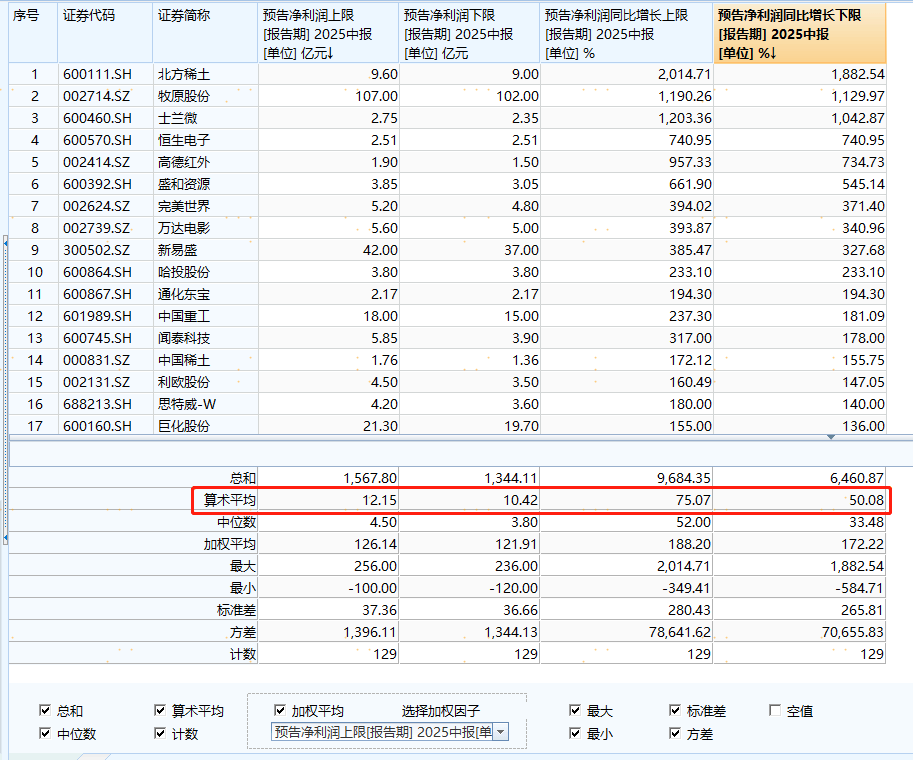
Group 1 - The core viewpoint of the articles emphasizes that as the A-share market enters the mid-year performance reporting period, the focus is shifting back to fundamentals, with sectors showing stable profits likely to see valuation increases [1][2] - The CSI A500 ETF (563800) has shown strong performance, with a net asset value increase of 7.60% over the past six months, and its latest scale exceeding 17 billion yuan as of July 20 [1] - Among the CSI A500 index constituents, 129 companies have issued earnings forecasts, with 94 expected to be profitable and 85 anticipating year-on-year net profit growth, indicating a significantly better outlook than the overall market [1][2] Group 2 - The strong performance of the CSI A500 index constituents is attributed to its innovative compilation scheme, which selects leading companies across three industry segments while maintaining industry balance and over-allocating to new productivity sectors [2] - Analysts predict that from 2025 to 2027, the average annual growth rate of net profit attributable to the parent company for the CSI A500 index will reach 10.6%, significantly higher than other broad-based indices [2] - The current phase of the A-share market is characterized by a "profit bottom + policy bottom" resonance, with the CSI A500 index expected to build long-term support above 3,500 points [2]


燃爆!近百股涨停
Zhong Guo Ji Jin Bao· 2025-07-21 05:10
【导读】全市场近百股涨停,大基建板块爆发 中国基金报记者 晨曦 7月21日,A股市场窄幅震荡。截至午间收盘,上证指数涨0.44%,深证成指涨0.29%,创业板指涨0.12%。 盘面上,大基建板块全面爆发,建材、钢铁、建筑、工程机械等板块集体走高,水利水电建设、水泥制造、西部大基建、稀土、宇树机器人等概念股火 热;光模块、稳定币、光刻机、AI算力等概念股回调。 全市场半日成交额为1.1万亿元,较上日略有放量,其中3539只个股上涨,99只个股涨停,1732只个股下跌。 港股市场早间高开,午前涨幅有所回落。截至午间收盘,恒生指数涨0.28%,恒生科技指数涨0.32%,恒生国企指数涨0.14%。美团涨2.75%,领涨恒生科 技指数成份股。 | 24895.20 | | 8999.25 | 5556.62 | | --- | --- | --- | --- | | 恒生指数 +0.28% | | 国企指数 +0.14% | 恒生科技指数 +0.32% | | 序号代码 名称 | | 现价 涨跌 涨跌幅 * | | | 1 3690 美团-W | | 130.80 3.500 2.75% | | | വ 9866 | ...


688585,9个“20cm”涨停!
新华网财经· 2025-07-21 04:53
Core Viewpoint - The A-share market is experiencing a strong upward trend, driven by significant activity in infrastructure-related sectors, particularly hydropower and cement, following the commencement of a major hydropower project in Tibet [1][4][6]. Group 1: Market Performance - The A-share indices opened higher, with the Shanghai Composite Index at 3549.89 points, up 0.44%, and total market turnover reaching 110.26 billion yuan, an increase of 73.3 billion yuan compared to the previous trading day [1]. - Over 3,500 stocks in the market saw gains, indicating broad-based investor interest [2]. Group 2: Sector Highlights - The hydropower engineering and cement sectors experienced a surge, with multiple stocks hitting the daily limit up, including companies like China Power Construction and Tibet Tianlu [4][6]. - The launch of the Yarlung Tsangpo River hydropower project, with a total investment of approximately 1.2 trillion yuan, is expected to significantly benefit related industries, particularly hydropower equipment and core components for power transmission [6]. Group 3: Individual Stock Performance - The stock of Upwind New Materials (688585) achieved a 20% limit up for the ninth consecutive trading day, with a total increase of 416.20% since July 9 [2][10]. - In the humanoid robot sector, stocks such as Changsheng Bearing and Wanda Bearing rose over 10%, reflecting growing interest and investment in robotics [8][11]. Group 4: Future Outlook - Analysts from Huatai Securities and CITIC Securities predict that the ongoing construction of the Yarlung Tsangpo hydropower project will provide long-term benefits to leading suppliers in the hydropower equipment sector, potentially leading to a recovery in valuations as orders exceed expectations [6]. - The humanoid robot industry is entering a critical phase of commercialization, with increasing demand driven by rising labor costs and technological advancements, suggesting a promising market outlook [11].


“反内卷”激发供改猜想,有色龙头ETF(159876)盘中涨超2.3%!机构:建议把握四条主线!
Xin Lang Ji Jin· 2025-07-21 03:35
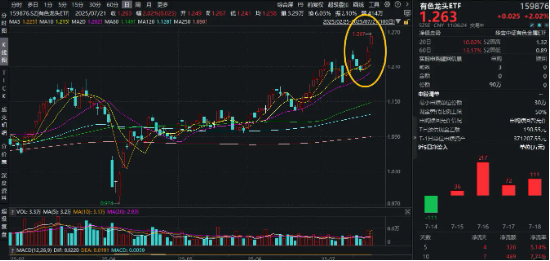
7月21日,揽尽有色金属行业龙头的有色龙头ETF(159876)场内价格涨幅盘中上探2.34%,现涨 2.02%,再度刷新年内高点(1.267元)!当前,有色龙头ETF(159876)已获资金实时净申购90万 份! 成份股方面,雅化集团、盛和资源涨停,北方稀土、中孚实业涨超6%,中色股份、天山铝业、西藏矿 业涨逾5%。 消息面上,7月18日,工信部宣布将出台有色金属等十大重点行业稳增长工作方案,重点推动"调结构、 优供给、淘汰落后产能"。该政策被视为2016年供给侧改革的延续,旨在解决产能过剩导致的低价无序 竞争问题。 市场分析人士指出,光伏、水泥等行业已通过主动减产响应政策,有色行业紧随其后,市场预期铜、 铝、锂等品种的过剩产能将加速出清。 中信建投表示,工信部消息一出,有色金属价格全面上涨,越是过剩的行业表现越是强势,如氧化铝、 锌。尽管未知方案具体内容,但从调结构、优供给、淘汰落后产能的工作侧重点来看,对供应端的约束 会推高金属底部重心。 基本面上,截至7月20日,有色龙头ETF(159876)覆盖的60只有色金属行业龙头上市公司中,已有27 家披露2025年中报业绩预告,其中22家预告盈利,占比超八成 ...
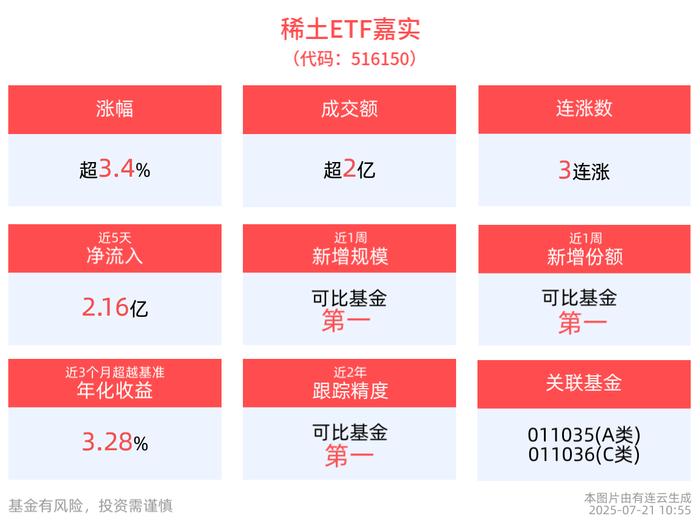
稀土ETF嘉实(516150)冲高上涨3.48%, 成分股卧龙电驱、盛和资源10cm涨停
Xin Lang Cai Jing· 2025-07-21 03:28
Core Viewpoint - The rare earth industry is experiencing significant growth, with the China Rare Earth Industry Index rising by 3.36% and key stocks reaching their daily limit up, indicating strong market interest and potential investment opportunities [1][3]. Market Performance - The rare earth ETF, Jiashi (516150), has seen a 3.48% increase, marking its third consecutive rise [1]. - The ETF recorded a turnover rate of 7.84% and a transaction volume of 238 million yuan, with an average daily transaction of 297 million yuan over the past week, ranking first among comparable funds [3]. - The Jiashi rare earth ETF's scale increased by 336 million yuan in the past week, also leading among comparable funds [3]. - The ETF's shares grew by 18.4 million, achieving significant growth and ranking first in new share issuance among comparable funds [3]. - Over the past five trading days, the ETF experienced net inflows on three days, totaling 216 million yuan [3]. Historical Performance - The Jiashi rare earth ETF has seen a net value increase of 58.80% over the past year, ranking 168 out of 2917 in the index stock fund category, placing it in the top 5.76% [3]. - Since its inception, the ETF's highest monthly return was 41.25%, with the longest consecutive monthly gains being four months and a maximum cumulative increase of 83.89% [3]. Industry Outlook - The investment opportunities in the non-ferrous metals sector are viewed positively for the second half of 2025, with expectations of rising rare earth prices due to increasing demand and limited supply [3]. - The rare earth sector is recognized as a strategically important industry in China, with potential for increased attention and value reassessment driven by policy changes and its global leadership position [4]. - The permanent magnet sector is expected to benefit from the growth in humanoid robotics and the low-altitude economy [4]. Key Stocks - The top ten weighted stocks in the China Rare Earth Industry Index include Northern Rare Earth, China Rare Earth, China Aluminum, and others, collectively accounting for a significant portion of the index [4][6]. - Notable stock performances include Northern Rare Earth rising by 6.64%, China Rare Earth by 4.19%, and Wolong Electric Drive by 10% [6].




中际旭创上周获融资资金买入超88亿元丨资金流向周报
2 1 Shi Ji Jing Ji Bao Dao· 2025-07-21 03:12
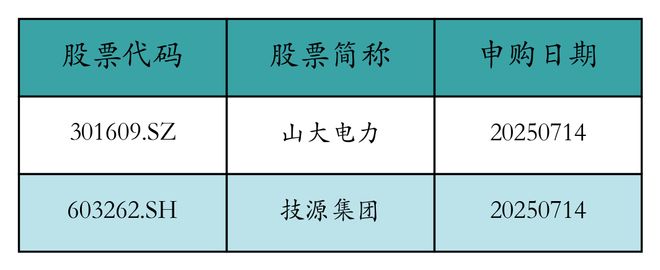
Market Overview - The Shanghai Composite Index rose by 0.69% to close at 3534.48 points, with a weekly high of 3536.01 points [1] - The Shenzhen Component Index increased by 2.04% to 10913.84 points, reaching a high of 10946.4 points [1] - The ChiNext Index saw a rise of 3.17%, closing at 2277.15 points, with a peak of 2296.91 points [1] - In the global market, the Nasdaq Composite Index increased by 1.51%, while the Dow Jones Industrial Average fell by 0.07% and the S&P 500 rose by 0.59% [1] - In the Asia-Pacific region, the Hang Seng Index rose by 2.84% and the Nikkei 225 Index increased by 0.63% [1] New Stock Issuance - Two new stocks were issued last week: Shanda Electric Power (301609.SZ) and Jiyuan Group (603262.SH), both on July 14, 2025 [2] Margin Trading - The total margin trading balance in the Shanghai and Shenzhen markets reached 18964.13 billion yuan, with a financing balance of 18832.44 billion yuan and a securities lending balance of 131.68 billion yuan [3] - The margin trading balance increased by 265.22 billion yuan compared to the previous week [3] - The Shanghai market's margin trading balance was 9613.62 billion yuan, up by 143.67 billion yuan, while the Shenzhen market's balance was 9350.51 billion yuan, increasing by 121.55 billion yuan [3] - A total of 3442 stocks had margin buying, with 89 stocks exceeding 1 billion yuan in buying amount, led by Zhongji Xuchuang (88.2 billion yuan), Xinyi Sheng (80.46 billion yuan), and Dongfang Caifu (62.35 billion yuan) [3][4] Fund Issuance - Sixteen new funds were issued last week, including various types such as mixed funds, bond funds, and money market funds [5] Share Buybacks - Seventeen companies announced share buybacks last week, with the highest amounts being TCL (2.5 billion yuan), Hangyang Co. (60.36 million yuan), and Yanshan Technology (59.99 million yuan) [7] - The sectors with the highest buyback amounts were electronics, basic chemicals, and computers [7]

北方稀土(600111):半年度业绩预告点评:供给优化提升经营质量,需求增长带来价格弹性
Orient Securities· 2025-07-21 02:44
Investment Rating - The report maintains a "Buy" rating for the company with a target price of 38.18 CNY, based on a 46X valuation multiple for 2025 [3][5]. Core Views - The company is expected to see improved profitability driven by supply optimization and demand growth, leading to price elasticity in the rare earth market [9]. - The second quarter performance is projected to show a significant increase in net profit, estimated between 4.7 to 5.3 billion CNY, which is higher than the first quarter's 4.3 billion CNY, attributed to tight supply and strong demand [9]. - The company is enhancing operational efficiency through innovation and optimizing product structure to meet market demands for high-value customized rare earth products [9]. - Ongoing mergers and acquisitions are expected to strengthen the company's position in the rare earth industry, enhancing its market influence and pricing power [9]. - Emerging applications in sectors like low-altitude economy and electric vehicles are anticipated to drive demand for rare earth materials, with the company poised to benefit from these trends [9]. Financial Summary - Revenue projections show a decline in 2023 and 2024, followed by a recovery with expected growth rates of 11.0%, 10.1%, and 10.0% for 2025, 2026, and 2027 respectively [4][11]. - The company's net profit is forecasted to rebound significantly in 2025, with a projected increase of 198.0% compared to 2024, followed by continued growth in subsequent years [4][11]. - The earnings per share (EPS) is expected to rise from 0.28 CNY in 2024 to 1.18 CNY by 2027, reflecting the company's recovery and growth trajectory [4][11].
北方稀土涨超6%,稀土ETF(159713)持有该股票13.88%
news flash· 2025-07-21 02:43
Group 1 - Northern Rare Earth (600111) has seen its stock price increase by 6.49% [1] - The Rare Earth ETF (159713) holds 13.88% of Northern Rare Earth, with its current increase at 3.06% [1] - The stock has experienced three consecutive days of gains, reaching a 120-day high [1] Group 2 - The trading volume for Northern Rare Earth reached 65.19 million yuan, with a month-on-month increase of 21.09%, adding 9.35 million shares [1]
北方稀土(600111):供给优化提升经营质量 需求增长带来价格弹性
Xin Lang Cai Jing· 2025-07-21 02:28
Group 1 - The company forecasts a strong performance for the first half of the year, with Q2 net profit expected to be between 470-530 million yuan, surpassing Q1's 430 million yuan, driven by tight supply and increased demand for rare earth products [1] - The company is enhancing operational efficiency through innovation and optimizing product structure based on market demand, leading to improved production efficiency and reduced energy consumption [1] - The company is actively pursuing mergers and acquisitions to strengthen its position in the rare earth industry, enhancing its market influence and pricing power [2] Group 2 - The demand for rare earth materials is expected to grow significantly due to emerging applications in low-altitude economies and the electric vehicle sector, with the company poised to benefit from increased downstream demand [2] - The company has adjusted its EPS forecasts for 2027 to 0.83, 1.05, and 1.18 yuan, reflecting a positive outlook based on current rare earth prices and supply-demand dynamics [2] - The company maintains a target price of 38.18 yuan based on a 46X valuation, indicating a strong buy rating [2]