
KWEICHOW MOUTAI(600519)

Search documents
“五个最”战略 仁怀的底气和路径
Sou Hu Cai Jing· 2026-01-27 04:49
茅台镇。 2025年8月23日仁怀举行乙巳年高粱归仓仪式。 产业链条最完备:从物理集聚到化学协同的生态重构 底气基于链条完备,路径在于协同共生的生态重构。产业链的完备性与协同性,是产区抗风险韧性的核 心支撑。目前,仁怀已形成覆盖原料种植、酿造生产、包材配套、物流运输的全产业链,35万亩高粱种 植基地筑牢上游根基,以茅台为引领的800余家企业集群构成中游主体,申仁包装等200余家配套企业形 成下游集群,本地配套率达85%。但"有链条"不等于"强链条",价值链中低端锁定、协同创新不足等问 题仍待破解。仁怀以"强链、补链、延链"为核心,推动产业链从物理集聚走向化学协同。一方面,布局 工业设计、检验检测、品牌策划、数字营销、供应链金融等生产性服务业,支持企业"智改数转"和设备 更新,补强高端价值链环节;另一方面,组建酱酒产业创新联盟,聚焦环保包材、智能酿造机器人、酒 体风味数字化解析等领域协同攻关,推动产学研用深度融合。同时,加快建设酿酒副产物资源化利用循 环经济产业园,将酒糟、窖泥、秸秆等转化为生物饲料、有机肥、生物能源,实现产业与生态的良性循 环。 当下,白酒行业正经历深度调整期,市场从"增量共享"转向"存量博弈 ...



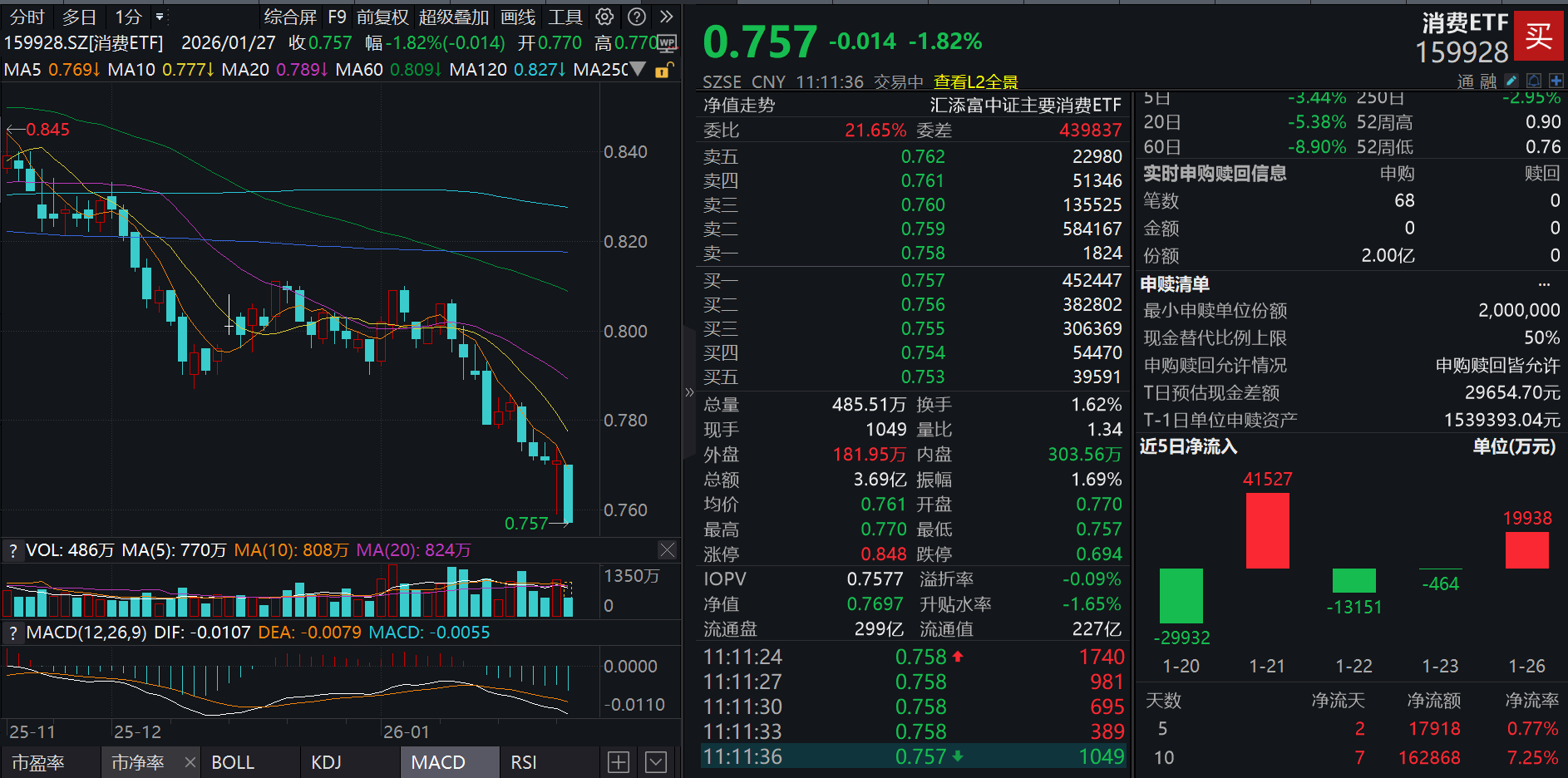
洋河股份净利预降六成,70亿分红承诺告吹,再跌超3%!消费ETF(159928)回调近2%,狂揽2亿份净申购!2026白酒板块如何看?
Xin Lang Cai Jing· 2026-01-27 03:35
Core Viewpoint - The liquor sector is experiencing a downturn, with Yanghe Co. seeing significant declines in stock prices and a bleak profit forecast for 2025, indicating a challenging environment for the industry [1][3]. Group 1: Company Performance - Yanghe Co. has forecasted a net profit decline of 62.18%-68.30% for 2025, estimating a loss of 1.451 billion to 1.859 billion yuan in Q4 2025 [1]. - The company has also retracted its previous commitment to a minimum 7 billion yuan dividend [1]. - Other major liquor companies like Wuliangye, Luzhou Laojiao, and Shanxi Fenjiu have also seen stock price declines, while Kweichow Moutai has shown slight gains [1]. Group 2: Market Trends - The consumption ETF has seen a near 2% drop, with a transaction volume of 400 million yuan, indicating a cautious market sentiment [2]. - The liquor sector is in a phase of inventory reduction and price stabilization, with companies adjusting their strategies in response to external pressures [3][6]. Group 3: Policy and Economic Environment - New policies aimed at boosting consumer spending are expected to be introduced, including measures to expand inbound consumption and promote the replacement of durable goods [1]. - The overall market sentiment is improving, with expectations that the worst period for liquor sales is over, aided by easing consumption restrictions [6]. Group 4: Investment Insights - The liquor sector is currently characterized by low expectations, low valuations, and low public fund holdings, presenting a potential buying opportunity [7]. - High dividend yields from leading liquor companies are expected to attract investors, as they commit to returning at least 100% of their net profits as dividends [7]. - Historical data suggests that high-end liquor stocks like Moutai and Wuliangye may lead the recovery in the sector, similar to past cycles [8].




上证180指数上涨0.22%,上证180ETF指数基金(530280)成立以来超越基准年化收益达2.32%
Xin Lang Cai Jing· 2026-01-27 01:48
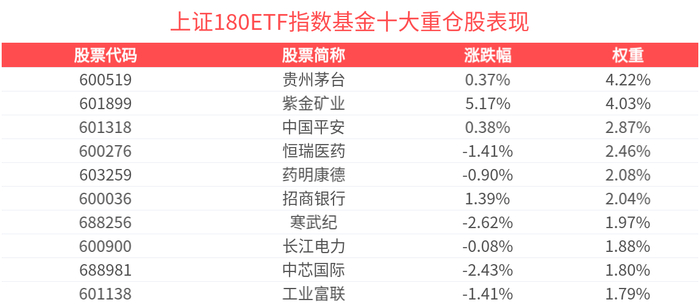
Core Viewpoint - The Shanghai 180 ETF Index Fund (530280) has shown a positive performance with a recent increase of 0.96%, reflecting a stable market trend and investor interest in the underlying assets [1]. Performance Summary - As of January 26, 2026, the Shanghai 180 Index (000010) increased by 0.22%, with notable gains from stocks such as Zijin Mining (up 10.00%) and China National Offshore Oil Corporation (up 6.66%) [1]. - The Shanghai 180 ETF Index Fund has experienced a cumulative increase of 0.24% over the past week [1]. - The fund's year-to-date maximum drawdown is 1.30%, with a relative benchmark drawdown of 0.06% [3]. Liquidity and Trading Activity - The trading volume for the Shanghai 180 ETF Index Fund was 6.07 thousand yuan, with a turnover rate of 0.1% [1]. - The average daily trading volume over the past year was 177.38 thousand yuan [1]. Risk and Return Metrics - The fund has a Sharpe ratio of 2.12 since its inception, indicating a favorable risk-adjusted return [2]. - The tracking error over the past three months is 0.022%, demonstrating the fund's close alignment with the Shanghai 180 Index [5]. Fee Structure - The management fee for the Shanghai 180 ETF Index Fund is 0.15%, while the custody fee is 0.05% [4]. Top Holdings - As of December 31, 2025, the top ten weighted stocks in the Shanghai 180 Index account for 25.29% of the index, with notable companies including Kweichow Moutai and Ping An Insurance [5]. - The top ten stocks and their respective weightings are as follows: - Kweichow Moutai: 4.22% - Zijin Mining: 4.03% - Ping An Insurance: 2.87% - Hengrui Medicine: 2.46% - WuXi AppTec: 2.08% - China Merchants Bank: 2.04% - Cambricon Technologies: 1.97% - Yangtze Power: 1.88% - SMIC: 1.80% - Industrial Fulian: 1.79% [5].





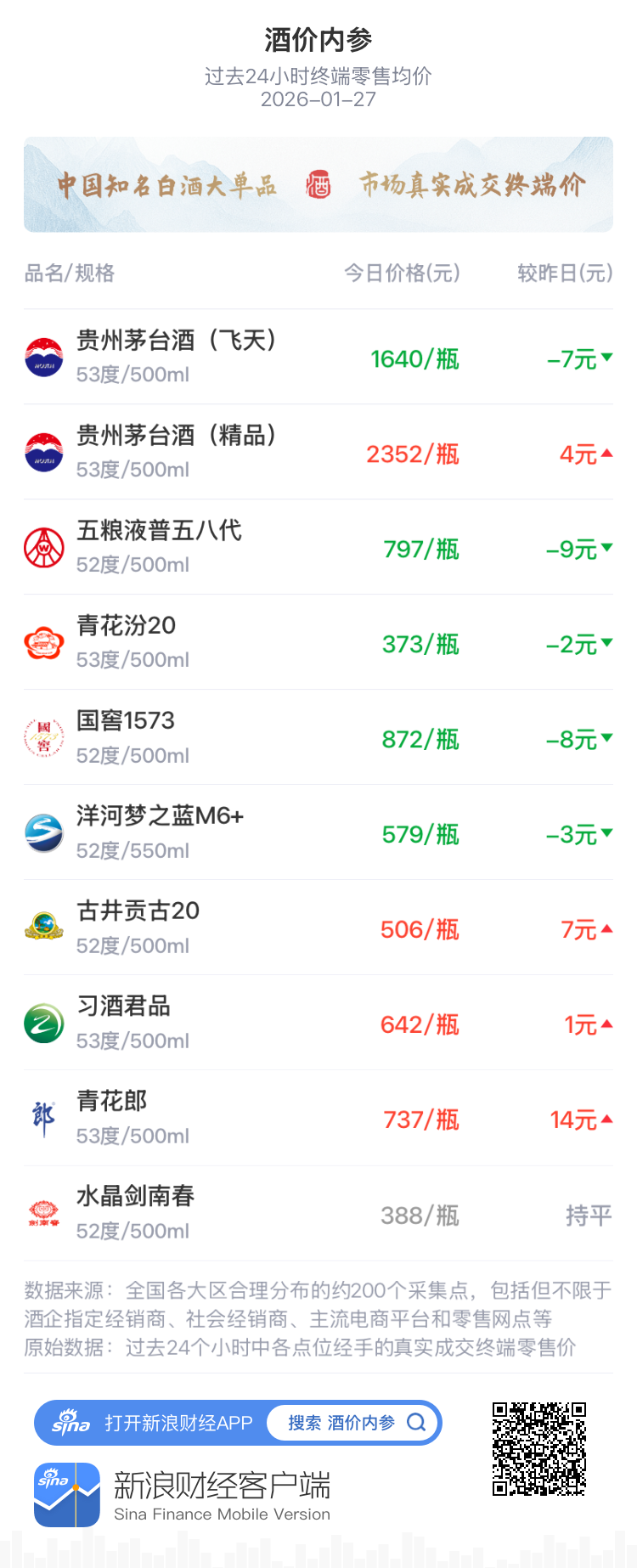
酒价内参1月27日价格发布 青花汾20下跌2元/瓶
Xin Lang Cai Jing· 2026-01-27 01:36
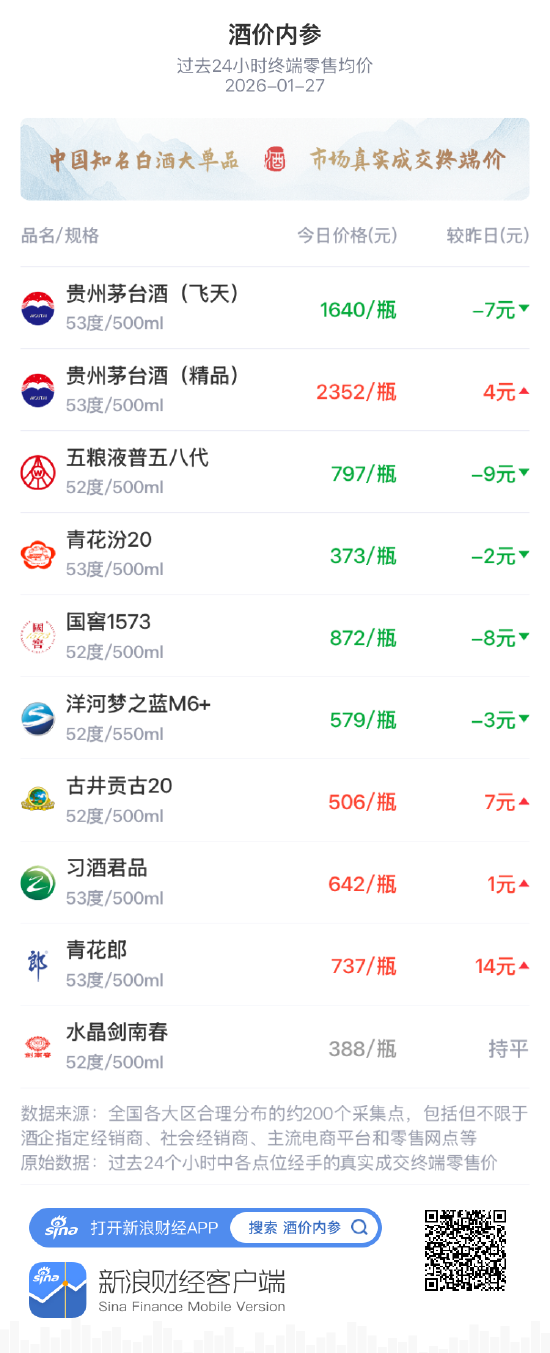
Core Insights - The Chinese liquor market is experiencing a mixed trend in retail prices for its top ten products, with an overall slight decline in total price [1][4] - The market shows signs of stabilization, with some products increasing in price while others decrease [1][4] Price Movements - The total retail price for a package of the top ten liquor products is 8886 yuan, down 3 yuan from the previous day [1] - Four products saw price increases, while five experienced declines, with one remaining stable [1] - The leading price increase was for Qinghua Lang, which rose by 14 yuan per bottle, marking five consecutive days of price growth [1][3] - Other notable increases include Gujing Gonggu 20 and Jingpin Moutai, which rose by 7 yuan and 4 yuan per bottle, respectively [1][2] - On the decline side, Wuliangye dropped by 9 yuan, and Guojiao 1573 fell by 8 yuan per bottle [1][2] Market Context - The data is sourced from approximately 200 collection points across various regions, aiming to provide an objective and traceable overview of the liquor market prices [4] - The introduction of new sales channels for Moutai products has begun to influence market prices, particularly for the Flying Moutai and Premium Moutai [4] - The liquor sector is currently navigating a challenging period, with institutional holdings at historical lows, yet there are signs of potential recovery as Moutai's sales exceed expectations [4]
酒价内参1月27日价格发布 五粮液下跌9元/瓶
Xin Lang Cai Jing· 2026-01-27 01:21
Core Viewpoint - The Chinese liquor market is experiencing a mixed trend in retail prices for major products, with the overall average price for the top ten products showing a slight decline, indicating market stabilization with varied performance among core products [1][5]. Price Trends - The total retail price for a package of the top ten liquor products is 8,886 yuan, down by 3 yuan from the previous day [1][5]. - In today's market, there are four products that increased in price, five that decreased, and one that remained stable [6]. - The price increases are led by Qinghua Lang, which rose by 14 yuan per bottle, marking five consecutive days of price increases; Gujing Gonggu 20 and Premium Moutai increased by 7 yuan and 4 yuan per bottle, respectively; Xijiu Junpin saw a slight increase of 1 yuan per bottle [1][6]. - On the downside, Wuliangye dropped by 9 yuan per bottle; Guojiao 1573 fell by 8 yuan; and Feitian Moutai decreased by 7 yuan due to the regular supply from the iMoutai platform; Mengzhilun M6+ and Qinghua Fen 20 decreased by 3 yuan and 2 yuan, respectively; and Shuijing Jianan Chun remained unchanged [1][6]. Market Data Collection - The "Liquor Price Reference" collects data from approximately 200 sampling points across various regions, including designated distributors, social distributors, e-commerce platforms, and retail outlets, aiming to provide objective and traceable market price data [4][9]. - The introduction of new sales channels for Feitian Moutai and Premium Moutai has begun to show a magnetic influence on their market retail prices [4][9]. Industry Context - The liquor sector is currently experiencing a struggle between a "dark moment" and signs of recovery, with institutional holdings at a historical low since 2015, impacting the performance of leading companies like Yanghe [4][9]. - Despite the pessimistic market sentiment, Moutai's sales in January exceeded expectations, and Yanghe has committed to a 100% dividend, indicating potential recovery signals [4][9]. - Public fund holdings in liquor stocks have decreased for nine consecutive quarters, now at 2.9%, close to 2015 levels, suggesting a possible bottoming out in the market [4][9].
酒价内参1月27日价格发布 精品茅台上涨4元/瓶
Xin Lang Cai Jing· 2026-01-27 01:16
Core Viewpoint - The Chinese liquor market is experiencing a mixed trend in retail prices for major products, with the overall average price for the top ten products showing a slight decline, indicating market stabilization with varied performance among core products [1][5]. Price Trends - The total retail price for a package of the top ten liquor products is 8,886 yuan, down 3 yuan from the previous day [1][5]. - In today's market, there are four products that increased in price, five that decreased, and one that remained stable [6]. - The price increases are led by Qinghua Lang, which rose by 14 yuan per bottle, marking five consecutive days of price increases [1][6]. - Other products that saw price increases include Gujing Gonggu 20 (up 7 yuan), and Boutique Moutai (up 4 yuan), while Xijiu Junpin saw a slight increase of 1 yuan [1][6]. - On the downside, Wuliangye dropped by 9 yuan, Guojiao 1573 by 8 yuan, and Feitian Moutai decreased by 7 yuan due to the impact of the iMoutai platform's regular supply [1][6]. Market Data Collection - The "Liquor Price Reference" collects data from approximately 200 sampling points across various regions, including designated distributors, social distributors, e-commerce platforms, and retail outlets, aiming to provide objective and traceable market price data [4][9]. - The introduction of new sales channels for Feitian Moutai and Boutique Moutai has begun to show a magnetic influence on their market retail prices [4][9]. Industry Context - The liquor sector is currently experiencing a struggle between a "dark moment" and signs of recovery, with institutional holdings at a historical low since 2015, impacting the performance of leading companies like Yanghe [4][9]. - Despite the pessimism, Moutai's sales in January exceeded expectations, and Yanghe has committed to a 100% dividend, indicating potential recovery signals [4][9]. - Public fund holdings in liquor stocks have dropped to 2.9%, close to 2015 levels, suggesting a possible "golden pit" for investment as market sentiment shifts [4][9].
酒价内参1月27日价格发布 总价微跌青花郎逆势连涨
Xin Lang Cai Jing· 2026-01-27 01:06
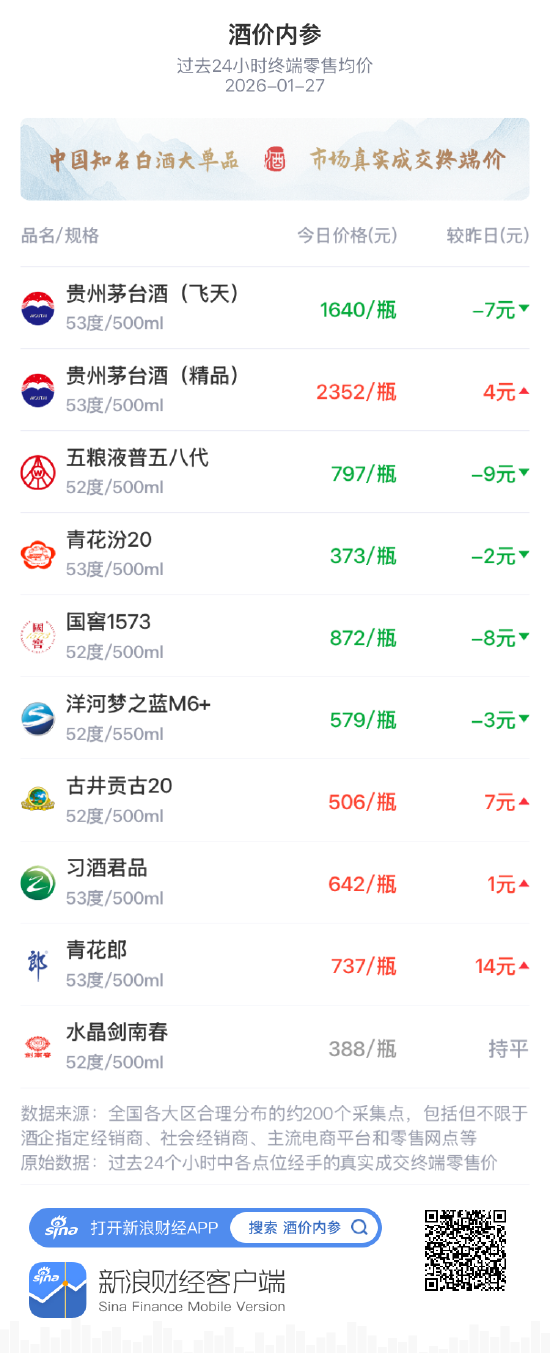
Core Viewpoint - The Chinese liquor market shows a mixed trend in retail prices for the top ten products, with an overall slight decline in total price, indicating market stabilization with fluctuations among core products [1]. Price Trends - The total retail price for a package of the top ten liquor products is 8,886 yuan, down by 3 yuan from the previous day [1]. - Among the ten products, four increased in price, five decreased, and one remained stable [1]. Price Increases - Qinghua Lang leads the price increase with a rise of 14 yuan per bottle, marking five consecutive days of price growth [1]. - Gujing Gonggu 20 and Jingpin Moutai saw increases of 7 yuan and 4 yuan per bottle, respectively [1]. - Xijiu Junpin experienced a slight increase of 1 yuan per bottle [1]. Price Decreases - Wuliangye dropped by 9 yuan per bottle [1]. - Guojiao 1573 decreased by 8 yuan per bottle [1]. - Feitian Moutai's average retail price fell by 7 yuan per bottle due to the normalized supply from the iMoutai platform [1]. - Mengzhilun M6+ and Qinghua Fen 20 saw decreases of 3 yuan and 2 yuan per bottle, respectively [1]. - Shuijing Jianan Chun's price remained unchanged from the previous day [1]. Specific Product Prices - Feitian Moutai (53 degrees, 500ml) is priced at 1,640 yuan, down by 7 yuan [3]. - Jingpin Moutai (53 degrees, 500ml) is priced at 2,352 yuan, up by 4 yuan [3]. - Wuliangye (52 degrees, 500ml) is priced at 797 yuan, down by 9 yuan [3]. - Gujing Gonggu 20 (52 degrees, 550ml) is priced at 506 yuan, up by 7 yuan [4]. - Xijiu Junpin (53 degrees, 500ml) is priced at 642 yuan, up by 1 yuan [4]. - Qinghua Lang (53 degrees, 500ml) is priced at 737 yuan, up by 14 yuan [4]. - Shuijing Jianan Chun (52 degrees, 500ml) is priced at 388 yuan, unchanged [4].
独家 | 茅台给经销商“松绑”:近期酱香酒不再要求强制打款
Xin Lang Cai Jing· 2026-01-27 01:00
Core Viewpoint - Moutai's sauce-flavored liquor company is allowing distributors to order based on actual needs without mandatory payment requirements to avoid excessive inventory issues in the market [1][2]. Group 1: Market Strategy - The company is strengthening resource allocation towards excellent distributors while potentially eliminating those who do not comply with regulations [1][2]. - Traditionally, distributors are required to return payments in multiple batches throughout the year, which corresponds to the release of equivalent value goods from the liquor company [1][2]. Group 2: Industry Commentary - Industry commentator Xiao Zhuqing noted that the decision to avoid forced inventory is aimed at preventing distributors from accumulating unsold stock that could lead to price dumping, thereby maintaining market order [1][2]. - The relaxation of requirements indicates a degree of "decontrol" by Moutai over its distribution channels [1][2].
穿越周期的力量:2025中国企业家年度榜单
Sou Hu Cai Jing· 2026-01-26 15:59
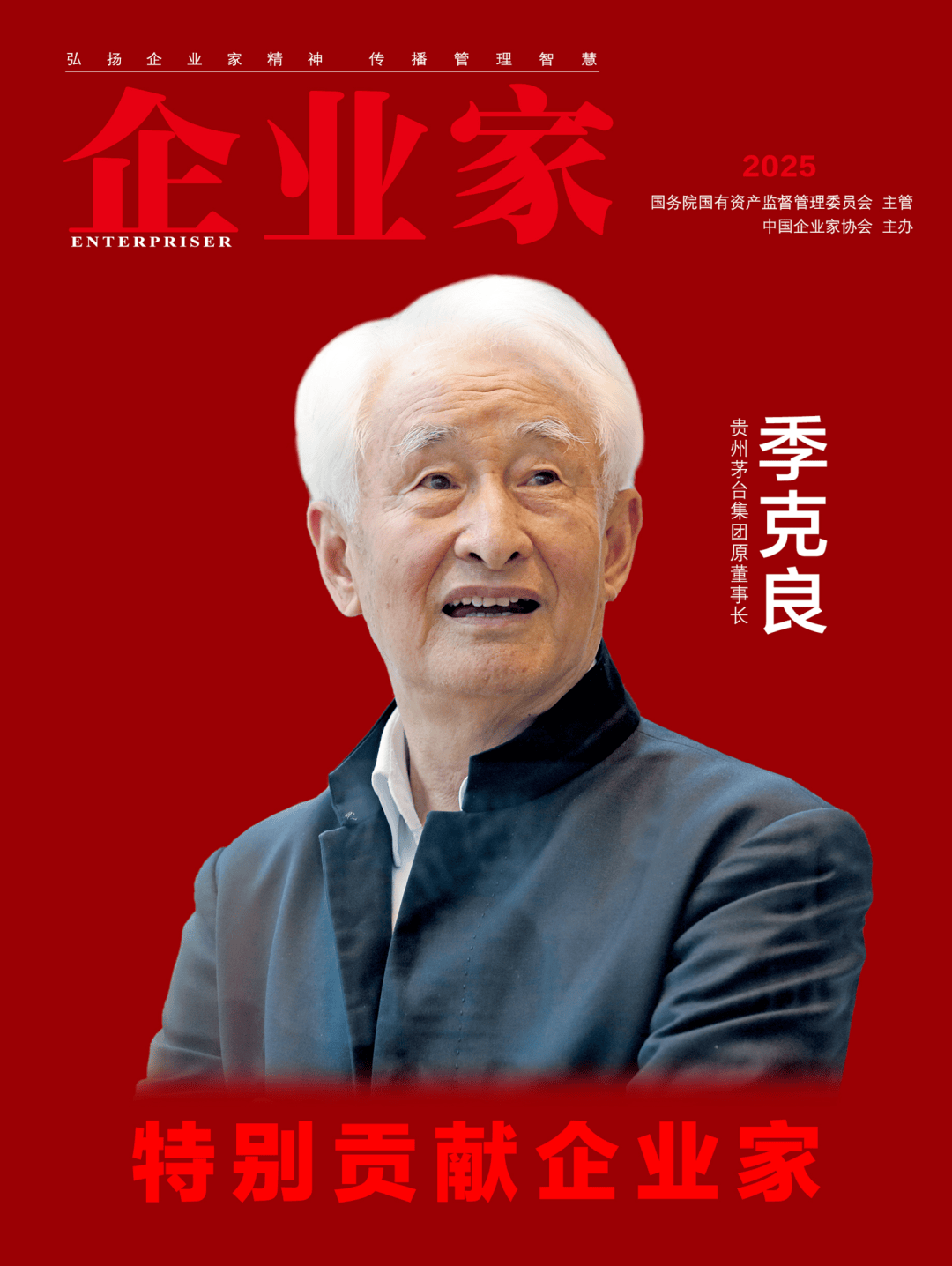
Core Insights - The article highlights the recognition of 3 "Special Contribution Entrepreneurs" and 20 "2025 Entrepreneurs" who exemplify long-termism and innovation across various industries in China, including liquor, manufacturing, energy, agriculture, internet, AI, and new consumption [1][2]. Group 1: Special Contribution Entrepreneurs - Ji Keliang, former chairman of Kweichow Moutai Group, transformed traditional brewing techniques into scientific data over 60 years, emphasizing quality over speed, which laid the foundation for Moutai's billion-dollar brand value [4][10][12]. - Zhang Ruimin, founder of Haier Group, is known for his continuous self-disruption and innovation, leading Haier from a struggling factory to a global leader in home appliances with over 400 billion yuan in revenue [18][20][21]. - Jiang Baoquan, founder of Nanjing Gold Foil Holdings, turned a failing workshop into the world's largest gold foil producer, emphasizing resilience and innovative management theories [25][27][29]. Group 2: 2025 Entrepreneurs - Ma Huateng, chairman of Tencent, focuses on "technology for good," committing to social responsibility and innovation in digital technology to drive high-quality economic development [31][34][41]. - Wang Ning, founder of Pop Mart, capitalizes on emotional value and consumer psychology, creating a successful business model around collectible toys that resonate with young consumers [43][45][46]. - Wang Xingxing, founder of Yushutech, leads advancements in humanoid robotics, achieving significant market presence and profitability while promoting technological innovation [48][49][51]. - Fang Hongbo, chairman of Midea Group, has successfully transformed Midea into a global technology group through strategic restructuring and a focus on efficiency and innovation [54][56]. - Liu Yonghao, chairman of New Hope Group, maintains a long-term vision in agriculture, achieving growth even during economic downturns by embracing new technologies [67][69][70]. - Liu Qiangdong, founder of JD.com, integrates the concept of "common prosperity" into business practices, ensuring fair profit distribution among stakeholders while enhancing supply chain efficiency [73][75][78]. - Li Dongsheng, founder of TCL, exemplifies global leadership in semiconductor display and photovoltaic sectors, driving innovation and sustainable growth through strategic partnerships [110][111].



食品饮料2025年四季度基金持仓分析:白酒持仓继续下降,食品配置环比回升
Shenwan Hongyuan Securities· 2026-01-26 15:01
Investment Rating - The investment rating for the food and beverage sector is "Buy" for key companies such as Kweichow Moutai, Wuliangye, and Luzhou Laojiao [44]. Core Insights - The report indicates a continued decline in the holdings of the food and beverage sector within mutual funds, with the top 20 holdings' market value as a percentage of total fund equity investments decreasing to 16.31% in Q4 2025, down 0.47 percentage points from Q3 2025 [5][21]. - Kweichow Moutai's market value as a percentage of total fund equity investments is 1.31%, a decrease of 0.06 percentage points from the previous quarter, while Wuliangye and Luzhou Laojiao also saw declines [9][10]. - The food and beverage sector's weight in the total A-share market capitalization has decreased to 4.04%, down 0.66 percentage points [25]. Summary by Sections Fund Holdings Analysis - In Q4 2025, the number of funds holding Kweichow Moutai remained stable at 1,048, while Wuliangye saw a decrease of 109 funds to 175, and Luzhou Laojiao's holdings dropped by 18 to 128 [21]. - The concentration of holdings in the food and beverage sector is low, with only one company (Kweichow Moutai) in the top 20 holdings [7][8]. Sector Allocation - The food and beverage sector's heavy stock holdings accounted for 6.10% of total fund equity investments, a decrease of 0.28 percentage points from the previous quarter [25]. - The white liquor sector's heavy stock holdings accounted for 5.13%, also down 0.4 percentage points, indicating a position close to levels seen in Q1 2010 [25][39]. Individual Stock Performance - The report highlights that Kweichow Moutai, Wuliangye, and Luzhou Laojiao are currently below their average allocation levels since 2009, indicating potential undervaluation [9][10]. - The report notes that the allocation coefficient for the white liquor sector is 1.92, which is below the historical average of 2.11, suggesting a potential for recovery [25][39]. Northbound Capital Changes - In Q4 2025, the northbound capital holdings for major food and beverage stocks showed a mixed trend, with Shuanghui Development seeing an increase of 0.13 percentage points, while Kweichow Moutai and Wuliangye experienced declines of 0.48 and 0.58 percentage points, respectively [44][45].
