KWEICHOW MOUTAI(600519)

Search documents
突然爆发!白酒股,涨停潮!
证券时报· 2026-01-29 08:55
Market Overview - The Shanghai Composite Index experienced narrow fluctuations, while the STAR 50 Index saw a significant decline. The total trading volume in the A-share market exceeded 3 trillion yuan, returning to above 30 billion yuan [1] - The Shanghai Composite Index closed up 0.16% at 4157.98 points, with the SSE 50 Index rising 1.65%. The Shenzhen Component Index fell 0.3%, and the ChiNext Index dropped 0.57%. The STAR 50 Index fell over 3% [1] Sector Performance Alcohol Sector - The alcohol sector witnessed a notable surge, with approximately 20 stocks hitting the daily limit. Notable performers included Gujing Gongjiu, Shanxi Fenjiu, Wuliangye, and Luzhou Laojiao, with Kweichow Moutai rising nearly 9% to surpass 1400 yuan [3][5] - Institutions indicate that as the Spring Festival approaches, demand for inventory is gradually increasing, and the stabilization of prices from leading liquor companies is becoming evident. This is expected to lead to a valuation recovery in the liquor sector post-Spring Festival [5] Financial Sector - The financial sector also showed strength, with significant gains in insurance, banking, and brokerage stocks. China Ping An rose over 5%, while China Pacific Insurance and China Life increased by over 4% and nearly 3%, respectively [8] - The banking sector is expected to maintain its appeal due to high dividends and low valuations, despite recent passive fund outflows causing some disturbances in liquidity [9] - The brokerage sector is anticipated to continue its upward trajectory, supported by strong fundamentals and potential catalysts from favorable financial policies [9] AI Application Sector - The AI application sector was notably active, with companies like Yinsai Group and Tianlong Group hitting the daily limit, and BlueFocus reaching a historical high with a nearly 15% increase [11][13] - The demand for computing power is expected to rise due to the rapid iteration of AI models and applications, indicating a positive outlook for the AI application and computing power sectors [13]




“老登股”大反攻!白酒板块全线飘红,泸州老窖等18股封板
2 1 Shi Ji Jing Ji Bao Dao· 2026-01-29 08:49
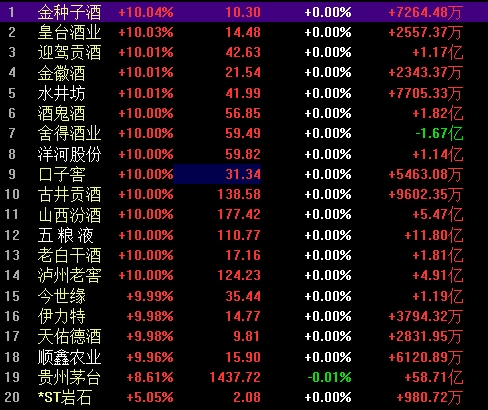
Market Performance - On January 29, A-shares showed mixed performance with the Shanghai Composite Index experiencing narrow fluctuations, the SSE 50 Index rising over 1%, while the ChiNext Index peaked and then retreated, and the Sci-Tech 50 Index fell over 3% [1] Sector Analysis - The liquor sector saw a significant surge in the afternoon, with all constituent stocks in the sector closing in the green. Notable stocks such as Jinzhongzi Liquor, Huangtai Liquor, Yingjia Gongjiu, Jinhui Liquor, Shui Jing Fang, Jiu Gui Jiu, She De Jiuye, and Luzhou Laojiao all hit the daily limit, while Shunxin Agriculture, Kweichow Moutai, and Gujing Gongjiu B rose over 5% [1] Price Movements - The price of Feitian Moutai has been continuously rising ahead of the festival, with the wholesale price of a full box surpassing 1600 yuan. As of January 29, the price for a single bottle of 2026 original box Moutai increased by 20 yuan to 1610 yuan, recovering above 1600 yuan, while the price for loose bottles remained at 1570 yuan. Previously, the wholesale price of Moutai had stabilized around 1550 yuan [1] Sales Insights - The "i Moutai" platform indicated that the price of 1499 yuan for the regular Moutai has been sold out for 29 consecutive days after multiple sell-outs [1]


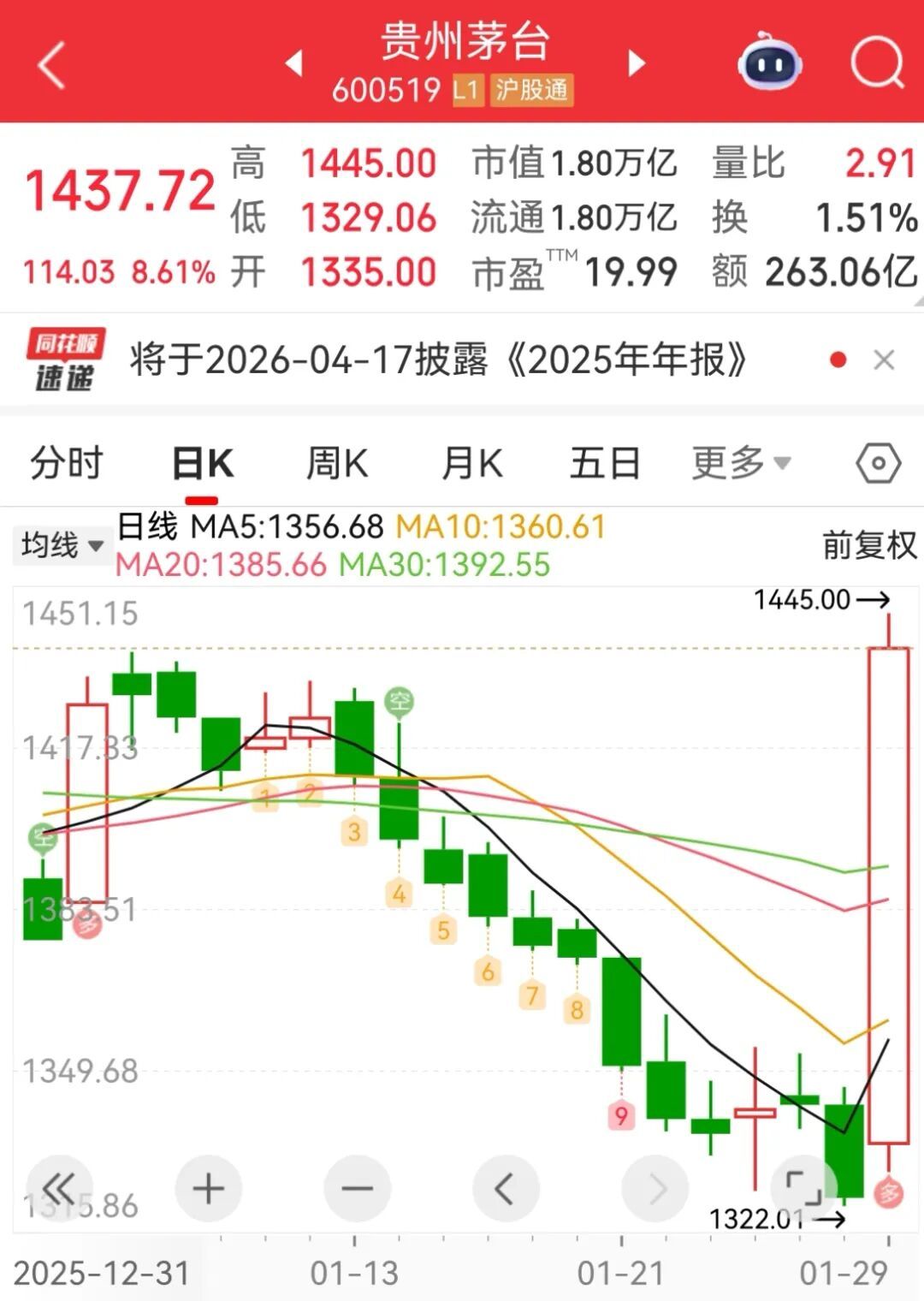
茅台股价涨8.61%创一年来单日最大涨幅,飞天茅台上涨至1600元上方
Xin Lang Cai Jing· 2026-01-29 08:48
Core Viewpoint - The A-share liquor sector, particularly Guizhou Moutai, has experienced significant price increases and trading activity, driven by market demand and strategic pricing adjustments by the company [1][2][3] Group 1: Stock Performance - The A-share liquor sector saw a rebound, with multiple stocks hitting the daily limit, including Guizhou Moutai, which rose by 8.61% to close at 1437.72 yuan per share, marking its largest single-day increase in nearly a year [1] - Guizhou Moutai's total market capitalization reached 1.8 trillion yuan, with a trading volume exceeding 26.3 billion yuan on the same day [1] Group 2: Price Trends - The wholesale price of 2026 Feitian Moutai increased by 20 yuan to 1610 yuan per bottle, while the 2025 and 2024 versions also saw price hikes [1] - The price of the 2026 Feitian Moutai has been consistently sold out on the iMoutai app, indicating strong demand despite no significant surge in market demand [2] Group 3: Strategic Adjustments - Guizhou Moutai announced a new market operation plan that includes adjustments in product systems, operational models, channel layouts, and pricing mechanisms to better meet consumer demand [3] - The company is shifting from a traditional sales model to a multi-faceted marketing system that includes self-sale, agency sale, and consignment to enhance market reach [3]
20只白酒股中19只涨停,贵州茅台大涨8.61%,“老登”酒类股重回A股舞台中央!白的、黄的、啤的、红的全线大涨,超过600亿元资金疯狂涌入白酒板块
Jin Rong Jie· 2026-01-29 08:45
Core Viewpoint - The liquor sector, including core liquor stocks, yellow wine, beer, and red wine, has experienced a significant surge, with many stocks hitting their daily limit up, indicating a strong market interest and potential recovery in the sector [1][2]. Liquor Sector Performance - On the afternoon of the 29th, the core liquor stocks continued to rise, with multiple stocks such as Shui Jing Fang, Shanxi Fenjiu, Wuliangye, and others reaching their daily limit up. Kweichow Moutai saw an increase of over 9% at one point [1]. - A total of 19 out of 20 core liquor stocks hit the daily limit up, while Kweichow Moutai, which did not, still rose by 8.61%. Over 600 billion yuan flowed into the liquor sector, with total trading volume reaching 614.2 billion yuan [2][3]. Price Movements - The price of Feitian Moutai has risen above 1,600 yuan per bottle, with the price on January 29 showing an increase of 20 yuan to 1,610 yuan per bottle. This price increase is attributed to strong demand during the upcoming Spring Festival [5]. Market Sentiment and Future Outlook - Analysts from CITIC Securities suggest that the liquor sector is poised for a recovery as the Spring Festival marketing activities approach, with stable sales expected. The report indicates that the current stock prices reflect market expectations, and the sector's valuation is relatively low, making it an attractive investment opportunity [6]. - The report from Guotai Junan Securities highlights that the current public fund holdings in the liquor sector are at a historical low of 3.93%, suggesting that the conditions for a new cycle in the sector are in place [6]. Broader Market Trends - The real estate sector also saw a significant rise, with stocks like Dayuecheng and Sanxiang Impression hitting their daily limit up, indicating a rotation in market interest towards liquor and real estate sectors [4]. - The A-share indices showed divergent trends, with the Shanghai 50 Index rising over 1% while the Sci-Tech 50 Index fell over 3% [4]. Investment Perspectives - Notable investor Duan Yongping commented on Kweichow Moutai, suggesting that while short-term fluctuations are uncertain, the long-term outlook remains positive, indicating that the current price is not expensive when viewed over a decade [8].
极致分化!3.2万亿资金上演“高低切换”,后市方向明确了
Sou Hu Cai Jing· 2026-01-29 08:32
Overall Market Overview - The A-share market showed mixed performance with the Shanghai Composite Index slightly up by 0.16% to 4157.98 points, while the Shenzhen Component and ChiNext Index fell by 0.3% and 0.57% respectively. The STAR 50 Index experienced a significant drop of 3.03%, closing at 1507.64 points. Total trading volume reached 3.23 trillion yuan, an increase of over 260 billion yuan compared to the previous day [1][2]. Sector Performance - Traditional blue-chip and cyclical sectors dominated the gainers' list, with the food and beverage sector surging by 6.57%. Notably, liquor stocks saw a rally, with Kweichow Moutai rising by 8% and trading volume exceeding 20 billion yuan. Other sectors like media, real estate, non-bank financials, and oil & petrochemicals also saw gains of over 2% [2]. - The technology and high-end manufacturing sectors, represented by the electronics sector, faced the largest declines, with a drop of 3.56%. Other sectors such as power equipment, defense, and machinery also fell by more than 1.7% [2]. Market Sentiment and Fund Flows - The current market sentiment reflects a clear preference for "reality" over "dreams," with funds moving away from long-term investments in "hard technology" towards short-term performance certainty in "consumer recovery" sectors. This shift indicates a significant change in investment strategy [3]. - Data shows that major broad-based ETFs like CSI 300 and CSI 1000 have experienced substantial net outflows this year, indicating a shift from beta (market overall) to alpha (individual stock opportunities). However, niche products like the STAR 100 ETF have seen continued net inflows, suggesting selective investment in high-potential "hardcore" assets within the technology sector [3]. Future Market Outlook - The current trend of "blue-chip leading, growth resting" is expected to continue in the short term, with sectors like real estate and liquor likely to maintain upward momentum driven by policy and sentiment. The sustainability of this trend will depend on upcoming consumer and real estate sales data validating the strength of the recovery [4]. - Despite the significant pullback in the technology sector, there is no need for excessive pessimism. As valuation pressures are quickly released, the medium to long-term investment value may gradually become more apparent, especially for leaders in emerging industries that align with national policy directions [4].
白酒股今日情绪爆发午后17股涨停 茅台大涨8.6%
Di Yi Cai Jing· 2026-01-29 08:29
Group 1 - The core viewpoint of the news is that the recent surge in liquor stocks, particularly in the white liquor sector, is attributed to a combination of capital seeking safety and changes in market sentiment [1][2] - On January 29, 17 white liquor stocks collectively hit the daily limit, with Kweichow Moutai rising by 8.61%. Other notable stocks like Wuliangye, Luzhou Laojiao, and Yanghe also reached their daily limits [1] - The performance of white liquor stocks has been poor since the third quarter of 2025, with many companies reporting significant declines in earnings growth. For instance, Jinzhongzi Liquor expects a net profit loss of 150 to 190 million yuan for 2025 [1] Group 2 - The collective rise in white liquor stocks is not closely related to the fundamentals of individual companies, as observed by Shen Meng from Xiangsong Capital. The strong performance of white liquor, resource, and banking stocks contrasts with the noticeable pullback in the technology and small-cap sectors [2] - The current bullish sentiment in the stock market is favorable for liquor consumption during the upcoming Spring Festival, contributing to optimistic investor sentiment [2] - Real estate stocks also experienced a collective surge due to news influences, highlighting the strong correlation between the liquor and real estate sectors [2]


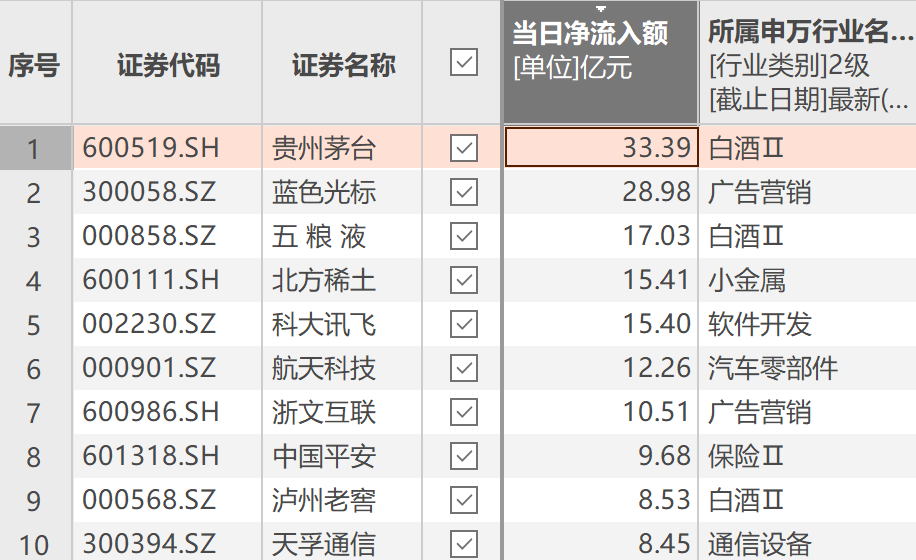
资金风向标 | 贵州茅台、五粮液获大额资金净流入
Shang Hai Zheng Quan Bao· 2026-01-29 08:28
Group 1 - The top ten stocks with the highest net inflow of funds on January 29 include Kweichow Moutai, BlueFocus, Wuliangye, Northern Rare Earth, iFlytek, Aerospace Science and Technology, Zhejiang Wenchuang, Ping An Insurance, Luzhou Laojiao, and Tianshu Communication [1][2] - Kweichow Moutai received a net inflow of over 3.3 billion yuan, while Wuliangye saw a net inflow exceeding 1.7 billion yuan [1][2] - Other notable stocks in the top ten include BlueFocus with a net inflow of approximately 2.9 billion yuan and Northern Rare Earth with about 1.5 billion yuan [2] Group 2 - The sectors represented in the top ten net inflow stocks include liquor, advertising, small metals, software development, automotive parts, and insurance [2] - Kweichow Moutai and Wuliangye are both categorized under the liquor industry, highlighting the strong performance of this sector [2] - BlueFocus and Zhejiang Wenchuang are part of the advertising industry, indicating a significant interest in marketing-related stocks [2]
白酒股今日情绪爆发午后17股涨停,茅台大涨8.6%
Di Yi Cai Jing Zi Xun· 2026-01-29 08:28
Group 1 - The core point of the news is the significant surge in Chinese liquor stocks, particularly after a period of underperformance, driven by a combination of market sentiment and capital seeking safer investments [1][3] - On January 29, 17 liquor stocks, including Kweichow Moutai, experienced a collective limit-up, with Kweichow Moutai rising by 8.61% [1] - The rise in liquor stocks also positively impacted yellow wine stocks, with Gu Yue Long Shan and Kuaiji Mountain hitting the limit-up, and Jin Feng Jiu Ye increasing by 6.8% [1] Group 2 - Since the third quarter of 2025, liquor stocks have faced challenges, with many companies reporting significant declines in performance growth [1] - Several liquor companies have issued profit warnings, indicating substantial impacts on their annual performance, with Jin Zhong Zi Jiu predicting a net loss of 150 to 190 million yuan for 2025 [1] - The collective rise in liquor stocks is not closely related to individual company fundamentals, but rather reflects a broader market trend where funds are moving from high-risk sectors like technology to safer stocks [3]
白酒股大爆发!飞天茅台价格全线上涨,茅台股价大涨8.61%
Mei Ri Jing Ji Xin Wen· 2026-01-29 08:23
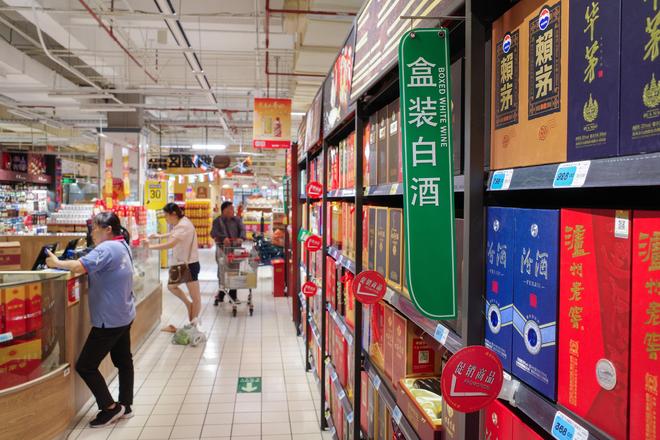
Group 1 - Moutai's price has surpassed 1600 yuan, with the 25-year Flying Moutai (original) wholesale price at 1610 yuan per bottle, an increase of 20 yuan from the previous day [2] - Some Moutai direct stores are experiencing "insufficient inventory" of Flying Moutai, with only successful applicants on the iMoutai app guaranteed to have stock [2] - Public fund positions in the liquor sector have dropped below 4%, indicating a relatively low allocation [5][7] Group 2 - Investor Duan Yongping expressed optimism about Moutai's direct sales through the iMoutai app, stating it addresses issues of counterfeit products and high prices, potentially releasing significant purchasing power [3] - Duan also mentioned that while Moutai's sales may be affected by external factors like the real estate industry, the long-term outlook remains positive due to the app's ability to provide genuine products [3] - The overall public fund allocation to the liquor sector has decreased from a peak of 16% in 2020 to the current 3.93%, which is below historical levels, suggesting conditions are set for a new cycle [7] Group 3 - Moutai's recent price adjustments have led brokerages to lower profit expectations for 2026, forecasting a net profit growth rate of 0% to 3% for the company this year [8] - Some fund managers are looking to increase their positions in the liquor sector, citing strong brand barriers and potential for marginal improvement in the industry [7] - Conversely, other managers have opted for reduction in holdings due to uncertainties regarding short-term performance and rapid price declines of leading brands [7]
拉爆了!茅台真飞天,股价暴涨超8%!股民:重视商业航天遗珠,提供向上想象空间...
雪球· 2026-01-29 08:19
Group 1: Market Overview - The three major indices showed mixed performance, with the Shanghai Composite Index rising by 0.16%, while the Shenzhen Component Index and the ChiNext Index fell by 0.3% and 0.57% respectively. The total trading volume in the Shanghai and Shenzhen markets reached 3.23 trillion yuan, an increase of 264.6 billion yuan compared to the previous trading day [2]. Group 2: White Wine Sector - The white wine sector experienced a significant surge, with Kweichow Moutai rising by 8.6%, and other major brands like Wuliangye and Luzhou Laojiao hitting the daily limit. The overall sector saw a rise of 9.68%, leading the industry sector rankings [6][12]. - The recent price increase in Moutai has been attributed to a clean-up of holdings and a market rotation, as the sector had previously underperformed. Analysts suggest that the bottom buying point for the white wine sector has emerged, with a heavy reduction in fund holdings to 3.5% [18]. - The upcoming Spring Festival is expected to boost sales, with traditional channels showing signs of acceleration in sales volume [18]. Group 3: Gold Sector - Gold prices have surged, with spot gold reaching a historical high of over $5,500 per ounce, marking an increase of over 28% since the beginning of the year [21]. - The rise in gold prices is attributed to escalating geopolitical tensions and a re-evaluation of the "credit premium" of dollar assets, making gold a direct beneficiary [22]. - Central banks globally are increasing their gold reserves, with Poland planning to purchase 150 tons and China continuing its net purchases for 14 consecutive months, indicating strong demand for gold [22]. Group 4: Real Estate Sector - The real estate sector saw a significant rebound, with stocks like Zhujiang Holdings, Dayuecheng, and Sanxiang Impression hitting the daily limit [26]. - Recent policy changes, such as the reduction of the value-added tax on second-hand housing and the easing of purchase restrictions in Beijing, have contributed to a more favorable outlook for the real estate market [28]. - Analysts believe that the overall policy environment is becoming more accommodating, which may support the stabilization of the real estate market [28].