HAIER SMART HOME(600690)

Search documents
中国家电出海,为什么不怕西方制裁?
3 6 Ke· 2025-09-17 08:41
Core Insights - China's home appliance exports have shown unexpected growth in the first seven months of this year, with air conditioner exports increasing by 4.1%, refrigerators by 2%, and washing machines by 5.3% [1] - In the first half of the year, China's total home appliance exports reached $68.78 billion, a year-on-year increase of 6.2% [1] - The participation of 764 Chinese companies at the Berlin International Consumer Electronics Show, accounting for over one-third of total exhibitors, highlights the industry's resilience despite Western trade barriers [1] Group 1: Market Dynamics - The Chinese home appliance market faced challenges post-2018 due to a slowdown in real estate and competition from emerging brands in niche segments, prompting traditional manufacturers to lower prices [1][3] - Major players like Haier, Midea, and Gree have consolidated market share through strategic pricing and supply chain optimization [1][3] Group 2: International Expansion - There is significant growth potential for Chinese home appliances in overseas markets, particularly in Southeast Asia, where the annual growth rate for major appliances is between 7% and 9% [4] - The Middle East and Latin America are also key markets, with the Middle East expected to see a compound annual growth rate of 5.5% in home appliance retail from 2022 to 2024 [4] Group 3: Supply Chain and Cost Challenges - The logistics costs for exporting from China have surged, making it imperative for home appliance companies to establish overseas supply chains to mitigate risks [4][7] - Rising costs in regions like Vietnam pose challenges for Chinese brands looking to expand manufacturing capabilities abroad [7][9] Group 4: Product Adaptation and Market Understanding - Successful international expansion requires understanding local consumer preferences and adapting products to meet specific climatic and cultural needs [11][12] - For instance, air conditioners in the Middle East must withstand higher temperatures and include features like sand filters, while Southeast Asian products need to address humidity-related issues [11][12] Group 5: Strategic Acquisitions - Chinese companies like Haier and Midea have pursued acquisitions to enhance their technological capabilities and market presence, with Haier's acquisition of GE Appliances being a notable example [19][20] - Midea's acquisitions, including Toshiba's home appliance business, have allowed it to leverage established brands and technologies to strengthen its market position [20][22] Group 6: R&D Investment - Leading brands like Haier and Midea invest significantly in R&D, with Haier's R&D expenditure at 10.74 billion yuan, representing 3.8% of revenue, and Midea's at 16.2 billion yuan, or 4.4% of revenue [25] - This investment in innovation is crucial for maintaining competitiveness and transitioning from a manufacturing-focused model to a brand-oriented approach [25]




海尔集团等出资成立数字科技公司
Zheng Quan Shi Bao Wang· 2025-09-17 08:35
人民财讯9月17日电,企查查APP显示,近日,青岛尚合领航数字科技有限公司成立,法定代表人为朱 海洋,注册资本2000万元,经营范围包含大数据服务、信息技术咨询服务、工业互联网数据服务等。企 查查股权穿透显示,该公司由海尔集团旗下卡奥斯数字科技(青岛)有限公司等共同持股。 ...
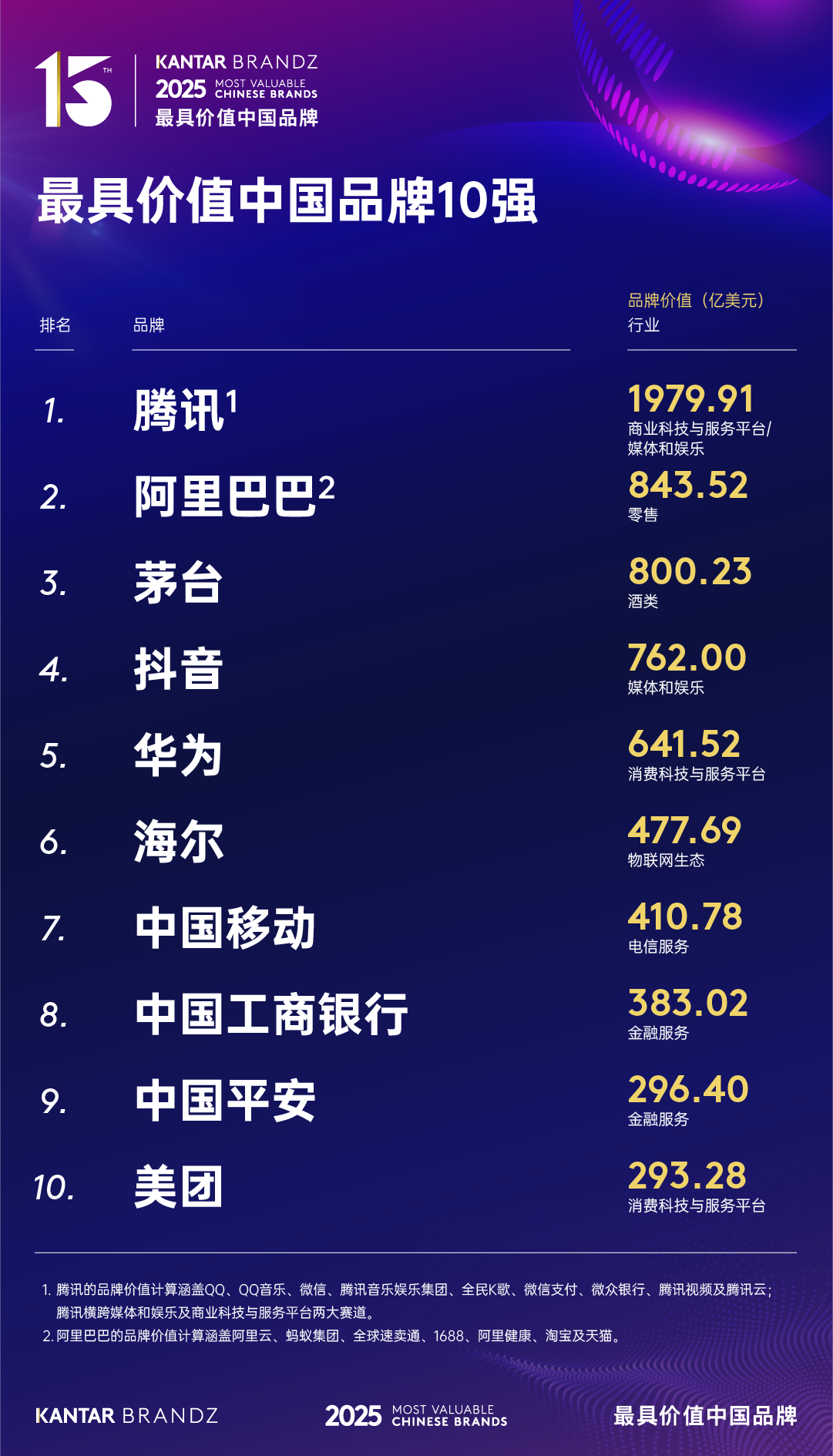
海尔连续15年上榜2025凯度BrandZ最具价值中国品牌100强
Ren Min Wang· 2025-09-17 05:43
Core Insights - The 2025 Kantar BrandZ Top 100 Most Valuable Chinese Brands list was revealed, with Haier ranking 6th and marking its 15th consecutive year on the list, showcasing its strong brand value growth of 47% [1][2] - The total value of the top 100 brands reached $1.21 trillion, reflecting a 25% increase from the previous year, driven significantly by advancements in artificial intelligence [2] - Haier is recognized as a leader in the Internet of Things (IoT) ecosystem, emphasizing its commitment to AI integration across all business processes [6] Brand Value and Growth - Haier's brand value growth of 47% positions it among the fastest-growing brands, and it has been awarded the title of "2025 Kantar BrandZ Globalization Pioneer" [1] - The overall brand value of the top 100 brands indicates a robust recovery in the Chinese market, with AI innovation being a key driver of this growth [2] AI Integration and Innovation - Haier has defined 2025 as the "Year of AI Application," with a focus on transforming organizational processes to fully embrace AI [2][3] - The company has implemented AI across its entire business process, enhancing product quality and production efficiency by 30% through AI visual inspection systems [3] - The successful launch of the Leader Lazy Three-Tub Washing Machine, achieving over 100 million yuan in sales within 16 hours, exemplifies Haier's effective AI application [3] Globalization and Localization Strategy - Haier has adopted a "three-in-one" differentiation localization strategy, establishing a vast network of 35 industrial parks and 163 manufacturing centers globally [4] - The company serves over 1 billion households across more than 200 countries, demonstrating its commitment to localized solutions that address specific consumer needs [4][5] - Recent partnerships with top football clubs in Europe highlight Haier's strategy to enhance brand recognition and cultural resonance through sports [5] Ecosystem Expansion - Haier is transitioning from a traditional appliance manufacturer to an ecosystem enterprise, focusing on smart living, health, and digital economy sectors [6] - The company has made significant investments to expand its ecosystem, including a 12.5 billion yuan stake in Shanghai Raist to enhance its blood industry chain [6] - Future plans include continued collaboration with upstream and downstream partners to create an open ecosystem that maximizes long-term value [6]
国信证券:8月家电零售增长良好 企业亮相IFA彰显出海决心
Zhi Tong Cai Jing· 2025-09-17 03:38
Core Insights - The home appliance retail sector in China showed a positive growth trend in August, with offline sales improving and online sales remaining stable despite entering a low season [1][2] - Home appliance exports faced challenges, with a year-on-year decline of 6% in August, but companies are showing confidence in overseas expansion [1][3] - Domestic appliance manufacturers showcased new products at the IFA exhibition in Berlin, indicating strong intentions to penetrate international markets [1][4] Retail Performance - In August, the total retail sales of consumer goods in China grew by 3.4% year-on-year, with cumulative growth of 4.6% [2] - The retail sales of home appliances and audio-visual equipment increased by 14.3% year-on-year, with cumulative growth of 28.4% [2] - The growth of offline retail was boosted by the arrival of the third batch of national subsidy funds, while online sales of essential items saw a slowdown [2] Export Trends - In August, the export value of home appliances reached 60.37 billion yuan, a year-on-year decrease of 6.3%, with a dollar value of 8.43 billion USD, also down by 6.6% [3] - The average export price decreased by 3.2% to 20.9 USD per unit [3] - The decline in exports has narrowed slightly due to easing tariff policies, and companies are accelerating overseas production capacity [3] Product Launches and Market Strategy - The IFA exhibition featured major Chinese appliance brands like Midea, Haier, and TCL, showcasing innovative products and emphasizing their commitment to international markets [4] - Midea's exhibition theme was "Master Your Home," highlighting smart home appliances, while Haier introduced its latest AI technology [4] - Stone Technology launched its first all-terrain robotic lawn mower, indicating diversification into new product categories [4] Investment Recommendations - Recommended stocks include Midea Group, Bear Electric, and Stone Technology for their strong market positions and product offerings [1][4]

海尔智家HOPE平台上线“许愿池”板块
Huan Qiu Wang· 2025-09-17 02:53
Core Viewpoint - The HOPE platform by Haier Smart Home has been upgraded with a new "Wishing Pool" section, aimed at facilitating direct user input for product innovation and development [1][4]. Group 1: User-Centric Product Development - Haier Smart Home emphasizes user needs as a driving force for product innovation, exemplified by the successful launch of the "Lazy Washing Machine," which was developed based on user feedback for a machine that can wash different types of clothing separately [3]. - Following the "Lazy Washing Machine," additional user requests led to the introduction of products like the "Lazy Washing and Shoe Washing Machine" and "Lazy Drying Machine," expanding the "Lazy Family" product line [3]. - The "Lazy Washing Machine" has been delivered to over 130,000 users in China, with plans for a European launch by the end of the year, showcasing the effectiveness of the user co-creation model [3]. Group 2: Wishing Pool Functionality - The "Wishing Pool" section allows users to submit product improvement suggestions directly to the R&D team, enhancing the efficiency of communication and idea generation [4][7]. - This platform enables R&D engineers and product managers to review and respond to user ideas, fostering a two-way interaction that accelerates the transition from concept to product [7]. - By integrating internal and external expert resources, the "Wishing Pool" aims to optimize the user co-creation mechanism, improving the accuracy and efficiency of responding to user demands [7].
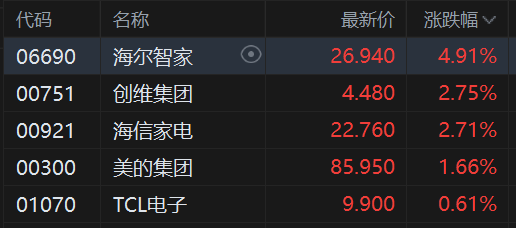
家电股普涨 海尔智家涨超5% 美的集团涨约2%
Ge Long Hui· 2025-09-17 02:06
Group 1 - The core viewpoint of the news is that the home appliance sector in Hong Kong has seen a collective rise, with notable increases in stock prices for companies like Haier Smart Home and Skyworth Group, driven by positive retail growth trends despite some fluctuations [1][2] - In August, China's home appliance retail sales saw a year-on-year growth of 14.3%, indicating a good growth trend, although the growth rate has slowed compared to previous months [1] - The arrival of the third batch of national subsidy funds has boosted offline retail sales of home appliances, while online sales growth for essential categories has slowed down, but optional categories like robotic vacuum cleaners and floor washers continue to grow rapidly [1] Group 2 - Haier Smart Home's stock price increased by 4.91% to 26.940, while Skyworth Group and Hisense Home Appliances rose by 2.75% and 2.71% respectively [2] - Midea Group's stock rose by 1.66%, and TCL Electronics saw a smaller increase of 0.61% [2] - The overall outlook for China's home appliance exports is expected to return to a stable growth path as tariff policies become clearer, with significant potential for overseas development in Southeast Asia [1]
港股异动丨家电股普涨 海尔智家涨超5% 美的集团涨约2%
Ge Long Hui· 2025-09-17 01:59
Group 1 - The core viewpoint of the article highlights the collective rise of Hong Kong's home appliance stocks, with Haier Smart Home increasing over 5% and other companies like Skyworth Group and Hisense Home Appliances also showing gains [1] - According to Guosen Securities, China's home appliance retail sales in August experienced a year-on-year growth of 14.3%, although the growth rate has slowed compared to the previous month, indicating a still positive growth trend [1] - The report notes that with the arrival of the third batch of national subsidy funds, offline home appliance retail has seen an increase in growth, while online sales for essential categories have slowed down, but optional categories like robotic vacuum cleaners and floor washers continue to grow rapidly [1] Group 2 - The article mentions that Chinese home appliance companies are accelerating their capacity expansion overseas, particularly in Southeast Asia, which is expected to impact the growth rate of home appliance exports from China [1] - It is anticipated that as tariff policies become clearer, China's home appliance exports are likely to return to a stable growth path, indicating significant potential for the overseas development of home appliances [1] - The stock performance of major home appliance companies is as follows: Haier Smart Home at 26.940 with a rise of 4.91%, Skyworth Group at 4.480 with a rise of 2.75%, Hisense Home Appliances at 22.760 with a rise of 2.71%, Midea Group at 85.950 with a rise of 1.66%, and TCL Electronics at 9.900 with a rise of 0.61% [1]
AI技术之光照进“无人家务”梦想
Jing Ji Ri Bao· 2025-09-16 22:12
Core Insights - The article highlights the emergence of AI-driven home appliances, particularly focusing on Haier's innovative "lazy" washing machine, which has achieved a milestone of 130,000 units delivered, addressing the growing consumer demand for convenience and hygiene in laundry solutions [2][3] Group 1: AI Empowerment in Home Appliances - AI technology is transforming home appliances from passive responders to proactive service providers, enhancing user experience by optimizing household tasks through machine learning [3] - The development of Haier's washing machine involved a comprehensive approach, utilizing intelligent algorithms to identify user pain points and significantly reducing the product validation cycle by 30% [3] Group 2: Integration of AI in Household Scenarios - The integration of AI across various home environments is reshaping family experiences, with appliances now capable of coordinating tasks across different rooms, marking a shift towards a more interconnected smart home ecosystem [4] - Haier's solutions, such as the intelligent kitchen system, exemplify this trend by automating cooking processes and enhancing safety through real-time monitoring [4] Group 3: Data and Model Challenges - The article emphasizes the critical role of high-quality data in AI performance, particularly in the "unmanned household" sector, where data collection and model optimization are essential for overcoming technical challenges [5][6] - Haier has invested significantly in data acquisition, employing a dedicated team to gather diverse cooking scenarios to enhance the accuracy of AI functionalities [5] Group 4: Collaborative Innovation Ecosystem - The industry is moving towards a collaborative innovation ecosystem, where standardization in data collection and open cooperation among companies are vital for advancing AI applications in home appliances [7] - Haier is leading efforts to establish data collection standards that can evolve from corporate to national levels, ensuring a robust foundation for AI development [7] Group 5: Future of Robotics in Home Management - The future of home management is expected to be dominated by robots, with the integration of AI appliances creating a synergistic environment for efficient household management [8] - Haier's leadership in the consumer electronics sector positions it uniquely to drive the widespread adoption of "unmanned household" solutions, leveraging its comprehensive industry capabilities [8]
家电行业周报(25年第37周):8月家电社零增长14%,家电企业亮相IFA彰显出海决心-20250916
Guoxin Securities· 2025-09-16 14:43
Investment Rating - The report maintains an "Outperform" rating for the home appliance industry [6][7][85]. Core Views - The home appliance retail sector showed a strong growth of 14% year-on-year in August, with offline sales improving and online sales remaining stable despite entering a low season [1][2][19]. - Home appliance exports faced challenges, with a 6% year-on-year decline in August, but the resilience of growth is highlighted amid tariff disruptions [3][43]. - Domestic appliance companies showcased new products at the IFA exhibition, indicating a strong commitment to overseas expansion [4][49]. Summary by Sections Retail Performance - In August, the retail sales of home appliances grew by 14.3% year-on-year, with offline sales benefiting from government subsidies [2][20]. - Key categories such as air conditioners and kitchen appliances maintained positive growth, with air fryers seeing over 30% growth in online sales [2][20]. Export Performance - The export value of home appliances in August was 603.7 billion yuan, down 6.3% year-on-year, with a decline in export volume by 3.6% [3][43]. - The average export price decreased by 3.2% to 20.9 USD per unit, reflecting the impact of tariffs since April [3][43]. Product Innovation - Major domestic brands like Midea, Haier, and TCL introduced innovative products at the IFA, showcasing advancements in smart home technology and a commitment to international markets [4][49]. - Stone Technology entered the lawn mower market, indicating diversification in product offerings [4][49]. Company Recommendations - The report recommends investing in leading companies in the white goods sector such as Midea Group, Gree Electric, and Haier Smart Home, as well as in small appliances like Bear Electric and Stone Technology [5][14][82].


AI驱动、出海加速!2025中国品牌百强总价值突破1.2万亿美元
Guo Ji Jin Rong Bao· 2025-09-16 14:09
Core Insights - The total value of the 2025 BrandZ Top 100 Most Valuable Chinese Brands reached $1.21 trillion, marking a significant 25% increase from the previous year [1] - The strong recovery of Chinese brands is attributed to four main drivers: breakthroughs in artificial intelligence innovation, stable development in the financial services sector, accelerated expansion into overseas markets, and the value return of technology giants [1] Company Highlights - Tencent topped the BrandZ list with a brand value of $197.99 billion, achieving a 53% increase due to its expansion in consumer and enterprise sectors [3] - Alibaba reclaimed the second position with a brand value of $84.35 billion, growing at a rate of 23% [3] - Moutai maintained third place with a brand value of $80.02 billion, while Douyin surged 34% to $76.20 billion, securing fourth place [3] - Huawei's brand value increased by 56% to $64.15 billion, placing it fifth overall and among the top four in annual value growth [3] - Haier, ranked sixth with a brand value of $47.77 billion, strengthened its leadership in the IoT ecosystem through an enhanced ecological brand strategy [3] Emerging Brands - The BrandZ list showcased a diverse development landscape with seven new brands, including two from the fast-food sector [6] - Mixue Ice City ranked 51st with a brand value of $3.96 billion, recognized for its high-quality supply chain and affordable brand positioning [6] - Bawang Tea Ji ranked 88th with a brand value of $1.82 billion, focusing on cultural and aesthetic representation through tea [6] - Qunar, returning to the list at 78th with a brand value of $2.20 billion, improved its brand value through enhanced online service experiences [6] Growth Leaders - The average growth rate of the leading brands this year reached 67%, indicating strong development momentum among Chinese brands [7] - Xiaomi led the growth with a remarkable 154% increase, achieving a brand value of $28.15 billion through a user-centric innovation strategy [7] - BYD ranked 18th with a brand value of $17.16 billion, experiencing a 78% increase driven by advancements in smart driving technology and strategic partnerships [7] - XPeng Motors returned to the top 100 at 80th place with a brand value of $2.18 billion, bolstered by its overseas market expansion [7] Industry Trends - Chinese brands are at the forefront of artificial intelligence applications, optimizing manufacturing processes and transforming marketing strategies [8] - The integration of smart technology into daily life is becoming increasingly seamless, with innovations in smart home solutions leading the way [8]