CSC(601066)

Search documents
直击2025证券时报分析师年会!投研天团苏州论剑
券商中国· 2025-12-19 03:53
Core Viewpoint - The 2025 Securities Times Analyst Annual Conference and Best Analyst Awards Ceremony was held in Suzhou, focusing on enhancing financial service quality and supporting the development of the real economy [2][4]. Group 1: Event Overview - The conference gathered over 60 securities firms, nearly 100 listed companies, and more than 300 financial institutions, totaling around 2,000 attendees [4]. - Keynote speeches were delivered by prominent figures, including the Chief Economist of Changjiang Securities and the Chairman of Jiemai Technology [4]. - The main forum emphasized the importance of financial services in supporting the real economy, with subsequent specialized forums addressing hot investment topics [4]. Group 2: Best Analyst Awards - The 2025 Best Analyst Awards were announced, showcasing a strong lineup of analysts in the Chinese securities research field [5]. - The Superior Super Research (SSR) team award was given to top firms including Changjiang Securities, GF Securities, and others, highlighting their industry influence [6]. - In macroeconomic research, GF Securities' research team led by Guo Lei won first place, followed by teams from Huachuang Securities and others [6]. Group 3: Investment Strategy Discussion - From December 18 to 19, top analysts discussed macroeconomic trends and investment strategies for 2026 with representatives from major investment institutions [8]. - Guo Lei noted two key characteristics for 2025's pricing: the rise of global narratives and the differentiation of economic fundamentals, with precious metals and emerging market stocks expected to perform well [8]. - Looking ahead to 2026, Guo Lei predicted a convergence of global narratives and a narrowing of domestic economic disparities, with potential for improved investment conditions [9].







中信建投黄文涛:建议放开部分城市对房地产和汽车的消费限制
Xin Lang Cai Jing· 2025-12-19 02:17
Core Viewpoint - The Chinese consumption market has significant growth potential, with a shift towards service consumption expected as GDP per capita approaches $14,000, nearing the $15,000 threshold where service consumption typically accelerates [3][8]. Group 1: Economic Indicators - By the end of this year, China's GDP per capita is projected to be close to $14,000, indicating a transition towards rapid growth in service consumption [3][8]. - Currently, the proportion of per capita service consumption expenditure in China stands at 46.1%, which shows considerable room for improvement compared to developed countries [3][8]. Group 2: Demographic Changes - The entry of Generation Z into the workforce is driving new consumption trends, particularly in experiential consumption and local cultural elements [3][8]. - The aging population is contributing to the growth of the silver economy, with increasing demand in sectors such as elderly care, health, and smart home appliances [3][8]. Group 3: Policy Recommendations - To stabilize and expand consumption, it is recommended to maintain a long-term focus on expanding domestic demand, implementing more proactive fiscal policies and moderately easing monetary policies during the 14th Five-Year Plan period [4][9]. - Specific measures include enhancing income for urban and rural residents, improving employment stability through loan subsidies, and increasing the minimum purchase price for grain [4][9]. Group 4: Consumption Environment Optimization - Suggestions include increasing leisure time for residents by implementing school breaks and paid leave, as well as creating new public holidays to facilitate consumption [5][10]. - There is a call to remove unreasonable restrictions in the consumption sector and to support emerging consumption areas such as e-commerce and low-altitude economy [5][10]. Group 5: Future Outlook - The current challenges in the consumption market are seen as developmental issues, with expectations that as disposable income rises and policies take effect, the consumption market will gradually recover, contributing to stable economic growth [11].


中信建投:模拟IC回归新周期 国产化可替代空间依然广阔
智通财经网· 2025-12-19 01:55
根据WSTS数据,2024年全球模拟IC市场规模约800亿美元。结合不同统计口径与产业结构因素,预计 国产化空间约占全球市场的20%–35%,对应约160–280亿美元的空间。该体量显著高于当前国内厂商的 整体收入规模,为持续成长提供了充足的市场基础。 随着全球市场规模与主要厂商业绩逐步触底回升,行业正走出下行周期。尤其是国内模拟IC产业,在国 产替代持续推进的背景下,正站在新一轮中长期成长周期的起点。从供给端看,海外模拟IC龙头在上一 轮周期中的激进扩产预期已明显修正,资本开支趋于克制;国内一级市场则对同类项目的投资显著降 温,上市公司并购整合趋势开启,供给侧无序扩张逐步收敛。从需求端看,数据中心、新能源等新兴应 用持续拉动模拟IC需求增长,同时在地缘环境变化下,国产化率仍存在显著提升空间。供需两端的同步 改善,为国内模拟IC行业打开了新的结构性成长窗口 国内厂商可触及的国产化市场空间具备百亿美元级规模,显著高于当前国内厂商的收入体量 智通财经APP获悉,中信建投发布研报称,全球模拟IC行业正逐步走出下行周期,国产化所对应的可替 代空间依然广阔。随着本土企业在多条细分赛道中持续提升产品力并加速抢占市场份额, ...
中信建投:港股中期交易窗口打开,调整充分的成长板块或成核心主线
Mei Ri Jing Ji Xin Wen· 2025-12-19 01:35
中信建投(601066)证券研究所12月19日发表最新研报表示:港股迎来年内最后一次交易窗口。 恒生互联网ETF(513330.SH)聚焦互联网巨头(腾讯控股、阿里巴巴、美团、小米、百度等),也是 持有人户数最多的港股类ETF; 在经历了9月的单边上涨后,10月以来港股市场随着海外宏观预期反复的影响经历了震荡调整。随着AH 两地同步完成中期调整,当前港股部分优质资产重新进入高性价比区间,在北水持续配置、盈利预期修 复及年末宏观预期改善的共振下,港股正迎来一个不容忽视的年内交易窗口。 港股通科技ETF基金(159101.SZ)覆盖最广泛的港股科技细分行业,包含AI应用、创新药、机器人、 智能车等热门概念。 港股成长风格相关ETF: 恒生科技指数ETF(513180.SH)跟踪恒生科技指数规模最大的ETF; 从大周期来看,目前港股处于牛市中段。前期因风格切换而深度调整的成长板块,或伴随市场情绪回暖 与宏观不确定性消退,将凭借高盈利弹性成为引领市场的核心主线。 多重因素促成港股中期交易窗口打开:1)港股本轮经历的市场调整增厚了安全边际,为新一轮反弹预 留了足够的空间;2)南向资金依然保持净流入态势,或随着海外流动性 ...
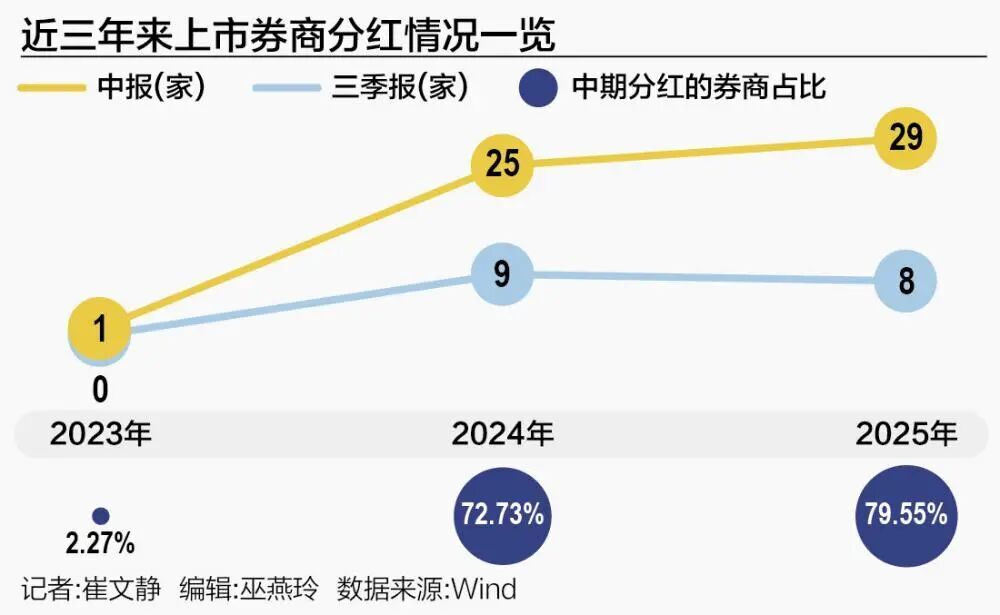
近八成券商一年多次分红!券商打响“季度分红赛”;公募机构年内参与85只个股定增,获配超340亿元 | 券商基金早参
Mei Ri Jing Ji Xin Wen· 2025-12-19 01:20
Group 1 - The core viewpoint of the articles highlights a significant increase in dividend frequency among brokerage firms, with nearly 80% of them implementing multiple dividends within a year, marking a new norm in the industry [1][2] - As of December 18, 2025, 35 brokerage firms have distributed dividends two times or more, accounting for 79.55% of the total, indicating a shift towards regular and timely sharing of profits [1] - Leading brokerage firms such as CITIC Securities have set a precedent with substantial dividends, with CITIC Securities distributing 29 yuan per share in the mid-year report, and several top firms exceeding 4 billion yuan in total annual dividends [1][2] Group 2 - The recent surge in trading volume of broad-based ETFs indicates a growing interest in capturing structural growth opportunities, with significant net inflows observed in various ETFs like the CSI A500 ETF [3][4] - The active participation of public fund institutions in the A-share private placement market, with 39 institutions involved and a total allocation exceeding 34 billion yuan, reflects a positive outlook on market prospects [4] - The increased dividend practices among brokerages are expected to enhance investor return expectations and attract long-term capital, potentially stabilizing market sentiment and improving risk appetite [2][4]




中信建投:预计2026年起我国将正式进入卫星互联网高频组网阶段
Zheng Quan Shi Bao Wang· 2025-12-19 00:49
Core Viewpoint - Since 2020, global rocket launch frequency has reached record highs for three consecutive years, indicating unprecedented activity in the aerospace sector [1] Group 1: Industry Trends - The construction of low Earth orbit (LEO) satellites in China is lagging behind high orbit high-throughput satellites [1] - The Tian Tong-1 satellite represents China's mature GEO satellite constellation, which has been widely adopted across various industries [1] - In 2024, two major constellations (GW and G60) in China will officially begin networking, marking the transition to a new era of regular satellite constellation launches [1] Group 2: Future Projections - Starting in 2026, China is expected to officially enter the high-frequency networking phase of satellite internet, driven by the gradual advancement of domestic satellite internet construction demands [1] - The overall industry scale is anticipated to experience rapid growth in the coming years, with a recommendation to focus on upstream satellite manufacturing and rocket launch sectors [1] - Key attention should be given to the official construction and batch networking timelines of domestic LEO satellite constellations, which may serve as a turning point for the performance of companies in the satellite internet industry chain [1]
中信建投:海南有望成为产业迁移的热土
Zheng Quan Shi Bao Wang· 2025-12-19 00:49
Core Viewpoint - The Hainan closure policy is a significant initiative in China's new round of reform and opening-up, characterized by unprecedented depth in institutional design and broad policy coverage [1] Group 1: Policy Framework - Hainan's free trade port policy system is built on "zero tariffs, low tax rates, and simplified tax systems," which significantly reduces operational costs for enterprises [1] - The financial sector in Hainan adopts a regulatory model of "freeing up the first line and controlling the second line," facilitating the liberalization and convenience of cross-border capital flows [1] - The establishment of the EF account system provides an upgraded infrastructure for financial openness [1] Group 2: Economic Opportunities - The policy dividends are expected to make Hainan a hotspot for industrial migration, with high-end manufacturing, air logistics, and digital economy industries likely to cluster in the region, creating new economic growth points [1] - Hainan's measures to relax visa policies and optimize the tourism environment effectively stimulate overseas consumption and enhance its status as an international tourism consumption center [1] Group 3: Demographic Changes - The relaxation of household registration policies and talent introduction plans in Hainan significantly promote population structure optimization and urbanization processes [1] - The influx of high-quality talent provides strong support for the construction of Hainan's free trade port [1] Group 4: Challenges and Future Outlook - The Hainan closure policy faces risks and challenges from deteriorating international economic and trade relations and rising global trade protectionism, which may restrict population migration [1] - Overall, the Hainan closure policy is expected to significantly enhance Hainan's position in the global value chain and inject new momentum into China's high-quality economic development [1] - Hainan needs to continue deepening policy implementation, strengthening risk prevention, and promoting the continuous achievement of new results in free trade port construction [1]
中信建投:港股迎来年内最后一次交易窗口
Xin Lang Cai Jing· 2025-12-19 00:49
Core Viewpoint - The Hong Kong stock market is experiencing a significant trading window as it enters a mid-term adjustment phase, with quality assets becoming more attractive due to ongoing capital inflows and improving profit expectations [1][4][42]. Group 1: Factors Influencing Recent Market Adjustments - The adjustment in the Hong Kong stock market over the past three months is primarily influenced by three factors: the U.S.-China relationship impacting market risk appetite, fluctuating overseas liquidity expectations, and a shift in investment styles towards more defensive sectors [2][41]. - The U.S.-China tensions, particularly regarding rare earth exports, have suppressed market risk preferences, leading to capital outflows and a decline in high-risk assets [6][46]. - The market's liquidity expectations have been volatile, particularly following the Federal Reserve's interest rate decisions, which have seen internal disagreements and fluctuating forecasts for future rate cuts [9][50]. Group 2: Market Dynamics and Cycles - The Hong Kong stock market is currently in the mid-stage of a bull market, with liquidity cycles leading the way, followed by valuation cycles, while the profit cycle is just beginning to recover [16][58]. - The overall valuation levels of the Hong Kong stock market have risen to the historical upper mid-range, following a prolonged bear market and subsequent recovery [22][64]. - The recovery in profits is expected to be gradual, with the current momentum primarily concentrated in structurally favorable sectors [24][66]. Group 3: Investment Opportunities - The recent market adjustments have increased the safety margin for investors, making certain core technology assets more attractive for a potential rebound [26][68]. - Continuous net inflows from southbound capital have reshaped the market's funding structure, indicating a long-term commitment to Hong Kong assets despite short-term fluctuations [28][70]. - Recent improvements in China's macroeconomic fundamentals, including rising inflation and export growth, are expected to catalyze broader profit recovery across various sectors [30][72]. Group 4: Strategic Focus Areas - Investment strategies should focus on high-quality dividend stocks with sustainable payouts and stable earnings, as the defensive attributes of dividend investments may weaken in the current economic environment [35][77]. - Growth sectors that have undergone significant adjustments may lead the market as sentiment improves and macro uncertainties diminish, particularly in areas like internet services and innovative pharmaceuticals [36][78]. - The new consumption sector, especially in trendy consumer goods, continues to show high growth potential and should be closely monitored for investment opportunities [79].

中信建投:港股正迎来一个不容忽视的岁末交易窗口
Xin Lang Cai Jing· 2025-12-19 00:45
Core Viewpoint - The report from CITIC Securities suggests that after a one-sided rise in September, the Hong Kong stock market has experienced a period of adjustment in October due to fluctuating overseas macro expectations. [1] Group 1 - The current A-H market is undergoing a mid-term adjustment, with some quality assets in the Hong Kong market entering a high cost-performance ratio zone. [1] - There is a continuous allocation from northbound capital, a recovery in profit expectations, and an improvement in the macro environment at home and abroad towards the end of the year. [1] - The Hong Kong stock market is entering a significant year-end trading window that should not be overlooked. [1]
近八成上市券商一年多次分红,多家头部机构分红超40亿
2 1 Shi Ji Jing Ji Bao Dao· 2025-12-19 00:41
Core Insights - The core viewpoint of the articles is that the Chinese securities industry is undergoing a significant transformation towards more frequent and substantial dividend distributions, reflecting a shift from a focus on financing to prioritizing shareholder returns [1][3][11]. Group 1: Dividend Frequency and Trends - In 2025, a notable change in the dividend practices of listed securities firms has emerged, with "multiple dividends per year" becoming the new norm [3][4]. - As of December 18, 2025, 35 securities firms have implemented or planned to distribute dividends two times or more, accounting for 79.55% of all listed firms [4][6]. - The trend of mid-term dividends (including interim and quarterly reports) has gained momentum, with 29 firms distributing mid-term dividends in 2025, a significant increase from previous years [3][4]. Group 2: Leading Firms and Dividend Quality - Leading firms are setting high benchmarks for dividend payouts, with CITIC Securities distributing 29 yuan per hand (100 shares), followed by CITIC Jiantou at 16.5 yuan, and Huatai Securities and Guotai Junan at 15 yuan each [6][7]. - The total dividend amounts for major firms like CITIC Securities and Guotai Junan have exceeded 40 billion yuan in 2025, with CITIC Securities alone reaching 84.48 billion yuan [7][9]. Group 3: Diversification of Shareholder Return Tools - In addition to cash dividends, share buybacks are becoming a key tool for securities firms to return value to shareholders and manage capital structure [9][10]. - As of December 18, 2025, several firms have initiated share buybacks, with Guotai Junan leading with over 1.2 billion yuan in buyback amounts [9][10]. - The combination of cash dividends and share buybacks is being increasingly adopted by firms to provide a more flexible capital operation space and diverse value realization paths for investors [9][10]. Group 4: Regulatory Influence and Market Environment - The ongoing regulatory emphasis on shareholder returns and the improved market environment are driving firms to enhance their dividend frequency and amounts [7][11]. - Policies such as the new "National Nine Articles" encourage multiple dividends per year, prompting firms to internalize dividend distribution as a rigid responsibility rather than a flexible option [7][11]. - The transformation reflects a broader cultural shift in the securities industry towards maturity, focusing on quality and sustainable shareholder returns [11].