CSEC,China Shenhua(601088)

Search documents
中国神华拟1335.98亿元并购控股股东12家能源企业
Zhong Guo Jing Ying Bao· 2025-12-21 09:54
财务数据显示,2024年标的资产合计实现营收1139.74亿元,扣非净利润94.28亿元。交易完成后,在不 考虑募集配套资金的情况下,2025年1—7月,中国神华总营收将增至2065.09亿元,扣非净利润增至 326.37亿元,资产总额增至8965.87亿元。 中国神华方面表示,本次收购覆盖煤炭、坑口煤电、煤化工等多个领域,有利于提高上市公司核心业务 产能与资源储备规模,进一步优化全产业链布局,为推进清洁生产、优化产能匹配、提升盈利能力创造 有利条件。中经记者 陈家运 北京报道 【中国神华拟1335.98亿元并购控股股东资产】12月19日晚间,中国神华(601088.SH)公告披露,拟以 1335.98亿元收购控股股东国家能源集团及关联方持有的12家核心能源企业股权,并配套募集资金。交 易采用"30%股份+70%现金"的组合支付方式,其中现金对价约935.19亿元。 交易完成后,中国神华煤炭可采储量将增加97.71%至345亿吨;年煤炭产量提升56.57%至5.12亿吨;发 电装机容量增至6088.1万千瓦,增长27.82%;聚烯烃产量增长213.33%。 ...



A股,重磅来袭!芯片,大消息!证监会出手!摩尔线程,最新发布!影响一周市场的十大消息
券商中国· 2025-12-21 09:31
Group 1: Government Initiatives - The State Council, led by Premier Li Qiang, emphasized the need for all departments to align their actions with the central government's economic strategies for the upcoming year, enhancing responsibility and urgency in task execution [2] - Departments are encouraged to collaborate closely and develop specific implementation plans to ensure effective execution of economic policies [2] Group 2: Market Regulation - The National Internet Information Office and the China Securities Regulatory Commission have cracked down on accounts spreading rumors and illegal stock recommendations, highlighting the importance of maintaining market stability [3] - The authorities have urged the public to adopt correct investment philosophies and enhance their ability to discern financial information [3] Group 3: Major Corporate Transactions - China Shenhua announced a significant acquisition involving the purchase of 100% equity in multiple companies, with a total transaction value of 133.598 billion yuan, marking it as the largest acquisition in A-share market history [4][5] - The acquisition will enhance China Shenhua's coal reserves and production capacity significantly, with coal reserves increasing by 64.72% to 6.849 billion tons and production capacity rising by 56.57% to 512 million tons [5] Group 4: Technological Advancements - Researchers at Shanghai Jiao Tong University have achieved a breakthrough in optical computing, developing a chip that supports large-scale semantic media generation, which is crucial for AI and data processing [6] - Moore Threads unveiled a new GPU architecture that improves computing density by 50% and energy efficiency by ten times, indicating advancements in AI computing capabilities [7] Group 5: Regulatory Developments - The National Development and Reform Commission has released the "Internet Platform Pricing Behavior Rules" to regulate pricing practices on online platforms, ensuring fair competition and consumer protection [9] - The rules prohibit platforms from imposing unreasonable restrictions on sellers' pricing autonomy, promoting a healthier e-commerce environment [9] Group 6: Market Movements - Major U.S. stock indices saw gains, with significant increases in tech stocks, indicating a positive market sentiment [11] - The Chinese stock market is set to experience a substantial unlock of restricted shares, with a total of 210.32 billion shares worth approximately 1879.88 billion yuan becoming tradable [14][15]



中国神华(601088):千亿资产收购方案落地,黑金航母扩容再启航
GOLDEN SUN SECURITIES· 2025-12-21 08:47
证券研究报告 | 公司点评 gszqdatemark 2025 12 21 年 月 日 中国神华(601088.SH) 千亿资产收购方案落地,黑金航母扩容再启航 公司发布《发行股份及支付现金购买资产并募集配套资金暨关联交易报告书》 公告。中国神华拟通过发行 A 股股份及支付现金的方式购买国家能源集团持 有的国源电力 100%股权、新疆能源 100%股权、化工公司 100%股权、乌海 能源 100%股权、平庄煤业 100%股权、神延煤炭 41%股权、晋神能源 49% 股权、包头矿业 100%股权、航运公司 100%股权、煤炭运销公司 100%股权、 港口公司 100%股权,并以支付现金的方式购买西部能源持有的内蒙建投 100%股权。 ➢ 交易对价:最终交易价款 1335.98 亿元,其中现金对价 935.2 亿元, 发行股份对价 400.8 亿元,发行股份的价格为 29.4 元/股; 业务体量显著提升。通过本次交易, 中国神华煤炭保有资源量将提升至 684.9 亿吨,增长率达;煤炭可采储量将提升至 64.72% 345 亿吨,增长率达 97.71%; 煤炭产量将提升至 5.12 亿吨,增长率达 56.57%;发 ...
中国神华(601088):收购资产方案落地,资源大幅增长,优势进一步凸显
GF SECURITIES· 2025-12-21 08:02
Investment Rating - The report maintains a "Buy" rating for the company’s A and H shares, indicating an expected performance that exceeds the market by more than 15% over the next 12 months [7][18]. Core Insights - The acquisition plan has been finalized, significantly increasing the company's resources and further enhancing its competitive advantages [1]. - The acquisition involves purchasing 12 assets from the National Energy Group for a total consideration of RMB 133.6 billion, which includes RMB 40.08 billion in shares and RMB 93.52 billion in cash [7]. - The transaction is expected to increase the company's coal resources by 269 billion tons and enhance its operational capacity, with a projected increase in net profit of 13.4% for 2024 and 11.6% for 2025 [7]. Financial Forecast - Revenue is projected to decline slightly from RMB 343.07 billion in 2023 to RMB 310.46 billion in 2025, with a growth rate of -0.4% in 2023 and -8.2% in 2025 [2][11]. - EBITDA is expected to decrease from RMB 116.81 billion in 2023 to RMB 97.96 billion in 2025, reflecting a downward trend in profitability [2]. - The net profit attributable to shareholders is forecasted to decline from RMB 59.69 billion in 2023 to RMB 52.29 billion in 2025, with a net profit margin of 20.3% in 2023 [11][14]. - The earnings per share (EPS) is projected to decrease from RMB 3.00 in 2023 to RMB 2.63 in 2025, with a price-to-earnings (P/E) ratio of 10.4 in 2023 [2][11]. Resource and Capacity Expansion - The acquisition will add significant coal production capacity of over 1.9 million tons and increase the company's coal and polyolefin output by approximately 185 million tons and 1.28 million tons, respectively [7]. - The company will also gain additional power generation capacity of 1.325 million kilowatts through the acquisition [7]. Valuation - The report estimates a reasonable value of RMB 46.85 per share for A shares and HKD 45.80 per share for H shares based on a projected P/E ratio of 17 times for 2026 [7].
重磅!中国神华实施千亿资产重组!覆盖煤炭生产、坑口煤电、煤化工及煤炭物流....
Xin Lang Cai Jing· 2025-12-21 07:53
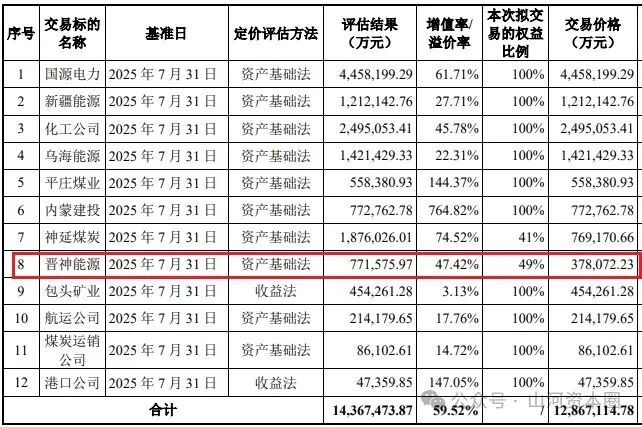
交易完成后,中国神华的煤炭保有资源量将提升至684.9亿吨,增长率达64.72%;煤炭可采储量将提升 至345亿吨,增长率达97.71%;煤炭产量将提升至5.12亿吨,增长率达56.57%;中国神华2024年每股收 益将提升至3.15元/股,增厚6.1%。2025年1月至7月每股收益提升至1.54元/股,增厚4.4%。 记者了解到,此次重组的核心价值在于实质性解决中国神华与国家能源集团长达二十年的同业竞争问 题,构建起更为完整的"煤—电—运—化"产业链闭环。通过集约化统一管理,企业将强化跨区域资源统 筹配置能力,提升能源保供关键时期的应急响应水平,切实履行央企保障国家能源安全的主体责任。 | 原号 | 交易标的 名称 | 基准日 | 定价评估方法 | 评估结果 (万元) | 增值率/ 澄价率 | 本次は 易的权益 | 交易价格 (万元) | | --- | --- | --- | --- | --- | --- | --- | --- | | | | | | | | 比例 | | | 1 | 国源电力 | 2025年7月31日 | 资产基础法 | 4.458,199.29 | 61.71% | 100% | ...
A股最大收购案!中国神华为何豪掷1336亿买了这些资产?
Xin Lang Cai Jing· 2025-12-21 03:31
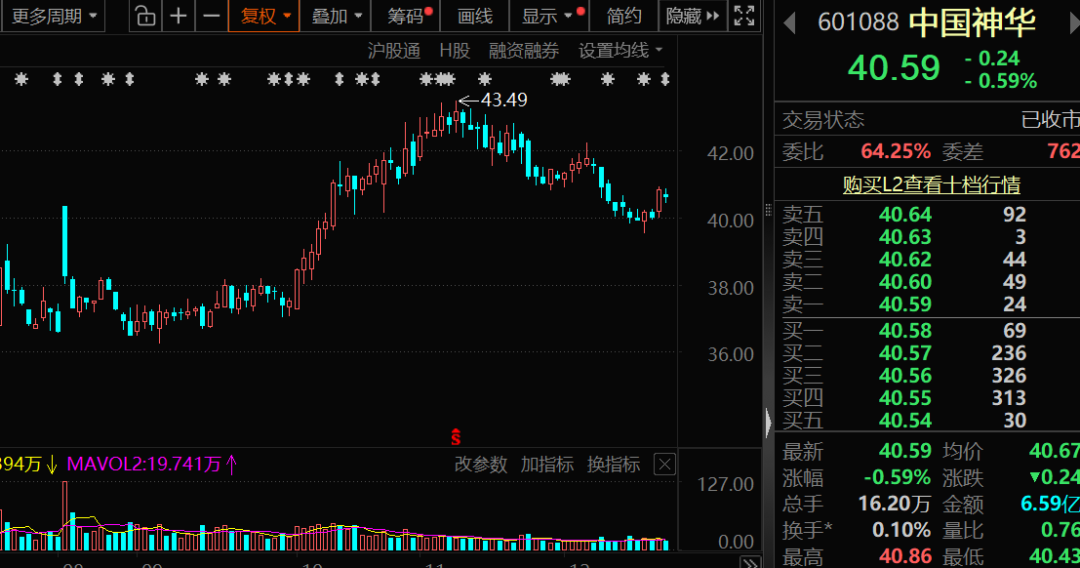
Core Viewpoint - China Shenhua (601088.SH) announced a significant acquisition plan to purchase assets worth 1,335.98 billion yuan from its controlling shareholder, China Energy Group, marking the largest acquisition in the A-share market to date [1]. Group 1: Acquisition Details - The acquisition involves 12 target companies across coal, coal power, coal chemical, shipping, and port sectors, with a payment structure of 30% in shares and 70% in cash [1]. - The assessed value of the target assets is 1,436.75 billion yuan, with a premium rate of 59.52% [3]. - The total assets of the acquired entities are projected to be 2,334.23 billion yuan, with a revenue of 1,139.74 billion yuan and a net profit of 94.28 billion yuan for the previous year [3]. Group 2: Financial Metrics - The acquisition's price-to-earnings (PE) ratio based on 2024's net profit is 14.2 times, comparable to China Shenhua's current PE of 15.49 times [4]. - Post-acquisition, China Shenhua's coal reserves will increase to 6.849 billion tons, a growth rate of 64.72%, while its recoverable coal reserves will rise to 3.45 billion tons, a 97.71% increase [5]. - The company's coal production capacity will reach 512 million tons, reflecting a 56.57% growth [5]. Group 3: Strategic Context - The acquisition aligns with China Energy Group's commitment to resolving industry competition issues, as outlined in previous agreements since 2005 [4]. - Following the restructuring of China Energy Group in 2017, the integration of assets into China Shenhua is expected to be completed by August 27, 2028 [4]. - The transaction is part of a broader trend of accelerating state asset securitization and is supported by recent regulatory encouragement for mergers and acquisitions in the capital market [11]. Group 4: Market Position and Performance - China Shenhua's total assets will reach 8,965.87 billion yuan post-transaction, with total liabilities increasing to 3,904.90 billion yuan, resulting in a debt-to-asset ratio rise from 25.11% to 43.55% [10]. - The company has faced declining revenues over the past four reporting periods, with a 16.57% year-on-year decrease in revenue for the first three quarters of 2025 [12]. - As of December 20, China Shenhua's stock price was 40.59 yuan, with a market capitalization of 8,064.63 billion yuan [12].
1336亿并购案落地!中国神华超级能源航母起航
Sou Hu Cai Jing· 2025-12-20 22:42
Group 1: Transaction Overview - China Shenhua has finalized a restructuring plan, acquiring 12 energy companies from its controlling shareholder for a total price of 133.598 billion yuan, marking the largest acquisition in A-share market history [1][5] - The acquisition will be financed primarily through cash, with 70% of the total price (approximately 93.519 billion yuan) paid in cash and 30% (around 40.080 billion yuan) through the issuance of shares [3] Group 2: Record Scale - The transaction's total price of 133.598 billion yuan surpasses previous record acquisitions, including China Shipbuilding's merger with China CSSC at 115.15 billion yuan and Guotai Junan's merger with Haitong Securities at 97.6 billion yuan [5] Group 3: Asset Composition - The acquired assets include key segments of the energy industry such as coal mining, coal power, coal chemical, and port logistics, covering 11 companies and one wholly-owned subsidiary [7] Group 4: Strategic Intent - The primary goal of the acquisition is to enhance the quality of the listed company and resolve long-standing issues of competition between China Shenhua and its controlling shareholder in coal resource development [9] Group 5: Synergy Effects - The restructuring is expected to strengthen the full industry chain synergy, allowing for a more resilient supply chain and reduced logistics costs through integrated operations [11] Group 6: Financial Impact - Post-acquisition, China Shenhua's coal reserves will increase from 41.58 billion tons to 68.49 billion tons, a 64.72% increase, while its coal production capacity will nearly double [13] Group 7: Capacity Expansion - The acquisition will also expand China Shenhua's power generation capacity from 47.632 million kilowatts to 60.881 million kilowatts, a growth of approximately 27.82% [15] Group 8: Shareholder Returns - China Shenhua has a strong track record of shareholder returns, with cumulative cash dividends reaching 491.9 billion yuan and an average dividend payout ratio exceeding 60% [17][18] Group 9: Review Process - The transaction qualifies for a simplified review process, which is expected to set a precedent for other state-owned enterprises in optimizing their asset structures through mergers and acquisitions [20] Group 10: Future Outlook - Following the transaction, the controlling shareholder's stake in China Shenhua will increase from 69.58% to 71.53%, enhancing control over the company and positioning it as a leading global energy player [22]

收购12家企业股权,中国神华实施千亿资产重组
Sou Hu Cai Jing· 2025-12-20 14:24
Core Viewpoint - China Shenhua announced a major asset restructuring plan to acquire equity stakes in 12 core enterprises under its controlling shareholder, China Energy Group, with a total transaction value of 133.598 billion yuan [1][6]. Group 1: Transaction Details - The acquisition involves issuing A-shares and cash payments for 100% equity stakes in several companies, including Guoyuan Power, Xinjiang Energy Chemical, and others, while also acquiring a 41% stake in Shanxi Jingshen Energy and a 49% stake in Shenyan Coal [1][2]. - The total assets of the target companies amount to 233.423 billion yuan, with a net asset value of 87.399 billion yuan as of July 31, 2025 [6]. Group 2: Strategic Importance - This transaction is a significant step for the company to address industry competition, optimize resource allocation, and enhance core competitiveness, which is crucial for strengthening national energy security and boosting market confidence [5]. - The restructuring will allow China Shenhua to integrate coal mining, coal power, coal chemical, and logistics services, significantly increasing its core business capacity and resource reserves [5]. Group 3: Financial Impact - Post-transaction, the company's coal reserves will increase to 6.849 billion tons, a growth rate of 64.72%, while the recoverable coal reserves will rise to 3.45 billion tons, reflecting a 97.71% increase [7]. - The basic earnings per share, excluding non-recurring gains and losses, are projected to increase to 3.15 yuan per share for 2024, representing a 6.10% enhancement [7][8].
601088,千亿级重大收购
Zheng Quan Shi Bao· 2025-12-20 14:18
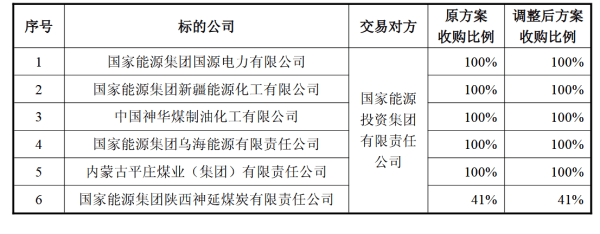
短短数周内,白银价格便开启了连续刷新纪录的上涨行情。 中国神华千亿级收购方案出炉 12月19日晚,煤炭行业龙头公司中国神华(601088)一口气发布了88则公告,其中主要内容为:中国神华拟购买国家能源集团及其全资子公司西部能源持 有的相关资产,交易价格高达1335.98亿元。公告称,公司拟收购控股股东国家能源集团旗下12家核心企业股权,业务覆盖煤炭、坑口煤电、煤化工等多 个领域。千亿元级的收购交易价格,在A股历史上并不多见。 国际银价突破67美元/盎司 根据公告披露,本次交易具体包括:中国神华通过发行A股股份及支付现金的方式购买国家能源集团持有的国源电力100%股权、新疆能源100%股权、化 工公司100%股权、乌海能源100%股权、平庄煤业100%股权、神延煤炭41%股权、晋神能源49%股权、包头矿业100%股权、航运公司100%股权、煤炭运 销公司100%股权、港口公司100%股权,并以支付现金的方式购买西部能源持有的内蒙建投100%股权;同时,中国神华拟向不超过35名特定投资者发行A 股股份募集配套资金。 公司表示,本次交易前后,公司控股股东均为国家能源集团,实际控制人均为国务院国资委;本次交易不会导致 ...
煤价分化炼焦煤企稳向上,神华千亿收购提升价值
ZHONGTAI SECURITIES· 2025-12-20 11:51
Investment Rating - The report maintains an "Overweight" rating for the coal industry [2][5]. Core Views - The coal market is expected to stabilize as supply tightens and demand rebounds, driven by seasonal factors and production adjustments [7][8]. - China Shenhua's acquisition of significant assets is projected to enhance its coal production capacity and resource reserves substantially [8]. - The investment strategy suggests a focus on undervalued stocks with high dividend yields and growth potential in the coal sector [8]. Summary by Sections 1. Industry Overview - The coal industry comprises 37 listed companies with a total market capitalization of 1,875.44 billion yuan and a circulating market value of 1,839.35 billion yuan [2]. 2. Coal Price Tracking - Recent trends indicate a divergence in coal prices, with coking coal stabilizing upwards while thermal coal prices are under pressure due to weak demand [7][8]. - As of December 19, 2025, the price of thermal coal at the port was 708 yuan/ton, reflecting a week-on-week decrease of 42 yuan/ton [8]. 3. Supply and Demand Dynamics - Coal production in November 2025 was 42,679 million tons, a year-on-year decrease of 0.5% but a month-on-month increase of 4.93% [7]. - The report highlights that the demand for electricity coal has been affected by warmer weather, leading to a decrease in daily coal consumption [7]. 4. Key Company Insights - China Shenhua's acquisition plan involves purchasing multiple coal and energy assets for a total consideration of 1,335.98 billion yuan, significantly increasing its coal production capacity by approximately 230 million tons per year [8]. - Other companies such as Yancoal Energy and Shanxi Coking Coal are also highlighted for their growth potential and dividend policies [13]. 5. Investment Recommendations - The report recommends a strategy of buying undervalued stocks with strong dividend yields, such as China Shenhua, Zhongmei Energy, and Xinji Energy, while also focusing on companies with significant production capacity growth [8][13].