
CHALCO(601600)

Search documents
共享基经丨与AI一起读懂ETF(十三):央企科技和央企科创主题,有何不同?
Mei Ri Jing Ji Xin Wen· 2025-05-08 02:08
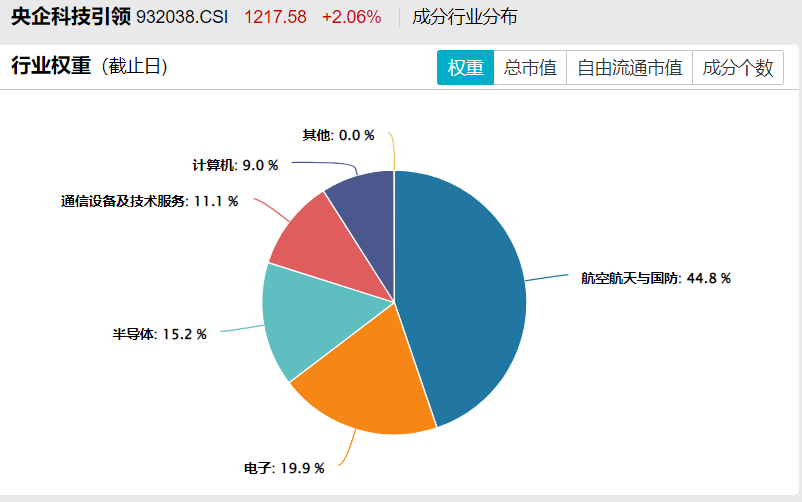
Core Viewpoint - The article discusses the differences and similarities between two indices related to central enterprise technology: the China Securities National New Central Enterprise Technology Leading Index and the China Securities Chengtong Central Enterprise Technology Innovation Index, highlighting their performance and characteristics in the context of recent market movements. Group 1: Differences Between the Indices - The China Securities National New Central Enterprise Technology Leading Index is customized by Guoxin Investment Co., Ltd., while the China Securities Chengtong Central Enterprise Technology Innovation Index is customized by China Chengtong Group [2]. - The selection methods differ: the National New Index scores based on net profit growth, revenue growth, total market capitalization, and R&D expenditure as a percentage of revenue, whereas the Chengtong Index evaluates based on the number and quality of patents and the implementation of equity incentives [3]. - Industry distribution varies significantly; the National New Index focuses heavily on aerospace and defense, electronics, and semiconductors, with a combined weight of nearly 80%, while the Chengtong Index has a more balanced distribution across telecommunications, aerospace and defense, and electronics, with the top five industries also exceeding 80% [4][6]. Group 2: Key Holdings and Performance - The top ten holdings of the National New Index account for 52.63% of the total, with Hikvision and AVIC Optoelectronics each exceeding 7% [8]. - In contrast, the Chengtong Index's top ten holdings represent 60.34% of the total, with China Telecom, Hikvision, and China Mobile each exceeding 7% [12]. - Historical performance shows that while the one-year returns of both indices are similar, the Chengtong Index outperforms the National New Index over three and five years, with the National New Index exhibiting higher volatility across all time frames [14]. Group 3: Valuation and Commonalities - As of now, the National New Index's TTM price-to-earnings ratio has risen to the historical 100th percentile, indicating a high valuation position [15]. - The Chengtong Index's TTM price-to-earnings ratio is also above the historical 80th percentile, suggesting a similarly high valuation, although its historical data is limited [17]. - Both indices select samples from listed companies under the State-owned Assets Supervision and Administration Commission, aim to reflect the overall performance of central enterprises in technology innovation, and emphasize that R&D expenditure as a percentage of revenue should not be less than 3% [20].




黄金:情绪缓和,现实恶化,继续看多金价
NORTHEAST SECURITIES· 2025-05-06 09:19
Investment Rating - The report maintains an "Outperform" rating for the non-ferrous metals sector [4] Core Viewpoints - The report indicates a bullish outlook on gold prices despite ongoing trade tensions and economic uncertainties, suggesting that the worst of market sentiment has passed and prices are expected to trend upwards [2][11] - For copper, the supply-demand dynamics remain tight, and there are opportunities for low-position equity investments despite short-term volatility [3][12] - The aluminum market is experiencing price fluctuations, with a focus on downstream inventory replenishment and the impact of macroeconomic factors [14] Summary by Sections 1. Weekly Research Insights - Gold prices are expected to remain volatile but trend upwards due to easing trade tensions and ongoing economic concerns [2][11] - Copper demand remains strong, with high operating rates in production and a supportive supply side despite recent disruptions [3][12] 2. Sector Performance - The non-ferrous metals index fell by 0.85%, underperforming the broader market [15] - The top-performing sub-sectors include rare earths and magnetic materials, while lithium and aluminum showed declines [15] 3. Metal Prices and Inventories 3.1. New Energy Metals - Cobalt prices are stable, while lithium prices have decreased, indicating a mixed market for these metals [25][28] 3.2. Base Metals - Base metal prices have generally declined, with specific price movements noted for copper, aluminum, zinc, lead, nickel, and tin [35][37] 3.3. Precious Metals - Gold prices increased by 0.8% to $3319 per ounce, while silver prices decreased by 2.1% to $32.83 per ounce [48][49]



9股获重要股东大手笔增持(附股)
Zheng Quan Shi Bao Wang· 2025-05-06 01:49
Summary of Key Points Core Viewpoint - In the recent five trading days (April 24 to April 30), significant shareholders of 17 companies increased their holdings, totaling 55.21 million shares and an investment of 474 million yuan, while 49 companies saw a reduction in holdings amounting to 4.909 billion yuan [1]. Group 1: Shareholder Activity - A total of 17 companies experienced significant shareholder increases, with a cumulative increase of 55.21 million shares and an investment of 474 million yuan [1]. - Among the companies with notable increases, Debon Holdings led with an increase of 9.5563 million shares and an investment of 13.132 million yuan, followed by China Aluminum with 17.3 million shares and 11.1 million yuan [1][2]. - The majority of the increased holdings were concentrated in the transportation and non-ferrous metals sectors, with 4 and 2 companies respectively [1]. Group 2: Market Performance - The average performance of stocks with increased holdings saw a decline of 0.71% over the five days, underperforming the Shanghai Composite Index during the same period [1]. - Notable gainers included Tongkun Co., with a rise of 3.13%, and Kangxin Materials, which increased by 2.02% [1][2]. - Conversely, stocks like Beibu Gulf Port and Debon Holdings experienced significant declines of 6.73% and 5.82% respectively [1][2]. Group 3: Fund Flow - Among the stocks with increased holdings, 9 experienced net inflows of main funds, with Renfu Pharmaceutical seeing the highest net inflow of 5.8 million yuan [2]. - In contrast, Beibu Gulf Port and Qiyi Er experienced the largest net outflows, with 205 million yuan and 61 million yuan respectively [2].


A股资金新动向!牛散爱算力,私募投材料
Zheng Quan Shi Bao Wang· 2025-05-05 04:42
Group 1: Investment Trends of Super Investors - Super investors in A-shares have shown a significant divergence in investment directions, with a focus on computing power and humanoid robots by individual investors, while billion-dollar private equity firms have concentrated on materials and resources sectors [1] - Notable individual investor Zhang Jianping has heavily increased his stake in computing power concepts, becoming a top shareholder in companies like Hangang Steel and Aofei Data, while also increasing his holdings in Cambrian [1] - Investor Ge Weidong has entered the top ten shareholders of Su Da Weige, holding 1.62 million shares valued at approximately 30 million yuan, indicating a strategic focus on micro-nano optical materials and communication industries [1] Group 2: Private Equity Movements - Over 20 billion-dollar private equity firms have appeared in the first quarter reports of listed companies, with firms like Gao Yi Asset and Xuan Yuan Private Equity being particularly active [3] - Gao Yi Asset has newly entered the top ten shareholders of companies such as Guoci Materials and China Aluminum, while increasing stakes in Longbai Group and Zijin Mining, and reducing holdings in Hikvision and Yangnong Chemical [3] - Xuan Yuan Private Equity has also made significant moves, entering the top ten shareholders of Huabao Co. and Stanley, while reducing positions in companies like Jidong Equipment [4] Group 3: Sector Focus and Company Highlights - The computing power and humanoid robot sectors are gaining traction among individual investors, with companies like Zhongjian Technology being highlighted as key players in the humanoid robot concept [1][2] - The materials and resources sectors are favored by private equity firms, with companies like Wolong Nuclear Materials receiving attention from multiple billion-dollar private equity products [4] - The first quarter has seen a notable increase in collaboration agreements between companies like Zhongding Co. and various robot enterprises, positioning Zhongding as a leader in the humanoid robot sector [2]




“五一”财报细读|有色金属行业:价格攀升驱动 多家龙头公司业绩亮丽
Zheng Quan Shi Bao· 2025-05-03 06:14
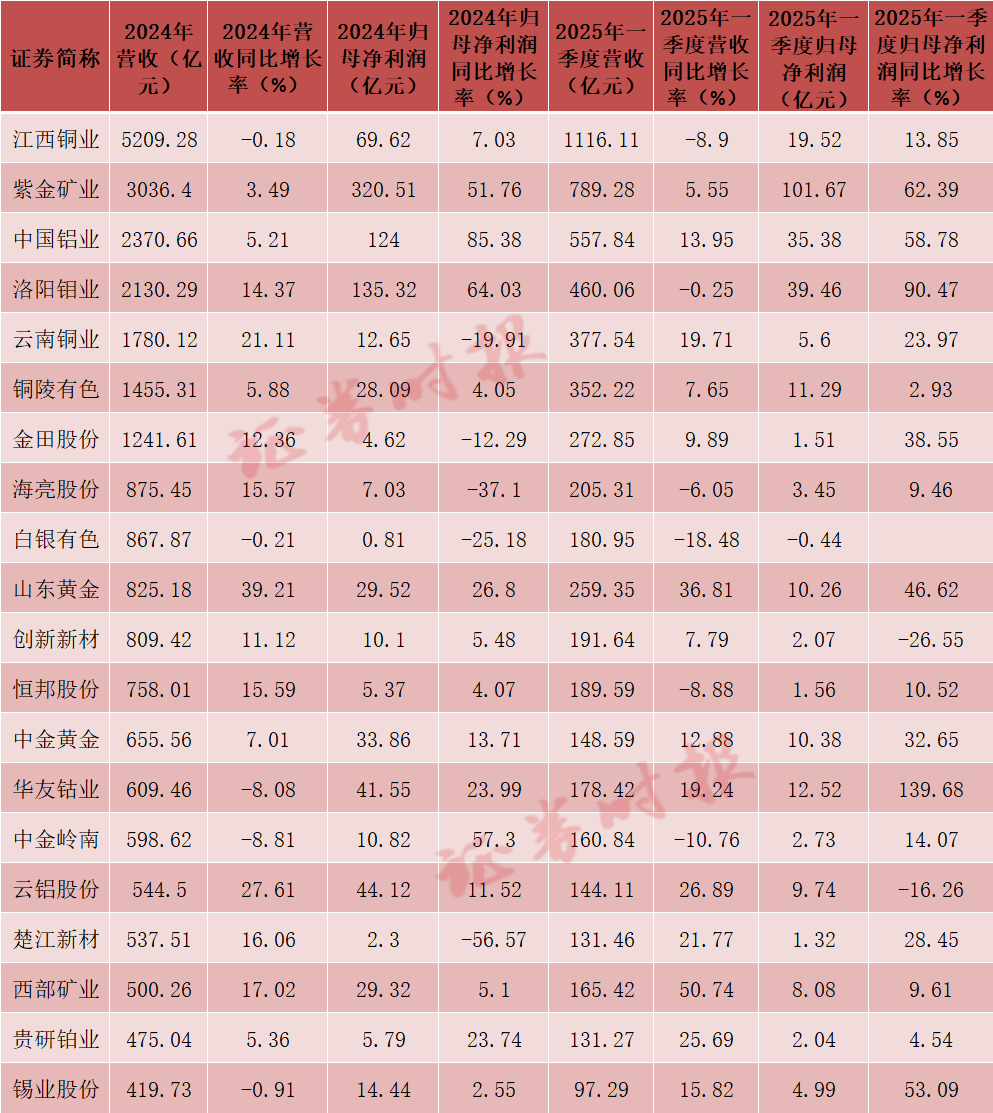
Core Viewpoint - The non-ferrous metal industry is experiencing significant growth driven by rising metal prices, with several leading companies reporting strong performance in 2024 and maintaining rapid growth in the first quarter of the year [1][2]. Group 1: Company Performance - Zijin Mining reported a revenue of approximately 303.64 billion yuan in 2024, a year-on-year increase of 3.49%, and a net profit attributable to shareholders of about 32.05 billion yuan, up 51.76% [2]. - In the first quarter of 2024, Zijin Mining achieved a revenue of 78.93 billion yuan, a 5.55% increase year-on-year, and a net profit of 10.17 billion yuan, reflecting a 62.39% growth [2]. - China Aluminum's revenue for 2024 reached 237.07 billion yuan, a 5.21% increase, with a net profit of 12.4 billion yuan, up 85.38% [2]. - In the first quarter of 2024, China Aluminum's revenue was 55.78 billion yuan, a 13.95% increase, and the net profit was 3.54 billion yuan, up 58.78% [2]. - Luoyang Molybdenum achieved a revenue of 213.03 billion yuan in 2024, a 14.37% increase, with a net profit of 13.53 billion yuan, up 64.03% [4]. - In the first quarter of 2025, Luoyang Molybdenum's revenue was 46.01 billion yuan, a slight decrease of 0.25%, while the net profit increased by 90.47% to 3.95 billion yuan [4]. Group 2: Industry Trends - The non-ferrous metal industry is benefiting from high prices of metals like gold and copper, leading to sustained high growth in revenues and profits for major companies [2][5]. - The market outlook for gold remains positive in the medium to long term, despite recent fluctuations, with expectations of a strong performance driven by inflation and weakening dollar credit [6][7]. - The copper market is expected to face a supply shortage in the medium term, with demand from sectors like home appliances and electric vehicles driving prices upward [7]. - The aluminum market is anticipated to improve, with a potential rise in prices due to recovering profits from electrolytic aluminum and increasing demand [7].
“五一”财报细读|有色金属行业:价格攀升驱动 多家龙头公司业绩亮丽
证券时报· 2025-05-03 05:59
Core Viewpoint - The non-ferrous metal industry has experienced significant growth in performance driven by rising metal prices, particularly in gold and copper [1][4]. Group 1: Industry Performance - The overall performance of the non-ferrous metal industry has shown high growth, with several listed companies maintaining rapid growth in Q1 2024 [2][4]. - Major companies like Zijin Mining, China Aluminum, and Luoyang Molybdenum have reported substantial increases in revenue and net profit for 2024 [4][6]. Group 2: Company Highlights - Zijin Mining achieved approximately 303.64 billion yuan in revenue for 2024, a year-on-year increase of 3.49%, with a net profit of about 32.05 billion yuan, up 51.76% [4][6]. - In Q1 2024, Zijin Mining's revenue was 78.93 billion yuan, growing by 5.55%, and net profit reached 10.17 billion yuan, an increase of 62.39% [4][6]. - China Aluminum reported 2024 revenue of 237.07 billion yuan, a 5.21% increase, and a net profit of 12.4 billion yuan, up 85.38% [4][6]. - Luoyang Molybdenum's revenue for 2024 was 213.03 billion yuan, a 14.37% increase, with a net profit of 13.53 billion yuan, up 64.03% [4][6]. Group 3: Market Outlook - Institutions remain optimistic about the long-term price trends of gold and copper, despite short-term fluctuations due to geopolitical factors [8][9][10]. - The copper market is expected to face a supply shortage, with demand from sectors like home appliances and electric vehicles driving prices upward [10]. - The aluminum market is anticipated to improve, with potential profit recovery for electrolytic aluminum as demand increases [10].

【全网最全】2025年铝加工行业上市公司全方位对比(附业务布局汇总、业绩对比、业务规划等)
Qian Zhan Wang· 2025-05-03 03:10
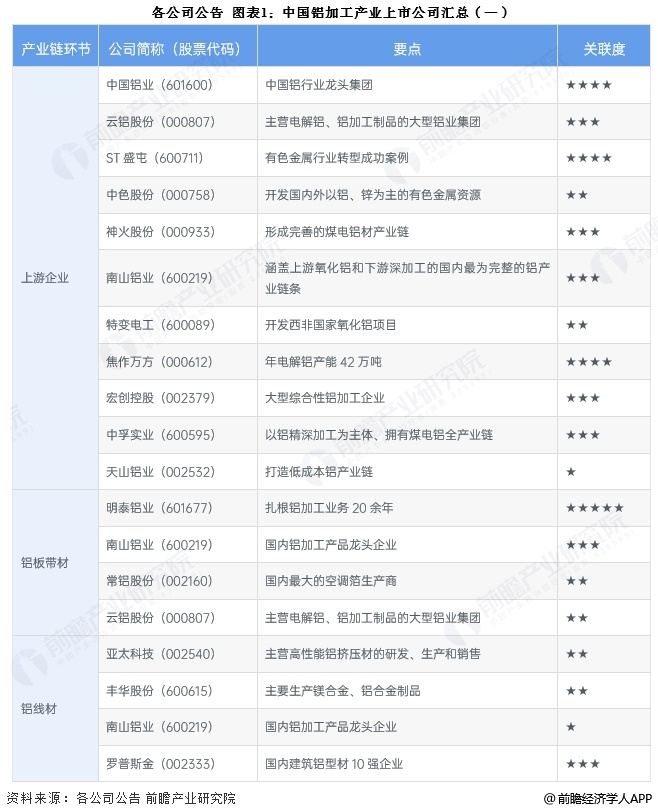
Group 1 - The aluminum processing industry involves the use of plastic processing methods to convert aluminum ingots into products such as aluminum profiles, plates, and foils [1] - Major upstream processes include the production of electrolytic aluminum and recycled aluminum, which require bauxite and alumina processing [1] - The aluminum processing products are widely used in various sectors including transportation, packaging, construction, aerospace, and electrical machinery [1] Group 2 - Key listed companies in the aluminum processing industry include Tianshan Aluminum (002532), Mingtai Aluminum (601677), China Aluminum (601600), and Nanshan Aluminum (600219) [2][3] - Mingtai Aluminum, Asia Pacific Technology, Nanshan Aluminum, Ding Sheng New Materials, and Hong Chuang Holdings have over 90% of their business focused on aluminum processing [8] - Domestic market sales dominate, with overseas sales being relatively small for most aluminum processing companies [8] Group 3 - In 2023, Mingtai Aluminum, Nanshan Aluminum, and Yun Aluminum reported revenues exceeding 20 billion yuan, with significant variations in gross margins due to the diversity of aluminum processing products [11] - The production output of aluminum processing products is led by Nanshan Aluminum, Mingtai Aluminum, and Yun Aluminum [11] - Companies are focusing on optimizing their business models and enhancing their technological capabilities to meet the growing demand for aluminum in high-end applications [13] Group 4 - Companies are planning to reduce upstream costs, accelerate technological research and development, and increase production capacity as part of their strategic initiatives [13] - Specific plans include Mingtai Aluminum's focus on recycling aluminum and enhancing product quality, while Nanshan Aluminum aims to develop high-end aluminum materials for the automotive and aerospace sectors [15][16] - The industry is expected to continue growing steadily, driven by the increasing application of aluminum in various sectors and the push for carbon neutrality [13]


2025“五一”后,会不会“煤飞色舞”?
Sou Hu Cai Jing· 2025-05-01 23:10
Core Viewpoint - The article discusses the cyclical nature and structural opportunities within the coal and non-ferrous metal sectors, highlighting the potential for a "coal flying and color dancing" market scenario, which refers to the simultaneous rise of coal and non-ferrous metal prices driven by macroeconomic factors and supply-demand dynamics [3][5]. Group 1: Market Performance - The coal and non-ferrous sectors have shown an overall upward trend since the A-share market began to recover in September 2024, despite some underperformance in specific futures [3]. - An example of strong performance is Anyuan Coal Industry, whose stock price rose from 1.8 yuan to 7.16 yuan by March 25, 2025, indicating a potential return to the "coal flying" era [3]. - In contrast, Shanxi Coking Coal has experienced a downward trend despite the overall market rise, reflecting the divergence in performance within the coal sector [3][4]. Group 2: Supply and Demand Dynamics - The coal market is influenced by three main factors: policy regulation (such as capacity reduction and environmental restrictions), seasonal demand (like winter heating), and energy transition (renewable energy substitution) [6]. - Non-ferrous metals are more sensitive to global industrial activity and monetary policy, with copper prices closely linked to manufacturing PMI and infrastructure investment growth [6]. - The article notes that the global copper mine production growth is expected to slow to 2% in 2025, while demand growth is projected at 3.5%, indicating a potential supply-demand imbalance [8]. Group 3: Economic Context - The global economy is experiencing a "weak recovery," with China's GDP growth at 5.4% in Q1 2025, driven by infrastructure investment and manufacturing upgrades [6]. - The International Monetary Fund (IMF) forecasts a global GDP growth rate of 3.2% for 2025, which is still below pre-pandemic levels, suggesting limited demand pull for commodities [6][7]. - The article emphasizes that a true "coal flying and color dancing" market requires a conducive environment, including global economic recovery, monetary easing, supply constraints, and geopolitical premiums [6][7]. Group 4: Investment Opportunities - Investors are encouraged to focus on sectors benefiting from the new energy revolution, such as rare earth magnets and copper foil, while avoiding those reliant solely on traditional industrial demand [9]. - The article suggests that for long-term investors willing to endure market fluctuations, identifying the right timing for bottom-fishing in the coal and non-ferrous sectors could be advantageous [9].


汇丰:中国铝业-买入 -表现平稳,无意外
汇丰· 2025-04-30 02:08
Investment Rating - The report maintains a "Buy" rating for Aluminum Corp of China (Chalco) H/A shares, with target prices adjusted to HKD6.10 for H-shares and RMB9.80 for A-shares, implying upside potentials of approximately 42% and 48% respectively [5][40]. Core Insights - Chalco reported a net profit after tax (NPAT) of approximately RMB3.5 billion in 1Q25, reflecting a 5% quarter-on-quarter increase and a 59% year-on-year increase, attributed to better-than-expected sales volume and average selling prices (ASP) for aluminum and alumina [1][9]. - The company expects capital expenditures of RMB14.8 billion in 2025, focusing on wind power projects and new alumina production sites, while aiming to increase green power usage from 47% in 2024 to 55% in 2025 [2][9]. - Despite solid fundamentals for aluminum, earnings are expected to decline by approximately 12% in 2025 due to lower alumina prices, with the alumina price already below breakeven levels [3][9]. Financial Performance - In 1Q25, Chalco's sales volumes for self-produced aluminum decreased by 5% quarter-on-quarter, while alumina sales increased by 6% quarter-on-quarter. However, revenue and gross profits fell by 12% and 29% quarter-on-quarter respectively due to a significant drop in alumina prices [1][31]. - The company recorded a decrease in selling, general and administrative (SG&A) expenses by 6% year-on-year and 66% quarter-on-quarter, indicating effective cost control [1][31]. - Investment income rose by RMB0.37 billion in 1Q25, driven by higher alumina prices year-on-year and gains from hedging [36]. Production and Operational Strategy - Chalco's aluminum production operating rate reached 95% in China, supported by demand from electric vehicles, batteries, and solar products [3][9]. - The company plans to relocate alumina production from inland to coastal provinces to reduce transportation costs and expects to close down 1-2 million tons of alumina production in 2025 [2][34]. - Chalco aims to optimize its alumina capacity of 25 million tons by utilizing lower-cost imported bauxite, which may lead to some impairment losses [34]. Market Outlook - The report anticipates steady aluminum prices in 2025, supported by robust demand from the "New Three" sectors, while alumina prices are expected to have limited downside due to their current low levels [3][9]. - The coal price and electricity costs remained weak in 1Q25, which may benefit Chalco's operational costs [3][9].
中国铝业(601600) - 中国铝业关于控股股东及其一致行动人增持公司股份的进展公告
2025-04-29 15:54
股票代码:601600 股票简称:中国铝业 公告编号:临 2025-027 中国铝业股份有限公司(以下简称"公司")于 2025 年 4 月 9 日披露了《中国 铝业股份有限公司关于控股股东及其一致行动人增持公司股份计划的公告》(公告 编号:临 2025-022),基于对公司未来发展前景的信心,并为切实维护中小投资者 利益,公司控股股东中国铝业集团有限公司(以下简称"中铝集团")及其一致行 动人拟通过上海证券交易所(以下简称"上交所")及香港联合交易所有限公司(以 下简称"香港联交所")交易系统增持公司 A 股及 H 股股份,增持金额不低于人民 币 10 亿元,不超过人民币 20 亿元,增持股份数量不超过公司总股本的 2%,期限自 本次增持计划公告披露之日起不超过 12 个月,本次增持资金来源为增持主体自有资 金或金融机构增持股票专项贷款(以下简称"专项贷款")。 公司于 2025 年 4 月 29 日收市后收到控股股东中铝集团的通知,截至 2025 年 4 月 29 日,中铝集团及其一致行动人通过上交所及香港联交所交易系统以自有资金和 专项贷款累计增持公司 A 股股份 53,971,083 股,增持金额约人 ...