China Life(601628)

Search documents
固原金融监管分局同意中国人寿西吉支公司吉强营销服务部变更营业场所
Jin Tou Wang· 2025-09-24 09:00
二、中国人寿保险股份有限公司应按照有关规定及时办理变更及许可证换领事宜。 中国人寿 中国人寿 分时图 日K线 周K线 月K线 38.01 0.06 0.16% 0.63% 0.42% 0.21% 0.00% 0.21% 0.42% 0.63% 37.71 37.79 37.87 37.95 38.03 38.11 38.19 09:30 10:30 11:30/13:00 14:00 15:00 0 7万 14万 21万 2025年9月16日,固原金融监管分局发布批复称,《关于变更中国人寿(601628)保险股份有限公司西 吉支公司吉强营销服务部营业场所地址的请示》(国寿人险宁发〔2025〕93号)收悉。经审查,现批复 如下: 一、同意中国人寿保险股份有限公司西吉支公司吉强营销服务部将营业场所变更为:宁夏回族自治区固 原市西吉县吉强西街(回小西侧)幸福佳苑住宅小区13-2号商业楼101铺-102铺2楼。 ...

中国人寿、人保健康、太保产险、太平人寿等2025年上半年保险公司短期健康险的综合赔付率均超50%
Jing Ji Guan Cha Wang· 2025-09-24 09:00
Group 1 - The comprehensive payout ratio is an important indicator of the protection level of insurance products, with higher values indicating more compensation received by consumers [1] - Companies such as China Life, PICC Health, Taiping Property & Casualty, Taiping Life, PICC Life, and AXA Tianping have short-term health insurance comprehensive payout ratios exceeding 50% [1] - The median comprehensive payout ratio for short-term health insurance among 120 insurance companies is only 42.12%, with an average of 45% after excluding extreme values, which is considered low by industry professionals [2] Group 2 - Industry professionals suggest that a comprehensive payout ratio between 50% and 70% for short-term health insurance is more reasonable, as it ensures consumer experience and supports the stable operation of insurance companies [2]
15家企业跻身“万亿俱乐部” 前十首现民营互联网企业
Xin Jing Bao· 2025-09-24 08:50
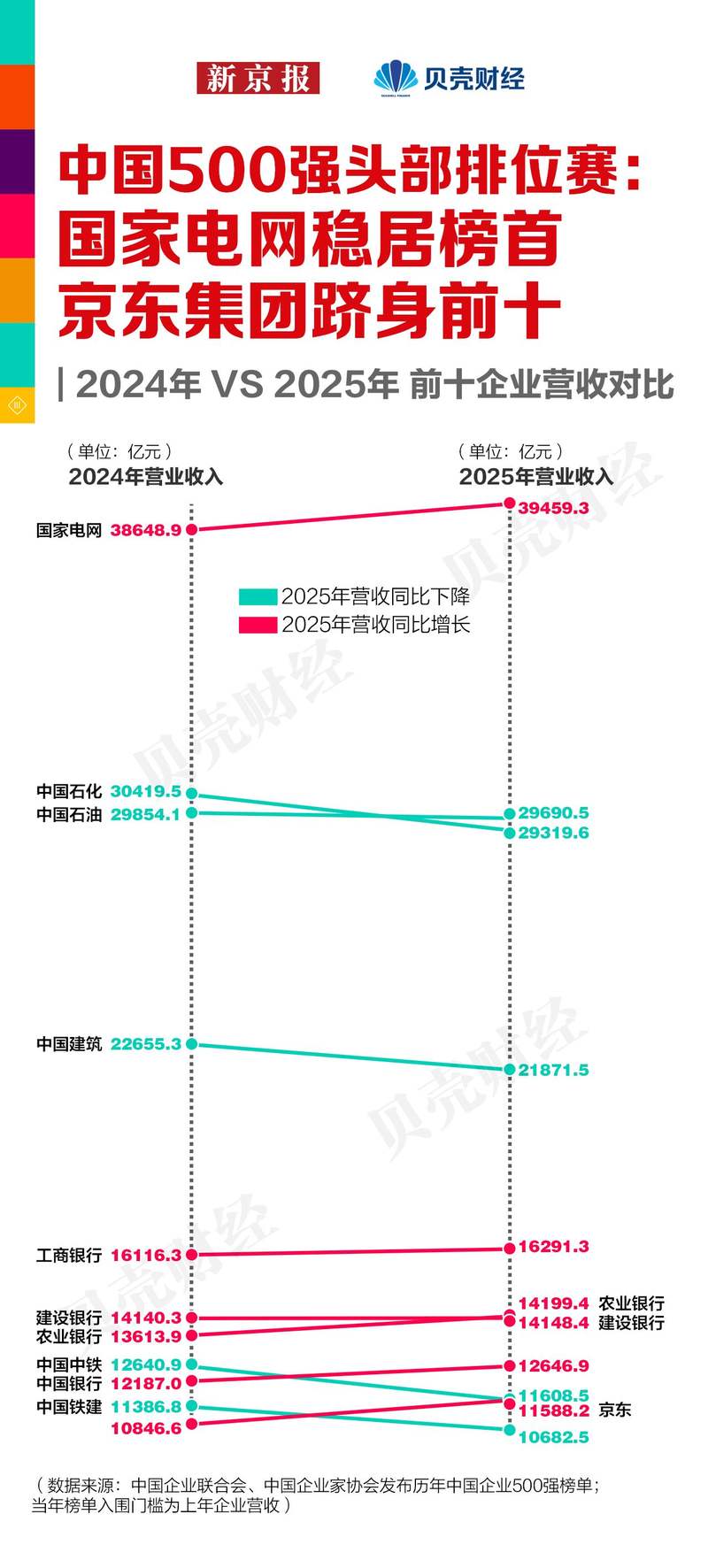
Group 1 - The threshold for entering the 2025 China Top 500 Enterprises list has increased to 47.96 billion yuan, marking a year-on-year rise of 579 million yuan, setting a new record [2] - A total of 15 companies have entered the "trillion yuan club" in 2025, indicating the substantial scale of leading enterprises, with energy and finance remaining the most stable sectors [2][8] - The top three companies by revenue are State Grid, China Petroleum, and Sinopec, collectively surpassing 900 billion yuan in revenue [2][3] Group 2 - Among the top ten companies, four experienced a decline in revenue compared to the previous year, with fluctuations in energy prices and demand impacting performance [3] - China Petroleum and Sinopec both saw rapid revenue growth in 2022-2023, exceeding 300 billion yuan, but are projected to decline to approximately 290 billion yuan in 2024-2025 [3][6] - JD Group has entered the top ten for the first time, while China Railway Construction has dropped to 11th place, with a revenue gap of 20.14 billion yuan between them in 2024 [3][8] Group 3 - The four major banks have shown continuous revenue growth, with Industrial and Commercial Bank of China leading the financial sector with a revenue of 1.63 trillion yuan in 2025 [7] - Agricultural Bank of China surpassed China Construction Bank in 2025, becoming one of the highest-grossing state-owned banks [7] - China Ping An's revenue has fluctuated, recovering to 1.14 trillion yuan in 2025 after a decline since 2021, while China Life surpassed 1.15 trillion yuan in the same year [7] Group 4 - The number of companies in the "trillion yuan club" has significantly increased from 8 in 2021 to 15 in 2025, reflecting a more diversified membership structure [8] - Traditional sectors such as energy, infrastructure, and finance maintain their stronghold, while emerging industries and the digital economy are gradually reshaping the landscape [8]






保险业AI进行时:业务核心环节已渗透,“价值创造”深水区未至
Xin Lang Cai Jing· 2025-09-24 08:46
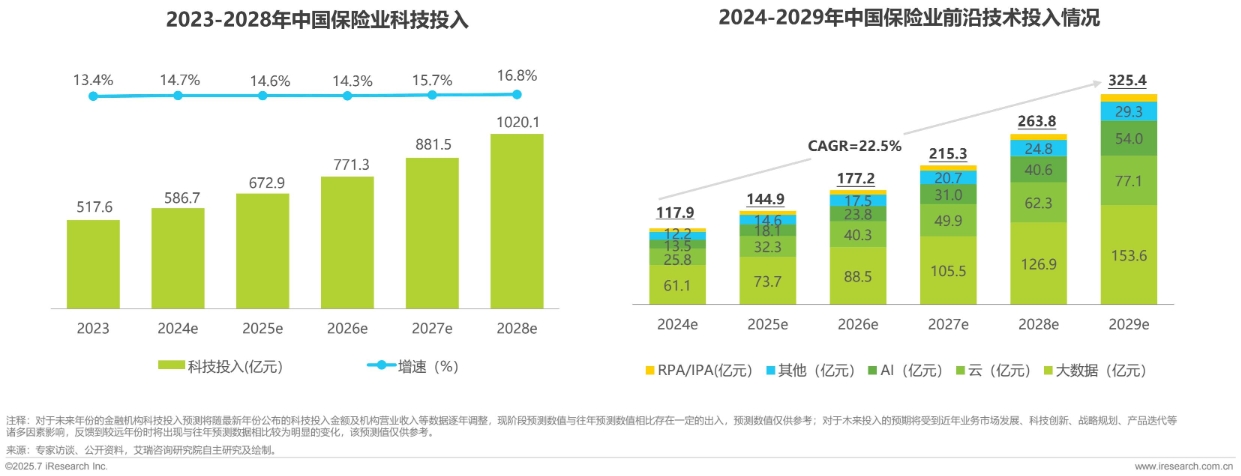
Core Insights - The insurance industry is rapidly adopting AI technologies, with a strategic shift from "ALL in AI" to "AI in ALL" becoming evident this year [1][2] - McKinsey estimates that generative AI could generate productivity gains of up to $70 billion for the insurance sector and $260 billion for the closely related health and wellness industry [2] - The year 2025 is projected to be a turning point for AI applications in the insurance industry, enhancing the capabilities of insurance professionals and automating repetitive tasks [2] Industry Investment and Growth - According to iResearch, total technology investment in the insurance industry is expected to exceed 67 billion yuan by 2025, with a compound annual growth rate of 22.5% [3] - The investment structure is heavily focused on cutting-edge technologies such as big data, cloud computing, and AI, which will optimize business models and drive digital transformation [3] AI Integration in Business Processes - AI has penetrated core business processes in the insurance sector, enhancing customer interaction, underwriting, claims processing, and fraud detection [6][8] - Major insurance companies like China Life, Ping An, and China Pacific Insurance have reported significant improvements in operational efficiency and customer service through AI applications [8][9] Performance Metrics - China Life's digital underwriting has achieved a 95.8% automation rate, while Ping An's instant underwriting accounts for 94% of its policies [10] - Claims automation rates have reached 16% for China Pacific, with a 99% accuracy rate in liability determination [11] - AI-driven sales support has generated 661.57 billion yuan in sales for Ping An, with an 18% increase in policy renewal rates [10] Challenges and Limitations - Despite advancements, the overall progress of AI in the insurance industry remains slow, with only a few leading companies fully implementing AI solutions [12][13] - Data quality, privacy concerns, and the need for continuous model iteration are significant barriers to broader AI adoption [13][14] - The complexity of insurance operations and the high costs associated with training AI models hinder smaller companies from leveraging AI effectively [14] Future Outlook - The future of AI in insurance is expected to drive integration with health management and retirement services, creating new "product + service" models [15] - By 2026, it is predicted that 15% of insurance companies will appoint AI coordinators to enhance the success rate of generative AI projects [15] - The industry is anticipated to see a significant shift towards digital self-service interactions, improving customer satisfaction and operational efficiency [15]



2025年亚洲品牌500强发布 中国入选品牌最多
Xin Hua Cai Jing· 2025-09-24 08:28
Group 1 - The core viewpoint of the report is that the 2025 Asia Brand 500 list features brands from 20 countries and regions, with Toyota, State Grid, and Samsung occupying the top three positions [1] - China has the highest representation with 217 brands, accounting for 43.40% of the total, followed by Japan with 129 brands and South Korea with 45 brands [1] - The report indicates a shift in global consumer trends, with increases in the number of brands from the finance, automotive, and retail sectors, while information technology, media, and food and beverage sectors saw declines [1] Group 2 - The finance sector has the most brands represented, totaling 71, followed by information technology with 49, media with 44, food and beverage with 41, and automotive with 28 [1] - Consumer loyalty varies significantly across countries, with Japanese consumers showing the highest loyalty at 84%, followed by South Korea at 73%, and mainland China at 71%, which has increased from 36% over the past decade [2]



银保渠道崛起!低利率时代,险企如何深耕实现业务增长?
Huan Qiu Wang· 2025-09-24 05:20
Core Insights - The life insurance industry is undergoing significant changes due to a continuous decline in preset interest rates and the implementation of the "reporting and operation integration" policy, leading to a shift towards a transparent fee structure and a focus on dividend insurance products [1][4]. Group 1: Sales Channel Dynamics - The bancassurance channel has seen a substantial transformation, with major insurance companies reporting significant growth in premium income from this channel. For instance, China Life's bancassurance premiums reached 72.44 billion yuan, a year-on-year increase of 45.7% [2]. - In the first half of 2025, New China Life's bancassurance premiums totaled 46.19 billion yuan, up 65.1%, while Taiping Life's premiums grew by 82.6% to 41.66 billion yuan [2]. - The individual insurance channel's performance has lagged, with some companies experiencing a decline in new business volume, highlighting the need for large insurers to reassess the value of the bancassurance channel [2][4]. Group 2: New Business Value - New business value, a key indicator of an insurance company's profitability and sustainability, has shown remarkable growth in the bancassurance channel, with companies like Taiping Life and New China Life reporting over 100% year-on-year growth in this area [3]. - The contribution of new business value from the bancassurance channel for New China Life and People’s Insurance has exceeded 50%, indicating its critical role in overall business performance [3]. Group 3: Product Strategy - The decline in product attractiveness due to lower interest rates has prompted insurers to adjust their product structures, with dividend insurance emerging as a strategic option due to its combination of guaranteed and floating returns [6]. - Dividend insurance is particularly suited for the bancassurance channel, as it aligns with customer preferences for stable returns and is easier for bank staff to sell compared to more complex products [8]. Group 4: Challenges for Smaller Insurers - Smaller insurers face heightened challenges in the current environment, struggling to compete for bancassurance resources due to the transparency of fees and the preference of banks for larger, more established companies [9]. - To navigate these challenges, smaller insurers are encouraged to focus on product differentiation, establish exclusive partnerships with regional banks, and leverage digital tools to enhance channel efficiency [9]. Group 5: Strategic Recommendations - The bancassurance channel is seen as a vital growth engine, complementing the individual insurance channel, which requires a professional transformation to enhance customer experience [10]. - Insurers are advised to promote multi-channel collaboration, ensuring that both bancassurance and individual channels work synergistically to maximize market potential [10].

防贫保险:织密防返贫防线
Jin Rong Shi Bao· 2025-09-24 04:51
Core Insights - The implementation of "anti-poverty insurance" by China Life Insurance in Chongzuo aims to prevent large-scale poverty return by providing a dynamic monitoring mechanism for at-risk populations [1][2] - By the end of 2023, 31 insurance institutions have collaborated with local governments to launch anti-poverty insurance, significantly contributing to the consolidation of poverty alleviation achievements [2][3] Group 1: Anti-Poverty Insurance Initiatives - The "anti-poverty insurance" project has monitored over 20,000 individuals and provided compensation exceeding 15.78 million yuan to nearly 1,300 eligible farmers [1] - The insurance covers multiple risks including illness, education, natural disasters, and accidents, enhancing the risk resilience of rural populations [2][3] Group 2: Policy and Market Integration - The integration of government guidance and market operations in anti-poverty insurance is being replicated in regions like Guangxi, Yunnan, and Gansu, expanding the coverage of protection [3] - The implementation of the "Implementation Plan for High-Quality Development of Inclusive Finance in Banking and Insurance" emphasizes the need for insurance companies to develop affordable and accessible insurance products for vulnerable groups [3]

中国人寿财险助力云南打好高原特色农业王牌
Zhong Guo Jin Rong Xin Xi Wang· 2025-09-24 02:31
Group 1 - The company plays a crucial role in supporting the agricultural sector in Yunnan Province through comprehensive insurance services, focusing on key industries such as grain, livestock, and cash crops [2][3] - In 2023, the company has taken on insurance responsibilities exceeding 389 billion yuan, with compensation payments surpassing 1 billion yuan, benefiting over 66,000 farming households [2] - The company has developed various insurance products, including planting insurance for flowers and rubber, and innovative offerings like meteorological index insurance for coffee, enhancing risk management for farmers [3] Group 2 - The company is committed to improving agricultural insurance models and services, aiming to help farmers mitigate risks from natural disasters and market fluctuations, thereby creating a stable production environment [3] - The company has implemented a "insurance + risk reduction services + technology" model, providing services such as hail prevention and forestry risk reduction to support ecological safety [3] - To bolster rural infrastructure, the company offers engineering and property insurance for projects like rural roads and water facilities, and has introduced logistics insurance to reduce transportation risks for agricultural products [3][4] Group 3 - The company aims to empower the transformation and upgrading of Yunnan's highland characteristic agriculture through innovative insurance products, precise risk management, and efficient claims services [4] - The company is focused on enhancing the value chain of highland characteristic agriculture, promoting industry growth, corporate efficiency, and increasing income for the local population [4]
平均赔付率45%,你买的短期健康险真的赔到了吗?
经济观察报· 2025-09-24 02:30
Core Viewpoint - The comprehensive claim ratio of short-term health insurance in the industry is low, with a median of 42.12% and an average of 45%, indicating insufficient consumer protection and trust in insurance companies [1][3][4]. Summary by Sections Comprehensive Claim Ratio - The comprehensive claim ratio is a crucial indicator of insurance product protection, with a higher value indicating more payouts to consumers [4]. - The current ratio of around 45% is considered low, with industry professionals suggesting a more reasonable range of 50%-70% for better consumer experience and sustainable operations [4][11]. Trends Over Time - From 2023 to the first half of 2025, the median claim ratio for life insurance companies increased from 38.83% to 42.12%, while for property insurance companies, it rose from 38.70% to 42.30% [6]. - Among the insurers reporting data, 11 had negative claim ratios, and 9 exceeded 100%, with 44 companies falling between 0%-40% and 33 between 40%-60% [6]. Company Performance - Major insurers like China Life, Ping An Health, and others have claim ratios above 50%, while companies like Zhong An Insurance and Tai Kang Online have significantly lower ratios [11]. - The disparity in claim ratios among companies is influenced by their product focus, with those offering broader coverage typically having higher ratios [14]. Cost Structure and Profitability - Low claim ratios do not necessarily equate to high profits for insurance companies, as high operational costs can offset potential gains [13]. - The competitive landscape for acquiring customers, especially through digital channels, has led to increased costs, impacting claim ratios [13]. Market Dynamics - The importance of commercial health insurance is growing, especially with reforms in payment methods that open new opportunities for development [16]. - The current short-term health insurance products primarily cover out-of-pocket expenses after basic insurance reimbursements, often with high deductibles [16]. Future Outlook - There is a recognized need to improve the claim ratio by at least 20 percentage points to enhance consumer satisfaction and trust [16]. - Strategies to increase consumer engagement and expand coverage are being explored, including targeting sub-healthy and sick populations [18][19]. - Government initiatives to support group health insurance purchases may provide a significant boost to the commercial health insurance market [20].




A股“老登”持股曝光,敢不敢对号入座
第一财经· 2025-09-24 02:08
Core Viewpoint - The article discusses the significant divergence in stock market performance between traditional "old stocks" (represented by sectors like liquor, real estate, and coal) and "new stocks" (focused on technology sectors such as AI and semiconductors) in 2023, highlighting a shift in investor sentiment and market dynamics [2][9]. Group 1: Market Performance Overview - As of September 23, 2023, the Shanghai Composite Index has risen by 14.02%, with technology sectors like SW Communication and SW Electronics showing remarkable gains of 103% and 93% respectively, while traditional sectors like SW Coal and SW Food & Beverage have declined by 1.82% and 0.78% [2][3]. - The article notes that many traditional blue-chip stocks have underperformed, with 16 out of 21 stocks in the SW liquor sector experiencing price declines this year, including a 3.16% drop in Kweichow Moutai [5][6]. Group 2: Individual Stock Performance - Notable "new stocks" include Cambricon Technologies (688256.SH), which has seen a price increase of 105.22%, and other companies in the AI sector like NewEase (300502.SZ) and Zhongji Xuchuang (300308.SZ), with annual gains of 329% and 253% respectively [4][6]. - In contrast, several "old stocks" such as Haitian Flavoring (603288.SH) and Gree Electric (000651.SZ) have reported declines of 12.68% and 6.96% respectively, despite some of these companies showing double-digit profit growth in the first half of the year [5][6]. Group 3: Investment Philosophy and Market Sentiment - The article highlights a growing divide between "old stock" investors, who favor value investing based on stable cash flows and dividends, and "new stock" investors, who are more focused on growth potential in technology sectors [9][10]. - The current market sentiment is characterized by a trend-driven investment approach, with younger investors and quantitative funds favoring short-term trends, leading to extreme sector divergence [10].