PSBC(601658)

Search documents
邮储银行(601658):2025年半年报点评:非息贡献增长,营收利润增速转正
Dongxing Securities· 2025-09-05 09:22
Investment Rating - The report maintains a "Strong Buy" rating for Postal Savings Bank of China (601658.SH) [9] Core Views - The bank's revenue and net profit growth turned positive in the first half of 2025, with revenue at CNY 179.45 billion and net profit at CNY 49.23 billion, reflecting year-on-year increases of 1.5% and 0.8% respectively [1] - Non-interest income significantly contributed to revenue growth, with a 25.2% year-on-year increase in other non-interest income, while net interest income saw a decline of 2.7% [2] - The bank's asset quality remains stable, with a non-performing loan (NPL) ratio of 0.92% as of June 2025, showing a slight increase from the previous quarter [5] Summary by Sections Financial Performance - In 1H25, the bank's revenue grew by 1.5% year-on-year, with a sequential improvement of 1.6 percentage points from 1Q25 [2] - The bank's net interest income decreased by 2.7% year-on-year, but the decline was less severe compared to previous periods [2] - Other non-interest income surged by 25.2%, driven by a recovery in the bond market and increased trading gains, with investment income rising by 64.6% [2] Loan Growth - As of June 2025, the bank's total assets and loans increased by 10.8% and 10.1% year-on-year, respectively, outpacing state-owned banks [3] - Corporate loans grew by 14.8%, while retail loans saw a modest increase of 1.9% [3] Interest Margin - The net interest margin (NIM) for 1H25 was 1.7%, down 17 basis points from 2024, with a year-on-year decline of 21 basis points [4] - The bank's deposit and interest-bearing liabilities interest rates decreased by 21 basis points compared to 2024, but the decline was less than the average of the five major banks [4] Asset Quality - The NPL ratio stood at 0.92% as of June 2025, with a slight increase of 1 basis point from the previous quarter [5] - The bank's provision coverage ratio was 260.4%, indicating a strong buffer against potential loan losses [5] Future Outlook - The report forecasts a net profit growth of 1.5%, 2.8%, and 3.8% for 2025, 2026, and 2027, respectively, with corresponding book value per share (BVPS) estimates of CNY 7.59, CNY 8.12, and CNY 8.20 [9][10]

国有大型银行板块9月5日跌2.12%,邮储银行领跌,主力资金净流出6.32亿元
Zheng Xing Xing Ye Ri Bao· 2025-09-05 08:56
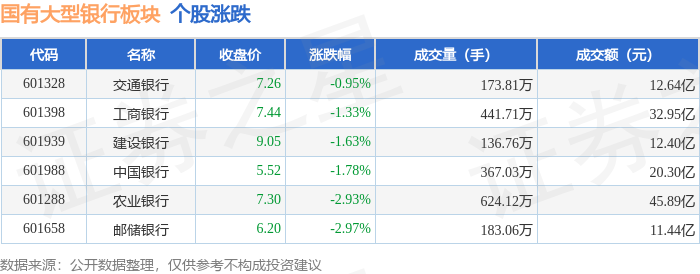
Core Viewpoint - The state-owned large banks sector experienced a decline of 2.12% on September 5, with Postal Savings Bank leading the drop, while the overall market indices showed an increase [1] Group 1: Market Performance - The Shanghai Composite Index closed at 3812.51, up 1.24% - The Shenzhen Component Index closed at 12590.56, up 3.89% [1] Group 2: Individual Bank Performance - Postal Savings Bank (601658) closed at 6.20, down 2.97% with a trading volume of 183.06 million and a turnover of 1.144 billion - Agricultural Bank of China (601288) closed at 7.30, down 2.93% with a trading volume of 624.12 million and a turnover of 4.589 billion - Industrial and Commercial Bank of China (601398) closed at 7.44, down 1.33% with a trading volume of 441.71 million and a turnover of 3.295 billion - China Construction Bank (601939) closed at 9.05, down 1.63% with a trading volume of 136.76 million and a turnover of 1.240 billion - Bank of China (601988) closed at 5.52, down 1.78% with a trading volume of 367.03 million and a turnover of 2.030 billion - Bank of Communications (601328) closed at 7.26, down 0.95% with a trading volume of 173.81 million and a turnover of 1.264 billion [1] Group 3: Fund Flow Analysis - The state-owned large banks sector saw a net outflow of 632 million from main funds, while retail funds experienced a net inflow of 71.03 million - The sector attracted a net inflow of 561 million from speculative funds [1][2] Group 4: Detailed Fund Flow for Individual Banks - Postal Savings Bank: Main funds net outflow of 32.03 million, speculative funds net inflow of 35.16 million, retail funds net outflow of 3.13 million - Industrial and Commercial Bank: Main funds net outflow of 54.24 million, speculative funds net inflow of 27.76 million, retail funds net inflow of 26.48 million - Bank of China: Main funds net outflow of 54.66 million, speculative funds net inflow of 101 million, retail funds net outflow of 46.28 million - China Construction Bank: Main funds net outflow of 95.08 million, speculative funds net inflow of 58.67 million, retail funds net inflow of 36.41 million - Bank of Communications: Main funds net outflow of 149 million, speculative funds net inflow of 116 million, retail funds net inflow of 33.23 million - Agricultural Bank: Main funds net outflow of 247 million, speculative funds net inflow of 223 million, retail funds net inflow of 24.33 million [2]





FICC日报:美债市场波动加剧,关注美国8月非农数据-20250905
Hua Tai Qi Huo· 2025-09-05 08:34
Report Industry Investment Rating No relevant content provided. Core Viewpoints - The volatility in the US Treasury market has intensified, and attention should be paid to the US non - farm payroll data for August [2]. - The Fed is expected to restart the easing cycle, and Powell's dovish stance paves the way for a September rate cut in the US, making the path of overseas inflation rise smoother [2]. - For commodities and stock index futures, it is advisable to allocate more industrial products on dips [4]. Summaries by Related Catalogs Market Analysis - In August, there were initial signs of rising overseas inflation. Global economic data in July remained resilient. China's exports in July increased by 7.2% year - on - year in US dollars, higher than expected. Domestic monthly economic data still faced pressure, with investment data under significant pressure [2]. - The A - share market on September 4 was in a volatile adjustment throughout the day, with the ChiNext Index leading the decline and the STAR 50 Index falling nearly 6%. Stocks fell more than they rose, with nearly 3000 stocks in the Shanghai, Shenzhen, and Beijing stock markets closing down [2][5]. - In the US, the ISM manufacturing index in August contracted for the sixth consecutive month, new orders improved, and the price index declined again. The US trade deficit in July widened to a four - month high [2]. Commodity Analysis - The domestic supply - side is most sensitive to the black and new energy metal sectors. Overseas inflation expectations can focus on precious metals and agricultural products [3]. - The black sector is still dragged down by downstream demand expectations. The supply limitation in the non - ferrous sector has not been alleviated. The energy supply is expected to be relatively loose in the medium - term. In the chemical sector, the "anti - involution" space of some varieties is worthy of attention [3]. - Agricultural products are driven by short - term tariffs and inflation expectations, but they still need signals from the fundamentals and attention to the disturbances brought by Sino - US negotiations [3]. Strategy - For commodities and stock index futures, it is recommended to allocate more industrial products on dips [4]. Important News - On September 4, the A - share market had more falling stocks than rising stocks. The trading volume exceeded 2.58 trillion yuan. The Shanghai Composite Index fell 1.25%, the Shenzhen Component Index fell 2.83%, and the ChiNext Index fell 4.25%. Financial stocks such as securities and banks were active [5]. - The Trump administration asked the Supreme Court to quickly decide whether he has the right to impose extensive tariffs. The Supreme Court may make a ruling in the summer of 2026 [5]. - The Fed's Beige Book showed that consumer spending was flat or declined, and prices rose in all districts [2]. - The US ADP employment in August increased by 54,000, lower than the market expectation of 65,000 [5]. - Trump's nominee for the Fed governor, Miran, said in the hearing that the Fed's main responsibility is to prevent economic depression and inflation, and he plans to maintain the independence of the FOMC [5].

超4800只个股上涨
第一财经· 2025-09-05 07:59
Core Viewpoint - The article highlights a significant rally in the Chinese stock market on September 5, with major indices experiencing substantial gains, indicating a positive market sentiment and potential investment opportunities in various sectors [2][3]. Market Performance - The Shanghai Composite Index closed at 3812.51 points, up 1.24% - The Shenzhen Component Index closed at 12590.56 points, up 3.89% - The ChiNext Index closed at 2958.18 points, up 6.55% - The North Star 50 Index rose by 5.15% - Total trading volume in the Shanghai and Shenzhen markets reached 2.3 trillion yuan, with over 4800 stocks rising [2][3]. Sector Performance - Solid-state batteries, photovoltaic, wind power, silicon energy, and CPO sectors showed the highest gains - The solid-state battery sector surged, with Tianhong Lithium Battery hitting a 30% limit up, and several other stocks like Jinhai Galaxy and Tianshu New Energy also reaching 20% limit up [5][6]. - The photovoltaic sector also performed well, with Jina Technology and Jing Sheng Machinery both seeing significant increases [7]. - Banking stocks experienced adjustments, with major banks like Postal Savings Bank and Agricultural Bank dropping nearly 3% [8]. Individual Stock Highlights - Zhongji Xuchuang rose by 10.26%, with a trading volume exceeding 30 billion yuan - Ningde Times increased by nearly 7%, with a trading volume over 22 billion yuan - Hanwujun saw a rise of over 6%, with a trading volume exceeding 24 billion yuan [9]. Capital Flow - Main capital inflows were observed in power equipment, electronics, and machinery sectors - Notable net inflows included 1.929 billion yuan into Xiandai Intelligent, 1.338 billion yuan into Shenghong Technology, and 1.223 billion yuan into Wolong Electric Drive [11][12]. - Significant net outflows were recorded from Pacific, Gongxiao Daji, and Sailisi, with outflows of 1.019 billion yuan, 571 million yuan, and 553 million yuan respectively [13]. Institutional Perspectives - Dexun Securities noted strong fluctuations around the 3800-point mark for the Shanghai Index, suggesting that low-valuation sectors will attract continued capital inflow, supporting a positive mid-term outlook for the index [15]. - Guojin Securities indicated that the recent pullback in strong sectors is a technical correction rather than a sign of market peak, with no substantial negative news affecting the market [15]. - Shenwan Hongyuan emphasized strong support at 3731 points, predicting that the market will not experience a unilateral adjustment [16].



“沸腾了”,牛回速归
中国基金报· 2025-09-05 07:49
Core Viewpoint - The A-share market experienced a significant rebound, with major indices showing strong gains, particularly the ChiNext index which rose over 6%, recovering from previous losses [1][2]. Market Performance - On September 5, the Shanghai Composite Index closed at 3812.51, up 1.24%, while the Shenzhen Component Index rose 3.89% to 12590.56, and the ChiNext Index increased by 6.55% to 2958.18 [2][3]. - A total of 4857 stocks rose, with 107 hitting the daily limit up, while 473 stocks declined [4]. Sector Highlights - Lithium battery and solid-state battery stocks surged, with companies like Ganfeng Lithium and Shanghai Xiba hitting the daily limit up [4]. - The photovoltaic and energy storage sectors also performed strongly, with stocks such as Tongrun Equipment and Jinlang Technology reaching the daily limit up [6][7]. Positive News Influencing Market - The Ministry of Industry and Information Technology and the State Administration for Market Regulation issued a plan to regulate low-price competition in the photovoltaic and lithium battery industries, aiming for high-quality development [12]. - Shenghong Technology reported its leading market share in the AI computing PCB sector, highlighting its advanced production capabilities [13]. - Xianlead Intelligent announced it has successfully established a complete production line for solid-state batteries, achieving significant technological breakthroughs and securing multiple orders from leading domestic and international companies [14]. Market Sentiment - According to CITIC Securities, the recent market decline was primarily due to a drop in risk appetite rather than any substantial negative news, suggesting that the market may be in a phase of consolidation before the next upward movement [15].





“寒王”一度连跌!科技股波动加剧,后市哪些方向值得关注?
Sou Hu Cai Jing· 2025-09-05 07:20
Group 1 - The core viewpoint of the articles highlights a significant shift in the technology sector, which has been a major driver of stock market gains in the US, Hong Kong, and A-shares, but has recently experienced a sharp decline [2][4] - The A-share market's Sci-Tech 50 Index fell over 6% on September 4, with a cumulative drop of nearly 10% over three trading days, while the Hang Seng Tech Index also declined by nearly 2% [2] - Notable individual stocks such as Tianfu Communication and Cambrian have seen declines exceeding 15%, indicating a broader sell-off in the tech sector [2][4] Group 2 - In contrast, sectors such as photovoltaic, energy storage, tourism, and banking in the A-share market have shown significant strength, with Agricultural Bank of China rising over 5% to reach a new high [4] - Despite a slight recovery in tech indices on September 5, the volatility in tech stocks suggests a divergence in market sentiment and potential selling pressure [4][5] - Institutions are optimistic about the future market, with expectations of interest rate cuts by the Federal Reserve, which could benefit fixed asset investment and manufacturing activities in the US [5][6] Group 3 - Recommendations from institutions include focusing on physical assets like industrial metals and capital goods, as well as sectors benefiting from domestic demand recovery [6][7] - The market is expected to see a rotation between growth and balanced styles, with TMT and cyclical sectors being highlighted for investment opportunities [6][7] - Overall, there is a consensus among institutions that the market's rally is not over, although there are differing opinions on which sectors to focus on moving forward [7]




银行股午后震荡走弱
Di Yi Cai Jing· 2025-09-05 06:13
Group 1 - Agricultural Bank of China fell over 3% [1] - Postal Savings Bank, Jiangyin Bank, Citic Bank, and Huaxia Bank all dropped over 2% [1] - Bank of China, China Construction Bank, and Chongqing Bank also experienced declines [1]

上半年银行新增15万高净值客户,“科学家”正在成为新宠?
第一财经· 2025-09-05 05:18
Core Viewpoint - The high-net-worth client segment is a key focus for retail banking, with significant potential for value extraction. The private banking business is seen as a cornerstone for wealth management transformation, showcasing structural differentiation among banks [2][8]. Group 1: Private Banking Growth and Client Statistics - As of June 2025, 15 banks reported private banking data, with a total client base exceeding 1.63 million, an increase of nearly 150,000 clients, representing a growth rate of over 10% [2]. - The four major state-owned banks have crossed the 3 trillion yuan mark in Assets Under Management (AUM), with Agricultural Bank of China leading at 3.5 trillion yuan, followed by China Bank at 3.4 trillion yuan, and Construction Bank at 3.18 trillion yuan, which saw a 14.39% growth [4][5]. - Postal Savings Bank reported a client growth of over 21%, adding 7,200 clients to reach 41,400, marking the highest growth rate among state-owned banks [4]. Group 2: Performance of Joint-Stock Banks - Joint-stock banks displayed a mixed performance, with China Merchants Bank leading in client numbers at 182,700, an increase of 13,600 clients, representing an 8% growth [5]. - Ping An Bank was the only bank to report a decline in AUM, with a slight decrease of 0.5% to 1.97 trillion yuan, although it added 3,100 clients [5][9]. - CITIC Bank and Industrial Bank maintained steady growth, with AUMs of 1.28 trillion yuan and 1.05 trillion yuan, respectively, showing growth rates of 9.33% and 9.59% [6]. Group 3: Regional Banks and Competitive Landscape - Regional banks like Ningbo Bank and Beijing Bank exhibited strong growth, with AUM growth rates of 17.62% and 17.06%, respectively [7]. - The competitive landscape is characterized by a concentration of top-tier banks and differentiated competition, with smaller banks focusing on niche markets or specific industries [7][10]. Group 4: Changing Client Demographics and Service Models - The profile of private banking clients is shifting, with a growing emphasis on new wealth groups such as scientists and entrepreneurs, diverging from the traditional client base of business owners [9][10]. - Banks are redefining their private banking client categories based on their strengths, with a focus on family wealth transfer, pension finance, and enhanced offline services [10][11]. Group 5: Strategic Importance of Private Banking - Private banking is becoming a critical component of retail banking transformation, providing stability in asset scale and high value-added services, essential for optimizing client structures and stabilizing short-term performance [10][11].

用金融温度温暖老年人
Jin Rong Shi Bao· 2025-09-05 05:01
Core Insights - The article highlights the efforts of the People's Bank of China in Baiyin City to enhance financial services for the elderly population, referred to as the "silver-haired group" [2][6] - It emphasizes the implementation of a series of measures aimed at improving payment services and financial accessibility for senior citizens [4][5] Group 1: Service Initiatives - The Postal Savings Bank of China provided personalized service by sending staff to assist an elderly customer with a frozen bank account, demonstrating a commitment to customer care [1] - The People's Bank of China has established a green channel for elderly customers, ensuring they receive timely assistance and support [4][5] - Financial institutions are encouraged to implement "warm-hearted" service modes, including the use of mobile devices for on-site assistance [5] Group 2: Financial Product Engagement - Elderly individuals in Baiyin City have a high savings capacity, with a total deposit balance of 32.2% of the city's personal deposits, indicating significant financial potential [6] - The preference for low-risk financial products among the elderly is evident, with 33.47% of national bonds and 31.42% of wealth management products sold to this demographic [6] Group 3: Training and Awareness - Banks are conducting regular training for staff to enhance their ability to identify and respond to the needs of elderly customers, particularly in preventing financial fraud [9] - There is a focus on community outreach to raise awareness about financial scams targeting the elderly, ensuring their financial security [9] Group 4: Infrastructure and Accessibility - The People's Bank of China has guided financial institutions to improve accessibility for elderly clients, including the installation of barrier-free facilities and the provision of home service options [4][5] - The implementation of "warm-hearted" banking apps and self-service machines tailored for elderly users has been completed across 269 bank branches [5]


A股银行股普跌,邮储银行、中信银行跌超2%
Ge Long Hui A P P· 2025-09-05 02:52
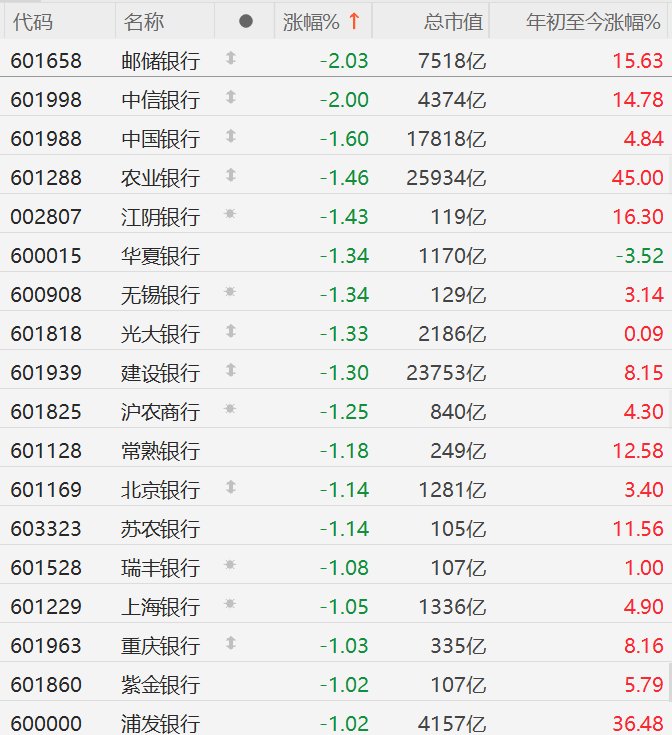
Core Viewpoint - The A-share market experienced a widespread decline in bank stocks, with several major banks seeing significant drops in their share prices [1][2]. Group 1: Stock Performance - Postal Savings Bank of China saw a decrease of 2.03%, with a total market capitalization of 751.8 billion [2]. - CITIC Bank's shares fell by 2.00%, with a market value of 437.4 billion [2]. - Bank of China experienced a decline of 1.60%, with a market capitalization of 1.7818 trillion [2]. - Agricultural Bank of China dropped by 1.46%, holding a market value of 2.5934 trillion [2]. - Other banks such as Everbright Bank, Construction Bank, and Shanghai Pudong Development Bank also reported declines of over 1% [1]. Group 2: Year-to-Date Performance - Agricultural Bank of China has the highest year-to-date increase at 45.00% [2]. - Postal Savings Bank of China and CITIC Bank have year-to-date increases of 15.63% and 14.78%, respectively [2]. - Shanghai Pudong Development Bank has a notable year-to-date increase of 36.48% despite the recent decline [2].