
CMES(601872)

Search documents
每天三分钟公告很轻松 | 华邦健康等公司预计年报业绩扭亏;利欧股份:完成停牌核查 21日起复牌;海康威视披露业绩快报
Shang Hai Zheng Quan Bao· 2026-01-20 16:23
Group 1: Earnings Forecasts - Huabang Health expects a net profit of 660 million to 730 million yuan for 2025, recovering from a loss of 299 million yuan in the previous year, driven by improvements in its agricultural chemical materials sector and steady growth in its pharmaceutical and tourism segments [2] - Kangda New Materials anticipates a net profit of 125 million to 135 million yuan for 2025, compared to a loss of 246 million yuan last year, primarily due to significant sales growth in adhesive and specialty resin products, particularly in the wind power sector [2] - Longxin Technology forecasts a net profit of 100 million to 150 million yuan for 2025, recovering from a loss of 250 million yuan, with improvements in its energy digitalization business and reduced losses in its new energy sector [3] - Hualu Bio expects a net profit of 100 million to 130 million yuan for 2025, recovering from a loss of 47.57 million yuan, attributed to increases in both sales price and volume [3] - Jiuxi Software predicts a net profit of 40 million to 60 million yuan for 2025, recovering from a loss of 156 million yuan, supported by AI technology enhancements and market expansion strategies [3] Group 2: Major Corporate Developments - Liou Co. has completed its stock suspension review and will resume trading on January 21, 2026, confirming that its business operations remain normal and no significant undisclosed matters exist [4] - Hikvision reported total revenue of 92.518 billion yuan for 2025, a slight increase of 0.02%, with a net profit of 14.188 billion yuan, up 18.46%, driven by strategic adjustments and improved cash flow management [6] - JianTou Energy expects a net profit of approximately 1.877 billion yuan for 2025, a significant increase of about 253.38% from the previous year, due to optimized coal resource allocation and cost management [6] Group 3: Investment and Mergers - Aibo Medical plans to acquire at least 51% of Demai Medical to gain control, aiming to leverage its R&D advantages in the sports health sector [19] - Yifan Transmission intends to purchase 87.07% of Beijing Helishi Motor Technology Co., which will become a subsidiary upon successful completion of the transaction [16] - Guangdong Hongtu plans to invest up to 95 million yuan to establish a subsidiary in Thailand for automotive parts production and sales [20] Group 4: Stock Performance and Changes - Huicheng Environmental's major shareholder plans to increase their stake in the company by investing between 25 million and 50 million yuan within six months [22] - Liou Co. will resume trading after completing its stock suspension review, indicating stability in its operations [24] - Kailong High-Tech and Debang Co. have been suspended from trading, indicating potential issues or developments requiring further clarification [25]





股市直播|300044大幅预亏,将被实施退市风险警示;9股今日获机构给予买入型评级
Zheng Quan Shi Bao Wang· 2026-01-20 14:14
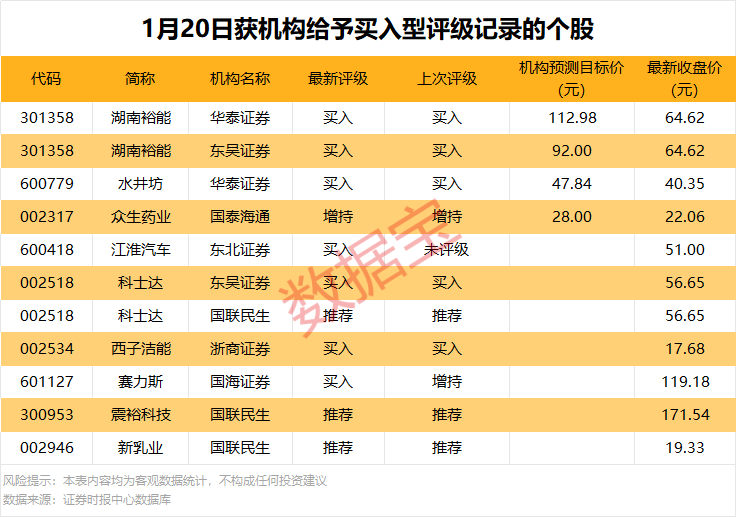
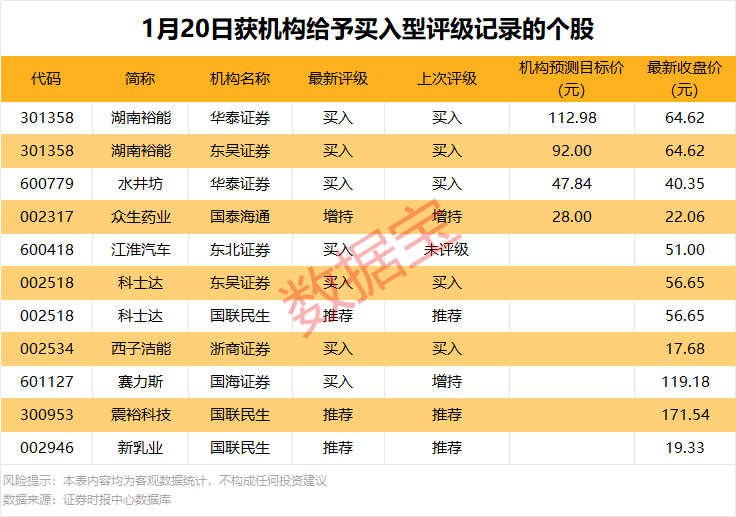
Market Overview - The three major A-share indices collectively closed lower on January 20, with a total market turnover of approximately 2.8 trillion yuan, and over 2,200 stocks rose, including 63 stocks hitting the daily limit [1] Institutional Ratings - A total of 11 buy ratings were issued by institutions today, covering 9 stocks, with Hunan YN and Keda receiving 2 buy ratings each [2] - Among the stocks with buy ratings, 6 companies provided earnings forecasts for 2025, with Hunan YN expected to see a net profit increase of 114.81% year-on-year, followed by Zhenyu Technology and Keda with expected increases of 106.74% and 59.82% respectively [2] Industry Focus - The power equipment industry was the most favored by institutions, with 4 stocks including Hunan YN and Keda listed [2] - The automotive and food & beverage industries also attracted institutional attention, each having 2 stocks featured [2] Institutional Trading - In the top trading list, 17 stocks had net buying amounts exceeding 10 million yuan, with Hunan Baiyin leading at 80.83 million yuan, followed by Tongyu Communications at 55.55 million yuan [4] - Among the net selling stocks, Sanwei Communication faced the highest net sell of 194 million yuan [4] Northbound Capital - 12 stocks on the northbound trading list saw net buying, with Tongyu Communications leading at 97.57 million yuan, followed by Tiantong Co. and Hunan Baiyin, both exceeding 60 million yuan [6] Company Announcements - ST Saiwei (300044) announced an expected net profit loss of 720 million to 1.02 billion yuan for 2025, influenced by litigation and arbitration judgments [7] - Kangxin New Materials (600076) plans to acquire 51% of Wuxi Yubang Semiconductor Technology for 392 million yuan, marking its expansion into the semiconductor sector [8] - Huadian Technology (601226) signed a procurement contract worth approximately 374 million yuan for a wind-solar hydrogen project [8] - China Merchants Energy (601872) plans to build 4 container ships with a total investment of up to 1.324 billion yuan [9] - Anhui Construction (600502) received project bids totaling 13.76 million yuan for two projects [9]






今日晚间重要公告抢先看——利欧股份称自查工作已完成,股票1月21日起复牌;通富微电称2025年净利同比预增62.34%—99.24%
Jin Rong Jie· 2026-01-20 14:03
Group 1 - Liou Co., Ltd. announced that its stock price fluctuations have been investigated, confirming normal operations and no undisclosed significant information [1] - Tongfu Microelectronics expects a net profit of 1.1 billion to 1.35 billion yuan for 2025, representing a year-on-year growth of 62.34% to 99.24% [17][18] Group 2 - Zhongtung High-tech reported an increase of 91,700 tons in tungsten metal resources, which will not directly impact its current operations or financial situation [2] - Aibo Medical plans to acquire at least 51% of Demai Medical to gain control, aiming to cultivate new profit growth points in the sports medicine sector [2] Group 3 - Zhaojin Gold confirmed normal operations and no undisclosed significant matters after its stock price experienced abnormal fluctuations [3] - Riying Electronics stated that it has no revenue from humanoid robot-related businesses and emphasized the need for rational investment decisions [4] Group 4 - Yifan Transmission intends to purchase 87.07% of Beijing Helishi Electric Technology Co., Ltd., which is expected to constitute a major asset restructuring [5] - China Merchants Industry plans to build four 3000TEU traditional fuel container ships with a total investment of no more than 1.324 billion yuan [6] Group 5 - Jiangtian Chemical plans to invest 49.8 million yuan in a project to produce 60,000 tons of acrylic acid annually [7] - *ST Xinyan has received approval to lift its delisting risk warning after completing its restructuring plan [7] Group 6 - Kangxin New Materials intends to acquire 51% of Wuxi Yubang Semiconductor for 392 million yuan, marking its expansion into the semiconductor field [8] - Guoshun Quantum signed a technology implementation license contract with the University of Science and Technology of China [8] Group 7 - Zhenyu Technology reported a significant increase in orders from the robotics sector for Q4 2025, although these orders represent a small portion of its overall revenue [9] - Yongxing Materials announced that its lithium extraction project has reached full production capacity [9] Group 8 - Nanjing Julong plans to invest 110 million yuan in a production line for modified plastics with an annual capacity of 60,000 tons [9] - Guodian Nanzi signed a strategic cooperation agreement with Huawei to establish an AI technology innovation center [10][11] Group 9 - He Sheng New Materials plans to sell idle factory assets for no less than 80 million yuan [13] - He Sheng New Materials expects a net profit increase of 55% to 75% for 2025, driven by improved supply chain management [14] Group 10 - Kangda New Materials forecasts a net profit of 125 million to 135 million yuan for 2025, marking a turnaround from a loss in the previous year [15] - Yanjing Beer anticipates a net profit increase of 50% to 65% for 2025, supported by its large product strategy [16] Group 11 - Jinfang Energy expects a net profit of 109 million to 143 million yuan for 2025, reflecting a year-on-year growth of 123.97% to 193.7% [19] - Yandong Microelectronics predicts a net loss of 340 million to 425 million yuan for 2025 due to market changes and increased R&D costs [20] Group 12 - Taishan Petroleum forecasts a net profit increase of 30.88% to 66.11% for 2025, benefiting from reduced expenses [21] - Huayuan Holdings expects a net profit increase of 50.98% to 66.82% for 2025, driven by lower raw material prices [22] Group 13 - Huajin Co. anticipates a net loss of 1.6 billion to 1.9 billion yuan for 2025, although the loss is expected to be less than the previous year [23] - Zhongyuan Neipei expects a net profit increase of 80.47% to 109.9% for 2025, supported by steady growth in core business [24] Group 14 - Dongfang Tower expects a net profit of 1.08 billion to 1.27 billion yuan for 2025, reflecting a year-on-year growth of 91.4% to 125.07% [34] - Dali Long anticipates a net profit increase of 51.88% to 86.27% for 2025, driven by market expansion and operational efficiency [35] Group 15 - Hikvision reported a net profit increase of 18.46% for 2025, with total revenue reaching 925.18 billion yuan [44] - Zhongfu Industrial expects a net profit increase of 120.27% to 141.59% for 2025, primarily due to lower costs in the electrolytic aluminum business [45]




300044大幅预亏,将被实施退市风险警示!
Zheng Quan Shi Bao· 2026-01-20 14:02
Market Overview - The three major A-share indices collectively closed lower on January 20, with a total market turnover of approximately 2.8 trillion yuan, and over 2,200 stocks rising, including 63 stocks hitting the daily limit [1] Institutional Ratings - A total of 11 buy ratings were issued by institutions today, covering 9 stocks, with Hunan YN and Keda receiving 2 buy ratings each [2] - Among the stocks with buy ratings, 6 companies provided earnings forecasts for 2025, with Hunan YN expected to see a net profit increase of 114.81% year-on-year, followed by Zhenyu Technology and Keda with expected increases of 106.74% and 59.82%, respectively [2] - The power equipment industry was the most favored, with 4 stocks listed, while the automotive and food & beverage industries also attracted attention with 2 stocks each [2] Institutional Trading - In the top trading list, 17 stocks had net buying, with 13 stocks seeing net buying amounts exceeding 10 million yuan. Hunan Baiyin topped the list with a net buying amount of 80.83 million yuan [4] - The net selling stocks included Sanwei Communication, which faced a net selling of 194 million yuan, followed by Redxiang Shares and Zhitex New Materials, both exceeding 20 million yuan in net selling [4] Company Announcements - ST Saiwei (300044) announced an expected net loss of 720 million to 1.02 billion yuan for 2025, influenced by litigation and arbitration judgments, with a potential negative net asset value [7] - Kangxin New Materials (600076) plans to acquire 51% of Wuxi Yubang Semiconductor Technology Co., Ltd. for 392 million yuan, marking its expansion into the semiconductor field [8] - Huadian Technology (601226) signed a procurement contract worth approximately 374 million yuan for a wind-solar hydrogen project [8] - China Merchants Energy (601872) announced plans to build four container ships with a total investment of up to 1.324 billion yuan, with delivery scheduled for 2027-2028 [9] - Anhui Construction (600502) received project bids totaling 13.76 billion yuan, including a hydrogen installation project and a chip industry park project [9]



招商轮船:1月20日召开董事会会议
Mei Ri Jing Ji Xin Wen· 2026-01-20 11:38
Group 1 - The company, China Merchants Energy Shipping Company, announced that its 26th meeting of the 7th Board of Directors was held on January 20, 2026, via written communication [1] - The board approved a related party transaction proposal for the construction of three 3,000 TEU container ships [1]
招商轮船(601872.SH):下属全资子公司拟新建3000TEU型集装箱船舶
Ge Long Hui A P P· 2026-01-20 11:18
Core Viewpoint - The company aims to enhance its container shipping business competitiveness by optimizing its fleet structure and route layout through the construction of new vessels [1] Group 1: Company Actions - The company's board approved a plan for its wholly-owned subsidiary to sign a shipbuilding agreement with an affiliate, China Merchants Industry [1] - The agreement involves the construction of four 3,000 TEU traditional fuel container ships equipped with desulfurization towers [1] - The expected total investment for this project is not to exceed 1.324 billion RMB [1] Group 2: Future Outlook - The delivery of the new vessels is scheduled for 2027-2028, indicating a long-term strategic investment in fleet modernization [1]
招商轮船(601872) - 招商轮船关于下属全资子公司拟新建3000TEU型集装箱船舶的关联交易公告
2026-01-20 11:15
重要内容提示: 交易简要内容:招商局能源运输股份有限公司(下称"本公司" 或"公司")拟通过下属全资子公司设立的单船公司与关联方招商局工 业集团有限公司(下称"招商工业")下属公司签署《船舶订造协议》, 订造 4 艘装配脱硫塔的 3,000TEU 型传统燃料集装箱船,项目总投资 金额预计不超过人民币 13.24 亿元。交船期为 2027-2028 年。 证券代码:601872 证券简称:招商轮船 公告编号:2026-007 招商局能源运输股份有限公司 关于下属全资子公司拟新建 3000TEU 型集装箱船舶 的关联交易公告 本公司董事会及全体董事保证本公告内容不存在任何虚假记载、误导性陈述 或者重大遗漏,并对其内容的真实性、准确性和完整性承担法律责任。 招商工业与本公司均受招商局集团有限公司(下称"招商局集 团")控制,本次交易构成关联交易。 本次交易已经公司第七届董事会第二十六次会议审议通过,关 联董事回避表决。本次交易与 12 个月内与同一关联人发生的关联交 易累计计算后,交易金额已达到股东会审议标准,尚需提交公司股东 会审议,与该关联交易有利害关系的关联股东将在股东会上对此议案 回避表决。 截至本公告披露 ...
招商轮船(601872) - 招商轮船第七届董事会第二十六次会议决议公告
2026-01-20 11:15
1 证券代码:601872 证券简称:招商轮船 公告编号:2026[006] 招商局能源运输股份有限公司 第七届董事会第二十六次会议决议公告 本公司董事会、全体董事保证本公告内容不存在虚假记载、误导 性陈述或者重大遗漏,并对其内容的真实性、准确性和完整性承担法 律责任。 招商局能源运输股份有限公司(下称"公司"、"本公司"及"招 商轮船")2026 年 1 月 13 日以电子邮件、书面送达等方式向公司全 体董事和高级管理人员书面发出《公司第七届董事会第二十六次会议 通知》。2026 年 1 月 20 日,公司第七届董事会第二十六次会议(下 称"本次会议")以书面会议方式召开。本次会议应出席董事 12 名, 实际出席董事 12 名。本次会议召开的时间、方式符合《公司法》等 法律、行政法规和部门规章以及《公司章程》的有关规定,形成的会 议决议合法、有效。 本次会议以投票表决方式审议通过了以下议案: 一、关于在关联方新建 3,000TEU 型集装箱船舶的关联交易议案 董事会同意公司下属全资子公司在关联方招商局工业集团有限 公司下属公司订造 4 艘 3,000TEU 型集装箱船舶,投资总金额不超过 人民币 13.24 ...
招商轮船:拟订造4艘装配脱硫塔的3000TEU型传统燃料集装箱船
Zheng Quan Shi Bao Wang· 2026-01-20 11:11
Core Viewpoint - The company, China Merchants Energy Shipping Company (招商轮船), plans to sign a shipbuilding agreement to construct four 3000 TEU traditional fuel container ships equipped with desulfurization towers, with a total investment not exceeding 1.324 billion yuan, and delivery expected between 2027 and 2028 [1]. Group 1 - The company will establish a single-ship company through its wholly-owned subsidiary [1]. - The shipbuilding agreement will be signed with a subsidiary of China Merchants Industry Group (招商局工业集团) [1]. - The total investment for the project is estimated to be no more than 1.324 billion yuan [1].
招商轮船:拟通过全资子公司订造4艘3000TEU型集装箱船
Mei Ri Jing Ji Xin Wen· 2026-01-20 10:57
Group 1 - The company, China Merchants Energy Shipping Company (招商轮船), announced plans to sign a shipbuilding agreement for four 3000TEU traditional fuel container ships equipped with desulfurization towers [1] - The total investment for the project is expected to be no more than 1.324 billion yuan [1] - The delivery period for the ships is set for 2027-2028 [1] Group 2 - The transaction constitutes a related party transaction and will require approval from the shareholders' meeting [1]