YINGJIA DISTILLERY(603198)

Search documents
白酒股异动拉升,迎驾贡酒涨超3%
Mei Ri Jing Ji Xin Wen· 2025-09-10 03:19
Group 1 - The liquor stocks experienced significant upward movement on September 10, with specific companies showing notable gains [1] - Welcoming the rise, W迎驾贡酒 increased by over 3%, while 古井贡酒 rose nearly 2%, and 贵州茅台 saw an increase of over 1% [1] - Other companies in the sector, such as 酒鬼酒 and 泸州老窖, also followed the upward trend [1]

“徽酒老二”迎驾贡酒陷内外困局:省内失守、省外缩水,年度目标恐难达
Guo Ji Jin Rong Bao· 2025-09-05 13:29
Core Viewpoint - Yingjia Gongjiu, once considered a "dark horse" in the liquor industry, has reported a significant decline in both revenue and profit for the first half of the year, marking the first time in five years that both metrics have decreased simultaneously [1] Financial Performance - In the first half of the year, Yingjia Gongjiu's revenue was 3.16 billion yuan, a year-on-year decrease of 16.89%, while net profit attributable to shareholders was 1.13 billion yuan, down 18.19% [1] - The company's revenue growth rates for each quarter of 2024 were 21%, 19%, 1.6%, and -5%, indicating a gradual contraction [3] - The total revenue for the previous year was 7.344 billion yuan, with a net profit of 2.589 billion yuan, but the company failed to meet its operational targets for the year [4] Market Dynamics - The decline in performance is attributed to a combination of external factors, including weak consumer demand and ongoing adjustments in the liquor industry [1][5] - The company's mid-to-high-end liquor segment saw revenue of 2.537 billion yuan in the first half, down approximately 14%, while ordinary liquor revenue fell by 32.47% to 452 million yuan [5] - The gross profit margin for the second quarter was 68.33%, a decrease of 2.8 percentage points, marking the lowest in nearly nine quarters [5] Regional Performance - Yingjia Gongjiu's revenue in its home province of Anhui has also seen a rare decline, with a 7.7% drop in the first quarter and a 12% decrease in the first half, accounting for over 60% of total revenue [8][9] - The company faces stiff competition in both provincial and external markets, with its provincial market share shrinking due to the dominance of Gujing Gongjiu [10][12] Future Outlook - The company has set a target for 2025 to achieve revenue of 7.6 billion yuan, a year-on-year increase of approximately 3.49%, and a net profit of 2.62 billion yuan, a growth of about 1% [12] - Contract liabilities, viewed as a future revenue indicator, stood at 440 million yuan, down about 5% year-on-year, suggesting potential further slowdown in growth [12]


业绩雪崩的“徽酒老二”迎驾贡酒,想起来重新聚焦主业了
Guan Cha Zhe Wang· 2025-09-05 04:54
Core Viewpoint - The company, Yingjia Gongjiu, has experienced significant declines in revenue and profit during the first half of 2025, marking its worst performance since 2021, amidst a challenging industry environment [1][5][10]. Financial Performance - Revenue for the first half of 2025 was 3.16 billion yuan, a decrease of 16.89% compared to the same period last year [2][5]. - Net profit attributable to shareholders was 1.13 billion yuan, down 18.19% year-on-year [2][5]. - Operating cash flow fell by 48.3% to 316.65 million yuan [2][11]. - Total assets decreased by 6.03% to approximately 12.58 billion yuan [2]. Market Position and Competition - Yingjia Gongjiu's market position as the "second in Anhui" is under threat, with significant competition from both local and national brands [3][14]. - The company is facing pressure from competitors like Gujing Gongjiu, which reported revenue growth, while Yingjia Gongjiu's revenue has fallen behind by over 100 million yuan [14]. - The company has seen a notable decline in both domestic and provincial sales, with provincial revenue down 12% and provincial revenue down over 30% [11]. Strategic Focus - The company is attempting to refocus on its core business by divesting from non-core assets, such as the sale of its hotel business [15]. - Yingjia Gongjiu's product line is heavily reliant on its high-end "Dingcang" series, which now accounts for nearly 60% of its revenue, indicating a risk if this segment underperforms [11][16]. Future Outlook - The company has set ambitious targets for 2025, aiming for revenue of 7.6 billion yuan and net profit of 2.62 billion yuan, which may be overly optimistic given current performance trends [12][16]. - To maintain its market position, Yingjia Gongjiu must adapt to changing consumer preferences and potentially diversify its product offerings to attract younger demographics [16].

迎驾贡酒成立君临酒业销售公司
Qi Cha Cha· 2025-09-04 23:42
Group 1 - Anhui Yingjia Junlin Liquor Co., Ltd. was established on August 28, 2025, with a registered capital of 30 million yuan [1] - The business scope of the company includes liquor operation and food sales [1] - Yingjia Junlin is wholly owned by Yingjia Gongjiu (603198) [1]
迎驾贡酒成立君临酒业销售新公司
Zheng Quan Shi Bao Wang· 2025-09-04 08:25
Group 1 - A new company named Anhui Yingjia Junlin Liquor Sales Co., Ltd. has been established with a registered capital of 30 million yuan [1] - The business scope of the new company includes liquor sales and food sales [1] - Yingjia Junlin Liquor Sales Co., Ltd. is wholly owned by Yingjia Gongjiu (603198) [1]
促消费政策催化,持续看好顺周期方向
CAITONG SECURITIES· 2025-09-03 11:00
Investment Rating - The industry investment rating is "Positive" (maintained) [2][9] Core Viewpoints - Recent policies aimed at boosting consumption, such as the "2025 Shaoxing City Consumption Promotion Policy," are expected to benefit cyclical sectors, particularly in the liquor and restaurant chains [5] - The policy includes subsidies for banquet consumption, which will directly stimulate demand for liquor and benefit suppliers in the banquet consumption chain [5] - The report anticipates that similar policies may be adopted in other regions, which could enhance overall consumer demand and support the recovery of liquor demand and banquet supply chain enterprises [5] - The restaurant industry is currently at the bottom of its cycle but is expected to gradually recover due to ongoing policy support, with specific recommendations for various segments including liquor, restaurant chains, beer, and yellow wine [5] Summary by Sections Recent Market Performance - The food and beverage sector has shown a performance of -7% over the last 12 months, compared to 2% for the CSI 300 and 11% for the Shanghai Composite Index [4] Policy Impact - The Shaoxing policy provides tiered subsidies for banquet consumption, with a maximum of 5,000 yuan for events with five tables or more and total spending exceeding 10,000 yuan [5] - The policy is expected to stimulate banquet consumption during the upcoming Mid-Autumn Festival and National Day holidays, benefiting liquor demand [5] Investment Recommendations - The report recommends focusing on the following companies: - Liquor: Guizhou Moutai, Wuliangye, Luzhou Laojiao, Shanxi Fenjiu, Shede Liquor, Gujing Gongjiu, Yingjia Gongjiu, and Jinshiyuan [5] - Restaurant Chains: Hai Tian Wei Ye, Anji Food, Angel Yeast, and Qianwei Central Kitchen [5] - Beer: Qingdao Beer, China Resources Beer, and Yanjing Beer [5] - Yellow Wine: Kuaijishan and Guyue Longshan [5]





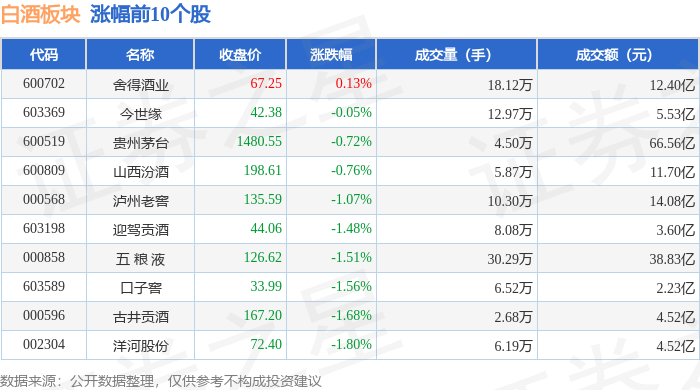
白酒板块9月3日跌0.98%,伊力特领跌,主力资金净流出7.26亿元
Zheng Xing Xing Ye Ri Bao· 2025-09-03 08:40
Market Overview - The liquor sector experienced a decline of 0.98% on September 3, with Yili Te leading the drop [1] - The Shanghai Composite Index closed at 3813.56, down 1.16%, while the Shenzhen Component Index closed at 12472.0, down 0.65% [1] Individual Stock Performance - Key stocks in the liquor sector showed varied performance, with the following notable changes: - Shede Liquor: Closed at 67.25, up 0.13% [1] - Kweichow Moutai: Closed at 1480.55, down 0.72% with a trading volume of 45,000 shares and a transaction value of 6.656 billion [1] - Wuliangye: Closed at 126.62, down 1.51% with a trading volume of 302,900 shares and a transaction value of 3.883 billion [1] - Yili Te: Closed at 15.56, down 3.35% with a trading volume of 78,800 shares and a transaction value of 1.25 billion [2] Capital Flow Analysis - The liquor sector saw a net outflow of 726 million from institutional investors, while retail investors contributed a net inflow of 479 million [2] - The following stocks had significant capital flow: - Shede Liquor: Net inflow from institutional investors was 59.79 million, while retail investors had a net outflow of 17.44 million [3] - Kweichow Moutai: Experienced a net outflow of 14 million from institutional investors [3] - Yili Te: Had a net outflow of 2.68 million from institutional investors [3]


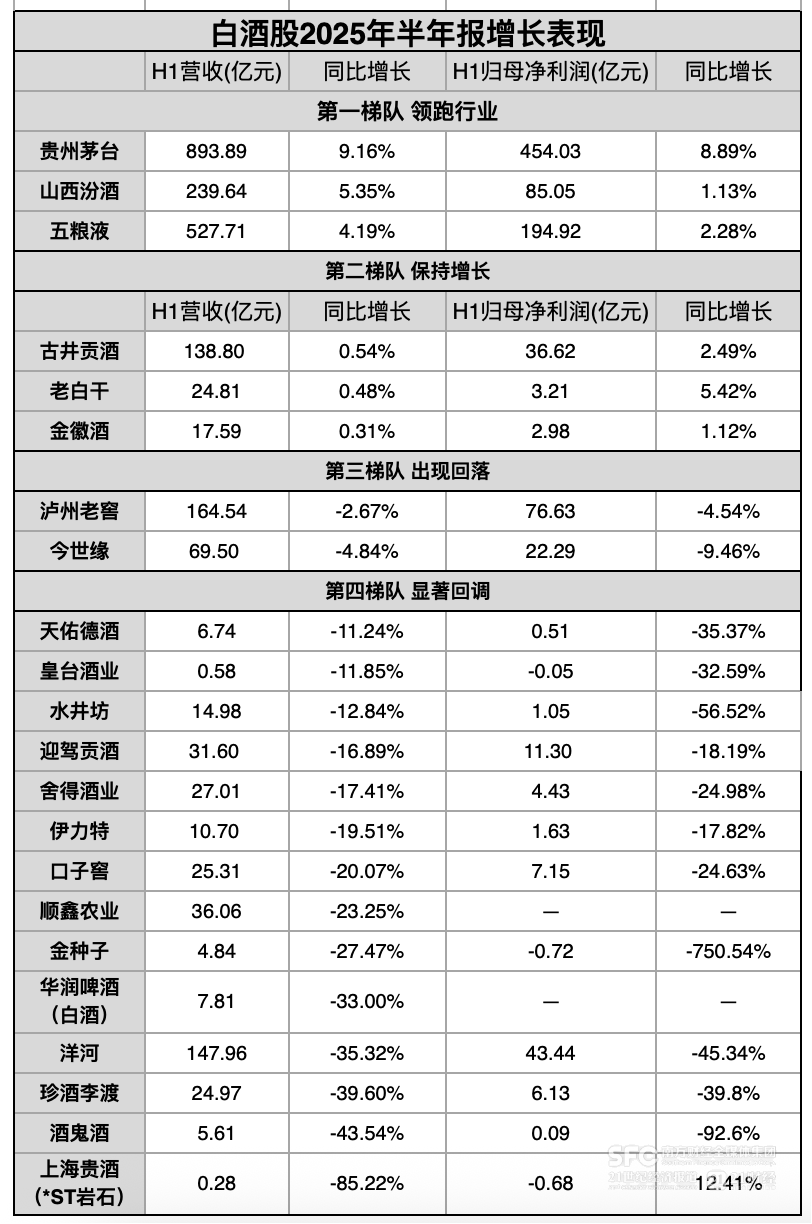
二季度迎驾贡酒、今世缘、珍酒李渡等17家白酒企业营收下滑
2 1 Shi Ji Jing Ji Bao Dao· 2025-09-03 08:22
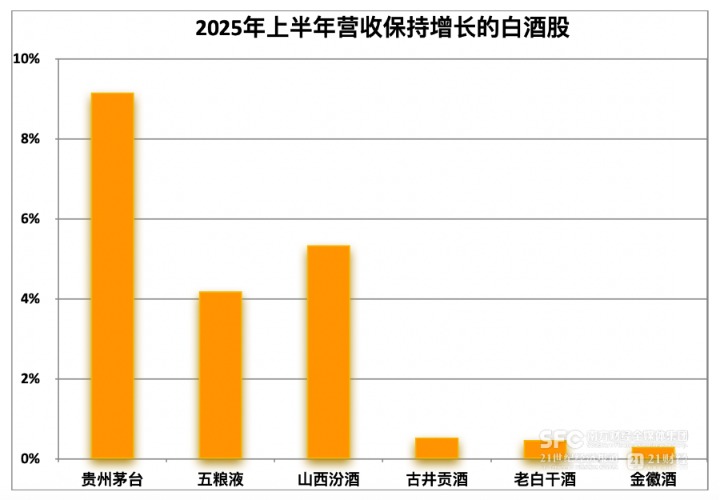
Core Viewpoint - The Chinese liquor industry is currently in a downward trend, with many companies experiencing significant declines in performance, indicating a challenging market environment [1][5][8]. Financial Performance Summary - Among 21 listed liquor companies, 15 reported a decline in performance in the first half of the year, while only 6 maintained positive growth, including leading brands like Kweichow Moutai, Wuliangye, and Shanxi Fenjiu [1][2]. - Kweichow Moutai reported a revenue of 89.39 billion yuan, with a year-on-year growth of 9.16%, and a net profit of 45.40 billion yuan, growing by 8.89% [2]. - Shanxi Fenjiu and Wuliangye also showed growth, but many other companies, especially in the lower tiers, faced significant declines, with some experiencing drops over 20% [2][4]. Market Dynamics - The second quarter saw 17 out of 21 liquor companies report revenue declines, with half of them experiencing drops exceeding 20% [4][5]. - The overall market is undergoing a reshuffling, with leading brands maintaining their positions while others struggle to keep up [8][10]. - The industry is witnessing a trend where competitive advantages are increasingly concentrated among top brands, leading to a significant market reshuffle [12][19]. Future Outlook - Analysts suggest that unless there is a rapid market recovery in the third quarter, most liquor companies are unlikely to see unexpected growth in the latter half of the year [7][15]. - There is speculation that the upcoming Mid-Autumn and National Day festivals could provide a window for price stabilization and potential recovery for leading brands [14][18]. - The current market conditions may lead to a prolonged adjustment period, with some experts predicting a U-shaped recovery by late 2026 [16][20].

方正证券:白酒行业筑底深化 龙头企业优势凸显
智通财经网· 2025-09-03 08:15
Core Viewpoint - The current outlook for the liquor industry indicates that a bottom has formed due to multiple policy catalysts, with the liquor sector showing signs of recovery but still at historical lows. The industry is expected to benefit from improved economic expectations, with a focus on the upcoming Mid-Autumn Festival and National Day for demand recovery [1][2]. Group 1: Industry Performance - In Q2 2025, the liquor industry entered a deep adjustment phase under macroeconomic and policy pressures, with total revenue for the first half of 2025 reaching 239.8 billion yuan, a year-on-year decrease of 0.9%, and net profit attributable to shareholders at 94.6 billion yuan, down 1.2% [2]. - Excluding Moutai, other listed companies in the sector reported a total revenue of 150.4 billion yuan in H1 2025, a decline of 6.1%, with net profit at 49.2 billion yuan, down 8.9% [2]. - The overall price of mainstream liquor products has declined, but with improving industry sentiment and easing constraints in H2, a recovery is anticipated, particularly during the peak sales periods of the Mid-Autumn Festival and National Day [2]. Group 2: Brand and Price Segmentation - High-end liquor brands are outperforming mid-range and regional brands, with high-end brands maintaining resilience through strong brand power and channel control. Moutai and other leading brands are stabilizing their market positions through inventory control and channel optimization [3]. - Mid-range liquor brands are experiencing more direct impacts from policy changes, with some brands like Fenjiu showing continued growth despite pressures [3]. - Regional leaders are focusing on maintaining market share and stabilizing core product prices, while brands like Jiangsu Yanghe and Jiuzi have seen significant adjustments [3]. Group 3: Investment Recommendations - The company suggests focusing on leading brands with strong market positions such as Moutai, Wuliangye, Luzhou Laojiao, and Shanxi Fenjiu during the economic transition [3]. - Regional leaders that maintain their core markets, such as Gujing Gongjiu and Jiuzi, are expected to sustain momentum as demand recovers [3]. - Brands that have actively managed their financials during this adjustment period, like Shede and Yanghe, are also recommended for attention [3].


名酒保住增长,白酒业即将穿越周期?
2 1 Shi Ji Jing Ji Bao Dao· 2025-09-03 08:05
Core Viewpoint - The Chinese liquor industry, particularly the baijiu sector, is currently experiencing a downturn, with many companies reporting declining performance. However, some analysts believe this could signal a bottoming out and potential recovery in the future [1][12]. Industry Performance - In the first half of the year, 15 out of 21 listed baijiu companies reported declining performance, with only 6 companies, including Kweichow Moutai and Wuliangye, showing positive growth [1][4]. - The overall industry is facing significant challenges, with many companies returning to average performance levels after years of high growth [4][11]. Company-Specific Insights - Leading companies like Kweichow Moutai and Wuliangye continue to show resilience, maintaining their positions despite a slowdown in growth [5][9]. - Companies such as Yingjia Gongjiu and Jiuzi Jiu have reported significant declines, with Yingjia Gongjiu's revenue dropping by 24% and net profit by 35% in Q2 [2][8]. - The performance of Shanxi Fenjiu has slowed, with growth rates returning to single digits after years of double-digit increases [2][6]. Market Dynamics - The competitive landscape is shifting, with a clear trend of market share concentrating among top brands, while smaller and regional brands struggle to maintain their positions [10][11]. - The number of regulated baijiu companies has decreased, indicating a consolidation trend within the industry [11]. Future Outlook - Analysts suggest that the second half of the year may see a potential rebound, particularly during the Mid-Autumn Festival and National Day, which could provide a window for price stabilization and recovery [12][13]. - Despite recent stock price increases, the overall sentiment remains cautious, with many expecting that a full recovery may take until late 2025 or beyond [13][14].