AMEC(688012)

Search documents
半导体ETF(159813)涨超1%,半导体设备龙头公司业绩大幅增长
Xin Lang Cai Jing· 2025-07-23 05:31
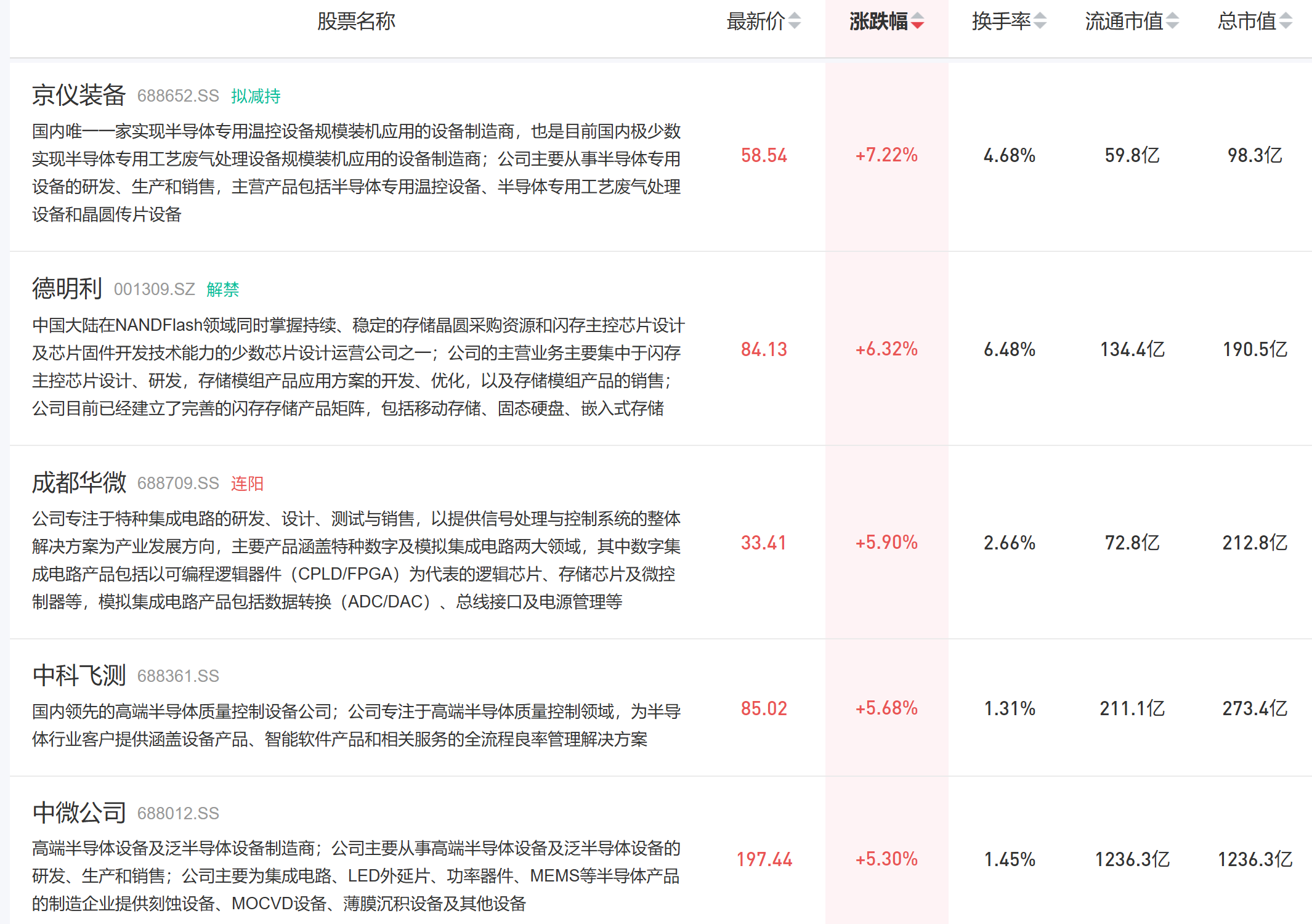
Group 1 - The semiconductor industry is experiencing strong growth, with significant increases in the performance of leading companies as indicated by their mid-year forecasts [1] - The National Semiconductor Chip Index (980017) rose by 1.38%, with notable gains from companies such as Zhongwei Company (688012) up 6.43% and Tuojing Technology (688072) up 5.28% [1] - TSMC's Q2 2025 revenue exceeded expectations, leading to an upward revision of its annual revenue growth forecast to around 30%, reflecting a positive industry outlook [1] Group 2 - The top ten weighted stocks in the National Semiconductor Chip Index (980017) account for 67.05% of the index, including companies like SMIC (688981) and Cambrian (688256) [2] - The semiconductor ETF (159813) closely tracks the National Semiconductor Chip Index, providing a tool for index-based investment in the semiconductor sector [1][2]

【大涨解读】半导体:半导体设备公司走强,半年报业绩预喜率超八成,三季度还有望迎来行业旺季期
Xuan Gu Bao· 2025-07-23 03:00
Core Viewpoint - The semiconductor sector is experiencing a strong performance, with several companies showing significant growth in their financial results and optimistic forecasts for the future [7][8]. Group 1: Financial Performance - TSMC reported a net profit of nearly 398.3 billion NTD for Q2 2025, marking a year-on-year increase of approximately 61%, achieving the highest quarterly net profit in history and the highest growth rate for the same period in three years [7]. - Over 30 semiconductor companies have disclosed their performance forecasts for the first half of 2025, with more than 80% of these companies expecting positive results. The median net profit for these companies is nearly 6.4 billion CNY, representing a year-on-year growth of over 80%, the highest growth rate for the same period since 2021 [7]. Group 2: Industry Trends - The National Integrated Circuit Industry Investment Fund (Big Fund) is focusing on supporting domestic equipment and components to accelerate local replacements, with local governments in cities like Beijing and Shanghai establishing special funds and offering tax incentives to support the semiconductor supply chain [8]. - The average validation cycle for domestic wafer fabrication equipment in China is expected to decrease from 24 months to 14 months by 2024, with the market share of domestic equipment manufacturers increasing from 7% in 2020 to 19% in 2024 [8]. - NVIDIA has resumed supplying its H20 computing chips to the Chinese market and launched a new series of fully compatible NVIDIA RTX PRO GPUs, aimed at digital twin AI applications in smart factories and logistics, addressing high-end computing bottlenecks [8]. - The global semiconductor market is projected to continue its optimistic growth trajectory in 2025, driven by AI demand and ongoing domestic replacement efforts amid rising risks of supply chain disruptions [8].


科创板平均股价32.07元,42股股价超百元
Zheng Quan Shi Bao Wang· 2025-07-22 11:05
Core Viewpoint - The average stock price of the STAR Market is 32.07 yuan, with significant variations in stock prices among different companies, indicating a mixed performance in the market [1][2]. Group 1: Stock Performance - A total of 278 stocks on the STAR Market rose today, while 303 stocks fell, reflecting a generally bearish sentiment [1]. - The highest closing price was recorded by Cambrian (寒武纪) at 593.93 yuan, which increased by 2.05% [2]. - Among the stocks priced over 100 yuan, the average increase was 0.29%, with 24 stocks rising and 18 stocks falling [2]. Group 2: Premium Analysis - The average premium of stocks priced over 100 yuan relative to their issue price is 331.48%, with notable premiums for Baili Tianheng (百利天恒) at 1159.03%, Anji Technology (安集科技) at 1088.16%, and Hotgen Biotech (热景生物) at 934.47% [2][3]. Group 3: Industry Distribution - The industries with the highest concentration of stocks priced over 100 yuan include Electronics (19 stocks), Pharmaceutical and Biological (10 stocks), and Computer (6 stocks) [3]. Group 4: Capital Flow - The net inflow of capital into stocks priced over 100 yuan today was 1.56 billion yuan, with Cambrian, Zhongwei Company, and Haitai Ruisheng leading in net inflows [3]. - The total margin financing balance for stocks priced over 100 yuan is 26.257 billion yuan, with Cambrian, Haiguang Information, and Zhongwei Company having the highest balances [3].



华安基金科创板ETF周报:科创板迎来开市六周年,科创50指数周涨1.32%
Xin Lang Ji Jin· 2025-07-22 09:31
Group 1: Event Overview - The "2025 China Sci-Tech Innovation Leaders Summit and the 6th Anniversary Forum of the Sci-Tech Innovation Board" will be held on July 25 in Shanghai, focusing on themes of "source innovation and industry leadership" [1] - The summit will include keynote speeches, high-level dialogues, and roundtable discussions on hot topics such as mergers and acquisitions and overseas expansion, aiming to promote the deep integration of technological innovation and capital markets [1] Group 2: Sci-Tech Innovation Board Performance - As of now, there are 589 listed companies on the Sci-Tech Innovation Board, with a total IPO financing amount of approximately 925.7 billion and a total market value exceeding 7 trillion [2] - The board has seen significant R&D investment, with a cumulative amount of 168.1 billion in 2024, which is more than three times the net profit attributable to the parent company [2] - The three strategic emerging industries—new generation information technology, biomedicine, and high-end equipment manufacturing—account for over 80% of the board's market value [2] Group 3: Market Trends and Investment Opportunities - The current trend of de-globalization and the urgent need for self-sufficiency have heightened the necessity for the development of new productive forces, with the Sci-Tech Innovation Board focusing on hard technology sectors such as electronic chips and biomedicine [3] - Investment directions represented by Sci-Tech Chip ETF (588290), Sci-Tech Information ETF (588260), and Sci-Tech 50 ETF Index Fund (588280) are worth long-term attention [3] Group 4: Recent Market Performance - The overall performance of the Sci-Tech Innovation Board has seen an increase, with the Sci-Tech 50 Index rising by 1.32%, the Sci-Tech Information Index by 0.88%, and the Sci-Tech Chip Index by 0.12% over the past week [4] - The top five industries on the Sci-Tech Innovation Board—electronics, biomedicine, computers, power equipment, and machinery—account for 87.2% of the board's total market value [5] Group 5: Sector Insights - In the new generation information technology sector, AI hardware, particularly optical modules, has seen a collective surge, driven by strong mid-year performance and increased global demand for AI computing power [7] - The high-end equipment manufacturing sector is experiencing significant growth, with industrial robot exports increasing by 61.5% year-on-year, and forklift sales up by 23.1% [8] - The innovative drug market is also on the rise, with the industry transitioning from "follower" to "leader," and 2025 expected to be a pivotal year for the emergence of blockbuster drugs [8]




科创板六周年!他们有话说!
Zhong Guo Ji Jin Bao· 2025-07-22 03:02
Group 1 - The core viewpoint of the article highlights the significant achievements of the Sci-Tech Innovation Board (STAR Market) in its six years, emphasizing its role as a "reform testbed" that has fostered the integration of technology and capital in China [1][3][21] - The STAR Market has nurtured nearly 600 innovative companies across key sectors such as semiconductors, biomedicine, new energy, and artificial intelligence, marking a historical transition of China's industrial chain from "catching up" to "leading" [3][11][21] - Over 60 companies on the STAR Market have launched globally innovative products, with 30% of companies having products or projects that are first-of-their-kind, showcasing the board's impact on fostering "hard technology" industries [6][21] Group 2 - The STAR Market has become a crucial platform for capital market reforms, with a focus on "hard technology," and has seen a significant increase in the number of institutional investors participating [21][27] - The introduction of various ETFs related to the STAR Market has provided investors with diversified investment tools, enhancing market liquidity and activity [6][8][21] - The STAR Market's reforms, including the registration system and the establishment of a growth tier, have improved the accessibility of capital for innovative companies, particularly in high-tech sectors [18][21][25] Group 3 - The article notes that the STAR Market has successfully transformed from a "testbed" for innovation to a "main battlefield" for China's technological self-reliance, with a focus on nurturing world-class tech companies [16][31] - The board's policies have led to a significant increase in R&D investment across the market, with a notable rise in the number of companies achieving breakthroughs in critical technologies [13][18][27] - Looking ahead, the STAR Market is expected to continue its role in supporting the development of high-quality tech enterprises and enhancing the synergy between technology, industry, and finance [19][31][34]
科创板六周年!他们有话说!
中国基金报· 2025-07-22 02:39
Core Viewpoint - The article celebrates the sixth anniversary of the Sci-Tech Innovation Board (STAR Market), highlighting its role as a "reform testbed" that has successfully integrated technology and capital, fostering a vibrant ecosystem for innovation in China [1][4]. Group 1: Development and Achievements - Over the past six years, the STAR Market has nurtured nearly 600 innovative companies, creating a robust ecosystem covering key sectors such as semiconductors, biomedicine, new energy, and artificial intelligence [4][8]. - The STAR Market has witnessed a significant transformation in China's industrial chain, evolving from "catching up" to "leading" in various sectors, with the STAR 50 Index reflecting this industrial upgrade [4][8]. - More than 60 companies on the STAR Market have launched globally innovative products, with 30% of companies having products or projects that are first-of-their-kind [8][20]. Group 2: Investment Opportunities - The growth of STAR Market-related ETFs has provided investors with efficient tools for participating in investment opportunities, enhancing market liquidity and activity [8][9]. - As of July 20, 2023, the total scale of STAR Market ETFs exceeded 260 billion yuan, accounting for about 9% of domestic A-share ETFs, indicating a strong interest in technology-themed investments [13][14]. - The article emphasizes the optimistic outlook for the technology growth sector in the A-share market, driven by advancements in artificial intelligence, innovative pharmaceuticals, and the overall recovery of market risk appetite [14][40]. Group 3: Future Prospects - The STAR Market is expected to cultivate more global industry leaders and witness original breakthroughs, particularly in the context of increasing global competition in technology [5][21]. - The introduction of the "1+6" reform policies is seen as timely, aligning with the emergence of strategic companies in key technology sectors, which may drive strong momentum for the STAR Market [21][37]. - The article suggests that the STAR Market will continue to deepen reforms and support the development of world-class Chinese technology companies, contributing to the country's goal of achieving high-level technological self-reliance [46][48].
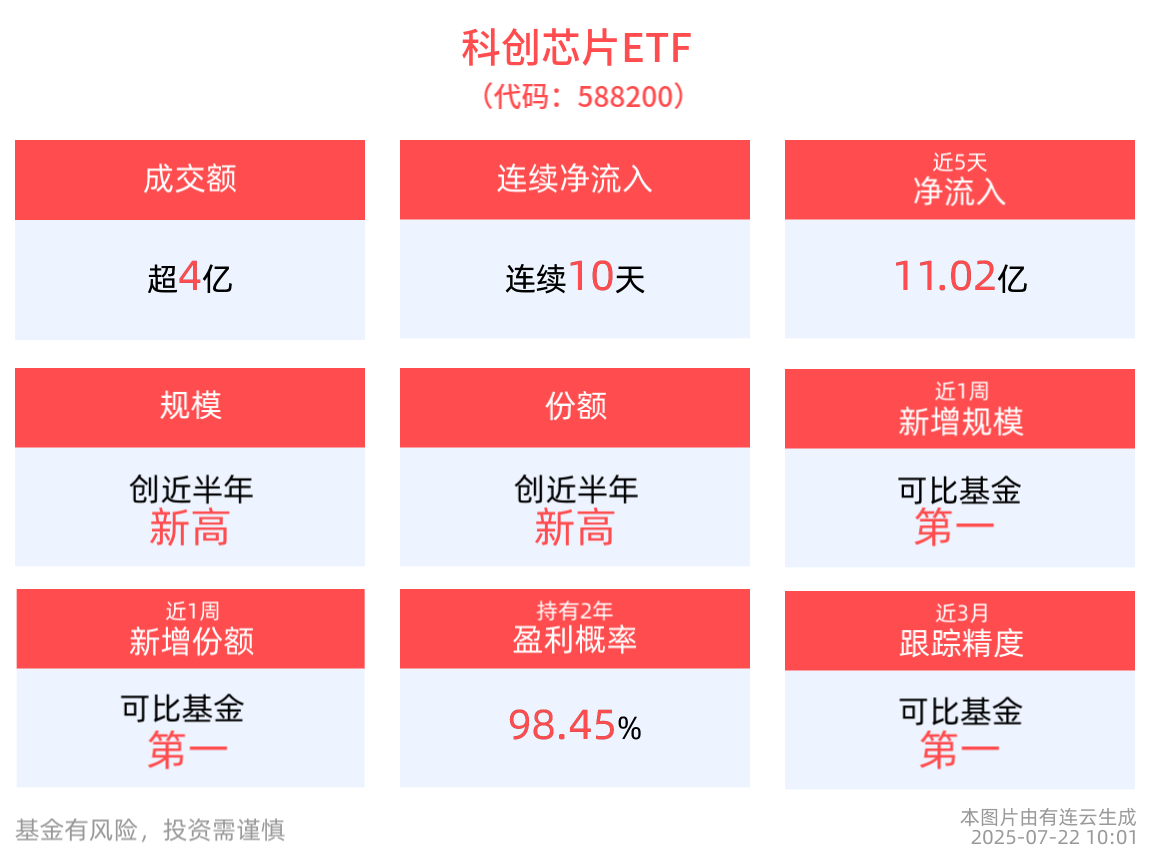
科创芯片ETF(588200)连续10天净流入,源杰科技涨超11%领涨成分股
Sou Hu Cai Jing· 2025-07-22 02:37
Group 1: ETF Performance - The Sci-Tech Chip ETF has a turnover rate of 1.3% and a transaction volume of 410 million yuan [3] - As of July 21, the ETF's latest scale reached 31.565 billion yuan, marking a six-month high and ranking first among comparable funds [3] - The ETF's latest share count is 20.644 billion shares, also a six-month high and leading among comparable funds [3] - Over the past 10 days, the ETF has seen continuous net inflows, with a maximum single-day net inflow of 761 million yuan, totaling 3.097 billion yuan [3] - The leveraged funds are actively investing, with a net financing amount of 23.377 million yuan this month and a latest financing balance of 1.855 billion yuan [3] - The ETF's net value has increased by 28.75% over the past two years, ranking 271 out of 2237 index equity funds, placing it in the top 12.11% [3] - Since its inception, the ETF's highest monthly return was 25.18%, with the longest consecutive monthly gains being 4 months and a maximum increase of 36.01% [3] Group 2: Semiconductor Industry Insights - Meta's founder Mark Zuckerberg announced plans for Meta to become the first to invest in a 1GW computing power supercluster laboratory, with expansion plans to 5GW in the coming years [4] - NVIDIA's CEO Jensen Huang announced two significant developments during his visit to China: approval for H20 chip sales to China and the launch of a custom RTX PRO GPU for the Chinese market [4] - Tianfeng Securities projects optimistic growth for the global semiconductor industry through 2025, driven by AI and ongoing domestic substitution efforts [4] - The second quarter showed strong performance forecasts across various semiconductor segments, with expectations for a robust third quarter [4] - The top ten weighted stocks in the Sci-Tech Chip Index as of June 30, 2025, include SMIC, Haiguang Information, and Cambricon, collectively accounting for 57.76% of the index [4]


科创板迈入服务“硬科技”新阶段
Jin Rong Shi Bao· 2025-07-22 01:06
6年前,肩负着支持科技创新"前沿阵地"与改革"试验田"的重任,科创板掀开了中国资本市场注册制改 革的新篇,重塑资本服务实体经济的底层逻辑。 6年来,汇聚起589家"硬科技"企业的科创板从未停止探索与创新的步伐。一个月前,《关于在科创板设 置科创成长层 增强制度包容性适应性的意见》(以下简称《科创板意见》)发布,为服务科技创新和 新质生产力发展再度加码。 当前,新一轮科技革命和产业变革深入发展,面对科技型企业对资本市场提出的更加多样化需求,"以 在科创板设置专门层次为抓手,重启未盈利企业适用科创板第五套标准上市",正是科创板给出的最新 答卷。 以集成电路为例,科创板集成电路上市公司达120家,涵盖芯片设计、制造、封测、设备、材料、软件 等产业链各环节,汇聚了中芯国际、中微公司、沪硅产业等主要行业龙头,逐步形成链条完整、协同创 新的发展格局,推动提升了我国集成电路产业的自主化水平。 与此同时,一批科创板公司持续推动前沿技术发展和产业变革,面向人工智能、基因技术、量子信息等 未来产业正加快布局。当前,我国科技领域,特别是在人工智能、商业航天、低空经济等领域取得较大 突破,更大力度支持这些行业企业发展、为投资者提供分 ...


朝闻国盛:业绩预告陆续披露,企业持续积极布局
GOLDEN SUN SECURITIES· 2025-07-22 00:04
Group 1: Market Overview - The report highlights that the market is expected to reach a new level, with a focus on the performance of various sectors and companies [2] - The A-share market has shown resilience, with indices rebounding after a pullback, indicating a return of positive sentiment [3] - The report notes that global equity markets have mostly risen, with Asian markets leading the gains [3] Group 2: Industry Insights - The food and beverage sector is experiencing a cyclical bottom, with the dairy industry moving towards supply-demand balance and beef prices recovering [4] - In the retail sector, companies are actively positioning themselves for growth, with a focus on new consumption trends and improving performance in the restaurant and tourism industries [6] - The C-REITs market is witnessing strong interest, particularly in data center REITs, with a positive outlook for the low-interest environment and macroeconomic recovery [8] Group 3: Company Performance - Zhongwei Company (688012.SH) is projected to achieve a revenue of 4.96 billion yuan in H1 2025, reflecting a year-on-year growth of 43.9%, driven by significant increases in etching equipment sales [10] - The company has increased its R&D investment to approximately 1.49 billion yuan in H1 2025, representing a growth of about 53.7%, which is significantly higher than the average R&D investment level of companies listed on the Sci-Tech Innovation Board [11] - Zhongwei Company aims to cover over 60% of semiconductor front-end equipment categories through both acquisitions and internal R&D, positioning itself as a leading supplier in the etching, film deposition, and measurement sectors [12][13]
科创板开市这六年:深耕“硬科技”培育沃土 浇灌7万亿创新生态
证券时报· 2025-07-22 00:00
Core Viewpoint - The article emphasizes the significant role of the Sci-Tech Innovation Board (STAR Market) in fostering "hard technology" companies, highlighting its achievements over the past six years, including the establishment of 589 listed companies with a total market capitalization exceeding 7 trillion yuan, and its ongoing reforms aimed at enhancing the capital market's support for technological innovation [1][11][15]. Group 1: Development and Achievements - The STAR Market has maintained its focus on "hard technology," serving as a "testbed" for reforms and facilitating the growth of companies in sectors like integrated circuits, biomedicine, and new energy [1][7]. - As of July 21, the STAR Market has 589 listed companies with a total market value of over 7 trillion yuan, and it has raised 1.1 trillion yuan through IPOs and refinancing [11][16]. - The board has successfully attracted a significant number of companies, with over 70% of IPO applications in the first half of the year targeting the STAR Market [6]. Group 2: Institutional Innovations - The STAR Market has implemented a series of groundbreaking institutional innovations across various aspects such as issuance, listing, trading, and mergers and acquisitions, enhancing its appeal to technology firms [23][24]. - Recent reforms include the introduction of a "growth layer" and the expansion of the fifth listing standard to cover industries like artificial intelligence and commercial aerospace, reflecting a commitment to supporting "hard technology" [24][26]. Group 3: Investment Trends - The STAR Market has shifted investment focus towards "hard technology," with nearly 90% of companies receiving venture capital support before going public [19][18]. - The market has seen a significant increase in institutional investor participation, with over 60% of holdings in the STAR Market attributed to institutional investors, indicating growing confidence in the sector [21]. Group 4: Future Outlook - The ongoing reforms are expected to further enhance the STAR Market's ability to support technological innovation and long-term value creation, positioning it as a key player in the capital market [26][28]. - The emphasis on long-term investment and the need for patient capital is highlighted, as the nature of technology innovation often involves high risks and long return cycles [28][29].