Hygon Information Technology (688041)

Search documents
中国半导体产业链代表企业地图
是说芯语· 2025-09-03 10:24
Group 1 - The article discusses various companies involved in semiconductor materials and technologies, highlighting their roles in the industry [2][22][30] - It lists numerous companies and their respective stock codes, indicating their presence in the semiconductor market [22][30][51] - The focus is on the advancements in semiconductor manufacturing processes and the importance of EDA (Electronic Design Automation) tools in enhancing efficiency [4][10][16] Group 2 - The article emphasizes the significance of packaging materials and technologies in the semiconductor industry, showcasing various companies that specialize in these areas [22][33] - It mentions the growing demand for advanced packaging solutions as a response to the increasing complexity of semiconductor devices [33][36] - The article also highlights the role of automation and precision in semiconductor manufacturing, with several companies providing innovative solutions [30][31][36] Group 3 - The article outlines the trends in automotive chips, indicating a shift towards more advanced and efficient semiconductor solutions for the automotive sector [51][64] - It discusses the impact of electric vehicles and autonomous driving technologies on the demand for specialized chips [51][64] - The article notes the competitive landscape in the automotive semiconductor market, with various players vying for market share [51][64] Group 4 - The article covers the advancements in sensor technologies, particularly in MEMS (Micro-Electro-Mechanical Systems) and their applications across various industries [44][46] - It highlights the increasing integration of sensors in consumer electronics and automotive applications, driving growth in this segment [44][46] - The article also mentions key players in the sensor market and their contributions to technological advancements [44][46]




创业板市值“老二”易主了!市场风格会切换吗?
Mei Ri Jing Ji Xin Wen· 2025-09-03 09:50
Market Overview - The A-share market showed mixed performance with the Shanghai Composite Index and Shenzhen Component Index down by 1.16% and 0.65% respectively, while the ChiNext Index rose by 0.95% [1] - The trading volume in the Shanghai and Shenzhen markets exceeded 2.3 trillion yuan, a significant decrease of over 500 billion yuan compared to the previous day [1] Market Sentiment and Technical Analysis - Market sentiment is nearing a low point, and a rebound will require increased trading volume [2] - Key technical levels to watch include the August 26 high of 3888 points for upward momentum and the August 28 low of 3761 points for potential further declines [2] - The performance of small-cap and micro-cap stocks has been notably weak, particularly in the CSI 1000 Index and CSI 2000 Index [2] Valuation Trends - Recent weeks have seen low valuation stocks outperform high valuation stocks across the A-share market [3] - The valuation gap between small-cap and large-cap stocks remains significant, with historical high ratios in PE valuations between various indices [3] Sector Performance - The communication equipment sector showed some recovery, with a 1.1% increase in the sector index, driven by strong performances from stocks like Zhongji Xuchuang and Tianfu Communication [3] - Zhongji Xuchuang's market capitalization has surpassed that of Dongfang Caifu, marking a shift in the second-largest market cap on the ChiNext [4] Impact of Major Stocks - Major stocks like "Yizhongtian" contributed significantly to the ChiNext Index's performance, indicating their influence on broader market movements [5] - The upcoming Apple product launch is anticipated to impact the performance of consumer electronics stocks, with analysts divided on the potential for a major upgrade cycle driven by the iPhone 17 [5][6] Investment Opportunities - Recent trends suggest that the market's adjustment phase may provide entry points for investors, particularly in small-cap and micro-cap stocks that have seen substantial gains since April 8 [7] - The CPO sector, represented by "Yizhongtian," is crucial for determining the future trajectory of AI hardware stocks, with a focus on key components like CPO, PCB, and AI chips [7]





9月3日科创板主力资金净流出68.08亿元
Zheng Quan Shi Bao Wang· 2025-09-03 09:29
Market Overview - The main funds in the Shanghai and Shenzhen markets experienced a net outflow of 71.426 billion yuan, with the Sci-Tech Innovation Board seeing a net outflow of 6.808 billion yuan [1] - A total of 191 stocks saw net inflows, while 395 stocks experienced net outflows [1] Sci-Tech Innovation Board Performance - On the Sci-Tech Innovation Board, 146 stocks rose, with one stock, Haibo Sichuang, hitting the daily limit, while 440 stocks declined [1] - The top three stocks with the highest net inflows were: - Yuanjie Technology with a net inflow of 292.44 million yuan - Sainuo Medical with a net inflow of 204.62 million yuan - Aters with a net inflow of 147.56 million yuan [1][2] Continuous Fund Flow - There are 29 stocks that have seen continuous net inflows for more than three trading days, with Hanwujing leading at 11 consecutive days of inflow [2] - Conversely, 200 stocks have experienced continuous net outflows, with Xuantai Pharmaceutical leading at 17 consecutive days of outflow [2] Top Net Inflow Stocks - The top stocks by net inflow include: - Yuanjie Technology: 292.44 million yuan, 10.50% inflow rate, 13.01% increase - Sainuo Medical: 204.62 million yuan, 7.96% inflow rate, 12.67% increase - Aters: 147.56 million yuan, 13.72% inflow rate, 3.34% increase [2][3] Top Net Outflow Stocks - The stocks with the highest net outflows include: - Haiguang Information: 805 million yuan outflow, 3.42% decrease - Lanqi Technology: 750 million yuan outflow - Dongxin Co.: 474 million yuan outflow [1][2] Summary of Fund Flow Trends - The overall trend indicates a significant outflow of funds from the market, particularly in the Sci-Tech Innovation Board, with a notable number of stocks experiencing prolonged periods of net outflows [1][2]


逼近2.3万亿元!A股两融余额创历史新高,股民是“留”还是“去”?
Hua Xia Shi Bao· 2025-09-03 05:33
Group 1 - The A-share market has shown strong vitality, with the margin trading balance exceeding 2 trillion yuan since August 5, and reaching a historical high of 2.29699 trillion yuan by September 1 [2][4] - The technology sector has emerged as the leading performer, with significant inflows into semiconductor, electronics, and computer industries, driven by high growth potential and clear industrial logic [5][7] - The current situation is reminiscent of the 2015 bull market, where the margin trading balance rapidly increased, reflecting a similar economic recovery phase and the profit-making effect of rising stock prices [6][9] Group 2 - As of September 2, 43 stocks have seen net financing inflows exceeding 1 billion yuan since August, with the top ten stocks including Shenghong Technology and Cambricon Technologies [6][8] - The financing balance has reached a historical high, with a notable increase in trading volume, indicating heightened investor enthusiasm for the A-share market [4][6] - The market is experiencing structural differentiation in fund flows, with core technology sectors attracting significant leverage while traditional cyclical sectors face cautious capital outflows [7][10] Group 3 - The top sectors attracting margin trading funds include semiconductors, communication equipment, and consumer electronics, reflecting strong market participation and high trading activity [8][9] - Analysts suggest that the current market environment supports long-term investment in technology sectors due to government policies favoring innovation and domestic substitution [10][11] - The market is expected to maintain a volatile upward trend, with a focus on technology self-reliance and consumer demand as key drivers for future growth [9][10]



多利好共振,科创芯片ETF(588200)近5日“吸金”近10亿元,成分股成都华微20cm涨停!
Sou Hu Cai Jing· 2025-09-03 04:09
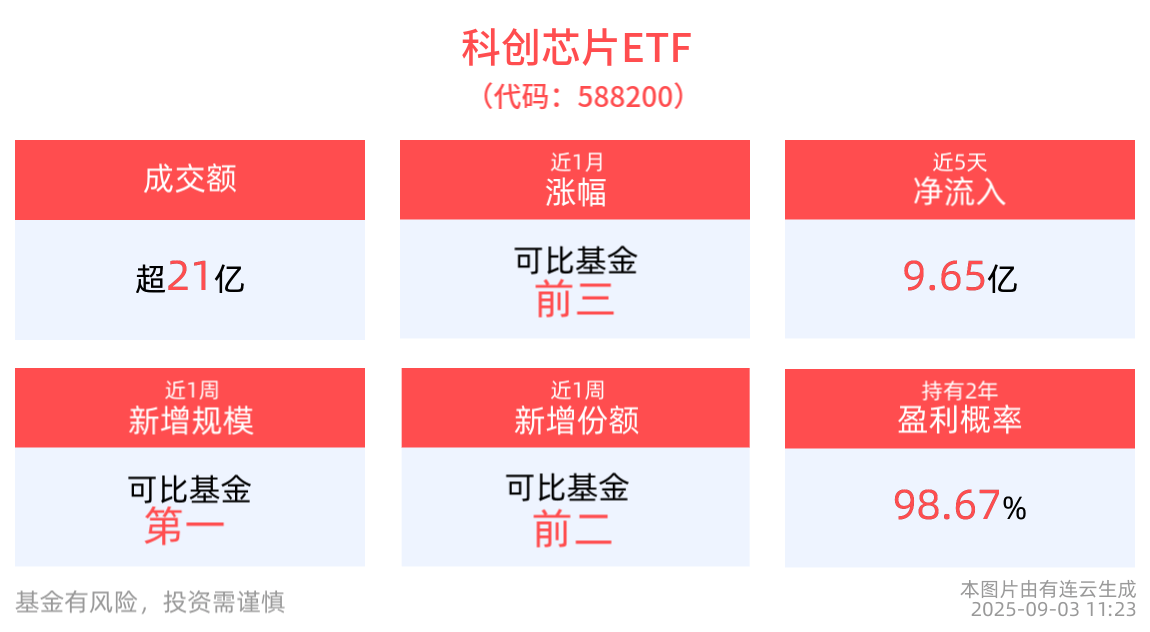
Group 1: ETF Performance - The Sci-tech Chip ETF had a turnover rate of 5.96% during the trading session, with a transaction volume of 2.188 billion yuan [1] - Over the past week, the average daily transaction volume of the Sci-tech Chip ETF reached 5.417 billion yuan, ranking first among comparable funds [1] - The ETF's scale increased by 2.746 billion yuan in the past week, marking significant growth and leading among comparable funds [1] - The number of shares for the Sci-tech Chip ETF grew by 723 million shares in the past week, indicating substantial growth [1] - In the last five trading days, the ETF attracted a total of 965 million yuan in inflows [1] - As of September 2, 2025, the net value of the Sci-tech Chip ETF has increased by 84.69% over the past two years, ranking 32nd out of 2279 index equity funds, placing it in the top 1.40% [1] - The highest monthly return since inception was 35.07%, with the longest consecutive monthly gains being four months and the longest cumulative gain being 36.01% [1] - The average monthly return during the rising months was 9.53% [1] Group 2: Market Drivers - Recent positive developments in the Sci-tech chip sector include Alibaba's reaffirmation of a 380 billion yuan investment plan for AI and cloud infrastructure over the next three years [2] - CITIC Securities estimates that this investment could drive an increase of hundreds of billions in domestic computing power and semiconductor sectors [2] - Assuming an average annual investment of 130 billion yuan, with 70% allocated to IT hardware, this corresponds to approximately 91 billion yuan [2] - Based on the Bill of Materials (BoM) for hardware, 70% of the computing chips would equate to around 65 billion yuan [2] - Industry analysts suggest that the Sci-tech chip sector may benefit from three main factors: a 42-fold year-on-year increase in net profit for leading stocks in Q1, the acceleration of domestic production due to safety incidents involving overseas chip giants, and a shift of domestic cloud providers towards self-developed chips [2] Group 3: Top Holdings - The top ten weighted stocks in the Sci-tech Chip Index include Cambricon, Haiguang Information, SMIC, and others, collectively accounting for 62.02% of the index [1]
主力个股资金流出前20:山子高科流出8.24亿元、新易盛流出5.19亿元
Jin Rong Jie· 2025-09-03 02:40
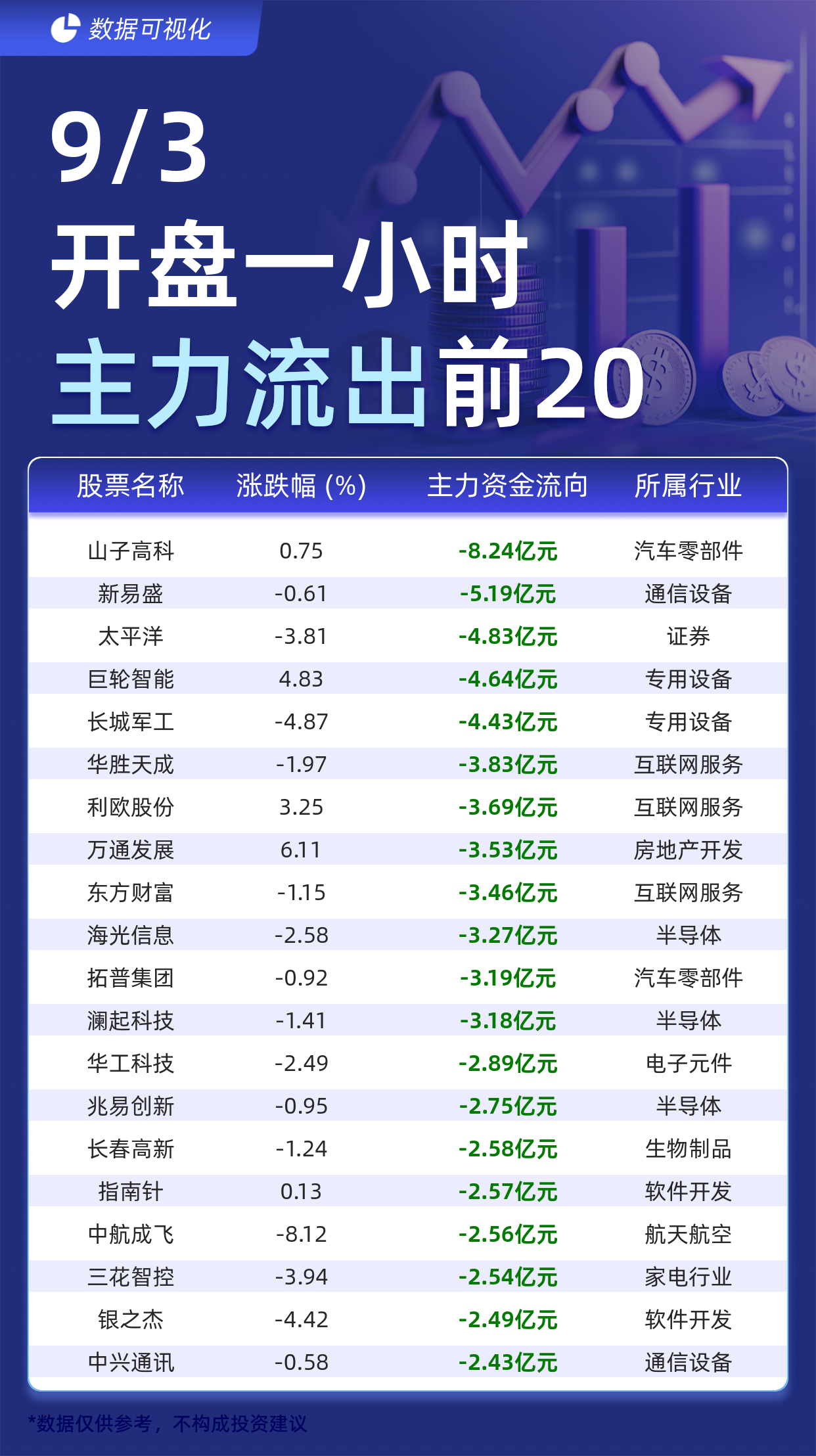
Group 1 - The main stocks with significant capital outflow include Shanzi Gaoke (-8.24 billion), Xinyi Sheng (-5.19 billion), and Pacific (-4.83 billion) [1][2] - The sectors affected by the capital outflow include automotive, telecommunications, securities, and internet services [2][3] - Notable stock performances show that Shanzi Gaoke had a slight increase of 0.75%, while Longcheng Military Industry and Zhonghang Chengfei experienced declines of -4.87% and -8.12% respectively [2][3] Group 2 - The total capital outflow from the top 20 stocks indicates a trend of investors pulling back from certain sectors, particularly in specialized equipment and internet services [1][2] - Companies like Wan Tong Development and Liou Shares saw positive stock performance despite significant capital outflow, indicating potential resilience in the real estate and internet service sectors [2][3] - The data reflects a broader market sentiment where certain stocks are under pressure, leading to strategic shifts in investment focus [1][2]


天风证券晨会集萃-20250903
Tianfeng Securities· 2025-09-02 23:42
Group 1 - The report highlights that the performance of various sectors such as electronics, home appliances, non-bank financials, machinery, non-ferrous metals, computers, food and beverage, defense, telecommunications, media, and agriculture is improving [3][25]. - From the perspective of earnings surprises, industries with the highest upward revisions in net profit forecasts from June 30, 2025, to August 30, 2025, include steel, non-ferrous metals, beauty care, non-bank financials, and banks [3][27]. - The report identifies a phenomenon of profit discontinuity, where the lowest price on the first trading day after earnings announcements is higher than the highest price on the previous trading day, particularly in sectors like food and beverage, beauty care, non-bank financials, banks, and transportation [3][27]. Group 2 - In August, major equity indices in the A-share market continued to rise, with the ChiNext index increasing by 24.13% [4][31]. - The central bank's net fund injection in August was 446.6 billion yuan, indicating a slight tightening of liquidity towards the end of the month [4][31]. - The report notes a rebound in non-ferrous metals, while oil prices have slightly declined, and pork prices remain low [4][31]. Group 3 - The global semiconductor industry is experiencing structural prosperity driven by rapid growth in AI computing demand, accelerated terminal intelligence, recovery in automotive electronics, and deepening domestic substitution [11][25]. - In Q2 2025, the semiconductor sector reported revenues of 133.66 billion yuan and a net profit of 10.63 billion yuan, indicating a clear trend of profit recovery [11][25]. - The report suggests focusing on sectors such as storage, power, foundry, ASIC, and SoC for their earnings elasticity, as well as equipment materials and domestic substitution in computing chips [11][25]. Group 4 - The U.S. fixed income market is the largest globally, with a market size of 58.2 trillion USD in 2024, accounting for 40.10% of the global total [9][38]. - As of Q1 2025, the U.S. fixed income market's outstanding amount reached 47.44 trillion USD, with U.S. Treasury bonds making up over 60% of this figure [9][38]. - The report indicates that the issuance volume in the U.S. fixed income market for the first half of 2025 was 5.70 trillion USD, reflecting a 14.21% increase compared to the same period in 2024 [9][38]. Group 5 - The report emphasizes the importance of AI applications across various sectors, including gaming, healthcare, marketing, education, finance, and office productivity, highlighting the ongoing integration of AI technologies [6][34]. - The AI sector is expected to see significant growth driven by government policies promoting the integration of AI into key industries [6][34]. - The satellite internet industry is also noted for its rapid development, with low-orbit satellites driving innovation across the supply chain [6][34].






9月2日科创板主力资金净流出130.68亿元
Sou Hu Cai Jing· 2025-09-02 15:37
Market Overview - The main funds in the Shanghai and Shenzhen markets experienced a net outflow of 151.28 billion yuan, with the Sci-Tech Innovation Board seeing a net outflow of 13.07 billion yuan [1] - A total of 144 stocks on the Sci-Tech Innovation Board saw net inflows, while 441 stocks experienced net outflows [1] Fund Flow Analysis - Among the stocks with net inflows, 11 had inflows exceeding 100 million yuan, with Ying Shi Innovation leading at 153 million yuan, followed by Han's Med and BeiGene with inflows of 146 million yuan and 145 million yuan respectively [1] - The stock with the highest net outflow was Lanqi Technology, which saw a net outflow of 1.04 billion yuan and a decline of 7.10% [1] Continuous Fund Flow - There are 39 stocks that have seen continuous net inflows for more than three trading days, with Han's Med leading at 10 consecutive days of inflow [2] - Conversely, 170 stocks have experienced continuous net outflows, with Xuantai Pharmaceutical leading at 16 consecutive days of outflow [2] Top Net Inflow Stocks - The top stocks by net inflow include: - Ying Shi Innovation: 152.79 million yuan, 6.20% inflow rate, 7.01% increase [2] - Han's Med: 146.19 million yuan, 0.57% inflow rate, 2.18% increase [2] - BeiGene: 145.45 million yuan, 3.28% inflow rate, 8.28% increase [2] Top Net Outflow Stocks - The stocks with the highest net outflows include: - Lanqi Technology: -1.04 billion yuan, -7.10% decrease [1] - Haiguang Information: -751 million yuan [1] - Huahong Semiconductor: -418 million yuan [1]
产业链业绩激增,中国AI的确定性与想象力
2 1 Shi Ji Jing Ji Bao Dao· 2025-09-02 13:35
Core Insights - The AI industry chain companies have shown varied performance in their mid-year reports, with a long-term positive trend driven by AI [1] - Approximately two-thirds of the 85 listed AI companies reported profits, with 15 companies experiencing net profit growth exceeding 100%, primarily in the computing infrastructure sector [1][2] Group 1: AI Infrastructure Performance - The AI infrastructure sector has seen significant growth, particularly in semiconductor and server manufacturers, driven by applications like DeepSeek [2] - Chinese AI semiconductor company Cambricon reported a revenue of 2.881 billion yuan, a year-on-year increase of 4347.82%, and a net profit of 1.038 billion yuan, marking its first profitable half-year [2] - Another leading domestic AI chip company, Haiguang Information, achieved a revenue of 3.763 billion yuan, up 44.08% year-on-year, with a net profit of 853 million yuan, a 25.97% increase [2] Group 2: Market Trends and Shifts - The demand for AI computing chips is surging, with local chips gaining market recognition, which is further boosting the performance of upstream wafer foundries [4] - Semiconductor manufacturer SMIC reported a revenue of 32.35 billion yuan, a 23.1% year-on-year increase, and a net profit of 1.9 billion yuan, up 47.8% [4] - Huahong Semiconductor's revenue for the first half of 2025 was 8.018 billion yuan, a 19.09% increase, but its net profit fell by 71.95% due to initial production costs and increased R&D expenses [4] Group 3: AI Model Development and Investment - Major internet companies like Alibaba and Tencent are enhancing AI model capabilities, leading to increased infrastructure demand, with Alibaba's capital expenditure reaching 38.7 billion yuan and Tencent's rising 119% year-on-year to 19.11 billion yuan [5] - The market is shifting from AI training to AI inference, with the demand ratio changing from 80% training to 70% inference [6][7] - The Chinese AI server market is experiencing rapid growth, with Inspur's revenue reaching 80.192 billion yuan, a 90.05% increase [7] Group 4: Policy and Future Outlook - The Chinese government has initiated the "Artificial Intelligence +" action plan, aiming for widespread integration of AI in six key areas by 2027, with a target application rate exceeding 70% for new intelligent terminals and agents [8][9] - This policy is expected to catalyze the comprehensive rollout of AI applications across various sectors, enhancing demand and ecosystem development [9]
“AI+”全面提速,政策与市场双轮驱动经济新动能
Huan Qiu Wang Zi Xun· 2025-09-02 06:27
Core Insights - The rapid development of artificial intelligence (AI) technology is becoming a core engine for economic growth, as highlighted by the State Council's recent issuance of the "Opinions on Deepening the Implementation of 'Artificial Intelligence +'" which outlines six key actions for industrial development [1] Group 1: AI Penetration Across Industries - AI is accelerating its penetration into various industries, with over 60% of exhibitors at the recent 2025 China International Big Data Industry Expo showcasing products and services related to "Artificial Intelligence +" [2] - Companies like Haiguang Information reported a net profit exceeding 1 billion yuan for the first time due to increased demand for AI models, while Industrial Fulian's AI server revenue grew over 60% year-on-year in Q2 [2] - AI algorithms are significantly enhancing the market competitiveness of companies such as Ruichuang Micro-Nano [2] Group 2: Strengthening Computing Power Infrastructure - Computing power is described as the "electricity" and core infrastructure for AI development, with China's total computing power reaching 302 EFLOPS, ranking second globally [4] - The National Development and Reform Commission is issuing "AI vouchers" to lower innovation costs and accelerate technology accessibility [4] - Major tech companies like Huawei are building large-scale computing centers to provide stable and high-performance computing services [4] Group 3: New Consumption Potential and Economic Growth - The deep integration of AI with consumer quality enhancement is stimulating new consumption potential and driving rapid growth in core smart economy industries [5] - AI is optimizing consumption structures, with smart devices like connected cars and smart homes becoming increasingly prevalent [5] - The AI industry in China is expected to enter a high-speed development phase over the next decade, with optimistic projections suggesting the market could reach 36.63 trillion yuan by 2035 [5]