
CHANGAN AUTOMOBILE-B(000625)

Search documents
乘用车全球化策略:从全面扩张走向分市场、分主体的结构性出海
Soochow Securities· 2026-01-08 09:35
Group 1: Global Market and New Energy Penetration Forecast - The overall global passenger car sales are projected to reach 9,015 million units by 2026, with a growth rate of 1.7% year-on-year [16] - In Europe, the new energy penetration rate is expected to exceed 30% by 2026, driven by the launch of affordable models and the reintroduction of subsidies [2][34] - Southeast Asia is anticipated to see a new energy penetration rate of 19% in 2026, with significant contributions from Chinese automakers and local manufacturers [2][37] Group 2: Chinese Automakers' Global Market Share Forecast - The potential export market for Chinese automakers is estimated at 27 million units, with an export potential of approximately 9.08 million units by 2025 [3][5] - The market share ceiling for Chinese brands in regions prioritizing local brand development is expected to be lower compared to markets that do not emphasize local brand cultivation [5] - By 2025, the export share of new energy vehicles is projected to reach 42%, with BYD being a major contributor to this growth [3] Group 3: Export Predictions for Automakers - BYD is expected to have a high market match across most regions, particularly in Oceania and the UK, where there are minimal structural constraints [9] - Chery's core markets with the highest external environment match include Russia, Central Asia, and the Middle East, while the EU market presents more constraints [9] - Great Wall Motors is well-positioned in markets with stable demand for SUVs and pickups, particularly in the Middle East and Africa [9] Group 4: Investment Recommendations - The report suggests prioritizing investment in automakers with mature overseas systems and proven execution capabilities, specifically recommending BYD, Great Wall Motors, and Chery [11] - The export volume of various automakers is expected to increase significantly, with Chery projected to have an export share of 42% by 2026 [10] - The overall export volume for Chinese automakers is forecasted to reach 745,000 units by 2027, with a year-on-year growth rate of 13% [12]




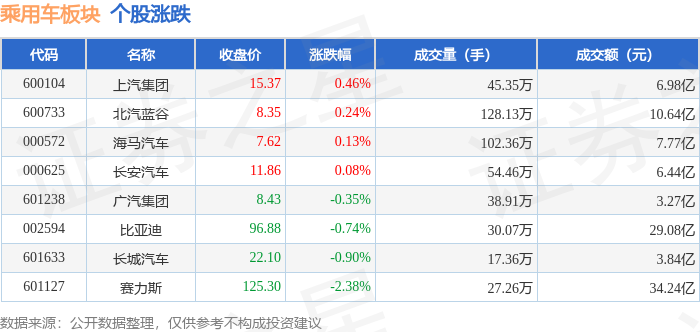
乘用车板块1月8日跌0.71%,赛力斯领跌,主力资金净流出8.08亿元
Zheng Xing Xing Ye Ri Bao· 2026-01-08 08:51
| 代码 | 名称 | 主力净流入(元) | 主力净占比 游资净流入 (元) | | 游资净占比 散户净流入 (元) | | 散户净点比 | | --- | --- | --- | --- | --- | --- | --- | --- | | 600104 | 上汽集团 | 1431.64万 | 2.05% | -3344.51万 | -4.79% | 1912.87万 | 2.74% | | 000625 长安汽车 | | -1789.80万 | -2.78% | -619.69万 | -0.96% | 2409.49万 | 3.74% | | 600733 北汽蓝谷 | | -2206.16万 | -2.07% | -4884.77万 | -4.59% | 7090.93万 | 6.67% | | 601238 广汽集团 | | -3569.60万 | -10.90% | 434.34万 | 1.33% | 3135.27万 | 9.58% | | 000572 海马汽车 | | -3600.32万 | -4.63% | -3160.85万 | -4.07% | 6761.18万 | 8.70% | | ...






从监管智驾到准许L3上路,十大事件解码多维博弈
Xin Jing Bao· 2026-01-08 08:29
Core Insights - The Chinese automotive market in 2025 is undergoing a multifaceted transformation driven by policy regulations, capital restructuring, technological breakthroughs, and safety standards. This transformation is not merely a technical iteration or market reshuffle but a comprehensive evolution that presents opportunities for industry restructuring and transformation [1] Regulatory Changes - The Ministry of Industry and Information Technology (MIIT) has mandated that automotive companies clarify system functionality and safety responses, moving away from exaggerated claims in intelligent driving promotions. This shift has led to a more rational understanding of "assisted driving" versus "autonomous driving" among consumers [2] Supply Chain Developments - The implementation of a 60-day payment term for large enterprises purchasing from small and medium-sized suppliers has significantly alleviated cash flow pressures on these suppliers. This change allows them to invest more in technology development, enhancing the quality and technical level of components [3] New Corporate Structures - The establishment of the China Changan Automobile Group as a new state-owned enterprise marks a significant shift in the industry landscape, enhancing decision-making autonomy and financing capabilities while focusing on new energy and intelligent technology [5] Asset Restructuring - Dongfeng Group has accelerated its transformation by divesting low-efficiency fuel assets and focusing on high-end new energy brands. This strategic move exemplifies how traditional automakers can innovate through capital restructuring [6][7] Safety Regulations - New regulations regarding hidden door handles require mechanical emergency functions to ensure safety in extreme conditions, reflecting a balance between innovation and safety in vehicle design [8] Market Performance - Chery Automobile's successful IPO, achieving a market value exceeding 200 billion HKD, highlights its strong performance with a 7.8% increase in total sales and a 54.9% surge in new energy vehicle sales [9] Autonomous Driving Milestones - The approval of L3-level conditional autonomous driving vehicles for real-world testing represents a significant milestone for the industry, allowing for data collection and setting safety boundaries for future developments [10] Corporate Integrations - The completion of the integration of Geely and Zeekr signifies a strategic elevation of Geely's market position, enhancing its technological capabilities and financial stability [11] Quality Concerns - A significant lawsuit against Xinwanda for quality issues in battery cells has raised alarms in the battery industry, emphasizing the need for improved quality management throughout the product lifecycle [12][13] Strategic Partnerships - FAW's investment in Leap Motor illustrates a strategic collaboration that combines manufacturing strength with innovative technology, potentially enhancing both companies' market positions [14]
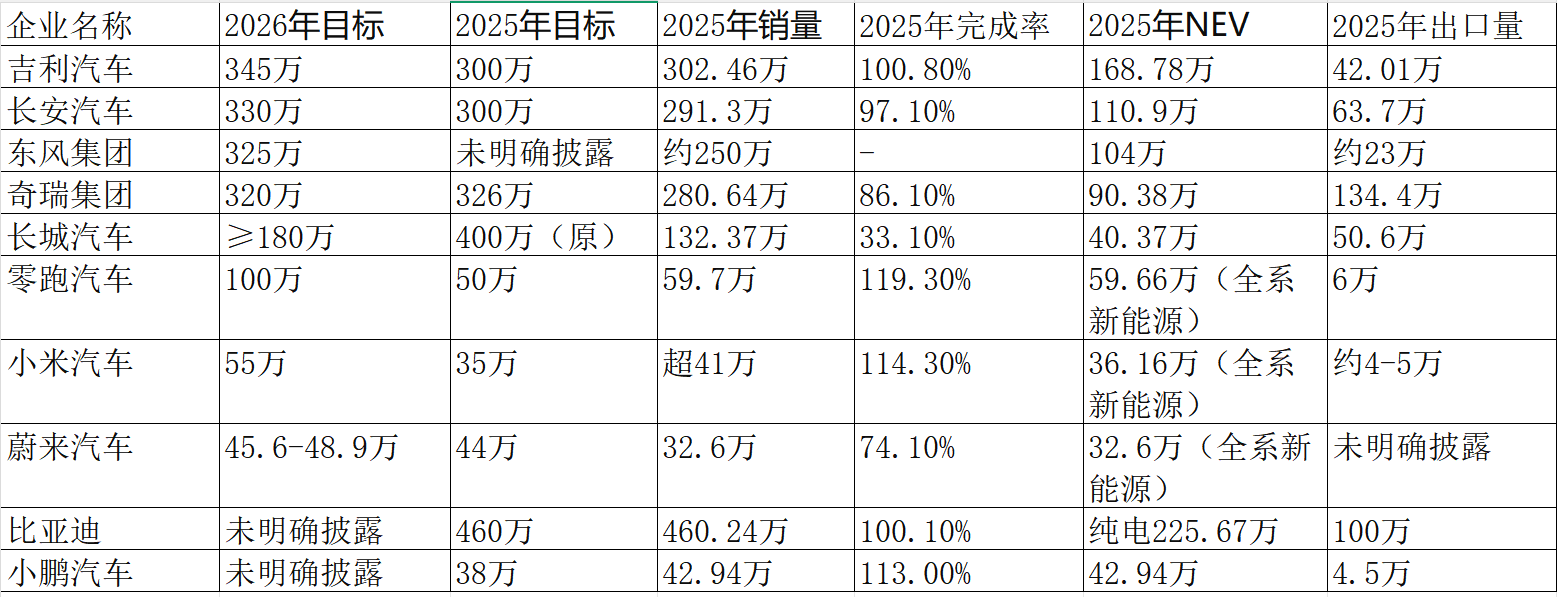
盘点2026年部分车企销量目标
Zhong Guo Qi Che Bao Wang· 2026-01-08 07:15
Core Viewpoint - Several automotive companies have announced their sales targets for 2026, and an analysis of their 2025 performance reveals the potential challenges they may face in achieving these goals [3]. Group 1: Company Performance and Targets - Geely Automobile aims for a target of 3.45 million units in 2026, having achieved 3.0246 million units in 2025, exceeding its target of 3 million units with a completion rate of 100.8% [3] - BYD's actual sales in 2025 reached 4.6024 million units, surpassing its adjusted target of 4.6 million units, with a significant pure electric sales figure of 2.2567 million units, ranking first globally [5] - Leap Motor set a target of 1 million units for 2026, achieving 597,000 units in 2025, exceeding its target of 500,000 units with a completion rate of 119.3% [8] - Changan Automobile has a target of 3.3 million units for 2026, with 2025 sales of 2.913 million units, achieving a completion rate of 97.1% [12] - Chery Group aims for 3.2 million units in 2026, having sold 2.8064 million units in 2025, with a completion rate of 86.1% [15] - NIO targets between 456,000 and 489,000 units for 2026, with 2025 sales of 326,000 units, achieving a completion rate of 74.1% [20] Group 2: Challenges Faced by Companies - Geely faces challenges such as EU anti-subsidy investigations and changes in Brazil's tax policies affecting exports [3][4] - BYD needs to improve sales in the high-end market, particularly for its luxury models, and address rising overseas transportation costs, which increased by 47% [6][7] - Leap Motor must compete in the 100,000-150,000 yuan market against Geely and Changan, while its gross margin is only 12%, below the industry average of 15% [10] - Changan's challenges include competition in the new energy market with BYD and Tesla, and reliance on Middle Eastern and Southeast Asian markets for exports, which are subject to geopolitical risks [14] - Chery's domestic market faces low new energy penetration at 32%, necessitating a faster transition, while its exports are vulnerable to currency fluctuations and trade barriers [15] - Great Wall Motors has significantly reduced its target from 4 million to 1.8 million units, indicating a strategic contraction, and faces delays in its new energy transition [18][19] - NIO's sales target increase of 40-50% requires monthly sales of 38,000-41,000 units, while its average monthly sales in 2025 were only 27,000 units, alongside ongoing financial losses [22] Group 3: Industry Trends and Insights - The competition in the automotive market is intensifying, with many companies having gross margins below the industry average of 15%, limiting their operational flexibility [23] - The price volatility of lithium carbonate, a key component for batteries, is expected to negatively impact cost reduction efforts for automotive companies in 2026 [23] - The automotive industry is entering a phase of "technology-driven + globalization" competition, requiring companies to balance scale, profit, and technology to achieve their 2026 targets [25]


长安年终奖,四个月起步......
自动驾驶之心· 2026-01-08 05:58
该消息也侧面印证了长安汽车取消年终奖一事不实,且内部已经进入到落实阶段。随着长安汽车官方辟谣,网 络上的争议也随之反转,有来自其他车企的员工在社交平台上表示,"两天前还在嘲笑长安,现在嘲笑我自己 了"。还有网友表示:"小丑竟是我自己"、"长安汽车,对不起,我承认我之前笑的太大声了"。(快科技) 点击下方 卡片 ,关注" 自动驾驶之心 "公众号 戳我-> 领取 自动驾驶近30个 方向 学习 路线 据雷锋网报道,1月7日消息,近日,有媒体爆料称,国内某车企发出一则内部通知称:鉴于今年公司销量、利 润率等指标未达成年终目标,所以今年没有年终激励奖。虽然该车企年度销量目标未达标,但销量完成率达到 了97%,有媒体据此推断,取消年终奖的车企是长安汽车,且在社交平台上,疑似有长安汽车员工证实年终奖 取消,此事引发热议。 7日,长安汽车不实信息举报中心发文称,针对近期网络上出现的"长安汽车取消年终奖"等不实信息,公司严 正声明如下:2025年,长安汽车整体经营态势稳健,公司已根据年度经营实绩,按照激励标准制定并推进相应 激励计划,切实保障员工权益,助力企业可持续发展。对此,有媒体从多位接近长安汽车的业内人士处获悉, 部分部 ...
研报掘金丨爱建证券:维持长安汽车"买入"评级,2026年新能源车目标140万辆
Ge Long Hui· 2026-01-08 05:33
Core Viewpoint - Chang'an Automobile's brand enhancement and overseas expansion are expected to drive sales growth in 2026, with a focus on new energy vehicles and globalization as dual main lines for 2025, achieving a sales target completion rate of 97% [1] Sales Targets - The target for new energy vehicles in 2026 is set at 1.4 million units, representing a year-on-year increase of 26.2% [1] - The overseas sales target for 2026 is 750,000 units, reflecting a year-on-year growth of 17.7% [1] Product Development and Investment - Over the next five years, the company plans to launch more than 50 new energy vehicle models, including over 7 models priced above 300,000 yuan [1] - The company will invest over 200 billion yuan in new vehicle development over the next decade and expand its technology innovation team by more than 10,000 personnel [1] Emerging Industries and Future Plans - The company plans to release its first manned flying car in 2026 and achieve solid-state battery installation verification [1] - Full-scale production of solid-state batteries is expected to begin in 2027, with flying cars set for mass production and humanoid robots to roll off the production line in 2028 [1] - Commercial operation of flying cars is anticipated by 2030 [1] Strategic Initiatives - The company is systematically advancing electric intelligence and globalization through three strategic plans, with forward-looking layouts in robotics and flying car businesses, maintaining a "buy" rating [1]
汽车早餐 | 长安汽车辟谣“取消年终奖”;字节跳动否认“将跨界联合车企造车”;萝卜快跑拿下迪拜首个全无人测试许可
Zhong Guo Qi Che Bao Wang· 2026-01-08 01:19
Group 1 - The Ministry of Industry and Information Technology and eight other departments issued the "Implementation Opinions on the Special Action of 'Artificial Intelligence + Manufacturing'" to promote the iteration of intelligent equipment and enhance the capabilities of industrial mother machines and robots [2] - The plan includes the development of a new generation of AI numerical control systems and the testing of intelligent connected vehicles with autonomous driving functions [2] - The Ministry of Industry and Information Technology also released the "Action Plan for the Integration of Industrial Internet and Artificial Intelligence," emphasizing the need to strengthen the supply of industrial intelligent computing power [3] Group 2 - The European Union's plan to strengthen trade protection measures in the steel sector has raised concerns among downstream industries, warning of high tariff risks that could lead to billions of euros in additional costs [5][6] - A joint statement from ten industry associations, including the European Automobile Manufacturers Association, highlighted the potential negative impact on EU internal manufacturers due to proposed tariffs of 50% on steel imports exceeding specific quotas [5][6] Group 3 - Mobileye announced plans to acquire Israeli humanoid robot startup Mentee Robotics for a total of $900 million, aiming to integrate Mentee's technology in bionic movement and autonomous decision-making into its operations [8] - Mercedes-Benz will relocate the production of its entry-level A-Class model from Germany to Hungary to reduce costs and improve production efficiency, starting in the second quarter of this year [9] Group 4 - GAC Group reported a total annual sales volume of 1.8135 million vehicles for 2025, with a fourth-quarter sales increase of 25.56% quarter-on-quarter, marking three consecutive quarters of positive growth [10] - Changan Automobile denied rumors regarding the cancellation of year-end bonuses, affirming that the company is implementing incentive plans based on annual performance to ensure employee rights [11] - Leap Motor announced a fundraising plan through the issuance of new domestic shares, raising approximately 3.74 billion RMB from one investor and about 3 billion RMB from another, totaling around 6.74 billion RMB [13] - Desay SV plans to issue H-shares for listing in Hong Kong to enhance its international strategy and influence, with details yet to be finalized [14] - Baidu's RoboTaxi service, "Luobo Kuaipao," received the first full unmanned testing license in Dubai, becoming the only company authorized for such testing in the region [15]

长安汽车申请车载总线测试方法专利,暴露车载总线的安全漏洞
Jin Rong Jie· 2026-01-08 00:27
Group 1 - Chongqing Changan Automobile Co., Ltd. has applied for a patent titled "Vehicle Bus Testing Method, Device, Equipment, Storage Medium, and Program Product," with publication number CN121283894A, and the application date is September 2025 [1] - The patent involves a method for testing vehicle safety by obtaining target messages from the vehicle bus, fuzzing the fields in the target messages, and conducting frame injection attacks to detect any anomalies in the vehicle's response [1] - The method aims to expose security vulnerabilities in the vehicle bus and validate the vehicle's safety and robustness under hybrid attacks by generating test results based on the vehicle's responses to both fuzzed and normal messages [1] Group 2 - Chongqing Changan Automobile Co., Ltd. was established in 1996 and is primarily engaged in the automotive manufacturing industry, with a registered capital of 991,408.606 million RMB [2] - The company has invested in 120 enterprises, participated in 5,000 bidding projects, and holds 3,116 trademark records and 5,000 patent records, along with 1,053 administrative licenses [2]
大反转?长安辟谣取消年终奖,或发4.3倍月薪+3000现金;吉利汽车今年要卖345万辆!多家车企公布2026销量目标;OPPO确认realme将回归
雷峰网· 2026-01-08 00:27
Key Points - Multiple automakers have announced their sales targets for 2026, with Geely aiming for 3.45 million units this year, representing a 14% growth rate, making it the highest among disclosed targets [4] - Dongfeng Group has set a target of 3.25 million units for 2026, with an estimated growth rate exceeding 30%, including 1.7 million electric vehicles [4] - Chery Group aims for 3.2 million units, a 14% increase from 2025, while Great Wall Motors has lowered its target from 2.49 million to 1.8 million units, reflecting a 36% growth from last year [5] - NIO's sales target for 2026 is set between 456,000 and 489,000 units, indicating a growth rate of 40-50% [5] Domestic News - Lei Jun, founder of Xiaomi, expressed his discomfort with being labeled a "marketing master," emphasizing that Xiaomi's success is rooted in product and technology rather than marketing [7] - Changan Automobile refuted rumors about canceling year-end bonuses, confirming a plan to distribute bonuses equivalent to 4.3 months' salary plus a fixed amount of 3,000 yuan [10][11] - Realme will return to OPPO as a sub-brand, with CEO Sky Li overseeing all sub-brand operations, aiming for better resource integration [13] International News - Tesla faced a significant decline in European sales for 2025, with a 27.8% drop from approximately 326,000 units in 2024 to about 235,000 units [35] - The decline was particularly severe in Germany, where sales plummeted by 48.4%, and in France, where new policies negatively impacted sales by 37.5% [36][37] - Despite the overall downturn, Tesla saw a 41.3% increase in Norway, although this growth is expected to be short-lived due to upcoming changes in electric vehicle incentives [37] Company Developments - IKEA China announced the closure of seven stores as part of a strategy to optimize its channel layout and enhance business resilience [14] - Huawei's spun-off business, xFusion, is set to initiate an IPO, with a valuation estimated at nearly $9 billion [15] - Roborock unveiled a concept cleaning robot at CES 2026, featuring a unique design that allows it to navigate stairs [30]



L3级自动驾驶行业:从测试阶段迈向商业化应用
Zheng Quan Ri Bao· 2026-01-07 17:06
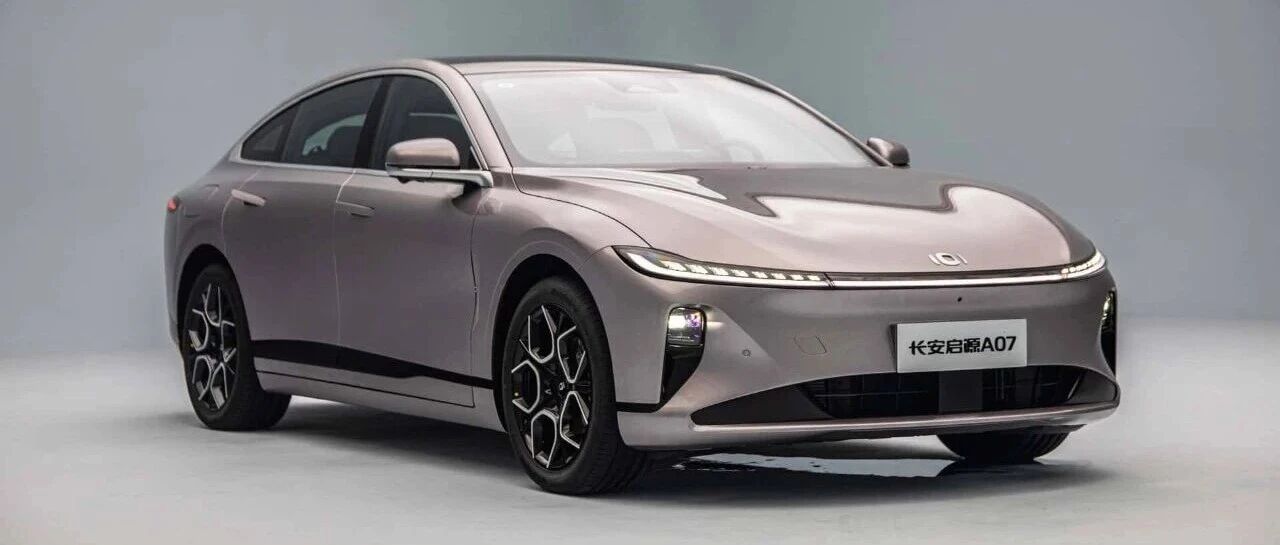
Core Viewpoint - The first batch of L3-level conditional autonomous driving vehicles has begun real-world testing in designated areas of cities like Chongqing and Beijing, indicating a significant step towards commercialization in the autonomous driving sector in China [1][2]. Group 1: L3-Level Autonomous Driving Development - The Ministry of Industry and Information Technology has officially granted approval for the first batch of L3-level conditional autonomous driving vehicles, including models from Changan Automobile and Arcfox, marking a critical transition from testing to commercial application [2]. - Changan Automobile's L3-level autonomous driving system allows for hands-free driving in specific conditions, such as traffic congestion and single-lane highways, with a maximum speed of 50 km/h [3]. - The L3-level autonomous driving system is expected to begin B-end pilot operations in the first quarter of 2026, with plans to gradually open more features to users based on national policies [3]. Group 2: Industry Impact and Market Potential - The approval of L3-level autonomous driving vehicles is seen as a pivotal moment that will reshape driving modes and significantly impact the entire intelligent driving industry chain, prompting companies to upgrade technologies in anticipation of commercialization [3][4]. - According to Southwest Securities, the domestic L3-level autonomous driving market is projected to exceed 1.2 trillion yuan by 2030, indicating a potential new trillion-yuan market segment [4]. - The industry is expected to transition from "testing demonstration" to "scale production" driven by policy, technology, and cost factors, although challenges such as responsibility recognition during human-machine switching and high costs remain [4].