WLY(000858)

Search documents
连续七日“吸金”累计超1.5亿元,食品饮料ETF天弘(159736)盘中获净申购1800万份,机构:食品饮料板块有望估值和业绩双提升
2 1 Shi Ji Jing Ji Bao Dao· 2025-09-25 07:18
Core Viewpoint - The Tianhong Food and Beverage ETF (159736) is experiencing active trading and has seen significant net inflows, indicating strong investor interest in the food and beverage sector amid positive market signals and upcoming consumption events [1][2][3]. Group 1: ETF Performance - As of September 25, the Tianhong Food and Beverage ETF (159736) showed a slight decline of 0.55% with a trading volume exceeding 24 million yuan and a premium/discount rate of 0.18% [1]. - The ETF has recorded a net subscription of 18 million units, reflecting strong demand from investors [2]. - The ETF has seen a continuous net inflow of funds for seven consecutive trading days, accumulating over 150 million yuan [3]. Group 2: Composition and Holdings - The Tianhong Food and Beverage ETF closely tracks the CSI Food and Beverage Index, which includes stocks from the beverage, packaged food, and meat industries [3]. - Major holdings in the ETF include leading companies such as Kweichow Moutai, Yili Group, Wuliangye, Shanxi Fenjiu, Luzhou Laojiao, and Haitian Flavoring & Food [3]. Group 3: Market and Consumption Trends - Recent reports indicate a positive outlook for the liquor market, with Moutai's management noting a significant recovery in terminal sales as the traditional double festival approaches [4]. - Various promotional activities are being launched to stimulate consumption, including a 10 million yuan tourism consumption voucher initiative in Haikou [3].






白酒板块午盘下跌 贵州茅台微跌0.07%
Bei Jing Shang Bao· 2025-09-25 05:10
Core Viewpoint - The overall market showed a slight increase with the Shanghai Composite Index rising by 0.16% to 3859.62 points, while the liquor sector experienced a decline, indicating mixed performance in the industry [1] Industry Summary - The liquor sector index closed at 2259.28 points, down by 0.45%, with 16 liquor stocks experiencing declines [1] - Key liquor companies reported the following stock prices: - Kweichow Moutai at 1441.03 CNY, down 0.07% - Wuliangye at 122.00 CNY, up 0.30% - Shanxi Fenjiu at 194.28 CNY, down 0.17% - Luzhou Laojiao at 130.50 CNY, down 1.07% - Yanghe Brewery at 68.76 CNY, down 0.51% [1] Company Insights - Tianfeng Securities noted that liquor companies have begun preparations for the upcoming double festival, although the overall consumption environment remains under pressure [1] - The report highlighted a slight downward trend in the short-term prices of core high-end liquor, suggesting that better value propositions may stimulate sales [1] - Future focus will be on the recovery of the banquet market during the double festival [1]

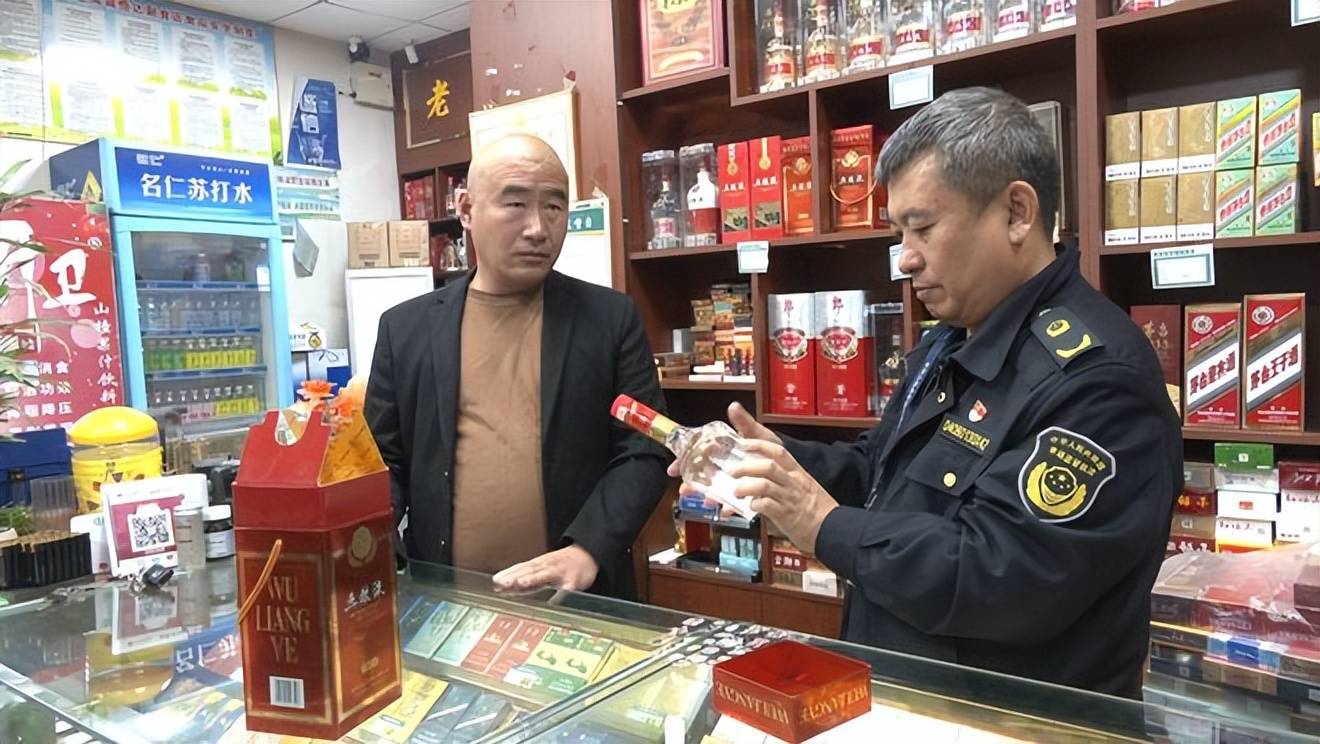
盐湖区市场监督管理局开展节前酒类产品安全检查 筑牢节日消费“安全防线”
Sou Hu Cai Jing· 2025-09-25 05:00
Group 1 - The upcoming Mid-Autumn Festival and National Day are expected to drive a peak in alcohol consumption, prompting regulatory actions to ensure product safety [1][3] - A joint inspection team was formed by the Salt Lake District Market Supervision Administration to conduct safety checks on alcoholic products in key retail locations, focusing on the safety of consumer products [1][3] - The inspection emphasized popular alcoholic beverages such as white wine, red wine, and beer, with a thorough examination of sourcing, quality, and labeling [3] Group 2 - Inspectors reviewed purchase ledgers and required documentation from retailers, specifically targeting well-known brands like "Fenjiu" and "Wuliangye" for authenticity verification [3] - Issues identified during inspections included incomplete purchase records and non-compliant labeling, leading to immediate corrective actions and follow-up checks to ensure compliance [3] - The administration plans to enhance market surveillance during the holiday period and maintain open channels for consumer complaints regarding counterfeit or expired products [3]

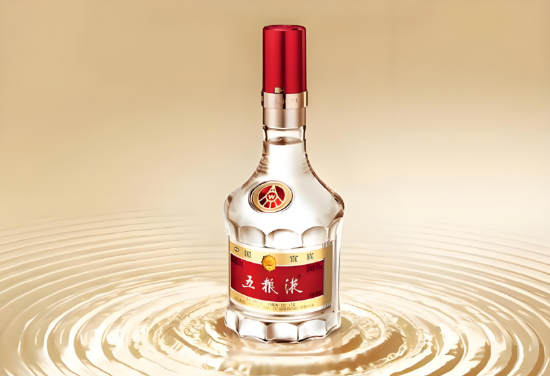
批价雪崩!五粮液“拯救”大单品:允许经销商自行收货救市
Xin Lang Cai Jing· 2025-09-25 04:38
Core Insights - The wholesale price of Wuliangye's flagship product, the eighth generation Wuliangye, has experienced significant fluctuations, dropping to around 800 yuan, which is lower than the price of high-end Guojiao 1573 [1][2] - Wuliangye has introduced a new policy allowing distributors to receive goods without upfront payment, which can be counted towards their 2025 contract obligations, aimed at stabilizing market prices [1][2] - The company's sales performance has been under pressure, with a notable decline in the collection rate from distributors, dropping to approximately 50% this year compared to 75% in the same period last year, indicating a 25 percentage point difference [1][2][3] Pricing and Sales Dynamics - The online pricing for the eighth generation Wuliangye is even lower, with single bottle prices around 750 yuan on e-commerce platforms, reflecting a broader trend of price decline [1][2] - Despite various measures taken by Wuliangye to stabilize prices, including seasonal stock halts and increased channel subsidies, these efforts have not effectively prevented price drops [1][2] Product Performance and Market Strategy - Wuliangye's new product, the 29-degree Wuliangye "Yijian Qingxin," is priced at 399 yuan and targets younger consumers, but there are concerns about its high price point relative to the purchasing power of this demographic [2] - The company's revenue for the first half of 2025 reached 527.71 billion yuan, with a year-on-year growth of 4.19%, marking the first single-digit growth in nearly a decade, indicating pressure on overall performance [3] - The sales volume of Wuliangye products increased by 12.75% in the first half of the year, but the average price per unit decreased by 7.25%, highlighting a typical volume-price relationship [3]
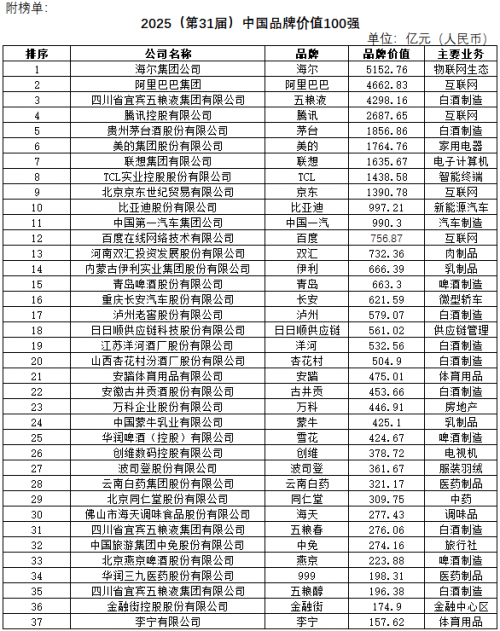
2025中国品牌价值100强揭晓
Sou Hu Cai Jing· 2025-09-25 04:04
Core Insights - The 2025 China Brand Value Top 100 report reveals Haier's brand value at 515.28 billion, maintaining the top position for 24 consecutive years, followed by Alibaba at 466.28 billion and Wuliangye at 429.82 billion [1][9] Brand Value Trends - The average revenue of the top 100 brands increased from 543.63 billion in 2019 to 823.69 billion in 2024, marking a 51.52% growth over five years, with an average annual growth rate of 10.3% [1] - The growth rate has slowed compared to the pre-pandemic average annual growth of 19.28%, indicating a decline of 9.39 percentage points [1] Historical Context - Since the 2008 global financial crisis, the average revenue of the top 100 brands has increased 7.13 times, with average operating profit rising 11.54 times, indicating that brand value remains a crucial asset [2] - The average revenue of the top 20 brands has grown from 49.84 billion in 1994 to 3,523.33 billion in 2024, a 69.69-fold increase, highlighting the trend of stronger brands becoming even stronger [2] Industry Performance - The home appliance industry showed the highest growth rate at 10.32%, followed by the liquor industry at 8.01%. In contrast, the tourism industry faced a negative growth of 1.59% in 2024 after a significant rebound in 2023 [4] - Retail has consistently declined, with drops of 21.21% in 2022, 24.23% in 2023, and 12.4% in 2024, indicating a trend of contraction in physical retail chains [4] Brand Development Insights - Haier's sustained success is attributed to its advancements in ecological co-construction, global layout, IP matrix, and AI technology, enhancing its brand influence [5] - Wuliangye's brand value leadership in the liquor industry is linked to its broad market coverage and high consumer repeat purchase rates, rather than just high product prices [6] Research Methodology - The report emphasizes the importance of independent research on brand value, focusing on consumer-related industries rather than resource monopolistic sectors [7]


批价雪崩! 五粮液“拯救”大单品:允许经销商自行收货救市
Xin Lang Cai Jing· 2025-09-25 03:29
Core Viewpoint - The wholesale price of Wuliangye's flagship product, the eighth generation Wuliangye, has experienced significant fluctuations, dropping to around 800 yuan, which is lower than its competitor, Gaoliang Guojiao 1573 [2][3][5] Pricing and Market Dynamics - The current actual wholesale price of the eighth generation Wuliangye is approximately 810-830 yuan, while Gaoliang Guojiao 1573 is priced at 830-840 yuan [3][5] - Online prices for the eighth generation Wuliangye are even lower, with single bottle prices around 760-780 yuan on certain e-commerce platforms [3][5] - Wuliangye has introduced a new policy allowing distributors to receive goods without upfront payment, which can count towards their 2025 contract obligations [5][7] Sales and Revenue Performance - Wuliangye's distributors have faced challenges in cash collection, with only about 50% of payments collected by mid-year, compared to 75% in the same period last year, reflecting a 25 percentage point decline [7][8] - By September, cash collection rates improved to 60%-80%, but still fell short of the previous year's 90% [7][8] - The inventory turnover days for Wuliangye have reached 70 days, indicating potential inventory pressure [8] Product Launch and Market Reception - Wuliangye's new product, the 29-degree Wuliangye "Yijian Qingxin," is priced at 399 yuan and targets younger consumers, but has faced criticism for its pricing strategy [10][11] - The product has sold over 14,000 bottles on major platforms like Taobao and JD within a month of its launch [8][11] Financial Performance - In the first half of 2025, Wuliangye reported revenue of 52.77 billion yuan, a year-on-year increase of 4.19%, but this marks the first single-digit growth in nearly a decade [11][12] - The company's gross profit margin has declined, with a slight decrease in gross profit despite revenue growth, indicating pressure on profitability [11][12] - The sales volume of Wuliangye products increased by 12.75%, but the average price per unit fell by 7.25%, highlighting a "volume increase, price decrease" trend [12][14]
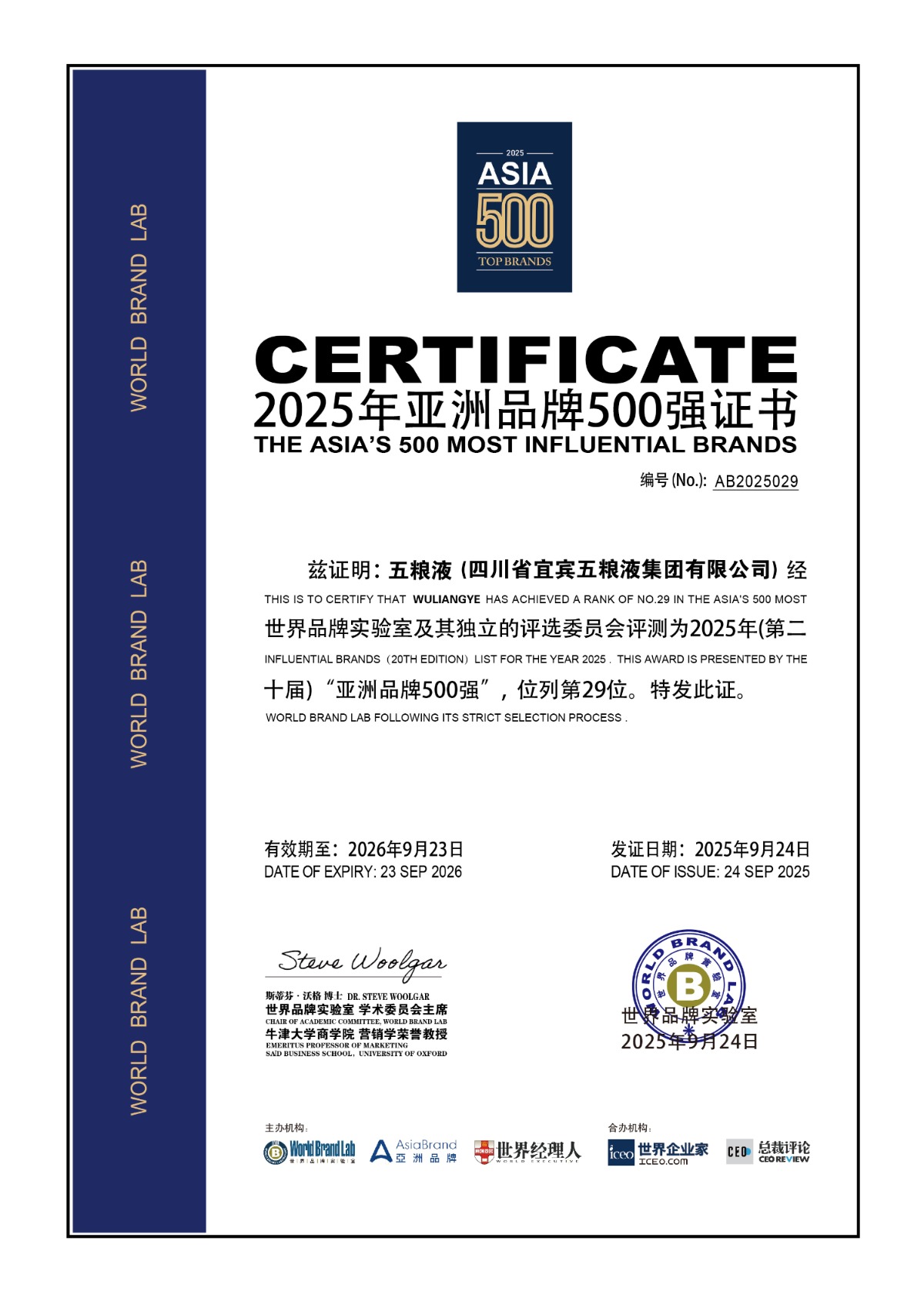
“国民最喜爱的10大品牌”,五粮液位列亚洲品牌500强第29
Qi Lu Wan Bao· 2025-09-25 02:59
Group 1 - The World Brand Lab released the 2025 "Asia's 500 Most Valuable Brands" report, with Wuliangye ranked 29th, an increase of one position from the previous year, marking its 20th consecutive appearance on the list [1] - Wuliangye was also listed among the "Top 10 Most Loved Brands" in the country, highlighting its strong brand influence [1] - The report indicates that 217 brands from China (including Hong Kong, Macau, and Taiwan) made the list, accounting for 43.40% of the total, the highest among all participating countries and regions [3] Group 2 - In the food and beverage sector, Wuliangye ranked second among 41 brands included, demonstrating significant global influence [3] - Wuliangye achieved full scores of 5 in brand influence, brand loyalty, and Asian leadership, with its Asian leadership score being the only one to receive full marks among listed liquor brands [3] - The company has actively participated in high-profile events such as the Boao Forum for Asia and APEC, promoting Chinese traditional culture globally and enhancing its brand image [3] Group 3 - Wuliangye ranked second in the "Brand Finance Global 50 Most Valuable Spirits Brands" list, maintaining the highest AAA+ rating, with a ten-year compound growth rate leading among global liquor brands [4] - The brand has been included in the "World's 500 Most Valuable Brands" list for eight consecutive years, improving its rank by 8 positions to 219th, the highest increase in the liquor industry [4] - With a brand value of 487.657 billion yuan, Wuliangye ranked 15th in the "China's 500 Most Valuable Brands" list, achieving positive brand value growth for eight consecutive years and recognized as the "Best Performing Brand of the Year" [4]
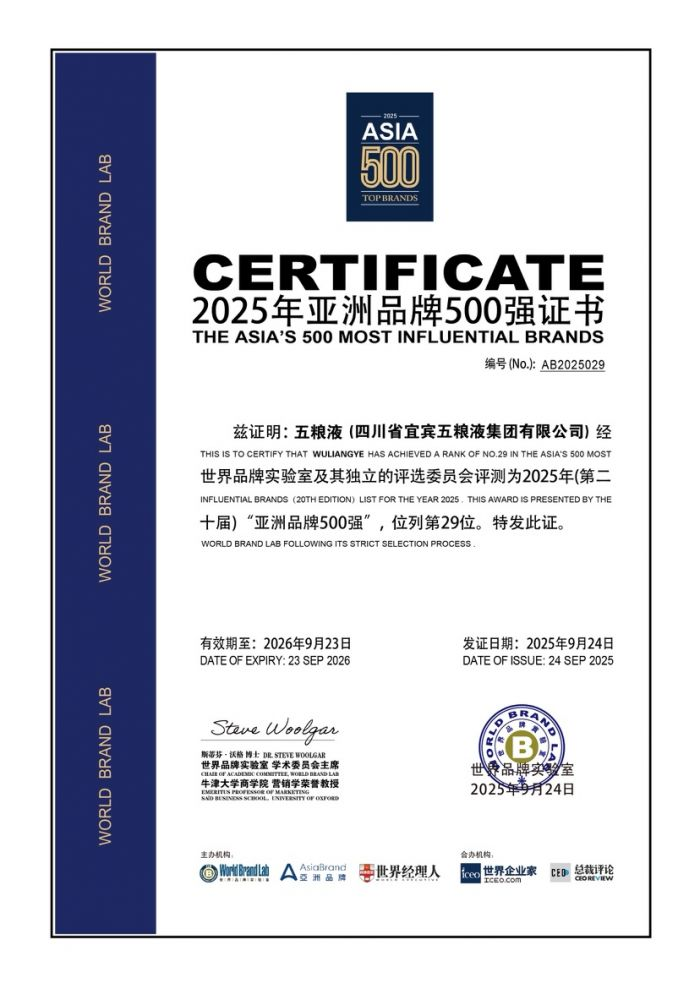
五粮液位列亚洲品牌500强第29名并上榜“国民最喜爱的10大品牌”
Zhong Jin Zai Xian· 2025-09-25 02:00
Core Insights - The World Brand Lab released the 2025 "Asia's 500 Most Valuable Brands" report, with Wuliangye ranked 29th, marking a rise of one position from the previous year, and it has been included in the list for 20 consecutive years [1][3] - Wuliangye was also recognized as one of the "Top 10 Most Beloved Brands" in the report, highlighting its strong brand influence [1] Group 1: Brand Rankings and Performance - The report included brands from 20 countries and regions, with 217 brands from China (including Hong Kong, Macau, and Taiwan), accounting for 43.40% of the total, the highest among all regions [3] - Wuliangye ranked second in the food and beverage sector, demonstrating significant global influence [3] - The evaluation criteria for the rankings included market share, brand loyalty, and Asian leadership, with Wuliangye achieving full scores of 5 in all three dimensions, being the only liquor brand to receive full marks in Asian leadership [3] Group 2: Brand Value and Recognition - Wuliangye ranked second in the "Brand Finance Global 50 Most Valuable Spirits Brands" list, maintaining the highest AAA+ rating, with a ten-year compound growth rate leading among global liquor brands [5] - It has been included in the "World's 500 Most Valuable Brands" list for eight consecutive years, now ranked 219th, an increase of eight positions year-on-year, the highest growth in the liquor industry [5] - With a brand value of 487.657 billion yuan, Wuliangye ranked 15th in the "China's 500 Most Valuable Brands" list, achieving positive brand value growth for eight consecutive years and recognized as the "Best Performing Brand of the Year" [5] Group 3: Cultural and Global Engagement - Wuliangye has actively participated in high-profile platforms such as the Boao Forum for Asia, APEC, and the China International Import Expo, showcasing China's national brand and cultural confidence [4] - The company aims to promote traditional Chinese culture, particularly through liquor, to the world, facilitating cultural exchange and mutual understanding [4] - Wuliangye plans to continue enhancing its brand construction and value, aiming to become a world-class brand while deepening its "Harmony" culture [5]
食品饮料周报:预制菜概念驱动餐供表现居前,关注双节催化-20250924
Tianfeng Securities· 2025-09-24 12:43
Investment Rating - The industry rating is maintained as "Outperform the Market" [7] Core Viewpoints - The pre-prepared food concept is driving short-term performance in the catering supply sector, with a focus on the upcoming double festival catalysis [5][16] - The overall food and beverage sector experienced a decline of 2.53% from September 15 to September 19, with specific segments like pre-processed foods and soft drinks showing positive performance [23][26] Summary by Sections Market Performance Review - From September 15 to September 19, the food and beverage sector declined by 2.53%, while the Shanghai Composite Index and CSI 300 Index fell by 1.30% and 0.44%, respectively [23] - Specific segment performances included: pre-processed foods (+0.32%), soft drinks (+0.07%), and health products (+0.05%), while snacks (-1.28%) and meat products (-3.64%) saw declines [23] Alcoholic Beverages - The liquor sector saw a decline of 2.95%, underperforming compared to the overall food and beverage sector and the CSI 300 [14] - Key brands like Jinhuijiu and Gujinggongjiu experienced significant drops, with the overall consumption environment remaining under pressure [14] - The current PE-TTM for the liquor index is 19X, indicating a relatively low valuation compared to the past decade [14] Beer Sector - The beer sector showed a slight increase of 0.03%, with brands like Qingdao Beer and Yanjing Beer performing well [15] - Cumulative beer production from January to August 2025 was 26.83 million kiloliters, a slight decrease of 0.2% year-on-year [15] Investment Recommendations - For the liquor sector, three main investment lines are recommended: strong beta stocks (e.g., Jiugui Jiu, Shui Jing Fang), value recovery stocks (e.g., Yingjia Gongjiu), and strong alpha stocks (e.g., Shanxi Fenjiu, Guizhou Moutai) [22] - In the beer sector, focus on companies with sustained growth potential and those benefiting from cost reductions [22] Key Data Tracking - The average price of fresh milk in major production areas was 3.03 yuan/kg as of September 18, 2025, with no year-on-year change [20] - The production capacity of Daizhou yellow wine increased from 18,000 tons to 130,000 tons over the past three years, with a reported output value of 263 million yuan in the first half of the year, up 14.3% year-on-year [14]


从文化自信到品牌认同 五粮液连续20年入选《亚洲品牌500强》
Xin Hua Cai Jing· 2025-09-24 10:06
Core Insights - The Asian Brand Conference held in Hong Kong on September 24 announced the 2025 edition of the "Asian Brand 500," where China's Wuliangye ranked 29th overall, improving by one position from the previous year and making it into the "Top 10 Most Loved National Brands" sub-list, showcasing its strong brand power [1][3] Brand Performance - The "Asian Brand 500" list evaluates brands based on their influence in Asia, with 217 brands from China (including Hong Kong, Macau, and Taiwan) making the list, accounting for 43.40% of the total, the highest among all participating countries and regions [1][3] - Wuliangye achieved full scores of 5 in brand influence, brand loyalty, and Asian leadership, ranking second in the food and beverage sector, highlighting its growing international brand influence [3] Consumer Loyalty - A survey conducted by the World Brand Lab over thirteen years indicates that consumer loyalty towards domestic brands in mainland China has risen from 36% over a decade ago to 71% today, reflecting a significant shift in cultural confidence and brand recognition [3] Innovation and Marketing Strategies - In response to changing consumer preferences, Wuliangye has launched innovative products such as 29° Wuliangye, "Wuliang Highball" sparkling wine, and themed consumption experiences like "Wuliang·Zhi Zao" stores and various cultural events, catering to diverse consumer needs [4] - The company actively participates in high-profile events like the Boao Forum for Asia and collaborates with major platforms to enhance brand visibility, engaging millions through interactive activities [4] Future Direction - Wuliangye aims to continue its brand philosophy of "Harmony and Coexistence," focusing on high-quality products, creative expressions, and a broader vision to tell the story of Chinese liquor and showcase the unique charm of national brands to the world [4]