
YTL(000960)

Search documents
11月CPI或增美联储鸽派声音,国际铜、铝期价上涨,工业有色ETF(560860)放量涨超2%,场内溢价频现,近10日“吸金”超5.8亿
Sou Hu Cai Jing· 2025-12-19 06:44
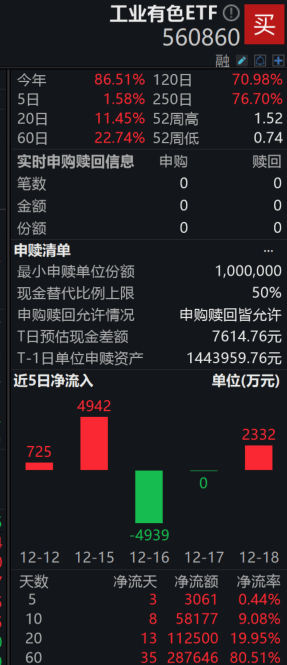
Group 1 - The market experienced a slight increase on December 19, with the non-ferrous metals sector leading the gains, including copper, aluminum, and rare earths, with Yun Aluminum rising over 60% [1] - The Industrial Non-Ferrous ETF (560860) saw a trading volume exceeding 3.1 billion, surpassing the total from the previous day, indicating active trading with frequent premiums in the market [1] - The Industrial Non-Ferrous ETF has attracted significant capital, with over 5.8 billion raised in the last 10 days, over 11 billion in the last 20 days, and over 28 billion in the last 60 days, bringing its latest scale to 69.88 billion [1] Group 2 - Internationally, U.S. inflation showed unexpected easing, with the November core CPI rising by 2.6%, the lowest since 2021, providing the Federal Reserve with substantial room to consider interest rate cuts [3] - LME metal futures generally rose, with LME copper increasing by 41 USD to 11,778 USD/ton and LME aluminum rising by 10 USD to 2,916 USD/ton [3] - In the rare earth sector, Chinese authorities have communicated policies to exporters, with some exporters meeting the basic requirements for applying for general licenses, indicating a potential increase in exports [3] Group 3 - According to Guotai Junan Securities, copper is expected to see dual positive catalysts from its financial and commodity attributes, with increased demand and inventory pressures due to insufficient supply [3] - Aluminum is anticipated to break out of its three-year price range due to strong demand and low inventory, entering a phase of significant upward movement driven by demand catalysts [4] - The Industrial Non-Ferrous ETF closely tracks the CSI Industrial Non-Ferrous Metals Theme Index, covering leading strategic resources such as copper, aluminum, and rare earths, providing opportunities for investors to capitalize on cyclical and policy-driven benefits [4]




水银体温计在线销售涨十倍,这些上市公司股价集体上涨
Di Yi Cai Jing· 2025-12-15 07:00
Core Points - The mercury thermometer will be discontinued starting January 1, leading to a surge in demand and price increases for existing mercury thermometers [1][2] - The price of mercury thermometers has significantly risen, with online prices reaching 15-20 yuan, and some exceeding 20 yuan, compared to previous prices of 2-10 yuan [1][2] - The alternative to mercury thermometers, non-mercury glass thermometers, are more expensive, costing 20-30 yuan, and are made with safer materials like gallium-indium-tin alloy [1][6] Industry Insights - The production of mercury thermometers in China was approximately 120 million units annually, resulting in over 10 tons of mercury needing disposal due to breakage [4] - Major manufacturers of non-mercury thermometers include Shanghai Huachen Medical Instrument Co., Yuyue Medical, and Jiuan Medical, with Shanghai Huachen being the largest producer [6] - The upstream suppliers for non-mercury materials include major metal producers such as China Aluminum (gallium), Zhuhai Group (indium), and Xiyang Silver Tin (tin) [6] Market Dynamics - The non-mercury thermometer market is limited and faces competition from electronic thermometers, which are also gaining popularity [7] - The safety and accuracy of gallium-indium-tin alloy thermometers are comparable to mercury thermometers, but they are positioned as a safer alternative [7] - Companies with capabilities in developing special alloy materials, such as Antai Technology and Yuyuan New Materials, are also noteworthy in this transition [6]



有色能源金属行业周报:短期锂价或维持震荡,战略金属价值重估背景下看好锑钴钨锡等金属-20251214
HUAXI Securities· 2025-12-14 05:36
Investment Rating - The industry rating is "Recommended" [3] Core Views - Short-term lithium prices are expected to remain volatile, with a positive outlook on antimony, cobalt, tungsten, and tin due to a reassessment of strategic metal values [1][2][7] - Supply concerns in the nickel market are supported by the lack of new approvals from Indonesia's RKAB, which may lead to price stabilization [1][28] - The cobalt market is expected to see continued price increases due to structural supply tightness, with Congo's export regulations impacting availability [2][5][16] - Antimony prices are anticipated to converge towards higher overseas prices due to export controls and tight domestic supply [6][17] - The lithium market is experiencing a strong demand backdrop, with expectations of continued inventory depletion supporting prices [7][17] - The rare earth market is tightening due to Vietnam's export ban, which is expected to support prices [9][18] - Tin prices are supported by ongoing supply concerns from overseas sources, particularly from Myanmar and Congo [11][20] - Tungsten prices are expected to remain supported due to supply constraints and regulatory controls [12][21] - The uranium market is facing supply tightness, which is likely to support prices amid geopolitical uncertainties [14][22] Summary by Sections Nickel and Cobalt Industry Update - Nickel prices are under pressure due to stable demand but cautious purchasing from smelters, with LME nickel closing at $14,420 per ton, down 2.04% [1][28] - Cobalt prices are expected to rise further, with Congo's export regulations causing supply constraints [2][5][16] Antimony Industry Update - Domestic antimony prices are lower compared to international prices, but supply tightness is expected to support future price increases [6][17] Lithium Industry Update - Lithium carbonate prices have increased, with a strong demand outlook from the electric vehicle sector [7][17] Rare Earth Industry Update - Vietnam's recent export ban on rare earths is expected to tighten global supply and support prices [9][18] Tin Industry Update - Tin prices are supported by supply concerns from Myanmar and Congo, with LME tin prices rising to $41,905 per ton [11][20] Tungsten Industry Update - Tungsten prices are expected to remain high due to supply constraints and regulatory measures [12][21] Uranium Industry Update - The uranium market is facing supply tightness, with prices supported by geopolitical factors and production delays [14][22]


有色金属股普涨,锡业股份、西部矿业涨超3%
Ge Long Hui· 2025-12-12 01:53
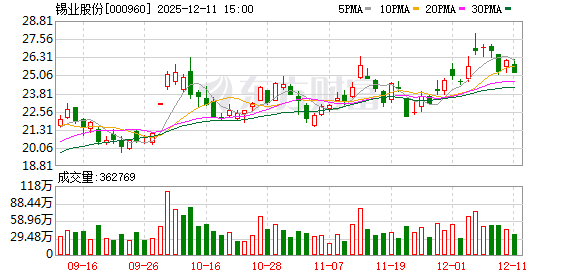
Core Viewpoint - The A-share market saw a significant rise in non-ferrous metal stocks on December 12, with several companies experiencing gains of over 2% to 3% [1]. Group 1: Stock Performance - Xiyeg股份 (Ticker: 000960) increased by 3.49%, with a total market capitalization of 42.9 billion and a year-to-date increase of 89.59% [2]. - Guocheng Mining (Ticker: 000688) rose by 3.42%, with a market cap of 28.3 billion and a year-to-date increase of 103.45% [2]. - Chihong Zn & Ge (Ticker: 600497) saw a gain of 3.41%, with a market cap of 33.7 billion and a year-to-date increase of 23.51% [2]. - Western Mining (Ticker: 601168) increased by 3.00%, with a market cap of 61.3 billion and a year-to-date increase of 70.38% [2]. - Jincheng Mining (Ticker: 603979) rose by 2.87%, with a market cap of 43.2 billion and a year-to-date increase of 92.53% [2]. - Zhongjin Lingnan (Ticker: 000060) increased by 2.67%, with a market cap of 23.9 billion and a year-to-date increase of 17.24% [2]. - Zhongjin Gold (Ticker: 600489) rose by 2.66%, with a market cap of 108.5 billion and a year-to-date increase of 91.05% [2]. - Shangda Co. (Ticker: 301522) increased by 2.28%, with a market cap of 12.4 billion and a year-to-date decrease of 8.57% [2]. - Shanjin International (Ticker: 000975) rose by 2.03%, with a market cap of 67 billion and a year-to-date increase of 59.85% [2]. - Yun Aluminum (Ticker: 000807) increased by 2.01%, with a market cap of 95.2 billion and a year-to-date increase of 108.06% [2].


A股有色金属股普涨,锡业股份、西部矿业涨超3%
Ge Long Hui· 2025-12-12 01:51
Group 1 - The A-share market saw a broad increase in non-ferrous metal stocks, with notable gains from companies such as Xiyeg股份, Guocheng Mining, and Chihong Zinc & Germanium, all rising over 3% [1] - Other companies including Jinchengxin, Zhongjin Lingnan, Zhongjin Gold, and Shanda股份 experienced increases of over 2% [1]
锡业股份:截至2025年12月10日股东人数为81070户
Zheng Quan Ri Bao· 2025-12-11 14:09
Core Viewpoint - As of December 10, 2025, the number of registered shareholders for Xiyu Co. is reported to be 81,070 [2] Group 1 - The company provided an update on its shareholder count in response to investor inquiries [2]
多重因素推动 小金属赛道多品种走强 两路资金大力加仓
Zheng Quan Shi Bao Wang· 2025-12-10 23:58
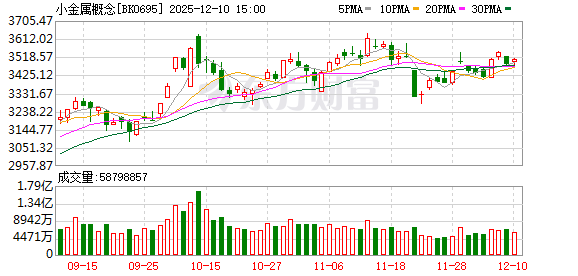
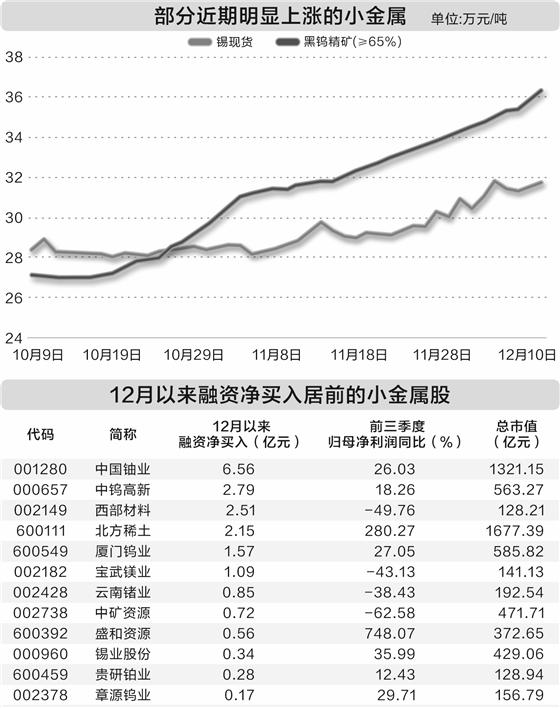
Core Viewpoint - The small metals sector in A-shares has shown a significant upward trend, with the sector index closing up by 0.79% on December 10, driven by notable price increases in various small metal varieties, particularly tungsten [2][3]. Price Movements - Tungsten prices have surged, with black tungsten concentrate (≥65%) priced at 363,000 yuan/ton, up 153.85% year-to-date; ammonium paratungstate (APT) at 535,000 yuan/ton, up 153.55%; and tungsten powder at 880 yuan/kg, up 178.48%, all reaching historical highs [3][5]. - Other small metals like cobalt and tin have also seen significant price increases, with cobalt averaging 408,000 yuan/ton (up 16.91% since October) and tin futures rising 15.74% since October [3][5]. Factors Driving Price Increases - The price increases are attributed to supply constraints, favorable macroeconomic conditions, and rising downstream demand. Supply-side constraints include strict mining quotas and environmental regulations for tungsten, and slow recovery of tin production in Myanmar [5]. - Macroeconomic factors include strong market expectations for a Federal Reserve interest rate cut, which typically weakens the dollar and supports commodity prices [5]. - Downstream demand is driven by growth in industries such as new energy, semiconductors, and military applications, enhancing the outlook for strategic small metals [5]. Capital Inflows - The small metals sector has seen substantial capital inflows, with a net inflow of 1.732 billion yuan on December 10, ranking high among secondary industries [7]. - Notable companies like Western Materials received a net inflow of 1.274 billion yuan, benefiting from their core supply roles in aerospace and marine engineering [7]. Company Performance - The small metals sector's overall performance has improved, with a total net profit of 13.589 billion yuan in the first three quarters, a year-on-year increase of 41.42% [8]. - Companies like Shenghe Resources and Northern Rare Earth have reported significant profit growth, with increases of 748.07% and 280.27% respectively [8]. Capacity Expansion - Shenghe Resources has disclosed plans for capacity expansion, with its subsidiary's high-performance rare earth polishing powder project progressing as scheduled, expected to be operational by the end of Q1 2026 [9].


小金属多品种走强 两大资金加仓热情高涨
Zheng Quan Shi Bao· 2025-12-10 18:49
Core Viewpoint - The small metals sector in the A-share market has shown a significant upward trend, driven by multiple factors including supply constraints, favorable macroeconomic conditions, and increasing downstream demand [2][5]. Group 1: Price Movements - The small metals sector has experienced notable price increases, particularly in tungsten, which has reached historical highs. As of December 10, black tungsten concentrate (≥65%) is priced at 363,000 yuan/ton, up 153.85% year-to-date; ammonium paratungstate (APT) is at 535,000 yuan/ton, up 153.55%; and tungsten powder is at 880 yuan/kg, up 178.48% [3][5]. - Other metals such as cobalt and tin have also seen significant price increases, with cobalt averaging 408,000 yuan/ton (up 16.91% since October) and tin rising 13.89% over the same period [3][5]. Group 2: Driving Factors - The price increases are attributed to supply-side constraints, such as strict mining quotas and environmental regulations affecting tungsten, and ongoing export restrictions on cobalt from the Democratic Republic of Congo [5]. - The macroeconomic environment is favorable, with strong expectations for a Federal Reserve interest rate cut, which typically weakens the dollar and supports commodity prices [5]. - Downstream demand from industries like new energy, semiconductors, and defense is rapidly growing, boosting expectations for strategic small metals [5]. Group 3: Capital Inflows - The small metals sector has seen significant capital inflows, with a net inflow of 1.732 billion yuan on December 10, ranking high among secondary industries [6]. - Notably, Western Materials received a net inflow of 1.274 billion yuan, with its stock achieving a strong performance in recent trading sessions [6]. - Financing net purchases in the small metals sector reached 1.879 billion yuan in December, with several stocks, including China Uranium Industry, receiving substantial net purchases [6]. Group 4: Performance Metrics - The small metals sector has shown strong performance in 2023, with a total net profit of 13.589 billion yuan in the first three quarters, reflecting a year-on-year growth of 41.42% [7]. - Companies like Shenghe Resources and Northern Rare Earth have reported significant profit increases of 748.07% and 280.27%, respectively [7]. - Shenghe Resources is expanding its production capacity, with a project expected to be operational by the end of Q1 2026 [7].


锡行业专题:矿端紧缺,库存低位
Guoxin Securities· 2025-12-10 09:11
Investment Rating - The investment rating for the tin industry is "Outperform the Market" (maintained) [1] Core Insights - Tin is an essential minor metal with increasing resource scarcity. As of the end of 2024, global tin reserves are estimated at 4.2 million tons, with a production of 300,000 tons. The reserve-to-production ratio has decreased from around 20 years in 2010 to 14 years in 2024, indicating a low level of reserves compared to production [2][21] - Global tin supply is expected to decline significantly by 2025 due to decreasing ore grades and various unpredictable factors affecting major production areas. China, the largest producer, has seen a decline in domestic production since 2015 due to lower ore grades and stricter environmental regulations [2][21] - Demand for tin is projected to remain stable or increase, driven by the semiconductor industry and other applications. The global demand for tin is expected to reach 386,000 tons in 2025, with a steady growth forecast through 2027 [2][21] - A significant shortage of refined tin is anticipated in 2025, with a projected supply-demand gap of approximately 16,000 tons. This gap may narrow in subsequent years as production resumes in Myanmar and new projects come online [2][21] - Key companies in the industry include Xiyang Co., Xingye Yinxin, and Huaxi Nonferrous [2] Summary by Sections Industry Overview - Tin is characterized by its low melting point and good conductivity, making it irreplaceable in solder applications. The global distribution of tin reserves is concentrated in a few countries, with China holding the largest share [2][21] Supply Dynamics - The global tin supply has been stable around 300,000 tons in recent years, but significant declines are expected due to various factors affecting major production areas, including environmental regulations and resource depletion [2][21] Demand Dynamics - The semiconductor sector is a major driver of tin demand, with a strong correlation to electronic product production. The demand for tin in solder applications is expected to grow, supported by a recovery in semiconductor sales [2][21] Price Trends - Tin prices have seen significant fluctuations, with a notable increase of 46% since early 2024. The average price for tin in 2024 is projected to be 248,300 yuan per ton, reflecting a year-on-year increase of 16.92% [12][21] Regional Insights - China's tin production has been on a downward trend, with production expected to be 69,000 tons in 2024, down from previous highs. Despite this, China remains the largest producer and holder of tin reserves globally [34][21]


小金属板块12月9日跌1.1%,锡业股份领跌,主力资金净流出6.83亿元
Zheng Xing Xing Ye Ri Bao· 2025-12-09 09:05
Group 1 - The small metal sector experienced a decline of 1.1% on December 9, with Xiyegongye Co., Ltd. leading the drop [1] - The Shanghai Composite Index closed at 3909.52, down 0.37%, while the Shenzhen Component Index closed at 13277.36, down 0.39% [1] - A table detailing the individual stock performance within the small metal sector was provided [1] Group 2 - On the same day, the small metal sector saw a net outflow of 683 million yuan from main funds, while speculative funds had a net inflow of 116 million yuan, and retail investors contributed a net inflow of 566 million yuan [2] - A table showing the fund flow for individual stocks in the small metal sector was included [2]
