
CMSK(001979)

Search documents
未知机构:华福建筑建材地产及地产链大涨点评上层态度变化政策渴望以及板块高低切的共振-20260121
未知机构· 2026-01-21 02:15
Summary of Conference Call Notes Industry Overview - The real estate and building materials sector experienced a significant increase, primarily driven by market rumors regarding policy relaxation in Shanghai and expectations of more substantial policy measures to follow [1][2] Core Insights and Arguments - A reassessment of the real estate and related sectors is deemed necessary at this juncture [2] - Key points highlighted in the commentary from "Qiushi" include: 1. Recognition of real estate as a significant financial asset, central to household wealth [3] 2. The need for comprehensive policy measures rather than incremental adjustments, indicating potential for new expectations regarding policy strength and breadth [3] - Statistical data from the National Bureau of Statistics indicates a decline in real estate investment by 17% year-on-year, new construction down by 20%, completions down by 18%, sales area down by 9%, and sales revenue down by 13% [3] - Despite the overall decline in data, the marginal negative impact on the building materials industry has noticeably weakened [3] - The fundamental investment logic in the building materials sector is centered on "supply-side improvement" preceding "demand-side recovery" [3] - Under the "anti-involution" policy direction, price coordination in industries like cement is beginning to show results, with profit levels continuing to recover [3] - The consumer building materials sector, including waterproofing and coatings, is entering the final phase of clearing out excess, with an improved competitive landscape and positive changes in gross margins and expense ratios for leading companies in specific segments [3] Recommendations - Recommended to focus on high-credit, high-quality real estate developers benefiting from policy rumors, such as China Merchants Shekou and Binjiang Group [4] - Suggested to pay attention to leading companies in the real estate supply chain that are expected to benefit from anticipated demand recovery, including Oriental Yuhong, Beixin Building Materials, Sankeshu, and Tubao [4]



房企穿越周期:龙头转型不动产运营 招商蛇口押中沐曦、长鑫
2 1 Shi Ji Jing Ji Bao Dao· 2026-01-20 12:51
Core Viewpoint - The performance of real estate companies is expected to stabilize as they navigate through the current market challenges, with a focus on asset impairment provisions and strategic investments in long-cycle industries [2][3][4]. Group 1: Company Performance - Poly Developments announced a projected revenue of approximately 308.26 billion yuan for 2025, a year-on-year decrease of 1.09%, with a net profit attributable to shareholders of about 1.03 billion yuan, reflecting a decline compared to 2024 [2][4]. - The company plans to recognize asset impairment and credit impairment losses totaling approximately 6.9 billion yuan, which is expected to reduce the net profit for 2025 by about 4.2 billion yuan [4]. - Excluding the impact of impairment provisions, Poly Developments' net profit for 2025 is estimated to be around 5.2 billion yuan, with the fourth quarter contributing approximately 3.3 billion yuan [4]. Group 2: Industry Trends - The real estate sector is experiencing a cautious yet orderly expansion in investment, with companies exploring new revenue streams beyond traditional real estate development, such as entering long-cycle industries and enhancing service offerings [3][6]. - The top 100 real estate companies are projected to have a total land acquisition amount of 964 billion yuan in 2025, representing a year-on-year increase of 3.9%, driven by favorable policies and the need for sustainable development [5]. - The industry is expected to enter a new development phase in 2026, as many companies have passed the peak of delivery and debt repayment, indicating a potential for recovery and stabilization in performance [2][8]. Group 3: Future Outlook - Real estate companies are increasingly focusing on property operations and other sectors, with many adopting strategies to enhance their operational efficiency and capitalize on the growing REITs market [6][7]. - Companies like China Resources Land and China Merchants Shekou are also expanding their presence in property operations, with significant growth in recurring income and rental revenues [6]. - The market conditions are improving, with expectations for a recovery in 2026, as companies work towards repairing their balance sheets and potentially achieving profitability [8].


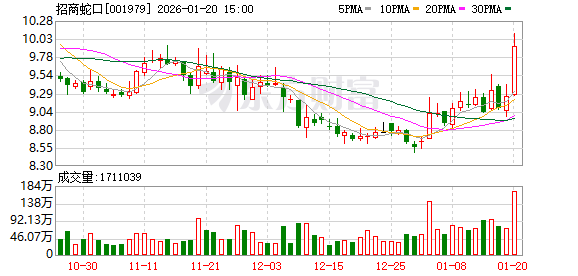
房企穿越周期:龙头转型不动产运营,招商蛇口押中沐曦、长鑫
2 1 Shi Ji Jing Ji Bao Dao· 2026-01-20 12:42
Core Viewpoint - The real estate industry is expected to stabilize as companies navigate through the current market challenges and explore new growth avenues, with major players like Poly Developments taking significant steps to adjust their strategies and financials [2][3][6]. Group 1: Company Performance - Poly Developments reported an estimated revenue of approximately 308.26 billion yuan for 2025, reflecting a year-on-year decrease of 1.09%, with a projected net profit attributable to shareholders of about 1.03 billion yuan, a decline compared to 2024 [2][3]. - The company plans to recognize asset impairment and credit impairment losses totaling around 6.9 billion yuan, which is expected to reduce the net profit for 2025 by approximately 4.2 billion yuan [3][4]. - Excluding the impact of impairment provisions, Poly Developments' net profit for 2025 is estimated to be around 5.2 billion yuan, with the fourth quarter contributing approximately 3.3 billion yuan [4]. Group 2: Industry Trends - The real estate sector is witnessing a cautious yet orderly expansion in investments, with companies focusing on stabilizing their operations and gradually reducing the impact of impairment provisions [2][3]. - The top 100 real estate companies in China are projected to have a total land acquisition amount of 964 billion yuan in 2025, marking a year-on-year increase of 3.9% [4]. - The market is expected to see a recovery in 2026 as companies navigate through the peak of delivery and debt repayment, entering a new development phase [2][6]. Group 3: Strategic Shifts - Many leading real estate firms are diversifying into long-cycle industries and real estate operations, with plans to invest in high-tech sectors and enhance service offerings [3][5]. - Poly Developments has expanded its operational assets to 5.73 million square meters, including 26,000 rental housing units, which increased by 18% compared to the end of 2024 [5]. - Other companies like China Resources Land and China Merchants Shekou are also pursuing similar strategies in real estate operations and indirect investments through industry funds [5].
1月20日深证国企ESG(970055)指数跌0.36%,成份股泰胜风能(300129)领跌
Sou Hu Cai Jing· 2026-01-20 10:23
Group 1 - The Shenzhen State-owned Enterprise ESG Index (970055) closed at 1483.72 points, down 0.36%, with a trading volume of 51.883 billion yuan and a turnover rate of 1.92% [1] - Among the constituent stocks of the index, 25 stocks rose, with China Merchants Shekou leading with a 7.35% increase, while 24 stocks fell, with Taisheng Wind Power leading the decline at 7.33% [1] Group 2 - The net outflow of main funds from the Shenzhen State-owned Enterprise ESG Index constituent stocks totaled 2.196 billion yuan, while the net inflow of speculative funds was 431 million yuan, and the net inflow of retail funds was 1.765 billion yuan [2] - Detailed fund flow information for the constituent stocks is available in the accompanying table [2]


租售同权概念涨1.75%,主力资金净流入15股
Zheng Quan Shi Bao Wang· 2026-01-20 08:49
Core Viewpoint - The rental and sales rights concept has seen a rise of 1.75%, ranking sixth among concept sectors, with significant gains from stocks like Chengdu Investment Holdings and Hefei Urban Construction, which hit the daily limit [1][2]. Group 1: Market Performance - The rental and sales rights concept had 18 stocks rising, with notable increases from Chengdu Investment Holdings (10.11%), Hefei Urban Construction (10.03%), and *ST Nan Zhi (5.14%) [1][3]. - The top gainers in the sector included China Merchants Shekou (7.35%), I Love My Home (7.33%), and Huitong Energy (4.99%) [1][2]. - Conversely, the biggest decliners were *ST Yang Guang (-4.91%), Shoukai Co. (-4.72%), and Yueshin Health (-2.68%) [1][2]. Group 2: Capital Flow - The rental and sales rights concept attracted a net inflow of 694 million yuan, with 15 stocks receiving net inflows, and five stocks exceeding 100 million yuan [2][3]. - Hefei Urban Construction led the net inflow with 277 million yuan, followed by I Love My Home (233 million yuan) and Poly Development (165 million yuan) [2][3]. - The net inflow ratios for leading stocks were Chengdu Investment Holdings (28.37%), Hefei Urban Construction (24.03%), and *ST Nan Zhi (20.17%) [3][4].




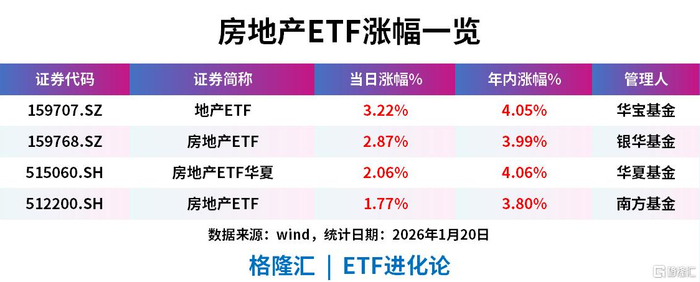
房地产板块活跃,地产ETF涨超3%,房地产ETF、房地产ETF华夏涨超2%
Ge Long Hui A P P· 2026-01-20 08:38
Group 1 - The real estate sector is experiencing significant activity, with stocks such as Dayue City, Chengdu Investment Holdings, and others reaching their daily limit up, while real estate ETFs have seen gains of over 3% [1] - The real estate ETFs tracking the CSI All Share Real Estate Index include major companies like China Merchants Shekou, Poly Developments, and Vanke A, indicating a concentration of top-tier firms in the investment direction [5] - The recent data from the National Bureau of Statistics shows a slight decline in new residential sales prices in first-tier cities, with a 0.3% decrease month-on-month, while second and third-tier cities also experienced price drops [5] Group 2 - According to Everbright Securities, the implementation of real estate policies is enhancing local government autonomy in market regulation, leading to further regional and city differentiation [6] - Huayuan Securities anticipates that the real estate adjustment cycle may be nearing its end, with historical data suggesting that the current price adjustments in China are relatively sufficient [7] - The trend towards "good housing" is emerging, with a shift in policy focus towards building safe, comfortable, and green homes, indicating potential growth in the high-quality residential market [7]
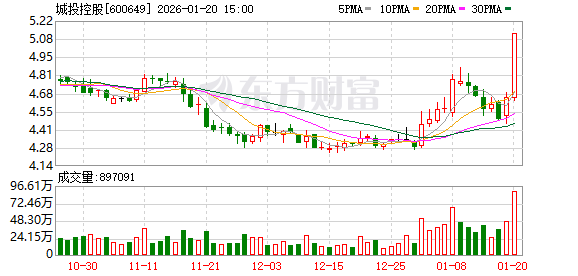
地产板块发力走高 城投控股、合肥城建等涨停
Zheng Quan Shi Bao Wang· 2026-01-20 07:21
Group 1 - The real estate sector showed significant gains on the 20th, with stocks like Dayuecheng, Zhonghua Enterprise, and Chengdu Investment Holdings hitting the daily limit, while China Merchants Shekou and China Merchants Jinling rose over 7% [2] - Recent policies from the Ministry of Finance, State Taxation Administration, and Ministry of Housing and Urban-Rural Development support residents in purchasing homes by extending personal income tax policies and lowering the minimum down payment for commercial property loans to 30% [2] - The financial regulatory authority aims to establish a normalized real estate financing coordination mechanism, while tax incentives for public rental housing are also being extended [2] Group 2 - According to Kaiyuan Securities, three trends are expected in 2026: 1) The real estate adjustment phase may be nearing its end, with current price adjustments in China being relatively sufficient compared to global averages [3] 2) There will be structural opportunities for "good houses" as the market enters a phase of differentiation, with a focus on high-quality residential developments [3] 3) The Hong Kong real estate market is expected to continue its recovery, driven by multiple favorable factors, leading to a potential revaluation of Hong Kong property developers [3]


房地产板块午后再度拉升
Di Yi Cai Jing· 2026-01-20 06:05
Group 1 - Zhonghua Enterprises has reached the daily limit increase in stock price [1] - Other companies such as Wo Ai Wo Jia, Chengtou Holdings, and Dayuecheng previously hit the limit as well [1] - Following this trend, companies like China Merchants Jin Yu, China Merchants Shekou, and Binjiang Group have also seen stock price increases [1]
住宅收益率跟踪研究(1月2026年):通胀好转,资产价格预期受益
GUOTAI HAITONG SECURITIES· 2026-01-20 05:30
Investment Rating - The report assigns an "Overweight" rating for the real estate sector [4]. Core Insights - The report highlights that the rental yield in major cities has shifted from a negative outlook to a neutral stance due to the CPI turning positive and the continuous decline in risk-free rates. This indicates potential stabilization in asset prices in key cities [2]. - The rental yield in first-tier cities has increased from 1.6% in 2020 to 1.9% in 2025, although it remains below the mortgage loan rates and slightly above the risk-free rates. The "rental yield + CPI" metric is expected to improve as the CPI in some first-tier cities turns positive [4]. - Second-tier cities are showing signs of price stabilization, with the "rental yield + CPI" metric improving from 2.3% in 2023 to 2.6% in 2024 and maintaining that level in 2025. Cities like Hefei and Xi'an are expected to see further improvements in their rental yields [4]. Summary by Sections Rental Yield Analysis - The historical rental yield was 1.5%, but when adjusted for CPI, it is not considered low. The report emphasizes the need to differentiate between actual and nominal yields [4]. - The nominal rental yield is adjusted to account for potential inflation, making it a more comparable metric. The report suggests that the high inflation period has made the first-tier cities' rental yield of 1.5% equivalent to an international nominal yield of 3.5% [4]. Market Trends - The report notes that the rental yield plus CPI in first-tier cities is around 2.5%, which is now higher than the risk-free rate. This indicates a potential shift in market dynamics [5]. - The report also points out that the proportion of declining listing prices has increased, indicating a weakening in the second-hand housing market, with about 19% of listings showing price declines [4][18]. Future Outlook - The report anticipates that as the CPI continues to rise and the risk-free rate declines, asset prices in key cities may transition from a negative outlook to a neutral one. This is particularly relevant for second-tier cities, which are expected to have a stronger rental yield plus CPI metric [4].


盘中,涨停!A股,突然异动!
Zhong Guo Ji Jin Bao· 2026-01-20 04:23
Market Overview - A-shares opened high but closed lower, with the Shanghai Composite Index down 0.3% at 4101.62 points, Shenzhen Component down 1.22%, and ChiNext Index down 1.83% [1] - The total trading volume in the Shanghai and Shenzhen markets reached 1.85 trillion yuan, an increase of 568 billion yuan compared to the previous trading day [2] Sector Performance - The communication equipment, aerospace military, electronic components, basic metals, and energy equipment sectors experienced significant declines [2] - The banking and insurance sectors saw a notable rise, with food and beverage, real estate, and semiconductor sectors also performing well [2] Banking and Insurance Sector - The banking and insurance sector showed resilience, with major insurance stocks like China Life and Ping An rising over 1% [3] - Key banking stocks such as CITIC Bank increased by over 2%, while other banks like China Construction Bank and Bank of China rose by over 1% [5] - A report from China Galaxy Securities indicated that structural monetary policy tools and a marginal improvement in RMB credit could support bank lending [5] Food and Beverage Sector - The food and beverage sector was active, with food processing stocks leading the gains, including Hongmian Co., Jingji Zhino, and Weizhi Xiang, all hitting the daily limit [6] - Notable performers included Hongmian Co. with a 10.13% increase and Jingji Zhino with a 10.01% increase [7] Real Estate Sector - The real estate sector showed a rebound, with stocks like Dayue City and Chengtou Holdings hitting the daily limit, and others like China Merchants Shekou and Binjiang Group rising over 5% [8] - Recent data from the National Bureau of Statistics indicated a slight decrease in new residential sales prices in first-tier cities, which may influence market sentiment [10] Aerospace and Military Sector - The aerospace and military sector faced significant declines, with stocks like Tongyu Communication and Aerospace Power hitting the daily limit down, and Aerospace Hongtu dropping 13% [11] - Other companies in the sector, such as China Satellite and China Aerospace, also saw declines exceeding 6% [12]






