Yanghe(002304)

Search documents
中酒协:2024年陈年老酒市场规模或突破1500亿元
Xin Jing Bao· 2025-10-28 13:29
Core Viewpoint - The Chinese liquor industry is witnessing significant growth in the aged liquor market, with expectations for the market size to exceed 150 billion yuan in 2024, driven by the establishment of standards and trust in "true vintage" products [1][2]. Group 1: Market Growth - The aged liquor market in China reached a scale of 128.5 billion yuan in 2023, showing a recovery in growth after a slowdown from 2020 to 2022 [1]. - The market sales exceeded 62.8 billion yuan in 2019 and surpassed 80.2 billion yuan in 2020, indicating a strong upward trend [1]. Group 2: Industry Standards and Trust - The China Alcoholic Drinks Association has implemented the "White Liquor Vintage Group Standard" in 2019, establishing a regulatory framework for vintage liquor [1]. - The association has initiated a vintage liquor certification process, with 6.13 million certification labels issued across 31 provinces and 305 cities, promoting a quality ecosystem that is provable, traceable, and regulated [2]. Group 3: Future Outlook - Industry experts believe that the vintage liquor sector is entering a new phase characterized by standardization, transparency, and internationalization, which will enhance market credibility and competitiveness [2].


白酒行业周期专题 2:以史为镜,当前时点为什么我们认为白酒进入布局阶段?
Guoxin Securities· 2025-10-28 12:10
Investment Rating - The report maintains an "Outperform" rating for the liquor industry [5][6]. Core Viewpoints - The current market for the liquor sector shows divergence, with significant year-on-year performance declines expected for liquor companies in Q3 2025. However, both valuation and holdings are at low levels, and positive factors on both supply and demand sides are increasing [1][4]. - Historical analysis from 2013-2015 indicates strong similarities between the current cycle and previous ones, suggesting that buying opportunities may accelerate [1][4]. Summary by Sections Price and Performance Trends - Most companies confirmed their stock price bottoms between Q4 2013 and Q1 2014, with performance declines starting in Q3 2013. Despite the declining performance, stock prices showed moderate reactions, following the overall market uptrend [2][7]. - The stock price performance of individual companies remains closely tied to their fundamentals, with regional leaders like Gujing and Laobaigan showing smaller declines compared to the overall market [2][13]. Company Strategies - Companies are leveraging channels to amplify brand and product advantages during the adjustment phase. High-end liquor brands focus on maintaining brand strength, with Moutai shifting its focus to customer expansion [3][32]. - Regional leaders are retreating to core markets while enhancing their presence in lower-tier markets, with companies like Yanghe and Gujing focusing on channel cultivation [3][39]. Investment Recommendations - The report suggests a two-phase recovery path for industry valuations. The first phase is driven by demand recovery, with expectations for Moutai's PE ratio to recover from 20x to 25x, corresponding to a dividend yield of about 3% [4][17]. - The second phase anticipates a return to long-term confidence in liquor assets, with industry PE potentially reaching 30x by Q4 2026. Recommended stocks include Luzhou Laojiao, Moutai, and Shanxi Fenjiu, with a watch on Wuliangye and Yanghe for potential recovery [4][5].



“洋”溢激情!跟着梦想追火箭
Zhong Jin Zai Xian· 2025-10-28 11:54
Core Viewpoint - The event organized by Yanghe Co. connects ordinary people's dreams of space exploration with China's significant aerospace achievements, showcasing the integration of national strength and cultural heritage through the lens of a major rocket launch [2][4]. Group 1: Event Overview - The Long March 5 rocket, with a payload capacity and mission importance, features a 5.2-meter diameter extended fairing and reaches a maximum height of 63.2 meters, marking it as the tallest active rocket in China [2]. - The countdown and launch elicited enthusiastic reactions from the audience, highlighting the emotional connection to China's aerospace advancements [2]. Group 2: Yanghe's Involvement - Yanghe has been a partner with China's aerospace since 2019 and upgraded to a strategic partner in 2022, continuing to engage consumers through initiatives like the "Yanghe Dream Blue" rocket launch and aerospace cultural development [6]. - The event attracted diverse participants, including overseas Chinese and local consumers, who expressed pride in witnessing the launch and connecting with the national brand [6]. Group 3: Cultural Significance - Yanghe's branding ties back to the Dunhuang Flying Apsaras, symbolizing a long-standing connection between the company and the aerospace industry, making space exploration more relatable to everyday consumers [10]. - The launch event encapsulated the essence of national pride and quality of life, emphasizing the emotional resonance of China's space achievements alongside Yanghe's products [12].


白酒行业周期专题2:以史为镜,当前时点为什么我们认为白酒进入布局阶段?
Guoxin Securities· 2025-10-28 10:59
Investment Rating - The report maintains an "Outperform" rating for the liquor industry [5][6] Core Viewpoints - The current market for the liquor sector shows divergence, with significant year-on-year performance declines expected for Q3 2025, yet both valuation and holdings are at low levels, indicating potential positive changes in supply and demand dynamics [1][4] - Historical analysis from 2013-2015 suggests that the current cycle has strong similarities, indicating that buying opportunities may accelerate [1][4] - The report anticipates a two-phase recovery in industry valuations, with the first phase driven by demand recovery and the second phase contingent on improved supply-demand relationships and market confidence in long-term liquor assets [4][17] Summary by Sections Price and Performance Analysis - Most companies confirmed their stock price bottoms between Q4 2013 and Q1 2014, with performance declines starting in Q3 2013, while stock prices remained relatively stable [2][7] - The report highlights that stock price performance is closely linked to fundamental performance, with regional leaders showing less decline compared to the overall market [2][13] Company Strategies - Companies are leveraging channels to enhance brand and product advantages during the adjustment phase, with a focus on maintaining brand strength for high-end products [3][30] - Regional leaders are concentrating on core markets and enhancing distribution channels, while expansion-oriented companies are increasing their presence in mid-to-low-end products [3][30] Investment Recommendations - The report suggests that the industry is entering a layout phase, recommending investments in stable-performing companies with long-term growth potential, such as Luzhou Laojiao, Guizhou Moutai, and Shanxi Fenjiu, while also monitoring Wuliangye and Yanghe for potential recovery [4][5]
白酒板块午盘微跌 贵州茅台上涨0.46%
Bei Jing Shang Bao· 2025-10-28 06:49
Core Viewpoint - The Shanghai Composite Index rose to 4000 points with a 0.21% increase, while the liquor sector showed mixed performance with a slight decline of 0.09% in the afternoon session, despite 18 liquor stocks experiencing gains [1] Company Performance - Kweichow Moutai closed at 1447.00 CNY per share, up 0.46% - Wuliangye closed at 120.35 CNY per share, up 0.05% - Shanxi Fenjiu closed at 189.12 CNY per share, up 2.31% - Luzhou Laojiao closed at 131.16 CNY per share, up 1.36% - Yanghe Brewery closed at 69.82 CNY per share, up 0.07% [1] Market Analysis - According to Huachuang Securities, the business banquet segment is performing weakly, while mass consumption and wedding banquet scenarios remain relatively strong with a smaller decline in Q3 - High-end gifting is showing improvement ahead of the holiday season [1] - Major liquor companies are adopting a more pragmatic approach, accelerating adjustments to reduce channel pressure, while also cutting investment and enhancing operational efficiency [1] Collection Progress - Leading liquor companies such as Moutai, Wuliangye, and Fenjiu have achieved over 80% collection progress - Regional liquor companies are performing adequately with most reaching around 70% - Mid-tier liquor companies are facing greater pressure [1]
白酒板块午盘上涨 贵州茅台下跌0.44%
Bei Jing Shang Bao· 2025-10-27 04:22
Core Viewpoint - The stock market showed positive momentum with all three major indices rising over 1%, indicating a favorable trading environment for investors [1] Industry Summary - The liquor sector closed at 2281.44 points, up 0.27%, with 12 liquor stocks experiencing gains [1] - The current price-to-earnings ratio (PE-TTM) for the Shenwan liquor index is 18.94X, which is considered reasonably low at 4.69% compared to the past decade [1] - Leading liquor companies are providing attractive dividend returns, making them appealing investment options [1] Company Summary - Kweichow Moutai closed at 1443.64 CNY per share, down 0.44% [1] - Wuliangye closed at 120.25 CNY per share, down 0.03% [1] - Shanxi Fenjiu closed at 183.75 CNY per share, down 0.34% [1] - Luzhou Laojiao closed at 130.15 CNY per share, down 0.07% [1] - Yanghe Brewery closed at 69.70 CNY per share, up 0.69% [1] - The terminal sales showed a mild recovery in September, and the third quarter of 2025 is expected to accelerate inventory clearance [1]
食品饮料行业周报:短期关注三季报业绩,长期关注提振内需政策-20251026
KAIYUAN SECURITIES· 2025-10-26 08:43
Investment Rating - The investment rating for the food and beverage industry is "Positive" (maintained) [1] Core Insights - The quarterly performance continues to show differentiation, with a recommendation to strengthen positions during the bottom cycle. The food and beverage index declined by 0.9% from October 20 to October 24, ranking 27th among primary sub-industries, underperforming the CSI 300 by approximately 4.2 percentage points. Sub-industries such as processed foods (+1.0%), meat products (+0.6%), and other alcoholic beverages (+0.5%) performed relatively well. The traditional consumption sector continues to face significant performance pressure, particularly in the liquor segment, where business demand remains under pressure. Although there has been a slight improvement in terminal consumption demand, the overall market demand remains weak. It is anticipated that the liquor sector will experience a further slowdown in performance growth for the third quarter [3][12][14]. Summary by Sections Market Performance - The food and beverage index experienced a decline of 0.9%, ranking 27th out of 28 sectors, and underperformed the CSI 300 by about 4.2 percentage points. Leading sub-industries included processed foods (+1.0%), meat products (+0.6%), and other alcoholic beverages (+0.5) [12][14]. Upstream Data - Some upstream raw material prices have decreased. For instance, the price of fresh milk was 3.0 yuan per kilogram, down 2.9% year-on-year. The price of pork was 17.7 yuan per kilogram, down 28.4% year-on-year [21][26]. Policy Insights - The 20th Central Committee's Fourth Plenary Session emphasized expanding domestic demand and building a strong domestic market, which is expected to inject clear policy dividends into the food and beverage industry. The core driver for long-term industry growth is the boost in domestic demand, which will directly stimulate market consumption and upgrade potential [4][13]. Recommended Stocks - The report recommends focusing on two types of stocks: first, leading companies with low valuations and national layout capabilities; second, growth companies that align with new consumption trends. Specific recommendations include Guizhou Moutai, Shanxi Fenjiu, Ximai Foods, Weilong, and Bairun [5][56].


海报实验室丨同种白酒不同渠道价格悬殊?实测12种常见白酒:最多相差40%
Sou Hu Cai Jing· 2025-10-25 10:27
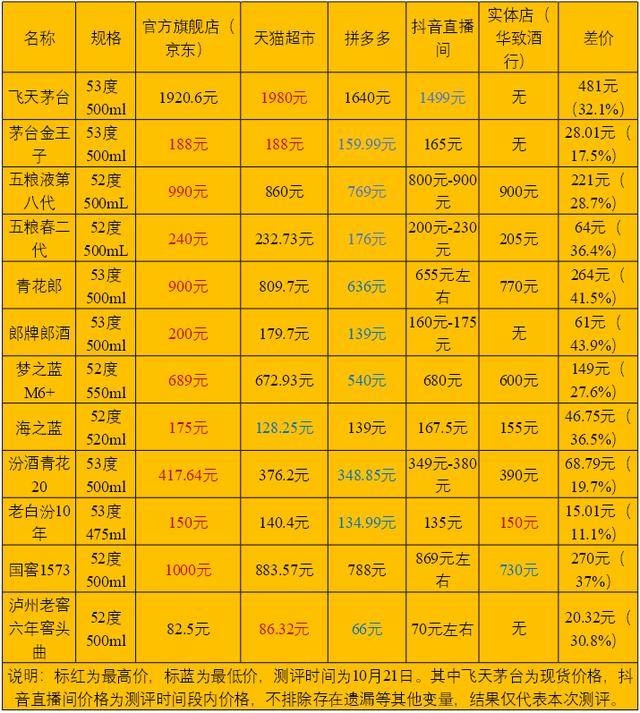
Core Viewpoint - The price of various brands of baijiu has been declining significantly this year, with some prices dropping by as much as 30% or nearly halved, leading to increased consumer attention and discussion about baijiu pricing [1][3] Price Discrepancies Across Channels - A recent survey conducted by the Haibao Laboratory revealed substantial price differences for the same type of baijiu across different purchasing channels, with official flagship stores generally having the highest prices and platforms like Pinduoduo offering the lowest prices, sometimes differing by over 40% [1][10][11] - For example, the price of 500ml Feitian Moutai varied from 1499 yuan (requiring reservation) to 1980 yuan (immediate purchase) on Tmall, while Pinduoduo offered it for 1640 yuan, showcasing a price difference of 32.1% [6][7][9] Specific Brand Price Comparisons - The survey included six well-known brands: Moutai, Wuliangye, Langjiu, Yanghe, Fenjiu, and Luzhou Laojiao, with findings indicating that the official flagship store prices were consistently higher than those on discount platforms [10][11] - For instance, the price of Wuliangye's 500ml product varied from 990 yuan on its official store to 769 yuan on Pinduoduo, reflecting a maximum difference of 28.7% [12] - Langjiu's 500ml Qinghua Lang had a price range from 900 yuan to 636 yuan across different platforms, resulting in a price difference of 41.5% [14] Reasons for Price Differences - Industry insiders suggest that the official prices set by liquor companies serve as a retail benchmark and are typically about 20% higher than prices found in other channels [18] - The rise of e-commerce has led to increased competition, with platforms often using baijiu as a loss leader to attract customers, resulting in lower prices compared to traditional retail [18][20] - Concerns about counterfeit products have also been raised, as some online sellers may mix genuine and fake products, particularly when prices are significantly lower than offline [20]
白酒双十一迎来“冷静期”?线上大促线下观望
Nan Fang Du Shi Bao· 2025-10-24 13:18
Core Insights - The annual Double Eleven shopping festival has begun, but the liquor industry is experiencing a "cooling period" with mixed price movements across online and offline channels [2][12] - High-end liquor prices have remained stable despite promotional activities, while some mid-to-high-end products are seeing slight price declines [2][12] Price Trends - In the Greater Bay Area, online platforms are using subsidies to lower high-end liquor prices, while offline channels are mostly observing the market [2][12] - In Guangzhou, over half of the sampled products saw price increases, with high-end products like Wuliangye and Guojiao 1573 experiencing minor price hikes [3][4] - Conversely, some products, including Moutai, saw price reductions due to adjustments by instant retail platforms [4][6] Regional Variations - In Shenzhen, liquor prices showed stability, with some products like Moutai and Guojiao 1573 experiencing slight declines, while others like Wuliangye saw price increases [5][6] - In Foshan, liquor prices remained stable, with Moutai showing a slight increase, while other products experienced minor fluctuations [8][9] - Dongguan reported significant price drops for Moutai, with online channels driving the decline, while mid-range products displayed mixed price movements [10][11] Market Dynamics - The Double Eleven promotions have intensified price competition among high-end liquors, with leading brands like Moutai facing downward pressure on prices [12] - The cautious attitude of distributors towards seasonal sales is reflected in the limited follow-up promotions in offline channels [12] - Despite overall pressure, some brands like Fenjiu and Xijiu have shown resilience with slight price increases, indicating consumer demand for specific products [12]


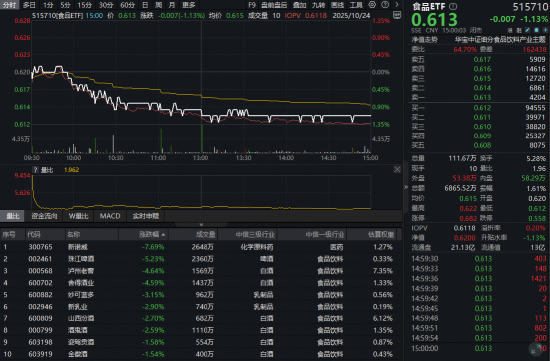
吃喝板块逆市下挫,白酒股集体“醉倒”!食品ETF(515710)跌超1%,机构高呼看好四季度行情!
Xin Lang Ji Jin· 2025-10-24 11:43
Group 1 - The food and beverage sector experienced a decline on October 24, with the Food ETF (515710) closing down 1.13% after fluctuating near the surface at the opening [1] - Key stocks in the sector, particularly in the liquor category, saw significant drops, with Zhujiang Beer down 5.23%, and both Luzhou Laojiao and Shede Distillery falling over 4% [1] - The overall performance of the sector was negatively impacted by declines in several stocks, including Miaokelando and New Dairy, which dropped over 3% and 2% respectively [1] Group 2 - Guosen Securities noted that as the impact of second-quarter consumption policies weakens, the restaurant supply chain is gradually recovering, with positive signals from the supply side, such as frequent mergers among leading companies [2] - The food and beverage sector is currently at a low valuation, with the food ETF's price-to-earnings ratio at 20.49, which is at the 7.06% percentile of the past decade, indicating a favorable configuration opportunity [2] - Historical trends suggest that any changes in supply and demand could catalyze stock price increases, especially in the fourth quarter when macro policies are expected to be active [2] Group 3 - Future outlook indicates that the food and beverage industry will focus on growth, with beverage leaders maintaining structural prosperity driven by major products, while companies in food raw materials and health products are expected to see accelerated performance [3] - The white liquor industry is currently in a "low expectation, weak reality" state, with the third-quarter reports being a crucial observation window as external factors diminish and liquor companies adjust strategies [3] - There is a mixed performance in consumer goods, with snacks, beverages, and health products showing good demand, while traditional products like dairy and beer are experiencing flat demand [3] Group 4 - Major liquor brands such as Luzhou Laojiao and Yanghe have launched new products recently, indicating ongoing innovation in the sector [4] - Luzhou Laojiao's new product was launched on Douyin, while Yanghe's new offering was showcased during the Nanjing Autumn Sugar event [4] Group 5 - The Food ETF (515710) focuses on core assets in the food and beverage sector, with approximately 60% of its portfolio allocated to high-end and mid-range liquor leaders, and nearly 40% to leading stocks in beverages, dairy, and condiments [5] - The top ten weighted stocks in the ETF include well-known brands such as Moutai, Wuliangye, and Yili [5] - Investors can also access the core assets of the food and beverage sector through the Food ETF linked funds [5]