
Yanghe(002304)

Search documents
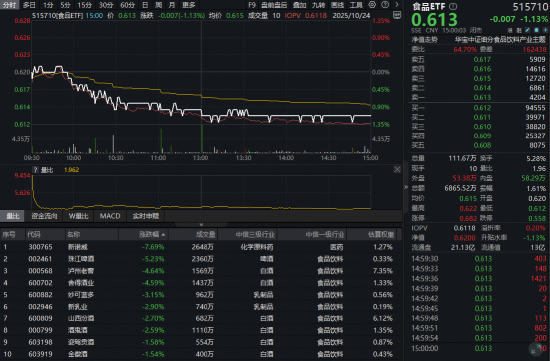
吃喝板块逆市下挫,白酒股集体“醉倒”!食品ETF(515710)跌超1%,机构高呼看好四季度行情!
Xin Lang Ji Jin· 2025-10-24 11:43
Group 1 - The food and beverage sector experienced a decline on October 24, with the Food ETF (515710) closing down 1.13% after fluctuating near the surface at the opening [1] - Key stocks in the sector, particularly in the liquor category, saw significant drops, with Zhujiang Beer down 5.23%, and both Luzhou Laojiao and Shede Distillery falling over 4% [1] - The overall performance of the sector was negatively impacted by declines in several stocks, including Miaokelando and New Dairy, which dropped over 3% and 2% respectively [1] Group 2 - Guosen Securities noted that as the impact of second-quarter consumption policies weakens, the restaurant supply chain is gradually recovering, with positive signals from the supply side, such as frequent mergers among leading companies [2] - The food and beverage sector is currently at a low valuation, with the food ETF's price-to-earnings ratio at 20.49, which is at the 7.06% percentile of the past decade, indicating a favorable configuration opportunity [2] - Historical trends suggest that any changes in supply and demand could catalyze stock price increases, especially in the fourth quarter when macro policies are expected to be active [2] Group 3 - Future outlook indicates that the food and beverage industry will focus on growth, with beverage leaders maintaining structural prosperity driven by major products, while companies in food raw materials and health products are expected to see accelerated performance [3] - The white liquor industry is currently in a "low expectation, weak reality" state, with the third-quarter reports being a crucial observation window as external factors diminish and liquor companies adjust strategies [3] - There is a mixed performance in consumer goods, with snacks, beverages, and health products showing good demand, while traditional products like dairy and beer are experiencing flat demand [3] Group 4 - Major liquor brands such as Luzhou Laojiao and Yanghe have launched new products recently, indicating ongoing innovation in the sector [4] - Luzhou Laojiao's new product was launched on Douyin, while Yanghe's new offering was showcased during the Nanjing Autumn Sugar event [4] Group 5 - The Food ETF (515710) focuses on core assets in the food and beverage sector, with approximately 60% of its portfolio allocated to high-end and mid-range liquor leaders, and nearly 40% to leading stocks in beverages, dairy, and condiments [5] - The top ten weighted stocks in the ETF include well-known brands such as Moutai, Wuliangye, and Yili [5] - Investors can also access the core assets of the food and beverage sector through the Food ETF linked funds [5]






10月24日深证国企股东回报R(470064)指数跌0.29%,成份股深物业A(000011)领跌




Sou Hu Cai Jing· 2025-10-24 11:00
Core Points - The Shenzhen State-Owned Enterprises Shareholder Return Index (470064) closed at 2305.1 points, down 0.29%, with a trading volume of 34.285 billion yuan and a turnover rate of 1.32% [1] - Among the index constituents, 20 stocks rose while 28 stocks fell, with China National Materials Technology leading the gainers at 5.67% and Shenzhen Properties A leading the decliners at 8.41% [1] Index Constituents Summary - The top ten constituents of the Shenzhen State-Owned Enterprises Shareholder Return Index include: - BOE Technology Group (sz000725) with a weight of 9.64%, latest price at 4.05, and total market value of 151.26 billion yuan [1] - Wuliangye Yibin (sz000858) with a weight of 7.95%, latest price at 120.29, and total market value of 466.92 billion yuan [1] - Hikvision (sz002415) with a weight of 7.72%, latest price at 33.29, and total market value of 305.10 billion yuan [1] - Luzhou Laojiao (sz000568) with a weight of 6.53%, latest price at 130.24, and total market value of 191.71 billion yuan [1] - XCMG Machinery (sz000425) with a weight of 6.28%, latest price at 11.37, and total market value of 133.63 billion yuan [1] - Changan Automobile (sz000625) with a weight of 3.87%, latest price at 12.72, and total market value of 126.11 billion yuan [1] - Shenwan Hongyuan (sz000166) with a weight of 3.78%, latest price at 5.46, and total market value of 136.72 billion yuan [1] - Yunnan Aluminum (sz000807) with a weight of 3.45%, latest price at 23.18, and total market value of 80.39 billion yuan [1] - Yanghe Brewery (sz002304) with a weight of 3.27%, latest price at 69.22, and total market value of 104.28 billion yuan [1] - Changchun High & New Technology (sz000661) with a weight of 3.17%, latest price at 117.84, and total market value of 48.07 billion yuan [1] Capital Flow Summary - The net outflow of main funds from the index constituents totaled 0.881 billion yuan, while speculative funds saw a net inflow of 0.65 billion yuan and retail funds a net inflow of 0.231 billion yuan [3] - Notable capital flows include: - Changan Automobile (000625) with a net inflow of 204 million yuan from main funds [3] - Yunnan Copper (000878) with a net inflow of 71.86 million yuan from main funds [3] - Hubei Energy (000883) with a significant net inflow of 44.39 million yuan from main funds [3]
机构:白酒三季报亮红灯,5个龙头利润下降30%,动销数据大幅走弱
Sou Hu Cai Jing· 2025-10-23 20:42
Core Viewpoint - The Chinese liquor industry is facing a bleak outlook, with multiple securities firms predicting significant profit declines for major companies, including Moutai and Wuliangye, by Q3 2025, indicating a severe downturn compared to previous optimistic expectations [1][4]. Group 1: Industry Predictions - Analysts from various securities firms, including Zhongyou Securities and Guangfa Securities, predict that major liquor companies may experience profit declines of up to 30% or more, with Wuliangye's profits potentially halving [1][3]. - Moutai is expected to see near-zero profit growth, while Wuliangye, Luzhou Laojiao, and Gujinggongjiu are projected to face around a 20% profit decline [1][4]. - The overall liquor industry is anticipated to face a more than 20% decline in sales volume due to external demand shocks [4]. Group 2: Market Conditions - The retail sales growth of consumer goods has significantly slowed, particularly in the catering sector, which has nearly stagnated, directly impacting liquor consumption [1][8]. - The average turnover days for inventory in the industry are high, indicating a pressing need for companies to manage inventory effectively amid changing consumer demand [10]. Group 3: Company Responses - Companies are adopting pragmatic strategies to alleviate channel pressure, including adjusting inventory and reducing expenses to enhance operational efficiency [6][9]. - Wuliangye acknowledged the challenges in the market during the recent holiday season but emphasized that official data should be awaited for a clearer picture [3]. Group 4: Consumer Trends - There is a noticeable shift in consumer behavior towards more rational consumption, with increased sensitivity to prices and a decline in the enthusiasm for high-priced products [9]. - The demand is shifting from traditional business banquets to more casual settings, such as gatherings with friends and family, prompting companies to adjust their product offerings [9][10]. Group 5: Future Outlook - Despite the short-term profit declines, the fundamentals of the liquor industry, especially for leading companies, remain intact, with a potential shift towards quality-focused growth rather than mere scale expansion [11]. - The upcoming Q3 reports are expected to provide critical insights into how companies are navigating the current challenges and adapting to market changes [11].




食品饮料周报:糖酒会反馈符合预期,短期关注业绩催化机会-20251023
Tianfeng Securities· 2025-10-23 12:12
Investment Rating - The industry rating is maintained as "Outperform the Market" [6] Core Views - The food and beverage sector showed a slight increase of +0.86% from October 13 to October 17, outperforming the Shanghai Composite Index, which decreased by -1.47%, and the CSI 300 Index, which fell by -2.22% [21] - The report highlights a mixed performance across sub-sectors, with other alcoholic beverages leading with a +3.62% increase, while soft drinks experienced a significant decline of -5.19% [21] - The report emphasizes the importance of performance catalysts in the liquor sector, particularly in the context of the recent Autumn Sugar and Wine Fair, where feedback was relatively subdued [2][13] Summary by Sections Weekly Market Review - The liquor sector, particularly baijiu, showed a +1.78% increase, outperforming the overall food and beverage sector [2][13] - The report notes a cautious sentiment among distributors, with a focus on cost-effective products gaining attention [2][13] Investment Recommendations - For the baijiu sector, three main lines of recommendation include strong beta stocks like JiuGuiJiu and Shuidao, value recovery concepts like YingJiaGongJiu, and strong alpha stocks like Shanxi Fenjiu and Guizhou Moutai [20] - In the broader consumer goods sector, recommended stocks include DongPeng Beverage and NongFu Spring, focusing on performance elasticity and potential cost benefits [20] Sector Performance - The report details the performance of various sub-sectors, with notable increases in other alcoholic beverages and health products, while soft drinks and meat products faced declines [21] - The report also provides insights into the valuation metrics, indicating that the baijiu sector's PE-TTM is at 18.94X, which is considered low compared to historical averages [13][30]



32+50,这项国家重要名单公布!
中国能源报· 2025-10-23 05:03
Core Points - The Ministry of Industry and Information Technology announced the seventh batch of national industrial heritage sites and the third batch of sites that passed re-evaluation, including 32 new sites and 50 re-evaluated sites [1][2]. Group 1: New National Industrial Heritage Sites - The seventh batch includes significant projects such as Shoushan Substation, Fengman Hydropower Station, Jingpo Lake Power Plant, Qinshan Nuclear Power Station, and Chongqing Power Plant [1][2]. Group 2: Re-evaluated National Industrial Heritage Sites - The third batch of re-evaluated sites includes major locations like Dagang Oilfield Port No. 5 Well, Kailuan Zhao Gezhuang Mine, Shigejie Coal Mine, Fushun West Open-pit Mine, Dongwo Hydropower Station, and the Controlled Nuclear Fusion Experiment Site [1][2]. Group 3: Recommendations for Heritage Management - The Ministry encourages local departments and enterprises to enhance the systematic protection of industrial heritage, increase resource support, and promote active utilization through new models such as "Industrial Heritage +” for education, tourism, and industrial restructuring [2].



2025年1-4月中国白酒(折65度,商品量)产量为130.8万千升 累计下降7.8%
Chan Ye Xin Xi Wang· 2025-10-23 01:24
Core Viewpoint - The Chinese liquor industry is experiencing a decline in production, with a significant drop in output expected in 2025, indicating potential challenges for major companies in the sector [1] Industry Summary - According to the National Bureau of Statistics, the production of Chinese liquor (converted to 65 degrees, in commodity volume) is projected to be 281,000 kiloliters in April 2025, representing a year-on-year decrease of 13.8% [1] - From January to April 2025, the cumulative production of Chinese liquor (converted to 65 degrees, in commodity volume) is expected to reach 1,308,000 kiloliters, reflecting a cumulative decline of 7.8% [1] - The report by Zhiyan Consulting provides an analysis of the market status and investment prospects for the Chinese liquor industry from 2025 to 2031, highlighting the ongoing challenges and potential shifts in the market landscape [1] Company Summary - Major listed companies in the Chinese liquor industry include Kweichow Moutai (600519), Wuliangye (000858), Yanghe Brewery (002304), Luzhou Laojiao (000568), Shanxi Fenjiu (600809), Gujing Gongjiu (000596), Shui Jing Fang (600779), Shede Liquor (600702), Jiu Gui Jiu (000799), and Lao Bai Gan Jiu (600559) [1]

2025双节后白酒进销存系列调研
2025-10-22 14:56
Summary of Conference Call Notes Industry Overview - The conference call primarily discusses the Chinese liquor industry, focusing on major brands such as Yanghe, Jinshiyuan, Moutai, Wuliangye, and Gujing. - The overall performance of the liquor market during the Double Festival period shows mixed results, with some brands experiencing declines while others see slight growth. Key Points and Arguments Yanghe's Performance - Yanghe's shipment volume declined by 16.5% during the Double Festival, while Jinshiyuan's increased by 8.9% [1][4]. - The leadership change at Yanghe has led to a focus on promoting mass-market products, such as the new Hai Zhi Lan, and plans to launch products priced below 300 RMB [9]. - Yanghe's market performance is not yet at the bottom, with expectations of further declines over the next two to three years due to unstable channel conditions and difficulties in attracting new distributors [10]. Jinshiyuan's Stability - Jinshiyuan's performance is considered slightly better than its peers, with a terminal transaction price for its four-open product around 420 RMB and the two-open product around 280 to 290 RMB [13]. - Despite thin margins, Jinshiyuan maintains its market share due to fast natural sales and high brand recognition [13]. Gujing's Inventory and Pricing - Gujing has a high inventory level, with a cycle exceeding 120 days. The wholesale price for Gu 16 is approximately 300 RMB, while Gu 20 ranges from 400 to 460 RMB [18][19]. - Gujing's sales volume decreased by 3% during the Double Festival, but overall performance remained stable [21]. Market Dynamics - Moutai's shipment volume remained flat with a slight increase of about 1%, while Wuliangye saw a decline of 1.7%, and Luzhou Laojiao dropped by 13.1% [3][21]. - The online channel's development in the liquor market depends on the manufacturers' efforts, with distributors lacking pricing advantages [25]. Profitability and Pricing Strategies - Yanghe's price decline is attributed to demand issues and customer preferences, with stricter cost controls affecting price stability [7][8]. - Jinshiyuan's V3 series has a profit margin of about 15%, while the four-open series has a gross margin of around 10% [31]. Future Outlook - For Yanghe, the fourth quarter of 2025 does not have repayment requirements, and most distributors expect to complete 75% of their repayment tasks [29]. - Jinshiyuan's distributors will adjust growth targets based on market conditions, with expectations for high growth in the V3 series [29]. Additional Important Insights - The overall liquor market in Jiangsu province is performing relatively well, with Moutai and Jinshiyuan being among the few brands to show growth [22]. - The feedback from the autumn sugar meeting indicates that distributors are primarily concerned about completing their tasks and whether year-end rebates will be honored [23]. - The performance of non-standard products in the liquor market has seen significant price fluctuations, with the need for Moutai's pricing strategy to influence overall market trends [27].
白酒板块10月22日跌0.31%,金徽酒领跌,主力资金净流出1.88亿元
Zheng Xing Xing Ye Ri Bao· 2025-10-22 08:19
Market Overview - The liquor sector experienced a decline of 0.31% on October 22, with Jinhuijiu leading the drop [1] - The Shanghai Composite Index closed at 3913.76, down 0.07%, while the Shenzhen Component Index closed at 12996.61, down 0.62% [1] Individual Stock Performance - Shede Liquor closed at 62.68, up 0.51% with a trading volume of 83,900 shares and a turnover of 529 million yuan [1] - Luzhou Laojiao closed at 134.67, up 0.34% with a trading volume of 56,200 shares and a turnover of 757 million yuan [1] - Jinhuijiu closed at 19.90, down 1.87% with a trading volume of 39,700 shares and a turnover of 79.43 million yuan [2] - Gujing Gongjiu closed at 153.69, down 1.63% with a trading volume of 15,400 shares and a turnover of 239 million yuan [2] Capital Flow Analysis - The liquor sector saw a net outflow of 188 million yuan from main funds, while retail investors contributed a net inflow of 168 million yuan [2] - Major stocks like Luzhou Laojiao and Shede Liquor experienced mixed capital flows, with Luzhou Laojiao seeing a net inflow of 41.57 million yuan from main funds [3] - Guizhou Moutai had a net inflow of 27.73 million yuan from main funds, indicating continued interest despite overall sector decline [3]

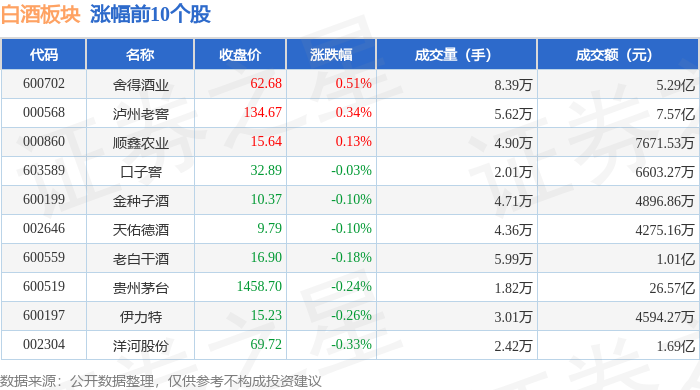
17只白酒股下跌 贵州茅台1458.70元/股收盘
Bei Jing Shang Bao· 2025-10-22 08:16
Core Viewpoint - The overall performance of the liquor sector, particularly the baijiu segment, is experiencing a decline during the 2025 double festival peak season, with leading brands showing slightly better performance than the industry average [1] Industry Summary - The Shanghai Composite Index closed at 3913 points, down 0.07%, while the baijiu sector closed at 2295.12 points, down 0.16% [1] - A total of 17 baijiu stocks declined, with Jinhuijiu leading the drop at 1.87% [1] - The industry is witnessing a further increase in concentration, indicating a shift towards fewer dominant players [1] Company Summary - Kweichow Moutai's closing price was 1458.70 CNY per share, down 0.24% [1] - Wuliangye's closing price was 120.10 CNY per share, down 0.35% [1] - Shanxi Fenjiu's closing price was 188.31 CNY per share, down 0.74% [1] - Luzhou Laojiao's closing price was 134.67 CNY per share, up 0.34% [1] - Yanghe's closing price was 69.72 CNY per share, down 0.33% [1] - According to a report by China Merchants Securities, the sales performance of leading brands like Feitian and Pu Wuliang is more favorable compared to the overall industry trend, especially after price adjustments that enhance their cost-performance ratio [1]
食品饮料行业2025年三季报前瞻:白酒加速出清,大众逐渐改善
Huachuang Securities· 2025-10-22 00:46
Investment Rating - The report maintains a recommendation for the liquor sector, indicating a bottoming out phase with potential for recovery in the future [2]. Core Insights - The liquor industry is experiencing a significant decline in sales, with an expected drop of over 20% in overall sales volume. However, there are signs of month-on-month improvement, and the decline is narrowing [5][9]. - Major liquor companies like Moutai and Wuliangye are showing strong recovery in payment collection, with over 80% collection rates, while regional brands are performing adequately [5][9]. - The report emphasizes the importance of focusing on high-quality liquor brands that are likely to recover faster, such as Moutai and Fenjiu, while also highlighting the need to monitor companies undergoing significant changes [6][9]. Summary by Sections 1. Liquor Sector: Q3 Accelerated Decline and Bottoming Out - The liquor sector is facing a 20%+ decline in sales due to external demand shocks, with a gradual improvement expected in the coming months [5][9]. - High-end liquor brands are expected to show resilience, with Moutai projected to achieve a 3% revenue growth in Q3, while Wuliangye is expected to see a 20% revenue decline [10][11]. - The report indicates that companies are adjusting their strategies to reduce channel pressure and improve operational efficiency [9][10]. 2. Consumer Goods Sector: Overall Demand Weakness, Structural Resilience - The consumer goods sector is experiencing overall weak demand, but segments like snacks and beverages are showing higher resilience [17][24]. - The report notes that while the demand for dairy and beer remains stable, the restaurant supply chain is still under pressure [17][24]. - Raw material prices are generally declining, which may provide some cost relief to companies in the sector [24][25]. 3. Investment Recommendations: Focus on Liquor Bottoming Catalysts and Selective Consumer Goods Trends - The report suggests focusing on liquor companies that are at the bottom of their cycles, with Moutai and Fenjiu being primary recommendations [6][9]. - For consumer goods, the report highlights the potential of snack and beverage companies, recommending brands that are well-positioned to benefit from current trends [6][17].


