
YanKershop(002847)

Search documents
食品饮料行业点评报告:经济格局延续韧性,9月社零总额增速回落
Huaxin Securities· 2025-10-21 11:00
Investment Rating - The industry investment rating is "Recommended" [9] Core Views - The economic landscape continues to show resilience, with GDP growth in the first three quarters reaching 101.50 trillion yuan, a year-on-year increase of 5.2%. Despite a marginal decline in growth rate to 4.8% in Q3, the overall economic stability is supported by new productive forces and effective macro policies [4] - Retail sales growth has slowed down, with total retail sales from January to September at 36.59 trillion yuan, a year-on-year increase of 4.5%. In September alone, retail sales were 4.20 trillion yuan, growing by only 3.0% [5] - The beverage sector is performing strongly, with a focus on new consumption opportunities driven by retail channel transformations. Key companies to watch include Huashang Auntie, Tea Baidao, and others [6] Summary by Sections Economic Overview - GDP growth has shown resilience despite external challenges, with a year-on-year increase of 5.2% in the first three quarters [4] - The Q3 GDP growth rate decreased by 0.4 percentage points, attributed to external tariff policy changes and transitional pains in various industries [4] Retail Sales Performance - Total retail sales for the first nine months reached 36.59 trillion yuan, with a growth rate of 4.5% year-on-year. September's retail sales were 4.20 trillion yuan, reflecting a slowdown to 3.0% growth [5] - The decline in growth is linked to the reduced impact of the "old-for-new" policy and the timing of the Mid-Autumn Festival [5] Investment Opportunities - The report highlights several companies with strong recovery expectations in the consumer goods sector, including Weilai Delicious, Ximai Foods, and Youyou Foods [6] - The beverage sector is noted for its robust performance, with a focus on companies like Dongpeng Beverage and others, as well as the impact of new birth policies on dairy demand, highlighting companies such as Yili and Mengniu [6]


休闲食品板块10月20日跌0.76%,盐津铺子领跌,主力资金净流出1937.83万元
Zheng Xing Xing Ye Ri Bao· 2025-10-20 08:30
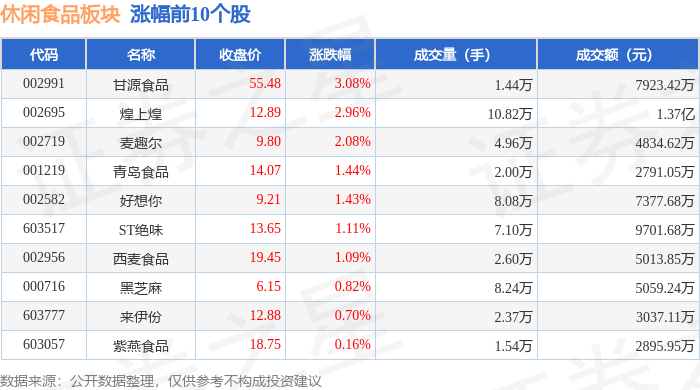
Market Overview - The leisure food sector experienced a decline of 0.76% on October 20, with Yanjinpuzi leading the drop [1] - The Shanghai Composite Index closed at 3863.89, up 0.63%, while the Shenzhen Component Index closed at 12813.21, up 0.98% [1] Individual Stock Performance - Ganyuan Food (002991) saw a closing price of 55.48, with an increase of 3.08% and a trading volume of 14,400 hands, totaling 79.23 million yuan [1] - Huangshanghuang (002695) closed at 12.89, up 2.96%, with a trading volume of 108,200 hands, amounting to 137 million yuan [1] - Yanjinpuzi (002847) led the decline with a closing price of 70.55, down 4.66%, and a trading volume of 41,800 hands, totaling 299 million yuan [2] - Other notable declines included Nanjiao Food (605339) down 3.39% and Ligao Food (300973) down 2.62% [2] Capital Flow Analysis - The leisure food sector saw a net outflow of 19.38 million yuan from institutional investors, while retail investors had a net inflow of 29.61 million yuan [2] - The main capital inflow was observed in Wancheng Group (300972) with a net inflow of 23.53 million yuan, while Ganyuan Food (002991) had a net inflow of 2.36 million yuan [3] - Conversely, Yanjinpuzi (002847) experienced a significant net outflow of 33.02 million yuan from retail investors [3]

盐津铺子实控人张学文3月内减持546万股 套现3.83亿元
Zhong Guo Jing Ji Wang· 2025-10-20 07:03
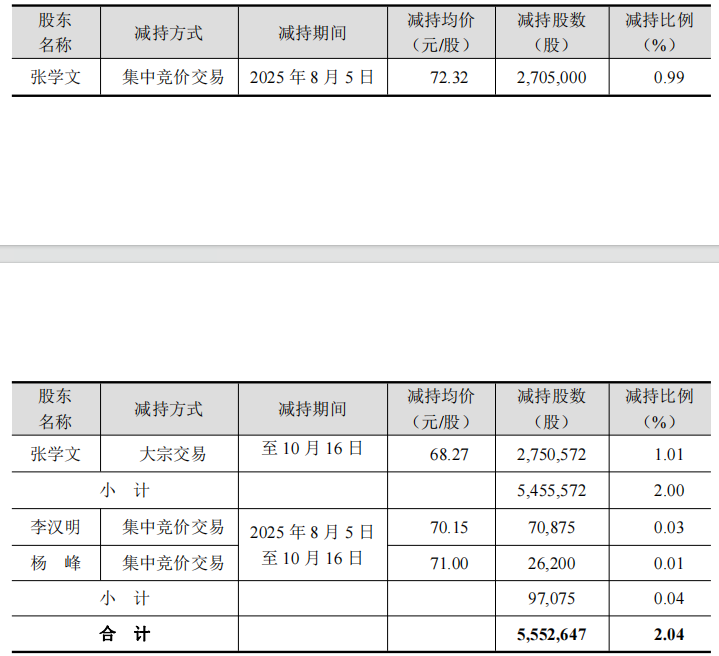
Core Points - The major shareholder Zhang Xuewen has completed a share reduction plan, decreasing his stake from 63.08% to 61.08% after selling a total of 5,455,572 shares [1][2] - Zhang Xuewen's share reduction generated a cash amount of approximately 383 million yuan [2] - The company's senior management, including Vice President Li Hanming and CFO Yang Feng, also completed their share reduction plans, with Li reducing his holdings by 70,875 shares and Yang by 26,200 shares [2][3] Summary by Sections - **Shareholder Reduction** Zhang Xuewen, a major shareholder, held 41,965,203 shares, representing 15.38% of the total share capital. After the recent reductions, his total holdings are now 166,619,367 shares, equating to 61.08% [1] The reduction occurred through a combination of centralized bidding and block trading, with specific amounts of shares sold during the period from August 5 to October 16, 2025 [1][2] - **Management Share Reduction** Vice President Li Hanming and CFO Yang Feng have also executed their share reduction plans, with Li reducing his holdings by 70,875 shares and Yang by 26,200 shares [2][3] Their combined reduction does not exceed 0.04% of the total share capital [3] - **Future Reduction Plans** The company previously disclosed a plan for Zhang Xuewen to reduce his holdings by up to 5,455,572 shares within a specified timeframe, which is within the legal limits set for such transactions [2][3] The management's future reduction plans are also outlined, with specific limits on the number of shares they can sell [3] - **Company Control Structure** The controlling shareholder of the company is Hunan Yanjinpuzi Holdings Co., Ltd., with Zhang Xuewen and Zhang Xuewu as the actual controllers. Zhang Xuewen has not held any position in the company since October 2019 [3]
盐津铺子股价跌5.03%,国联基金旗下1只基金重仓,持有4.55万股浮亏损失16.93万元
Xin Lang Cai Jing· 2025-10-20 06:08
Group 1 - The core point of the news is that Yanjinpuzi's stock price has dropped by 5.03% to 70.28 CNY per share, with a trading volume of 220 million CNY and a turnover rate of 1.25%, resulting in a total market capitalization of 19.171 billion CNY [1] - Yanjinpuzi Food Co., Ltd. is located in Changsha, Hunan Province, and was established on August 4, 2005, with its listing date on February 8, 2017. The company specializes in the research, production, and sales of snack foods and deep processing of agricultural products [1] - The main revenue composition of Yanjinpuzi includes: spicy snacks 44.91%, baked potato products 15.61%, dried fruits and jellies 14.56%, deep-sea snacks 12.33%, egg snacks 10.52%, and others 2.06% [1] Group 2 - From the perspective of major fund holdings, one fund under Guolian Fund has a significant position in Yanjinpuzi. Guolian Brand Preferred Mixed A (008424) reduced its holdings by 4,100 shares in the second quarter, holding a total of 45,500 shares, which accounts for 5.75% of the fund's net value, ranking as the sixth-largest holding [2] - The current estimated floating loss for Guolian Brand Preferred Mixed A (008424) is approximately 169,300 CNY [2] - Guolian Brand Preferred Mixed A (008424) was established on May 14, 2020, with a latest scale of 54.6683 million CNY. Year-to-date return is 6.88%, ranking 6214 out of 8234 in its category; the one-year return is 9.4%, ranking 5991 out of 8095; and since inception, it has a loss of 26.21% [2]
盐津铺子实控人张学文3月内减持546万股 套现3.83亿元
Zhong Guo Jing Ji Wang· 2025-10-20 03:37
Core Viewpoint - The major shareholder Zhang Xuewen of Yanjinpuzi has completed a share reduction plan, decreasing his stake from 63.08% to 61.08% after selling a total of 5,455,572 shares, which represents 2% of the company's total share capital [1][4]. Shareholder Reduction Details - Zhang Xuewen reduced his holdings through concentrated bidding and block trading, selling 2,705,000 shares at an average price of 72.32 yuan per share and 2,750,572 shares at an average price of 68.27 yuan per share [3][4]. - The total cash generated from Zhang Xuewen's share reduction amounts to 383 million yuan [2]. - Other executives, including Vice President Li Hanming and CFO Yang Feng, also completed their share reduction plans, selling 70,875 shares and 26,200 shares respectively [2][5]. Shareholding Structure - After the reduction, Zhang Xuewen and his concerted parties hold a total of 166,619,367 shares, which is 61.08% of the total share capital [1]. - The company has a total share capital of 273,000,000 shares, with Zhang Xuewen's previous stake being 41,965,203 shares, accounting for 15.38% [1][5]. Future Reduction Plans - Li Hanming and Yang Feng plan to reduce their holdings further within the same timeframe, with a maximum of 97,125 shares combined, which is 0.04% of the total share capital [5].
盐津铺子:实控人张学文减持545.6万股 金额约3.84亿元
2 1 Shi Ji Jing Ji Bao Dao· 2025-10-20 03:17
Core Viewpoint - The actual controller of Yanjinpuzi, Zhang Xuewen, is reducing his stake in the company, which may indicate a shift in confidence or strategy regarding the company's future performance [1] Shareholding Changes - Zhang Xuewen reduced his holdings by 5,455,572 shares, representing 2.00% of the total share capital, for approximately 384 million yuan [1] - After the reduction, Zhang Xuewen holds 36,509,631 shares, decreasing his ownership percentage from 15.38% to 13.38% [1] - Other senior management members, Li Hanming and Yang Feng, also completed their respective reduction plans, selling 70,875 shares and 26,200 shares [1]
盐津铺子- 食品借利好产品周期推进全渠道扩张
2025-10-19 15:58
Summary of Yankershop Food Conference Call Company Overview - **Company**: Yankershop Food - **Industry**: Snacks Industry in China - **Coverage Initiation**: Buy rating with a price target of Rmb90.00, implying 27x/22x 2026E/2027E PE [2][5][10] Key Points Growth Projections - **Revenue Growth**: Forecasted revenue CAGR of 15% from 2024 to 2027, with specific YoY growth rates of 18% in 2025, 15% in 2026, and 13% in 2027 [3][10] - **Konjac Products**: Expected to be a major growth driver, with revenue projected to increase from over Rmb800 million in 2024 to more than Rmb3,000 million in 2027, representing a 54% CAGR [3][10][14] Product and Channel Strategy - **Product Focus**: Strategic transition towards core products, particularly konjac, spicy & braised snacks, and bakery products [3][26] - **Omnichannel Strategy**: Expansion into multiple channels, including snack discounters and distributors, to capture growth potential [2][16][50] - **Channel Growth**: Snack discounter channel sales are expected to grow at a CAGR of 14% from 2024 to 2027, increasing its contribution to total sales from 9.0% in 2024 to 12.5% in 2027 [10][50] Margin Improvement - **Net Profit Margin (NPM)**: Projected improvement from 10.7% in 2024 to 13.7% in 2027, driven by limited margin dilution from channel shifts and a more focused product strategy [4][18][69] - **Gross Profit Margin (GPM)**: Expected stabilization at 29-30% in 2025-27, with improvements due to favorable raw material prices and economies of scale [18][69] Financial Metrics - **Valuation**: Stock trading at 21x 12-month forward PE, below historical average of 25x since 2022, and slightly below peers [5][19] - **Revenue Forecast**: Projected revenues to grow from Rmb5,304 million in 2024 to Rmb8,085 million in 2027 [6][26] Market Position - **Competitive Landscape**: Yankershop is positioned as a leader in the Chinese snacks industry, with a diversified product portfolio and strong brand recognition [2][10][25] - **Consumer Trends**: Increasing popularity of modern snacks, including konjac, among consumers, with Yankershop gaining market share [39][49] Risks and Considerations - **Online Channel Performance**: Anticipated slowdown in online sales due to strategic cuts in offerings, leading to a projected decline of 40-50% YoY in online sales for 2025 [55][64] - **Debt Levels**: Net debt projected to increase, with a forecast of Rmb649 million in 2025 [6] Conclusion Yankershop Food is positioned for significant growth in the Chinese snacks market, driven by a clear product strategy focused on konjac products and an effective omnichannel approach. The company is expected to improve its margins and deliver strong revenue growth, making it an attractive investment opportunity.
机构本周首次青睐46只个股

Mei Ri Jing Ji Xin Wen· 2025-10-19 11:40
Group 1 - Institutional investors have shown interest in 46 stocks this week, with 12 stocks receiving target prices [1] - SMIC has been rated "Buy" by Western Securities with a target price of 146.45 CNY, while its latest closing price was 121.98 CNY [1] - Tianyouwei received a "Buy" rating from Tianfeng Securities with a target price of 145.2 CNY [1] Group 2 - Other stocks mentioned include Beifang Huachuang, Shenxinfu, and Yanjinpuzi, which are also under institutional focus [1]
食品饮料行业周报:秋糖热度平淡,继续关注高股息品种-20251018
Shenwan Hongyuan Securities· 2025-10-18 14:38
Investment Rating - The report maintains a cautious outlook on the industry, suggesting that the liquor sector is in a bottoming process while food companies should seek structural opportunities from the bottom up [6][8]. Core Views - The liquor industry is expected to experience a prolonged period of inventory digestion, with pressure on third-quarter reports anticipated to continue into the first quarter of 2026. The report emphasizes that stock price recovery may precede fundamental improvements [6][7]. - For consumer goods, the report highlights the potential for structural growth driven by new consumption trends, recommending companies with strong long-term competitive advantages [6][8]. Summary by Sections 1. Weekly Industry Insights - The food and beverage sector outperformed the market, with a weekly increase of 0.86%, while the liquor segment rose by 1.78%. The sector ranked third among 31 sub-industries [5][29]. - Key stocks that performed well included Kweichow Moutai and Qingdao Beer, while stocks like Jinzi Ham faced significant declines [5]. 2. Market Performance by Sector - The report indicates that the liquor sector is facing significant adjustment pressures, with high channel inventories and weak demand expected to persist into the next year. The report anticipates that the sales performance during the 2026 Spring Festival will be under pressure due to high base effects from 2025 [7][29]. - The consumer goods sector is viewed positively, particularly in dairy and beer, with recommendations for stocks like Yili and Yanjing Beer, while also noting potential competition in the snack and beverage segments [8][29]. 3. Key Company Updates - Moutai's bottle price is reported at 1750 RMB, down 15 RMB week-on-week, while Wuliangye's price remains stable at approximately 830 RMB. The report notes that the autumn sugar and wine fair had a subdued atmosphere, reflecting ongoing market challenges [7][19]. - The report highlights significant profit growth for companies like Chenguang Biotech, with a projected net profit increase of 344.05% to 401.55% year-on-year for the first three quarters of 2025 [9][10]. 4. Valuation Metrics - As of October 17, 2025, the food and beverage sector's dynamic PE is reported at 19.74x, with a premium rate of 24%. The liquor sector's dynamic PE stands at 18.33x, with a premium rate of 15% [19][28]. 5. Sectoral Excess Returns - The food and beverage industry outperformed the Shenwan A index by 4.44 percentage points during the period from October 13 to October 17, 2025, with various sub-sectors showing different levels of performance [29][30].





盐津铺子(002847) - 关于持股5%以上股东减持股份触及1%刻度暨减持股份实施完成的公告
2025-10-17 13:03
证券代码:002847 证券简称:盐津铺子 公告编号:2025-054 盐津铺子食品股份有限公司 关于持股5%以上股东减持股份触及1%刻度 暨减持股份实施完成的公告 公司持股5%以上股东张学文先生,副总经理李汉明先生、财务总监杨峰先 生保证向本公司提供的信息内容真实、准确、完整,没有虚假记载、误导性陈述 或重大遗漏。 本公司及董事会全体成员保证公告内容与信息披露义务人提供的信息一致。 重要内容提示: 1、减持主体持股的基本情况 盐津铺子食品股份有限公司(以下简称"公司")持股 5%以上股东张学文 先生(实际控制人之一)持有公司股份 41,965,203 股,占公司总股本的 15.38% (总股本按剔除公司最新披露回购专用账户中的股份数量 1,050 股计算,下同); 副总经理李汉明先生、财务总监杨峰先生合计持有公司股份 388,500 股,占公司 总股本的 0.14%。 2、减持计划的主要内容 一、持股 5%以上股东减持股份触及 1%刻度的情况 | | 住所 | | 湖南省浏阳市****** | | | | --- | --- | --- | --- | --- | --- | | 权益变动时间 | | | ...