SUNWODA(300207)

Search documents
“一芯难求”!头部企业开启“加班”模式
起点锂电· 2025-09-30 08:20
Core Viewpoint - The article highlights a significant shift in the lithium battery market, transitioning from concerns about insufficient demand to worries about supply constraints, particularly in the energy storage sector, which is now a key driver of lithium battery demand [2][3]. Group 1: Market Dynamics - The lithium battery sector has seen a strong rebound in stock prices for major companies like CATL and Ganfeng Lithium, indicating a market sentiment shift [2]. - Energy storage has transitioned from a secondary role to a primary focus, with unexpected growth driving demand [3]. - Major manufacturers are experiencing order backlogs, with some companies unable to meet demand and having to forgo lower-margin orders [3]. Group 2: Production and Capacity Utilization - In 2025, the top 10 domestic energy storage cell manufacturers maintained a capacity utilization rate above 80%, with many exceeding 90% since the second quarter [5]. - CATL's capacity utilization reached approximately 89.86%, with a backlog of over 48 GWh in energy storage orders extending into Q1 2026 [6]. - Companies like EVE Energy and Aoxin Energy reported full production capacity, with significant year-on-year increases in shipment volumes [6][8]. Group 3: Demand and Supply Imbalance - The "chip shortage" phenomenon is attributed to a mismatch between supply and demand, with energy storage demand significantly outpacing supply capabilities [12][13]. - The domestic energy storage market has seen a 150% year-on-year increase in new tenders, with a total of over 210 GWh from January to August [15]. - Internationally, Chinese energy storage companies have experienced explosive growth in overseas orders, exceeding 180 GWh, a year-on-year increase of over 200% [16]. Group 4: Price Trends and Future Outlook - The article notes a potential continuation of the supply-demand gap until Q1 2026, with a forecasted compound annual growth rate of 30%-50% for global energy storage over the next 3-5 years [20]. - Prices for energy storage batteries are expected to rise due to increased costs of raw materials like lithium carbonate, although competitive pressures may limit price increases in the system integration market [21]. - The introduction of larger capacity cells (500Ah+) may eventually replace some of the demand for 314Ah cells, potentially stabilizing prices [21].






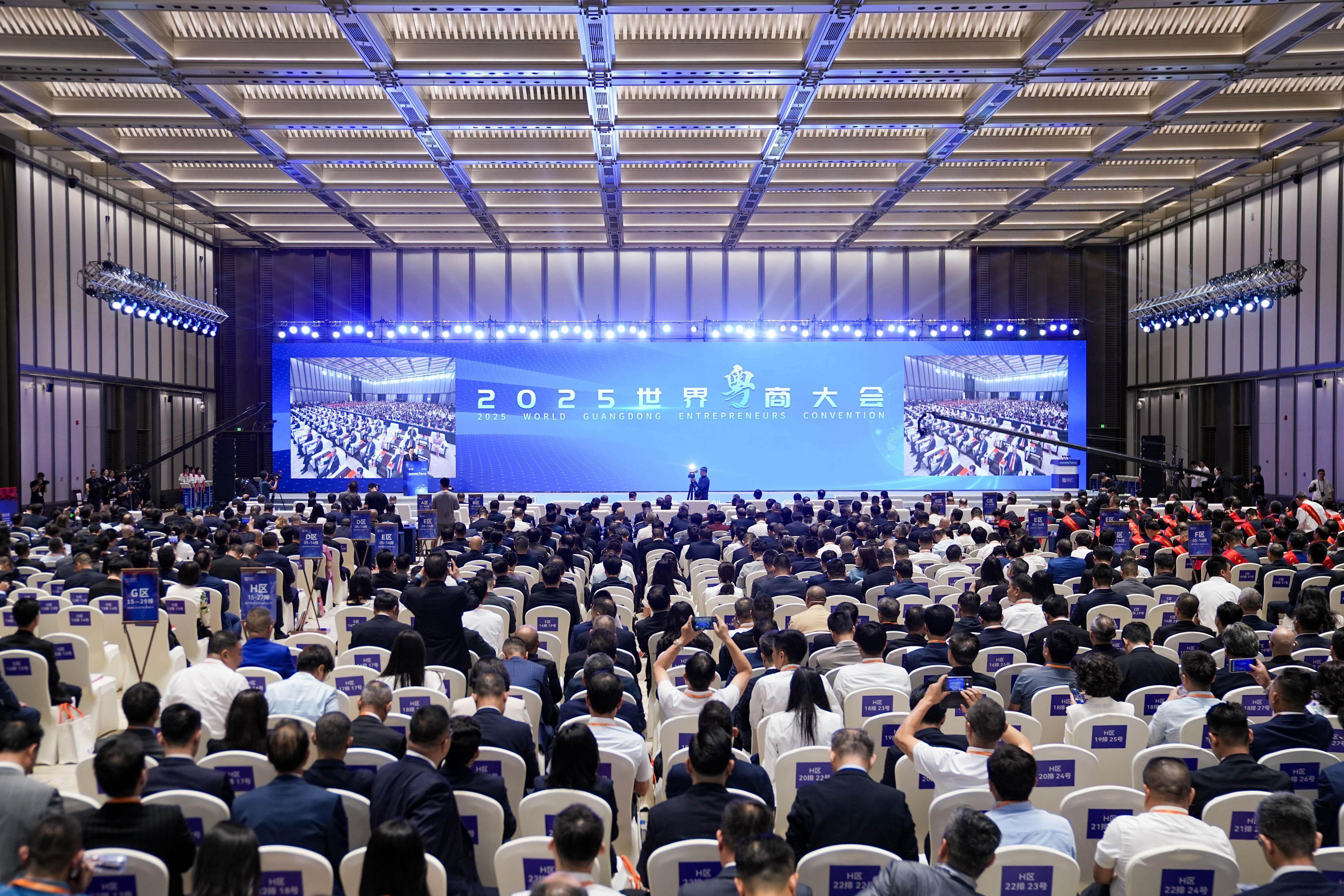
全球粤商齐聚这5场专题会,碰撞出哪些智慧火花?
Sou Hu Cai Jing· 2025-09-29 14:48
Group 1: Core Themes of the Conference - The 2025 World Cantonese Business Conference focused on modern industrial system construction, high-quality development projects, international cooperation, youth innovation, and financial support for development [1][4][8] - The conference gathered renowned Cantonese business leaders, experts, and scholars to discuss industrial upgrading and open cooperation opportunities [1][4] Group 2: International Cooperation and Global Market Expansion - Cantonese businesses have historically played a significant role in China's internationalization, evolving from product exports to global supply chain establishment [4][5] - The need for innovation and unique technological capabilities is emphasized for Cantonese businesses to remain competitive in the changing international landscape [5][6] - Businesses are encouraged to integrate local economic development with their operations when expanding internationally, fostering collaboration and cultural respect [5][6] Group 3: Modern Industrial System Development - Guangzhou's economic output has surpassed 3 trillion yuan, with six advanced manufacturing clusters and seven service industry clusters each exceeding 100 billion yuan [6][7] - The city is focusing on five future industrial sectors, including intelligent vehicles, biomedicine, new displays, low-altitude economy, and artificial intelligence [6][7] - Systematic policies and strong support for resources are crucial for the elevation of industrial capabilities in Guangdong [6][7] Group 4: Financial Support for High-Quality Development - Guangdong's financial system is actively supporting the transformation and upgrading of industries, with a significant increase in loans to private and small enterprises [7][8] - As of August, the loan balance for private enterprises reached 8.68 trillion yuan, with a year-to-date increase of 275.9 billion yuan [7][8] Group 5: Youth Engagement and Innovation - The conference highlighted the role of youth in driving innovation and contributing to high-quality development in the Greater Bay Area [11][12] - Young Cantonese entrepreneurs are encouraged to build collaborative platforms to share resources and enhance collective strength in supporting national strategies [11][12] Group 6: Regional Development and Cultural Integration - Cantonese businesses are actively participating in regional development initiatives, such as supporting industries in Tibet through resource development and cultural preservation [12] - The integration of local culture and economic activities is seen as vital for sustainable development and community engagement [12]
到2035年新能源汽车将成主流
Dong Zheng Qi Huo· 2025-09-29 11:14
1. Report Industry Investment Rating - Not provided in the given content 2. Core Viewpoints of the Report - By 2035, new energy vehicles will become the mainstream of newly sold vehicles in China, with the net greenhouse gas emissions in the entire economic scope decreasing by 7%-10% from the peak, non-fossil energy consumption accounting for over 30% of the total energy consumption, and other goals to be achieved [1][109][118]. - The penetration rate of the Chinese new energy vehicle market exceeded 30% in 2023 and 50% in 2024. In 2025, high - competitiveness new car products are continuously launched, and price wars are gradually stopped. Overseas markets face trade protectionism in Europe and the United States, so attention should be paid to new growth points such as countries along the Belt and Road and the Middle East. The market share of independent brands continues to expand [3][120]. 3. Summary According to Relevant Catalogs 3.1 Financial Market Tracking - The one - week price changes of related sectors and listed companies are presented in charts. For example, BYD's one - week price decline was 1.65%, while Seres' was 9.48% [12][15]. 3.2产业链数据跟踪 3.2.1 China New Energy Vehicle Market Tracking - **Sales and Exports**: Data on China's new energy vehicle sales, penetration rate, domestic sales, exports, and sales of EV and PHV are presented in charts [16][21][23]. - **Inventory Changes**: Charts show the monthly new additions to new energy passenger vehicle channel inventory and manufacturer inventory [24][25]. - **Delivery Volumes of Chinese New Energy Vehicle Enterprises**: Monthly delivery volumes of enterprises such as Leapmotor, Li Auto, XPeng, NIO, etc., are presented in charts [27][28][32]. 3.2.2 Global and Overseas New Energy Vehicle Market Tracking - **Global Market**: From January to July, global new energy vehicle sales reached 9.233 million, a year - on - year increase of 25.9%. Except for China, Europe and other regions also had significant growth, with year - on - year increases of 29.5% and 53.4% respectively [2]. - **European Market**: Data on European new energy vehicle sales, penetration rate, and sales of EV and PHV in countries like the UK, Germany, and France are presented in charts [44][50][55]. - **North American Market**: In August, US new energy vehicle sales and penetration rate reached record highs. Due to the expiration of the federal electric vehicle tax credit on September 30, high market enthusiasm is expected to continue in September, followed by a sharp decline. Data on North American new energy vehicle sales, penetration rate, and sales of EV and PHV are presented in charts [2][119]. - **Other Regions**: Data on new energy vehicle sales, penetration rate, and sales of EV and PHV in regions such as Japan, South Korea, and Thailand are presented in charts [62][70][72]. 3.2.3 Power Battery Industry Chain - Data on power battery installation volume, export volume, weekly average price of battery cells, material costs, and the operating rates and prices of various battery materials are presented in charts [79][81][85]. 3.2.4 Other Upstream Raw Materials - Data on the daily prices of rubber, glass, steel, and aluminum are presented in charts [102][103][104]. 3.3 Hot News Summaries 3.3.1 China: Policy Dynamics - By 2035, new energy vehicles will become the mainstream of newly sold vehicles in China. From 2026, export license management will be implemented for pure - electric passenger vehicles [109]. 3.3.2 China: Industry Dynamics - From September 1 - 21, new energy vehicle retail sales increased by 10% year - on - year, and cumulative retail sales since the beginning of the year increased by 24%. In the 38th week (September 15 - 21), new energy passenger vehicle retail sales were 299,000, a year - on - year increase of 5.9%, and cumulative retail sales since the beginning of the year were 8.214 million, a year - on - year increase of 23.0% [111][112][113]. 3.3.3 China: Enterprise Dynamics - Chery Automobile was listed on the Hong Kong Stock Exchange, raising HK$9.14 billion. Li Auto and Sunwoda Power jointly established a battery company [114]. 3.3.4 Overseas: Policy Dynamics - Australia announced a 2035 emission reduction target, aiming to reduce emissions by 62 - 70% compared to 2005. The US lowered the import tariff on EU cars to 15%, and Turkey imposed new tariffs on imported passenger cars [114][116][119]. 3.3.5 Overseas: Enterprise Dynamics - BYD's Brazilian factory obtained an international green certificate. Porsche adjusted its product strategy, slowing down electrification and lowering its 2025 performance expectations [117][118]. 3.4 Investment Advice - Pay attention to new growth points such as countries along the Belt and Road and the Middle East. Focus on enterprises with strong product capabilities, smooth overseas expansion, and stable supply [3][120].





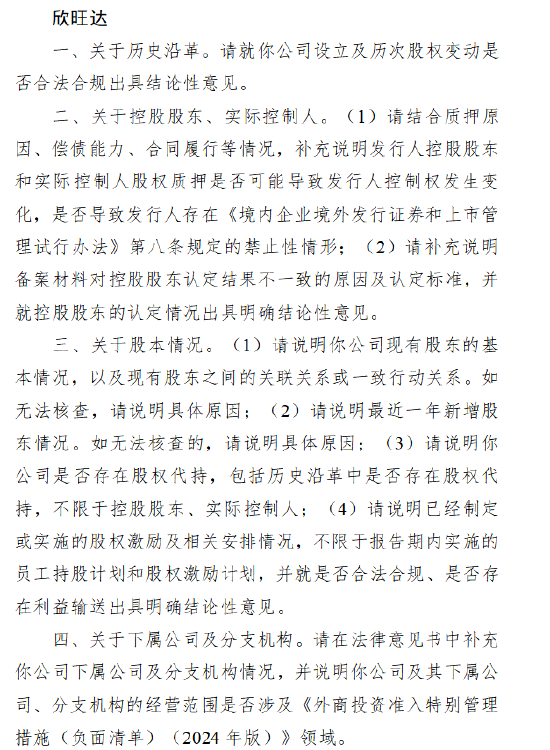
欣旺达A+H收证监会反馈意见:结合质押原因、偿债能力、合同履行,说明大股东质押是否会导致控制权发生变化
Xin Lang Zheng Quan· 2025-09-29 09:41
Core Viewpoint - XINWANDA is preparing for an IPO in Hong Kong, facing challenges such as a significant drop in battery prices and declining sales from major clients [1] Company Overview - XINWANDA Electronic Co., Ltd. is located in Shenzhen, Guangdong, established on December 9, 1997, and listed on A-shares on April 21, 2011 [3] - The company specializes in the research, design, production, and sales of lithium-ion battery modules [3] - Revenue composition includes consumer batteries (51.47%), electric vehicle batteries (28.18%), other (16.63%), and energy storage systems (3.72%) [3] - As of June 30, the number of shareholders is 114,600, an increase of 5.76%, with an average of 14,946 circulating shares per person, a decrease of 5.45% [3] Financial Performance - For the first half of 2025, XINWANDA achieved revenue of 26.985 billion yuan, a year-on-year increase of 12.82%, and a net profit attributable to shareholders of 856 million yuan, up 3.88% [3] - Cumulatively, the company has distributed 1.661 billion yuan in dividends since its A-share listing, with 645 million yuan in the last three years [4] Shareholding Structure - As of June 30, 2025, the second-largest circulating shareholder is Hong Kong Central Clearing Limited, holding 90.6951 million shares, a decrease of 5.8824 million shares [5] - The third-largest shareholder is E Fund's ChiNext ETF, holding 33.9136 million shares, down by 859,400 shares [5] - The sixth-largest shareholder is Southern CSI 500 ETF, with 21.9120 million shares, an increase of 300,960 shares [5]
【生态环境周观察】中国宣布2035年前风电、光伏装机力争达到36亿千瓦目标;天合储能管理层变动;理想汽车与欣旺达成立合资公司
Tai Mei Ti A P P· 2025-09-29 08:46
Group 1 - China aims to achieve a total installed capacity of wind and solar power reaching 3.6 billion kilowatts by 2035, which is over six times the capacity in 2020 [3] - The new national contributions include a target for non-fossil energy consumption to account for over 30% of total energy consumption [3] - The forest stock volume is targeted to exceed 24 billion cubic meters by 2035 [3] Group 2 - Four departments in China have issued guidelines to promote the development of a high-quality energy equipment system, aiming for significant advancements in the energy equipment industry by 2030 [4] - The guidelines emphasize the need for long-life, wide-temperature, low-degradation lithium batteries, sodium batteries, and solid-state batteries [4] - The focus is also on developing low-cost, long-duration flow battery systems and enhancing the safety performance of energy storage batteries [4] Group 3 - The steel industry is set to achieve an average annual growth of around 4% in value added from 2025 to 2026, with a focus on optimizing industrial structure and enhancing green and digital development [5] - The plan includes ten specific measures across five areas, such as precise control of production capacity and promoting quality upgrades of bulk products [5] Group 4 - The petrochemical industry aims for an average annual growth of over 5% in value added from 2025 to 2026, with a focus on enhancing technological innovation and achieving collaborative benefits in pollution reduction and carbon reduction [6] - The plan emphasizes the transition of chemical parks from standard construction to high-quality development [6] Group 5 - Li Auto and battery giant Xinwanda plan to establish a joint venture for the production and sale of lithium-ion batteries for electric vehicles, with each holding a 50% stake [7] - This follows a strategic cooperation agreement with CATL to collaborate on battery safety and ultra-fast charging technology [7] Group 6 - Four exchanges in the Guangdong-Hong Kong-Macao Greater Bay Area have signed a memorandum to promote the development of the carbon market and green finance ecosystem [8] - The collaboration aims to enhance professional capabilities in carbon market operations and green finance [8] Group 7 - Trina Solar's energy storage division has undergone management changes, with a new president appointed to focus on energy storage while the previous president shifts focus to the solar module sector [9] - Trina Solar aims for energy storage shipments to exceed 8 GWh by 2025, with a target of maintaining over 50% year-on-year growth in 2026 [9] Group 8 - China's first green energy supply railway project has been launched, integrating renewable energy and storage into the railway power supply system [10] - The project is expected to provide an average of 7.39 million kilowatt-hours of green electricity annually, saving 2,218.3 tons of standard coal and reducing carbon dioxide emissions by 5,804.53 tons [10]



继续看好储能板块投资机会
2025-09-28 14:57
Summary of Key Points from the Conference Call Industry Overview - The conference call focuses on the energy storage sector, highlighting the current supply-demand dynamics and future growth prospects in both domestic and international markets [1][2][3][6][7]. Core Insights and Arguments - **Supply-Demand Tension**: The energy storage battery market is experiencing significant supply-demand tension, particularly in the cell segment. Major manufacturers like CATL and EVE Energy are operating at full capacity, with production schedules extending into early 2026. Price increases of 5% to 10% have been reported, with some new orders seeing even higher price hikes [2][4]. - **Price Recovery in Energy Storage Systems**: Recent price adjustments in energy storage systems have been noted, with leading integrators like Haibo and Sunshine New Energy reporting increases of 3 to 4 cents, which is higher than the increase in battery prices. This aligns with national policies promoting fair pricing and is expected to lead to further price recovery in Q4 2025 [4][11]. - **Lithium Hexafluorophosphate Pricing**: The price of lithium hexafluorophosphate has surpassed 55,800 RMB per ton, reflecting a more than 10% increase from mid-2025. Despite a decline in lithium carbonate prices, there is still potential for further price increases due to optimistic demand forecasts [5][11]. - **Market Dynamics in Membrane and Iron Lithium**: The membrane market is stabilizing after a period of oversupply, with leading companies achieving full production. The iron lithium market is also seeing robust demand, with companies like Youneng and Fulin operating at or above capacity, indicating potential price recovery to support loss-making firms [5][11]. Future Demand Projections - **Domestic Demand Growth**: Domestic energy storage demand is expected to exceed national planning targets, with a projected increase of over 50%. The overall incremental demand in the next three years is estimated to reach 600 GWh, compared to last year's installed capacity of 100 GWh [3][7]. - **International Market Trends**: The European market is experiencing a doubling of demand due to energy shortages, while the U.S. data center storage demand is also growing significantly. By 2030, global data center lithium battery shipments are expected to approach 300 GWh, up from less than 200 GWh last year [8][9]. Investment Opportunities - **Key Players in the Battery Sector**: Leading companies such as CATL, EVE Energy, and XINWANDA are highlighted as key investment opportunities. CATL's projected earnings for next year are over 90 billion RMB, with a valuation of around 20 times earnings, indicating over 20% upside potential [11]. - **Material and PCS Companies**: Material companies like Hunan Youneng and Tianqi are also noted for their potential earnings growth. Power Conversion System (PCS) companies such as Sunon Electric and Jinlang Technology are expected to benefit from the overall growth in the energy storage sector [11]. Additional Important Insights - **Policy Impacts**: The "Document No. 136" and non-mandatory exit policies are favorable for independent storage development, with clearer revenue mechanisms emerging. This is expected to drive the release of independent storage capacity and improve the utilization of renewable energy sources [3][6]. - **Green Power Direct Connection Projects**: Domestic green power direct connection projects are anticipated to play a significant role in the energy storage market, with over 10 projects expected to be planned by 2026 [10]. This summary encapsulates the key points discussed in the conference call, providing a comprehensive overview of the current state and future outlook of the energy storage industry.

GGII:1-8月国内锂电池产业链总投资4000亿元
高工锂电· 2025-09-27 10:51
Core Viewpoint - The Chinese lithium battery industry is accelerating towards high-quality development, with significant investments and project expansions in various segments, particularly in lithium batteries and solid-state batteries, indicating a strategic shift towards advanced production capabilities and market positioning [4][7][10]. Investment and Project Expansion - From January to August 2025, the Chinese lithium battery industry chain signed and initiated 183 new projects with a total planned investment of 400 billion yuan, showcasing a trend of "accelerated high-end expansion and clearance of low-end capacity" [4][7]. - The expansion projects include 54 for lithium batteries and 23 for solid-state batteries, representing 30% and 13% of the total planned expansion projects, respectively [4]. - Major investments are led by top companies like CATL, BYD, and Enjie, focusing on traditional segments, while emerging sectors like solid-state and sodium batteries attract new capital and startups [7][10]. Regional Distribution - The expansion projects are primarily concentrated in East and Central China, with significant activities in the Yangtze River Delta and Hubei-Hunan regions, leveraging local resources and manufacturing capabilities [10]. - Internationally, projects in Malaysia, Indonesia, and Hungary are gaining traction, driven by favorable geopolitical conditions and local demand for electric vehicle components [10][11]. Specific Investment Highlights - The planned investment in the lithium battery segment exceeds 40% of the total, with solid-state batteries emerging as a new growth area with a planned investment of 35 billion yuan [7][8]. - Notable projects include a 331 billion yuan investment in Guizhou for phosphate iron and lithium production, and a 243 billion yuan investment by Qingshan Group in another Guizhou project [8][10]. - The negative electrode materials sector is also seeing significant investment, with 28.6 billion yuan planned, focusing on technology upgrades and overseas expansion [8]. Emerging Technologies and Trends - Solid-state batteries are becoming the most popular investment track, driven by technological advancements and accelerated mass production [7][8]. - The industry is witnessing a shift towards more sophisticated materials and production techniques, with companies like Dongchi New Energy planning a 5.2 billion yuan sodium battery project [7][10].


欣旺达又做LP | 融中投融资周报
Sou Hu Cai Jing· 2025-09-27 03:36
Group 1: Investment Funds and Initiatives - Hubei province has established a data industry fund with a total scale of 10 billion yuan, focusing on areas such as big data, data security, and artificial intelligence [2] - Shanghai Future Industry Fund plans to invest in 20 sub-funds this year, aiming to create a comprehensive innovation investment ecosystem [2] - A new 50 billion yuan mother fund has been launched in the Greater Bay Area, focusing on early-stage technology investments [3] - Guangxi has set up a 100 billion yuan AI industry investment fund to promote the integration of AI with the real economy [3] - Hubei Changjiang Jingchu New Material Industry Investment Fund has been established with a total scale of 10 billion yuan to enhance regional industrial competitiveness [4] - Shenzhen's new energy storage fund aims to raise 6 billion yuan, focusing on commercial energy storage projects [5] - Beijing's low-altitude technology investment fund has been established with a scale of 3 billion yuan, targeting early and growth-stage projects [6] Group 2: Company Financing and Developments - Wuxi Quan Zhi Bo Technology has completed over 100 million yuan in financing to enhance talent development and manufacturing capabilities [7] - Zero Gravity Aircraft Industry has secured nearly 100 million yuan in strategic financing to advance product development and certification processes [8] - Xingmai Innovation has raised 1 billion yuan in a new financing round, focusing on technology development and global market expansion [9] - Noitom Robotics has completed several million yuan in angel round financing, with a Pre-A round currently ongoing [10]
欣旺达(300207) - 关于控股股东部分股份质押及解除质押的公告
2025-09-26 09:30
证券代码:300207 证券简称:欣旺达 公告编号:<欣>2025-077 欣旺达电子股份有限公司 关于控股股东部分股份质押及解除质押的公告 注 2:本公告中占公司总股本比例均按 2025 年 9 月 26 日公司的总股本 1,847,462,446 股计算。 1 3、控股股东股份累计被质押的情况 本公司及董事会全体成员保证信息披露内容的真实、准确和完整,没有 虚假记载、误导性陈述或重大遗漏。 欣旺达电子股份有限公司(以下简称"公司")于 2025 年 9 月 26 日接到公 司控股股东王明旺先生的函告,获悉其将所持有本公司的部分股份办理了质押及 解除质押业务。具体事项如下: 一、本次控股股东部分股份质押及解除质押的基本情况 | 是否为控 | 是否为限 | | | | | | | | | | | | | | --- | --- | --- | --- | --- | --- | --- | --- | --- | --- | --- | --- | --- | --- | | 股股东或 | 占其所持 | 占公司总 | 是否为 | 股东名 | 本次质押数 | 售股(如 | 质押起始 | 质押到 | | | | ...
理想汽车与欣旺达成立电池合资公司 背后或暗含业绩压力考量
Da Zhong Ri Bao· 2025-09-26 03:41
Core Viewpoint - The establishment of a joint venture between Xinwanda Power Technology Co., Ltd. and Li Auto marks a significant step in Li Auto's strategy to enhance its supply chain through self-research and manufacturing, particularly in the context of rising battery costs impacting overall vehicle expenses [1][7]. Group 1: Joint Venture Details - The joint venture, Shandong Li Auto Battery Co., Ltd., will focus on the production, manufacturing, and sales of lithium-ion power batteries for electric vehicles, with both companies holding a 50% stake [1]. - This collaboration builds on an 8-year history of partnership between Xinwanda and Li Auto, which has included deep cooperation in R&D, quality, manufacturing, delivery, and customer service [3]. Group 2: Financial Context - Li Auto's Q2 2025 financial report indicated a revenue of RMB 30.246 billion, a year-on-year decline of 4.5%, with net profit remaining nearly unchanged at RMB 10.97 billion [8]. - The company has experienced a continuous decline in vehicle sales for three consecutive months, prompting the need for supply chain optimization to support operations [7][10]. Group 3: Industry Trends - The trend of automakers forming joint ventures with battery manufacturers is becoming more common, as seen with other companies like Dongfeng Group and CATL, to ensure supply chain security and improve profit structures [4][5]. - The battery segment has increasingly concentrated industry profits, with significant profit margins available as the electric vehicle market expands [6]. Group 4: Future Outlook - Li Auto's third-quarter guidance suggests a projected vehicle delivery of 90,000 to 95,000 units, representing a year-on-year decrease of 37.8% to 41.1%, with expected revenue between RMB 24.8 billion and RMB 26.2 billion, down 38.8% to 42.1% [10]. - Despite recent sales challenges, Li Auto maintains a strong gross margin, with expectations to sustain a vehicle gross margin around 19% in the upcoming quarter [10][11].