
WENS FOODSTUFF GROUP CO.(300498)

Search documents
农林牧渔行业周报第 31 期:猪价跌跌不休,双节有望提振-20250927
HUAXI Securities· 2025-09-27 13:20
Investment Rating - The industry rating is "Recommended" [3] Core Insights - The report highlights the ongoing decline in pork prices, with the average price of live pigs at 12.64 CNY/kg, down 3.05% week-on-week, indicating a supply surplus in the market. However, upcoming festivals are expected to boost consumption and potentially stabilize prices [2][13] - The report emphasizes the importance of improving grain yield through advanced agricultural practices and technology, particularly in the context of food security and the promotion of genetically modified crops [1][12] Summary by Sections Planting Industry Chain - The Ministry of Agriculture and Rural Affairs is focusing on enhancing grain yields through a comprehensive approach tailored to specific crops and regions. This includes promoting high-performance agricultural machinery and addressing storage issues in different regions [1][12] - Companies like Beidahuang and Suqian Agricultural Development are expected to benefit from these initiatives, along with seed companies such as Dabeinong and Longping High-Tech [1][12] Swine Farming - The current average price of live pigs is 12.64 CNY/kg, reflecting a significant decrease due to oversupply. A meeting was held to discuss reducing the breeding sow population by approximately 1 million to stabilize prices [2][13] - The report suggests that the swine industry will focus on quality improvement and efficiency, with a gradual elimination of outdated production capacity. Companies like Muyuan Foods and Wen's Foodstuffs are highlighted as key players to watch [2][5][13] Key Agricultural Product Data Tracking - Corn: The average price is 2360.47 CNY/ton, down 0.10% week-on-week [26] - Wheat: The average price is 2434.39 CNY/ton, up 0.23% week-on-week [29] - Soybeans: The average price is 4050.42 CNY/ton, up 0.17% week-on-week [38] - Cotton: The average price is 15090.00 CNY/ton, down 0.89% week-on-week [46] Feed and Vitamin Prices - The average price of pig feed is 2.68 CNY/kg, with no change week-on-week. Vitamin E prices have decreased by 7.84% to 51.70 CNY/kg [52][63]


全国过半区域生猪均价约5元
2 1 Shi Ji Jing Ji Bao Dao· 2025-09-26 11:14
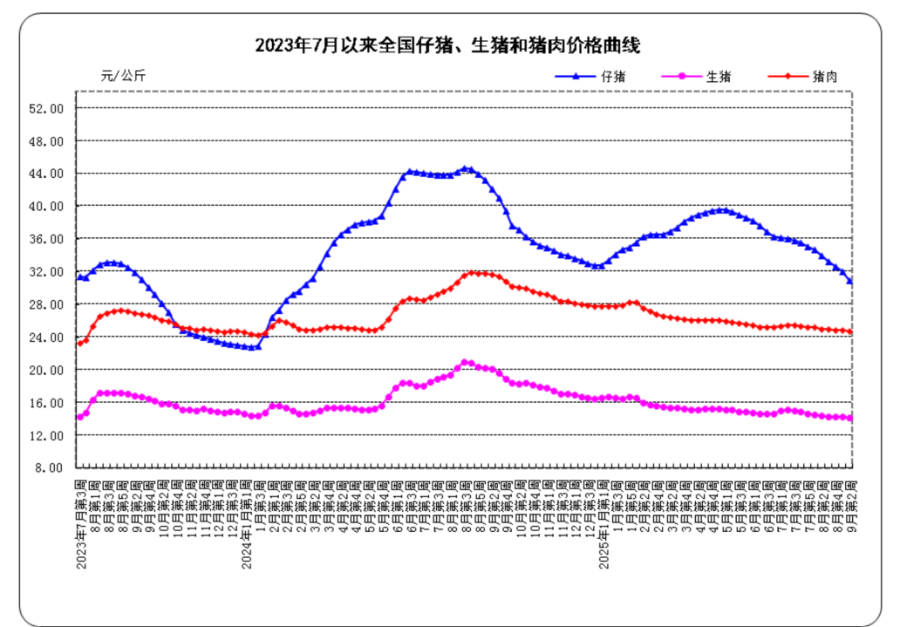
Core Viewpoint - The pig market is experiencing a downturn despite the traditional peak season, with prices dropping and concerns over overcapacity in the industry [1][4][6]. Group 1: Market Performance - As of September 26, the average price of external three yuan pigs in China was 12.71 yuan/kg, down 0.04 yuan/kg from the previous day, with half of the regions experiencing prices in the "5 yuan pig price zone" [1]. - The average price of pigs in the third week of September was 13.85 yuan/kg, and the average pork price was 24.51 yuan/kg, reflecting a 0.8% decrease from the previous week [1]. - The cumulative output of listed pig companies from January to August 2025 reached 126 million heads, a year-on-year increase of 21.12% [6]. Group 2: Industry Dynamics - The current pig industry is in its sixth cycle, with the internal expansion phase nearing its end, leading to accelerated capacity reduction due to policy and losses [3][12]. - The Ministry of Agriculture plans to reduce the breeding sow stock by approximately 1 million heads to 39.5 million [8]. - By the end of July 2025, the breeding sow stock was at 40.42 million heads, which is 103.6% of the normal holding capacity, indicating a need for capacity regulation [5][9]. Group 3: Consumer Behavior and Price Trends - Consumer demand is expected to recover during the Mid-Autumn Festival and National Day, potentially stabilizing prices [3]. - The market is witnessing a negative cycle where lower prices lead to panic selling among farmers, further driving prices down [7]. - The industry is shifting towards a more structured approach, with a focus on quality and differentiation rather than merely reducing capacity [12][13]. Group 4: Policy and Strategic Adjustments - The government is actively implementing measures to control pig production, including meetings with major pig companies to discuss production adjustments [8][9]. - Companies like Wens Foodstuffs and Muyuan Foods are reducing their breeding sow numbers and controlling the weight of pigs at slaughter [12]. - The industry is expected to evolve into a "30-30-40" structure, with 30% of large enterprises ensuring basic capacity, 30% focusing on niche markets, and 40% being flexible family farms [13].


全国过半区域生猪均价约5元
21世纪经济报道· 2025-09-26 11:11
Core Viewpoint - The swine market is experiencing a downturn despite the traditional peak season, with prices dropping significantly and concerns over overcapacity in the industry [1][7]. Price Trends - As of September 26, the average price of external three yuan pigs in China is 12.71 yuan/kg, with a notable decline in prices across various regions [1]. - The average price of pigs in the third week of September was reported at 13.85 yuan/kg, while pork averaged 24.51 yuan/kg, reflecting a week-on-week decrease of 0.8% [1]. Market Dynamics - Analysts indicate that the high inventory levels and pressure on enterprises to sell are contributing to the lack of a market bottom, despite government measures to regulate production capacity [3][5]. - The current swine industry is in its sixth cycle, with expectations that the effects of capacity reduction will become evident by the second half of 2026, potentially leading to price increases [5]. Supply and Demand Factors - The overall high inventory levels, coupled with insufficient consumer demand, have resulted in a "peak season not peaking" scenario for pig prices [7]. - By November 2024, the number of breeding sows is expected to reach a peak of 40.8 million, indicating a continued supply pressure [7]. Corporate Actions - Major companies are actively reducing their breeding sow numbers and controlling production to address overcapacity issues [16][17]. - For instance, companies like Wens Foodstuffs and New Hope are maintaining stable inventory levels and controlling the weight of pigs at the time of sale [17]. Market Sentiment - There is a shift in market sentiment, with some farmers exhibiting panic selling behavior, leading to a negative feedback loop where lower prices prompt quicker sales, further driving prices down [8]. - Despite the challenges, there is a consensus in the industry regarding the need for proactive capacity reduction and quality improvement [8]. Structural Changes - The industry is expected to evolve into a "three-three" structure, with 30% of leading enterprises ensuring basic capacity, 30% focusing on niche markets, and 40% consisting of medium-sized family farms leveraging flexibility [18].

调研速递|温氏股份接受中金公司等2家机构调研,养猪养鸡业务成本数据成关注要点
Xin Lang Cai Jing· 2025-09-26 10:54
Core Viewpoint - The company has demonstrated significant improvements in production management and disease prevention, leading to stable operations and cost control in both pig and poultry sectors [2][3]. Group 1: Company Production and Cost Management - The company has focused on basic production management and disease prevention since the beginning of the year, achieving notable results in disease control and maintaining stable livestock production [2]. - In August, the production cost of piglets decreased to approximately 260 RMB per head, with a market pig listing rate of around 93% and a feed-to-meat ratio of 2.51 [2]. - Despite an increase in piglet and feed costs in August, the overall cost of pig farming remained stable at 6.1 to 6.2 RMB per jin, indicating effective cost control [2]. - The poultry sector also maintained high stability, with a meat chicken listing rate of 95% in August and a total cost of 5.8 RMB per jin for broilers [2]. Group 2: Cost Improvement and Market Dynamics - The improvement in pig farming costs is attributed to stable overall livestock production, effective disease control, and increased market pig listing rates, which significantly reduced ineffective losses [3]. - The company has increased investment in breeding to develop a "Five High" breeding system, enhancing the health and reproductive performance of the breeding stock beyond pre-ASF levels, which effectively lowers piglet costs [3]. - The company has optimized feed nutrition formulas by dynamically comparing different feed raw material prices and nutritional content [3]. - The average pigs sold per sow (PSY) in August was around 27 [3]. Group 3: Poultry Market Recovery - The poultry industry faced low prices in the first half of the year, but the traditional consumption peak in the second half has led to an increase in meat chicken sales prices to 6.6 RMB per jin since September, indicating a recovery in profitability [3]. - The recovery is driven by increased consumer demand and a reduction in the number of parent stock chickens due to the previous low price environment [3]. - The company anticipates that the market for traditional yellow feathered chickens will follow historical trends, expecting positive performance in the poultry sector for the second half of the year [3]. - Short-term feed raw material supply is expected to remain loose, maintaining a weak and fluctuating state [3].

温氏股份(300498) - 2025年9月25日投资者关系活动记录表
2025-09-26 10:00
Group 1: Company Overview - The company is engaged in stable production management and effective epidemic prevention, leading to improved core production indicators and cost control [2] - The company’s stock code is 300498 and bond code is 123107 [1] Group 2: Swine Production - In August, the cost of piglets decreased to approximately 260 RMB per head, with a market pig listing rate of around 93% and a feed-to-meat ratio of 2.51 [2] - The comprehensive cost of pig farming remains stable at 6.1-6.2 RMB per jin [2] - The company’s PSY (Pigs Weaned per Sow per Year) level is around 27 [5] Group 3: Poultry Production - The company’s meat chicken listing rate in August was 95%, with a feed-to-meat ratio of 2.86 [2] - The total cost of broiler chickens in August was 5.8 RMB per jin [3] - Since September, the sales price of meat chickens has risen to 6.6 RMB per jin, indicating a recovery in profitability for the poultry business [8] Group 4: Cost Management and Future Outlook - The improvement in swine farming costs is attributed to stable production, effective epidemic control, and reduced losses [4] - The company anticipates a continued weak fluctuation in raw material prices in the short term [8]
全国“5元猪价区”过半 猪业产能过剩何解?
2 1 Shi Ji Jing Ji Bao Dao· 2025-09-26 09:26
Core Viewpoint - The pig market is experiencing a downturn despite the traditional peak season, with prices dropping and concerns over excess production capacity [1][2][3] Price Trends - As of September 26, the average price of external three yuan pigs in China is 12.71 yuan/kg, down 0.04 yuan/kg from the previous day, with half of the regions experiencing prices in the "5 yuan pig price zone" [1] - The average price of pigs in the third week of September was 13.85 yuan/kg, and the average pork price was 24.51 yuan/kg, reflecting a 0.8% decrease from the previous week [1][2] Supply and Demand Dynamics - High inventory levels and the release of production capacity by leading enterprises are contributing to the oversupply in the pig industry, compounded by weak consumer demand [2][3] - The number of breeding sows is projected to reach a high of 40.8 million by November 2024, indicating sustained supply levels [2] Industry Adjustments - Major pig farming companies are actively reducing production capacity, with a consensus on the need for quality improvement and capacity reduction [5][6] - Companies like Wens Foodstuffs and New Hope are implementing measures to control the number of breeding sows and reduce average slaughter weights [8] Market Sentiment and Future Outlook - Analysts suggest that the market may stabilize by November as excess capacity is gradually absorbed, with potential for price recovery [5][6] - The industry is expected to evolve into a "three-three" structure, balancing large enterprises, specialized farms, and medium-sized family farms to better withstand cyclical fluctuations [9]

农林牧渔行业双周报(2025/9/12-2025/9/25):阿根廷暂时零税出口农产品-20250926
Dongguan Securities· 2025-09-26 09:19
Investment Rating - The report maintains an "Overweight" rating for the agricultural, forestry, animal husbandry, and fishery industry [42] Core Viewpoints - Recent declines in pig prices and continuous profit decreases for breeding companies will force upstream breeding sows to reduce stock. The current stock of breeding sows remains relatively high, indicating significant potential for future reduction. The valuation of pig breeding companies is still at a historically low level, presenting an opportunity for investment based on capacity reduction expectations. In the chicken breeding sector, overall capacity is relatively high, and profitability remains under pressure. There is a potential for capacity reduction in the future, with attention to marginal profit improvement opportunities. In the feed sector, opportunities arise from increased market concentration and overseas expansion. The domestic pet market still has expansion potential, with leading domestic companies expected to maintain rapid growth [42][43] Summary by Sections 1. Market Review - The SW agricultural, forestry, animal husbandry, and fishery industry slightly underperformed the CSI 300 index, declining by 5.07% from September 12 to September 25, 2025, lagging behind the index by approximately 6.07 percentage points [10] - All sub-sectors recorded negative returns during this period, with declines of 2.89% in planting, 3.59% in animal health, 4.36% in feed, 5.32% in agricultural product processing, 5.95% in breeding, and 6.73% in fisheries [13][14] 2. Industry Key Data - **Pig Farming**: The average price of external three-way cross pigs fell from 13.31 CNY/kg to 12.51 CNY/kg during the reporting period. The cost of corn was 2365.1 CNY/ton, and soybean meal was 3002 CNY/ton, both showing slight declines. As of September 26, 2025, the profit for self-bred pigs was -74.11 CNY/head, and for purchased piglets, it was -236.57 CNY/head, indicating a decrease in profitability [22][24][27] - **Poultry Farming**: The average price of broiler chicks was 3.29 CNY/chick, showing a slight increase, while the average price of white feather broilers was 6.9 CNY/kg, reflecting a slight decline. The profit for white feather broilers was -2.22 CNY/chick, also indicating a decrease [29][33] - **Aquaculture**: The average wholesale prices for crucian carp and carp were 21.09 CNY/kg and 14.2 CNY/kg, respectively, both showing slight declines [35] 3. Industry News - Argentina announced a temporary zero-export tax on agricultural products, effective from September 23, 2025, until October 31, or until exports reach 7 billion USD. This measure aims to address domestic foreign exchange pressures and currency devaluation, significantly lowering export costs and enhancing competitiveness in the global market [37]




生猪养殖行业新周期系列报告之一:从2025年中报看猪周期新趋势
Shenwan Hongyuan Securities· 2025-09-25 10:42
Investment Rating - The report suggests a positive outlook for the pig farming industry, indicating a shift towards stable and high-quality development, with a recommendation to focus on leading pig farming companies that demonstrate good performance and dividend payouts [6][5]. Core Insights - The pig farming industry is entering a new phase characterized by improved profitability and stability, driven by effective cost management and policy support for capacity reduction. The report emphasizes the importance of recognizing the strength of current policies aimed at reducing production capacity [6][5]. - In the first half of 2025, the pig farming sector saw a significant increase in supply, with a slight decline in pig prices year-on-year. However, listed companies in the sector reported substantial revenue growth and profit increases, primarily due to volume-driven strategies [6][21]. - The report highlights that the current profitability cycle in the pig farming industry is expected to be prolonged, with conservative market expectations and limited capacity expansion. The anticipated supply pressure may lead to continued losses for some farming operations [6][5]. Summary by Sections 1. Overview of the Pig Farming Industry in H1 2025 - The average price of pigs in H1 2025 was 14.80 yuan/kg, reflecting a year-on-year decrease of 4.21%. The supply of pigs increased due to higher production efficiency and a growing number of breeding sows [10][11]. - The slaughter volume from designated slaughterhouses increased significantly, with a year-on-year rise of 21.4% in Q2 2025, indicating stable demand despite price fluctuations [11][12]. 2. Performance Review of Listed Pig Farming Companies - In H1 2025, the total revenue of listed pig farming companies reached 201.9 billion yuan, a year-on-year increase of 17.9%, while net profit surged by 865.5% to 15.9 billion yuan [21][22]. - The leading companies, such as Muyuan Foods and Wen's Foodstuffs, reported substantial increases in both revenue and profit, with Muyuan achieving a 45% increase in the number of pigs slaughtered [27][26]. 3. Industry Outlook under the "Anti-Internal Competition" Policy - The report anticipates that the policy measures aimed at reducing production capacity will accelerate the pace of capacity reduction in the industry, with plans to cut 1 million breeding sows within six months [6][5]. - The industry is expected to transition towards a more stable and high-quality development phase, with improved profitability and cash flow for leading companies [6][5]. 4. Investment Analysis - The report suggests that investors should focus on companies with strong performance and reliable dividend payouts, as these firms are likely to experience a reassessment of their value in the market [6][5]. - The report indicates that the current cycle of profitability in the pig farming industry is expected to last longer than anticipated, with limited capacity expansion and ongoing supply pressures [6][5].

东兴证券晨报-20250925
Dongxing Securities· 2025-09-25 09:06
Core Insights - The report highlights a significant decline in pig prices, with the average price of live pigs dropping to 12.82 yuan/kg by September 19, marking a three-year low [5][6] - The report indicates that the supply side is experiencing pressure due to increased market supply, while demand remains weak, particularly affected by high temperatures in August [5][6] - The government is implementing stricter policies to control pig production capacity, aiming to stabilize prices and promote high-quality development in the industry [6] Industry Overview - In August 2025, the average prices for piglets, live pigs, and pork were 33.63 yuan/kg, 14.35 yuan/kg, and 24.98 yuan/kg, respectively, showing month-on-month declines of 5.87%, 3.77%, and 1.52% [5] - The report notes that the number of breeding sows in July was 40.42 million, with a slight decrease, indicating a trend of capacity reduction in the industry [5] - The report anticipates that the short-term pressure on pig prices will lead to a long-term upward trend as the government’s capacity reduction policies take effect [6] Company Insights - Major companies in the pig farming sector, such as Muyuan Foods and Wens Foodstuff Group, reported significant declines in sales prices in August, with average sales prices of 13.51 yuan/kg and 13.90 yuan/kg, respectively [7] - The report suggests that companies with strong cost advantages are likely to maintain profitability despite the current market pressures [6] - The report recommends focusing on leading companies in the industry, such as Muyuan Foods and Wens Foodstuff Group, which are expected to perform well in the long term [6]






温氏股份跌2.11%,成交额3.30亿元,主力资金净流出1273.65万元
Xin Lang Cai Jing· 2025-09-25 02:17
Group 1 - The core viewpoint of the articles highlights the recent performance and financial metrics of Wens Foodstuff Group Co., Ltd, including stock price fluctuations and revenue growth [1][2][3] - As of September 25, Wens' stock price decreased by 2.11% to 18.58 CNY per share, with a total market capitalization of 123.63 billion CNY [1] - The company has seen a year-to-date stock price increase of 13.91%, with a 2.62% decline over the last five trading days [1] Group 2 - For the first half of 2025, Wens reported a revenue of 49.88 billion CNY, reflecting a year-on-year growth of 6.67%, and a net profit of 3.48 billion CNY, which is a significant increase of 161.77% [2] - The company has distributed a total of 28.12 billion CNY in dividends since its A-share listing, with 4.94 billion CNY distributed in the last three years [3] - As of June 30, 2025, the number of shareholders decreased by 20.62% to 91,000, while the average circulating shares per person increased by 43.71% to 65,602 shares [2][3]