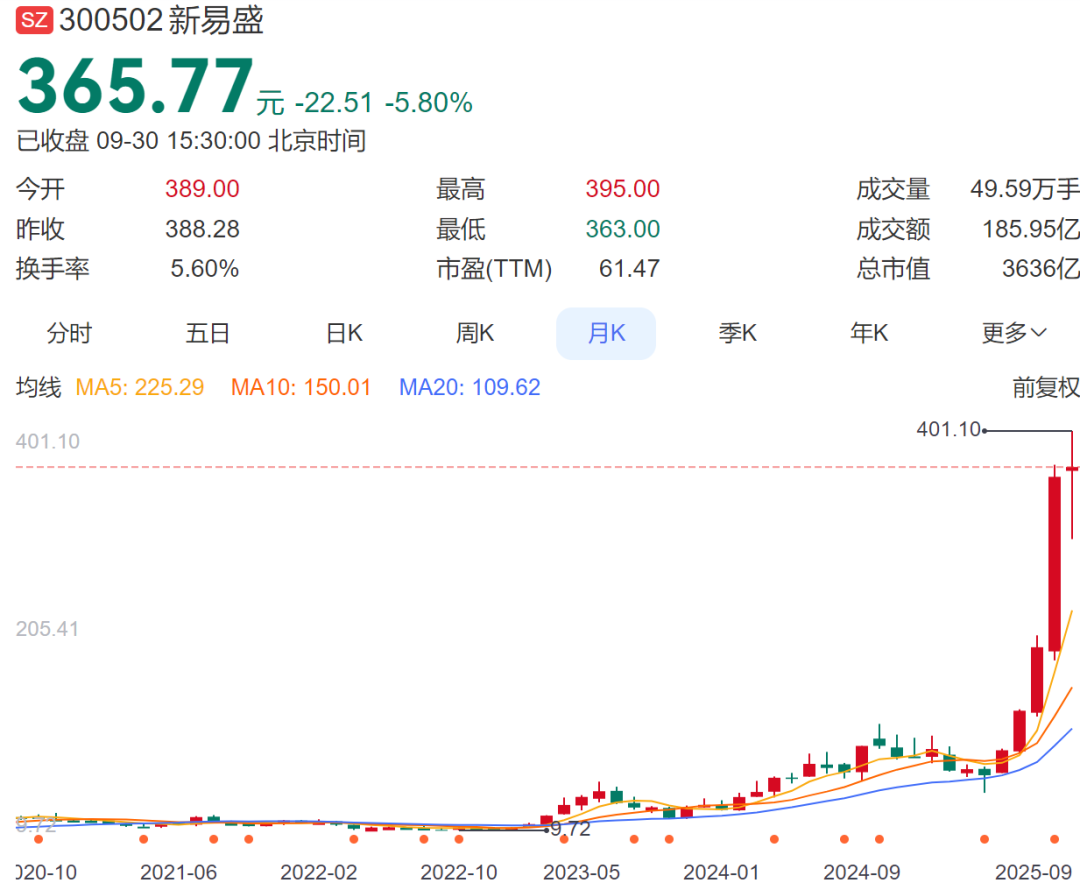
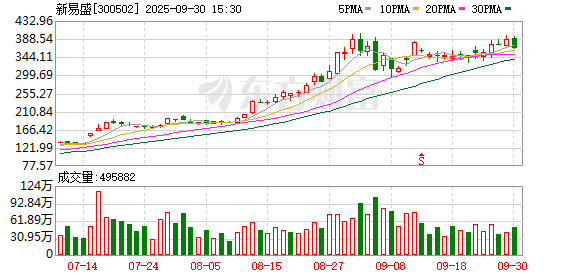
EOPTOLINK(300502)
Search documents
双创龙头ETF(588330)开盘跌1.44%,重仓股宁德时代涨0.77%,中芯国际跌1.27%
Xin Lang Cai Jing· 2025-09-24 04:37
Group 1 - The core viewpoint of the article highlights the performance of the Double Innovation Leader ETF (588330), which opened down by 1.44% at 0.892 yuan [1] - The major holdings of the ETF include companies like CATL, which rose by 0.77%, and SMIC, which fell by 1.27% [1] - The ETF's performance benchmark is the CSI Science and Technology Innovation 50 Index, managed by Huabao Fund Management Company, with a return of -9.74% since its inception on June 29, 2021, and a return of 20.82% over the past month [1] Group 2 - The article provides specific stock performance details, indicating that companies such as Mindray Medical and Huagong Technology experienced declines of 0.39% and 0.09% respectively, while companies like Haiguang Information and Yanguang Electric Power saw increases of 0.52% and 0.02% [1] - The overall market sentiment reflected in the ETF's opening performance suggests a cautious outlook among investors [1]
如何看待光模块龙头估值?
Changjiang Securities· 2025-09-24 02:57
Investment Rating - The report maintains a positive outlook on the optical module sector, indicating that the actual performance PE of leading companies is significantly lower than the consensus expected PE, suggesting room for upward valuation adjustments [3][6]. Core Insights - The current AI-driven market for optical modules shows a rapid amplification effect similar to the "Davis Double Play" seen in the consumer electronics sector, alongside attributes of "profit exceeding expectations and valuation mismatch" observed in the renewable energy sector, indicating both explosive growth potential and sustainability [3][6]. - The report highlights that the leading companies in the optical module market, such as Zhongji Xuchuang, Xinyi Technology, and Tianfu Communication, have experienced substantial rebounds in their stock prices, with respective increases of 481%, 607%, and 305% from their year-to-date lows [6]. - The anticipated performance PE for these companies from 2025 to 2027 is projected at 52/36/30x for Zhongji Xuchuang, 44/29/24x for Xinyi Technology, and 69/50/39x for Tianfu Communication, reflecting a significant growth trajectory [6]. Summary by Sections Vertical Analysis - The report discusses the varying performance of leading companies in different market cycles, noting that the AI model training has led to a surge in computing power demand, significantly elevating the valuations of these companies [8]. - The actual performance PE of leading companies is currently underestimated compared to their expected performance PE, with Zhongji Xuchuang, Xinyi Technology, and Tianfu Communication showing potential increases of 167%, 129%, and 103% respectively [8]. Horizontal Analysis - The report compares the optical module sector with consumer electronics and renewable energy sectors, emphasizing that the current market dynamics are driven by AI computing demand, which is distinct from the product-driven cycles seen in consumer electronics and policy-driven cycles in renewable energy [8]. - The optical module sector is characterized by a robust technological advantage and manufacturing capability, positioning it for sustained growth compared to its peers [8]. Investment Recommendations - The report recommends a reevaluation of leading optical module companies, highlighting the need for market participants to recognize the significant upside potential in their valuations as the demand for optical modules continues to rise due to increased ASIC usage and ongoing technological advancements [3][6].
A股“老登”持股曝光,敢不敢对号入座
第一财经· 2025-09-24 02:08
Core Viewpoint - The article discusses the significant divergence in stock market performance between traditional "old stocks" (represented by sectors like liquor, real estate, and coal) and "new stocks" (focused on technology sectors such as AI and semiconductors) in 2023, highlighting a shift in investor sentiment and market dynamics [2][9]. Group 1: Market Performance Overview - As of September 23, 2023, the Shanghai Composite Index has risen by 14.02%, with technology sectors like SW Communication and SW Electronics showing remarkable gains of 103% and 93% respectively, while traditional sectors like SW Coal and SW Food & Beverage have declined by 1.82% and 0.78% [2][3]. - The article notes that many traditional blue-chip stocks have underperformed, with 16 out of 21 stocks in the SW liquor sector experiencing price declines this year, including a 3.16% drop in Kweichow Moutai [5][6]. Group 2: Individual Stock Performance - Notable "new stocks" include Cambricon Technologies (688256.SH), which has seen a price increase of 105.22%, and other companies in the AI sector like NewEase (300502.SZ) and Zhongji Xuchuang (300308.SZ), with annual gains of 329% and 253% respectively [4][6]. - In contrast, several "old stocks" such as Haitian Flavoring (603288.SH) and Gree Electric (000651.SZ) have reported declines of 12.68% and 6.96% respectively, despite some of these companies showing double-digit profit growth in the first half of the year [5][6]. Group 3: Investment Philosophy and Market Sentiment - The article highlights a growing divide between "old stock" investors, who favor value investing based on stable cash flows and dividends, and "new stock" investors, who are more focused on growth potential in technology sectors [9][10]. - The current market sentiment is characterized by a trend-driven investment approach, with younger investors and quantitative funds favoring short-term trends, leading to extreme sector divergence [10].
CPO、PCB等算力硬件股走弱 光库科技跌超10%
2 1 Shi Ji Jing Ji Bao Dao· 2025-09-24 02:02
Group 1 - The CPO and PCB sectors, which are part of the computing hardware industry, experienced a decline in stock prices [1] - Guangku Technology saw a drop of over 10% in its stock price [1] - Jingwang Electronics approached the limit down, indicating significant selling pressure [1] Group 2 - Tianfu Communication's stock fell by over 6% [1] - Shenghong Technology and Simi Electronics both experienced declines of over 5% [1] - Multiple stocks, including Zhongji Xuchuang and Xinyi Sheng, dropped by over 4% [1]
双创50ETF(588380)开盘跌1.10%,重仓股宁德时代涨0.77%,中芯国际跌1.27%
Xin Lang Cai Jing· 2025-09-24 01:40
Group 1 - The core point of the article highlights the performance of the 双创50ETF (588380), which opened down by 1.10% at 0.902 yuan on September 24 [1] - The major holdings of the 双创50ETF include companies like 宁德时代, 中芯国际, and 迈瑞医疗, with varying performance; 宁德时代 increased by 0.77%, while 中际旭创 decreased by 4.21% [1] - The 双创50ETF's performance benchmark is the 中证科创创业50指数, managed by 富国基金管理有限公司, with a return of -9.01% since its inception on June 29, 2021, and a recent one-month return of 21.02% [1]
A股大分化:“小登”追AI算力狂赚,“老登”守白酒地产躲牛市
Di Yi Cai Jing· 2025-09-23 13:39
Core Viewpoint - The market is experiencing a significant divergence between traditional "old stocks" (represented by sectors like liquor, real estate, and coal) and "new stocks" (focused on technology sectors such as AI and semiconductors), with the latter showing substantial gains while the former declines [1][3][8]. Group 1: Market Performance - As of September 23, the Shanghai Composite Index has risen by 14.02% year-to-date, with technology sectors like SW Communication and SW Electronics seeing gains of 103% and 93% respectively, while traditional sectors like SW Coal and SW Food & Beverage have declined by 1.82% and 0.78% [1][2]. - The performance of individual stocks reflects this trend, with tech stocks like Cambrian (688256.SH) doubling in price, while major liquor stocks like Kweichow Moutai (600519.SH) have seen a decline of 3.16% [3][5]. Group 2: Sector Analysis - The "new stocks" or "small stocks" have shown remarkable growth, with companies like Xinji Technology (300502.SZ) and Zhongji Xuchuang (300308.SZ) experiencing year-to-date increases of 329% and 253% respectively, driven by the AI computing wave [3][5]. - In contrast, the "old stocks" have struggled, with 16 out of 21 major liquor stocks experiencing declines, and several blue-chip stocks like Haitian Flavoring (603288.SH) and Gree Electric (000651.SZ) also showing negative performance [4][5]. Group 3: Investment Perspectives - The divide between "old stocks" and "new stocks" has sparked debates within the investment community, with traditional investors advocating for value investing based on cash flow and safety margins, while tech investors focus on growth potential and disruptive technologies [6][7]. - Current market dynamics suggest that the tech sector is seen as a trend-driven investment, supported by policies favoring AI and computing power, while traditional value investment strategies are becoming less effective, leading to extreme sector divergence [8].
行业点评报告:英伟达拟投资OpenAI,利好光模块、液冷板块
KAIYUAN SECURITIES· 2025-09-23 13:13
Investment Rating - Industry investment rating: Positive (maintained) [1] Core Insights - The demand for AI computing power is driving the growth of the optical communication industry, with significant advancements in silicon photonics technology, which is becoming the mainstream solution for 1.6T high-speed optical modules [4] - The partnership between OpenAI and NVIDIA aims to deploy at least 10GW of AI data centers, which is expected to double NVIDIA's GPU shipments in 2025, indicating a strong market demand for AI infrastructure [3][4] - The introduction of NVIDIA's Rubin CPX GPU is anticipated to enhance AI application inference and increase demand for liquid cooling solutions, thereby benefiting the liquid cooling sector [5][6] Summary by Sections Industry Overview - The optical communication network is undergoing continuous upgrades, with a focus on new technologies such as OCS, hollow-core fibers, thin-film lithium niobate, and CPO, which are gaining attention and maturity [4] Market Opportunities - The competitive advantages of leading companies in the optical module sector are expected to strengthen, with rising demand for CW lasers and certain passive components [4] - The launch of the Rubin CPX GPU is projected to create additional liquid cooling demand, as it significantly increases processing capabilities and total power consumption [5][6] Recommended Stocks - Strong recommendations for leading companies in the optical module and liquid cooling sectors include: Zhongji Xuchuang, Xinyi Sheng, Yingweike, Tianfu Communication, and Yuanjie Technology [6]
新“新三样”领跑,接力中国资产重估
21世纪经济报道· 2025-09-23 06:19
Core Viewpoint - The article emphasizes the emergence of a new paradigm in China's economy, termed the "new new three samples," which includes robotics, artificial intelligence (AI), and innovative pharmaceuticals, as key drivers for high-quality economic development and a shift from traditional growth models to technology-led advancements [1][4][29]. Robotics Sector - The robotics sector has seen significant market capitalization growth, with companies like Huichuan Technology exceeding 200 billion yuan and several stocks doubling in price within the year [2][13]. - The market for industrial robots in China is projected to reach 302,000 units in 2024, maintaining its position as the largest industrial robot market globally [30]. - Key challenges include reliance on imported high-end servo motors and precision components, which need to be addressed to enhance domestic capabilities [33]. Artificial Intelligence Sector - The AI sector is characterized by a large number of high-value companies, with six firms exceeding a market cap of 100 billion yuan, including Cambricon and Hikvision [19]. - The demand for AI capabilities has surged, particularly in large model applications, leading to significant revenue growth for companies like Industrial Fulian and Cambricon, with year-on-year increases of 35.58% and 4347.82%, respectively [20]. - The sector is supported by national policies aimed at integrating AI into various industries, with a comprehensive action plan released to enhance AI's role in economic development [22]. Innovative Pharmaceuticals Sector - The innovative pharmaceuticals sector is represented by major players like Heng Rui Medicine, which is nearing a market cap of 500 billion yuan, and BeiGene, which recently achieved profitability [24][28]. - Recent policy measures have been introduced to support the development of innovative drugs, including streamlined approval processes and enhanced reimbursement mechanisms [27]. - The sector is witnessing a shift from loss-making to profitability, with companies like BeiGene demonstrating the commercial viability of innovative drug models [28]. Strategic Importance - The "new new three samples" signify a transition from scale-driven manufacturing to technology-driven innovation, crucial for enhancing China's global competitiveness and economic resilience [7][9][31]. - The collaboration among robotics, AI, and innovative pharmaceuticals creates a synergistic effect that strengthens overall productivity and fosters new business models [8][31]. - Addressing the "bottleneck" issues in these sectors is essential for sustaining growth and achieving leadership in global technology competition [32][33]. Policy Recommendations - To enhance competitiveness, policies should focus on data openness, regulatory reforms, and infrastructure development to support AI and innovative pharmaceuticals [35][38]. - Establishing a robust talent pipeline and fostering interdisciplinary education will be critical for sustaining innovation in these sectors [37][38]. - Encouraging public-private partnerships and international collaboration will further strengthen China's position in the global market [39].
通信行业2025年二季度行业研究:技术和政策驱动行业变革升级,行业格局或向“强者恒强”演化
Da Gong Guo Ji· 2025-09-23 06:09
Investment Rating - The report indicates a positive outlook for the communication industry, suggesting a potential shift towards a "stronger gets stronger" dynamic due to technological and capital barriers [1]. Core Insights - The communication industry is experiencing a transformation driven by technology and policy support, with a shift in demand from traditional to emerging services [1][39]. - The industry is expected to enter a recovery phase in Q3 2025, with capital expenditure expansion driven by technological breakthroughs and new infrastructure initiatives [39]. - The demand for AI computing power, accelerated commercialization of 5G-A, breakthroughs in 6G technology, and the rise of the "low-altitude economy" are key factors driving the industry's upgrade [1][39]. Supply Capacity Analysis - The report highlights the growth in the optical communication sector, particularly in high-speed optical modules, driven by AI computing demand and increased capital expenditure from global cloud service providers [3][10]. - The domestic penetration rate of traditional optical fiber and cable is nearing saturation, prompting companies to accelerate international expansion [5][4]. - The communication equipment integration market is recovering, with the Asia-Pacific region leading in 5G system integration and services [6]. Demand Matching Capability Analysis - The demand for optical modules, especially high-speed products for data centers, is robust, with a projected shipment increase from 6.4 million units in 2023 to over 31.9 million units by 2025 [3]. - The communication equipment market is experiencing strong growth, with a year-on-year revenue increase of 18.9% in Q2 2025, despite a contraction in 5G investment [11]. - The telecommunications service sector is seeing a shift towards emerging businesses, with significant growth in AI computing and quantum communication services [15][30]. Industry Chain Position Analysis - The communication industry is characterized by a high degree of market concentration, particularly among leading companies in optical communication and equipment integration [24][27]. - The report notes that traditional communication services are facing saturation, with new business areas becoming the core of competitive differentiation [28]. Innovation Capability Analysis - The report emphasizes the importance of policy support for technological advancements, particularly in AI, 6G, and satellite communication [31][32]. - Significant R&D investments are being directed towards AI and 6G technologies, with major companies like China Mobile leading initiatives in these areas [34]. Credit Rating Situation Analysis - The communication industry is witnessing a favorable credit environment, with a total bond issuance of 17.35 billion yuan in Q2 2025, primarily from leading companies [36][37]. - The report indicates that the dual barriers of technology and capital for leading firms will become more pronounced, reinforcing the trend towards market consolidation [36]. Cycle Development Outlook - The communication industry is expected to see revenue and profit growth, with cash flow recovery anticipated in Q3 2025 [38]. - The report forecasts a transition to an expansion phase driven by new infrastructure investments and a focus on domestic demand [39]. Key Segment Development Trends - The optical communication sector is evolving towards ultra-high-speed, intelligent, and integrated solutions, supporting the AI computing network [40]. - The commercialization of 5G-A and advancements in 6G technology are expected to enhance the capabilities of communication equipment integrators [41]. - Telecommunications services are anticipated to diversify, with new opportunities arising from the low-altitude economy and satellite internet developments [42].
新易盛成交额超上一日全天
Zheng Quan Shi Bao Wang· 2025-09-23 04:32
(文章来源:证券时报网) 数据宝统计,截至11:13,新易盛成交额139.02亿元,超上一日全天。最新股价上涨0.60%,换手率 4.40%。上一交易日该股全天成交额为138.60亿元。(数据宝) 注:本文系新闻报道,不构成投资建议,股市有风险,投资需谨慎。 ...