CATL(300750)

Search documents
容百科技回应1200亿合同估算,宁德时代合作存不确定性

Cai Jing Wang· 2026-01-18 09:44
Core Viewpoint - Company clarifies that the total contract amount of 120 billion yuan with CATL is an estimate, and final sales remain uncertain [1] Group 1: Contract and Financial Details - The company plans to acquire a portion of Guizhou Xinren's equity for 342 million yuan and invest 140 million yuan to expand its existing 60,000 tons lithium iron phosphate production line [1] - Future capital expenditures for capacity expansion are projected to be 8.7 billion yuan over the next three years, with annual expenditures of 3.6 billion, 3.3 billion, and 1.8 billion yuan for 2026, 2027, and 2028 respectively [1] - The company asserts that its financial reserves and financing capabilities can support these expenditures [1] Group 2: Risks and Compliance - The company highlights risks related to production capacity constraints and fluctuations in raw material prices [1] - An internal review found that two employees traded stocks during the contract period, but both have no current holdings and no motive for insider trading [1] - The company acknowledges that its previous announcement regarding the total contract amount was not precise and that risk disclosures were insufficient [1]


容百科技回复上交所关于公司与宁德时代签署合同的问询函:“1200亿元合同总金额”为估算,最终销售具不确定性
Mei Ri Jing Ji Xin Wen· 2026-01-18 09:36
每经AI快讯,1月18日,容百科技回复上交所关于公司与宁德时代签署合同的问询函:"1200亿元合同总 金额"为估算,最终销售具不确定性。公司拟3.42亿元收购贵州新仁部分股权并1.4亿元增资,其现有6万 吨磷酸铁锂产线。未来三年扩产预计资本性支出87亿元,2026-2028年分别为36亿、33亿、18亿元,公 司资金储备及融资能力可保障。同时提示产能不能满足、原材料价格波动等风险。此外,自查发现2名 员工在协议期间买卖股票,均已无持股,且无内幕交易动机。原公告对合同总金额表述不严谨,风险提 示不充分 。 ...
签下千亿锂电大单?688005,被证监会立案调查!
Xin Lang Cai Jing· 2026-01-18 09:09
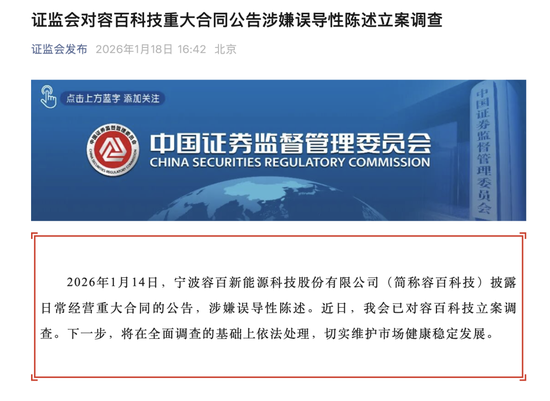
登录新浪财经APP 搜索【信披】查看更多考评等级 炒股就看金麒麟分析师研报,权威,专业,及时,全面,助您挖掘潜力主题机会! 证监会对容百科技重大合同公告涉嫌误导性陈述立案调查。 1月18日,据证监会官网通报,2026年1月14日,宁波容百新能源科技股份有限公司(简称容百科技 688005.SH)披露日常经营重大合同的公告,涉嫌误导性陈述。 证监会表示,已对容百科技立案调查。下一步,将在全面调查的基础上依法处理,切实维护市场健康稳 定发展。 容百科技随后公告称,公司于2026年1月18日收到中国证监会下发的《立案告知书》,因公司重大合同 公告涉嫌误导性陈述等,根据相关法律法规,中国证监会决定对公司予以立案。目前公司各项经营活动 和业务均正常开展。立案调查期间,公司将积极配合中国证监会的相关工作,并严格按照相关法律法规 和监管要求及时履行信息披露义务。 1月13日容百科技公告称,公司与宁德时代签署了《磷酸铁锂正极材料采购合作协议》,自今年第一季 度开始至2031年,将向宁德时代国内区域供应磷酸铁锂正极材料305万吨,总销售金额超1200亿元。有 业内人士评论称,如此大的订单量和协议金额,在锂电行业罕见,或将对容百 ...
电力设备及新能源周报20260118:钙钛矿晶硅叠层组件再创世界纪录,国网“十五五”计划投资同比大增-20260118
Minsheng Securities· 2026-01-18 08:11
Investment Rating - The report maintains a "Recommended" rating for several key companies in the power equipment and new energy sectors, including Ningde Times, Kodali, and others [5][6]. Core Insights - The power equipment and new energy sector saw a weekly increase of 0.79%, outperforming the Shanghai Composite Index, with the energy storage index showing the highest growth at 1.81% [1]. - The National Energy Administration projects a total electricity consumption of 10,368.2 billion kWh by 2025, representing a year-on-year growth of 5.0% [4][56]. - TCL Zhonghuan's strategic investment in a new energy company aims to enhance vertical integration in the photovoltaic industry, reducing costs and improving efficiency [3][37]. Summary by Sections 1. New Energy Vehicles - Hive Energy showcased three core technological breakthroughs at its sixth Battery Day, focusing on semi-solid technology, Dragon Scale 3.0 technology, and ion oscillation fast charging technology, all aimed at enhancing safety and performance [2][13][21]. 2. New Energy Generation - TCL Zhonghuan's acquisition of a new energy company is expected to optimize resources and enhance business synergy, facilitating a shift from low-level competition to value co-creation in the photovoltaic sector [3][37]. 3. Power Equipment and Industrial Control - The National Grid's "14th Five-Year Plan" anticipates a fixed asset investment of 4 trillion yuan, a 40% increase from the previous plan, to support the development of a new power system [4][56]. - The report highlights significant growth in electricity consumption across various sectors, with the service industry and residential electricity usage contributing 50% to the overall growth [4][56]. 4. Commercial Aerospace - Trina Solar set a new world record with a 886W per 3.1 m² perovskite/silicon tandem module, reinforcing its leadership in high-efficiency energy technology [5]. 5. Weekly Sector Performance - The energy storage index led the sector with a 1.81% increase, while the nuclear power index experienced the largest decline at 6.39% [1].




具身智能行业研究:逐际动力发布COSA系统,自变量机器人完成10亿融资
SINOLINK SECURITIES· 2026-01-18 07:35
Investment Rating - The report indicates a positive investment outlook for the humanoid robotics sector, highlighting 2026 as a pivotal year for the commercialization of humanoid robots [4]. Core Insights - The robotics industry is experiencing accelerated growth, with significant advancements in embodied intelligence models and partnerships aimed at enhancing logistics and operational efficiency [2][3][4]. - Key players like Qianxun Intelligent and Zhujidi Dynamics are making strides in developing advanced robotic systems, with Qianxun's Spirit v1.5 model achieving top rankings in evaluations and Zhujidi's LimX COSA system integrating high-level cognition with full-body control [2][28]. - The report emphasizes the importance of capital investment in driving technological innovation and market expansion within the robotics sector, as evidenced by substantial funding rounds for companies like Zivariable Robotics and Skild AI [3][31][17]. Summary by Sections 1. Robotics - The robotics sector is witnessing a surge in activity, with a focus on commercializing embodied intelligence and enhancing operational capabilities across various industries [9][10]. - Significant partnerships, such as the collaboration between Xingdong Jiyuan and SF Technology, aim to advance logistics automation through intelligent robotic solutions [3][36]. 1.1 Industry Dynamics - Recent policy shifts are steering the industry towards commercialization, with initiatives like Zhejiang's new industrialization plan emphasizing the development of humanoid robots and their core components [10][11]. - The report notes a growing trend of companies establishing strategic collaborations to enhance their technological capabilities and market reach [37]. 1.2 Main Body - Qianxun Intelligent's Spirit v1.5 model has achieved a breakthrough in performance, becoming the first model to exceed a 50% success rate in evaluations, and is now open-sourced for community development [26]. - Zhujidi Dynamics has launched the LimX COSA system, which merges cognitive functions with physical control, enabling robots to perform complex tasks autonomously [28]. - Zivariable Robotics has secured 1 billion yuan in funding to enhance its general-purpose robotic models and expand its operational capabilities in high-value scenarios [31]. 1.3 Core Components - The report highlights ongoing investments in core components and technologies essential for the robotics industry, including advancements in sensors and control systems [36]. - Companies like Shafler and Jiangsu Huaxuan are forming strategic partnerships to innovate in humanoid robot components, indicating a robust ecosystem for technological development [37].


机械设备行业跟踪周报:推荐固态催化加速的锂电设备,建议关注回调较多、产业进展加速的人形机器人-20260118
Soochow Securities· 2026-01-18 07:00
Investment Rating - The report maintains an "Overweight" rating for the mechanical equipment industry [1] Core Insights - The report highlights three major investment opportunities in the mechanical equipment sector: the Belt and Road Initiative, demand recovery in Europe and the US, and the transition from capacity to technology export in high-end manufacturing [2][18] - Solid-state battery technology is accelerating, benefiting equipment manufacturers, with significant investments from leading companies like BYD and Gotion [3][20] - The humanoid robot sector is poised for growth with Tesla's Optimus V3 nearing mass production, indicating strong market potential for core suppliers [4][41] Summary by Sections Investment Recommendations - Recommended companies include: Northern Huachuang, Sany Heavy Industry, Zhongwei Company, Hengli Hydraulic, CIMC, Tuojing Technology, Haitai International, Bichu Electronics, Jingsheng Mechanical, and others [1][15] Mechanical Equipment Export - China’s foreign investment is growing rapidly, with a focus on the Belt and Road Initiative, which is driving demand for domestic equipment in resource-rich countries [2][18] - The report emphasizes the importance of high-quality targets with significant exposure to European and American markets, particularly in hand tools and forklifts [19] Lithium Battery Equipment - The solid-state battery industry is experiencing rapid industrialization, with key players accelerating their production capabilities [3][20] - Recommended companies in this sector include: Xian Dao Intelligent, Lian Ying Laser, and Hangke Technology [3][20] Humanoid Robots - The report notes that the release and mass production of Tesla's Optimus V3 will be a significant event for the industry, with a focus on core suppliers with high production certainty [4][41] - Recommended companies include: Hengli Hydraulic, Sanhua Intelligent Control, and Top Group [4][41] Forklift Industry - The report indicates a decline in domestic forklift sales but anticipates a recovery in 2026 due to low base effects and improving overseas market conditions [5][19] - Recommended companies include: Hangcha Group, Anhui Heli, and Zhongli [5][19] High-end Manufacturing Export - The report highlights the shift from capacity export to technology export, with a focus on light module equipment and lithium battery equipment [2][18] - Recommended companies include: certain HJT equipment leaders and Aotewei [20][39] Data Center and Liquid Cooling - The report discusses the emergence of liquid cooling technology as essential for data centers, driven by increasing power density and cooling demands [45] - Recommended companies in this sector include: Yingwei Technology and others [34][45]





350亿龙头官宣重磅收购,看上曾与宁德时代传绯闻的光伏黑马
Xin Lang Cai Jing· 2026-01-18 06:45
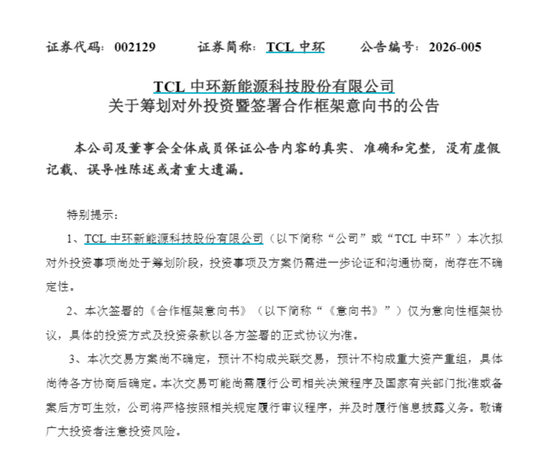
Core Viewpoint - TCL Zhonghuan, a leading company in the photovoltaic industry, announced its intention to invest in Yida New Energy Technology Co., Ltd. to enhance its integration strategy and leverage technological and operational advantages [1][9]. Investment Details - TCL Zhonghuan will invest in Yida New Energy through share acquisition, voting rights delegation, and capital increase, with specific terms to be determined later [3][11]. - The investment aims to align with TCL Zhonghuan's long-term strategic requirements and optimize its photovoltaic cell and module production capacity, thereby enhancing its competitive edge [3][11]. Yida New Energy's Capacity - Yida New Energy has established a production capacity of 30GW for high-efficiency batteries and modules in 2023, with plans to increase this to 40GW by the end of 2025, significantly surpassing TCL Zhonghuan's current capacity of 24GW [4][12]. - Yida New Energy has rapidly ascended to the global top ten in photovoltaic module shipments, ranking seventh alongside Canadian Solar in the first half of 2025 [4][12]. Market Context - The investment is seen as a market-driven response to the current downturn in the photovoltaic industry, with industry leaders advocating for market consolidation as a means to reduce excess capacity [5][13]. - Local governments are also promoting industry consolidation, with Yunnan Province's plan to support leading companies in integrating and restructuring the photovoltaic supply chain [14]. Shareholding Structure - The main shareholders of Yida New Energy include Qizhou Zhida Enterprise Management Partnership and its founder Liu Yong, holding approximately 30% of the shares, which are subject to transfer in the investment agreement [6][14]. - TCL Zhonghuan's potential acquisition of all shares would result in it taking control of Yida New Energy [6][14]. Financial Outlook - TCL Zhonghuan has projected a loss of between 8.2 billion to 9.6 billion yuan for the fiscal year 2025, although this represents an improvement compared to 2024 [7][15]. - The investment is expected to enhance both companies' technological capabilities and support advancements in new technologies such as BC cells [7][15]. Stock Performance - As of January 16, TCL Zhonghuan's stock price was 8.84 yuan per share, with a market capitalization of 35.7 billion yuan [10][17].

与宁德时代1200亿元大单存疑 容百科技遭上交所火速问询
Xi Niu Cai Jing· 2026-01-18 06:01
Core Viewpoint - Rongbai Technology (688005.SH) has signed a lithium iron phosphate cathode material procurement cooperation agreement with CATL (300750.SZ), with an expected total sales amount exceeding 120 billion yuan [2][3]. Group 1: Agreement Details - The agreement stipulates that from Q1 2026 to 2031, Rongbai Technology will supply approximately 3.05 million tons of lithium iron phosphate cathode materials to CATL in the domestic market [3]. - The execution of this agreement is expected to have a positive and significant impact on Rongbai Technology's future operating performance, enhancing operational stability and cyclical resistance [3]. Group 2: Regulatory Scrutiny - The Shanghai Stock Exchange has raised inquiries regarding the agreement, noting that the total sales amount was not explicitly stated in the agreement, and the basis for the sales amount calculation was not disclosed [5]. - The exchange has requested Rongbai Technology to provide detailed disclosures regarding annual capacity agreements, production capacity plans, and the company's ability to fulfill the agreement [6]. Group 3: Financial Context - On January 13, 2026, Rongbai Technology announced a profit forecast for 2025, expecting a net profit attributable to shareholders of 30 million yuan in Q4 2025, marking a return to profitability [7]. - The company anticipates a full-year net profit loss ranging from 190 million yuan to 150 million yuan, with a non-recurring net profit loss between 220 million yuan and 180 million yuan [7].
中国公司全球化周报|TikTok Shop在欧洲四国推出本地托管模式/创想三维携手阿里云优化3D打印云服务
3 6 Ke· 2026-01-18 05:49
Group 1: Events and Forums - The "Dubai Business Forum - China" will take place in Shenzhen on May 14, 2026, focusing on economic collaboration and investment opportunities between China and Dubai [2] Group 2: Company Developments - TikTok Shop has launched a local hosting model in four European countries, allowing merchants to stock goods in local warehouses while TikTok handles logistics [3] - Temu has introduced a local seller program in the UAE to enhance delivery efficiency and expand product offerings [3] - WeChat mini-programs are projected to surpass 5 billion uses by 2025, with significant growth in cross-border transactions [4] - ZhiYuan Robotics has opened its first overseas robot experience center in Malaysia, aligning with the country's "Industry 4.0" strategy [4] - Creality has launched a new sub-brand SPARKX at CES, integrating with Alibaba Cloud for enhanced 3D printing services [5] - Xpeng Motors plans to establish a localized supply chain team in Europe and ASEAN by 2026 to improve operational efficiency [6][7] - WeRide has deployed over 1,000 Robotaxis globally, with operations in Guangzhou, Beijing, and Abu Dhabi [7] - BYD has achieved a record high in exporting new energy buses, leading the industry for three consecutive years [7] - CATL has launched the largest overseas service center for new energy in Riyadh, providing comprehensive lifecycle services [8] - VortexInfo showcased an autonomous road cleaning robot at the Abu Dhabi Sustainability Week, focusing on smart city applications [8] Group 3: Investment and Financing - Gongye Technology has secured hundreds of millions in financing to enhance overseas sales channels [9] - Bay Measurement has completed over 100 million A+ round financing to strengthen its overseas business layout [9] - Huaxuan Sensor has completed a new round of strategic financing to accelerate global market expansion [9] - OMOWAY has raised tens of millions in Pre-A and Pre-A+ rounds to support the production and development of self-balancing electric motorcycles [10] - Haiwei Co. has received a 300 million yuan strategic investment to support lightweight component manufacturing [10] Group 4: Policies and Market Trends - Kickstarter's 2025 data shows that Chinese brands dominate the top ten popular projects, raising nearly $140 million [11] - China's high-tech product exports grew by 13.2% in 2025, with industrial robots becoming a net export product for the country [12] - The trade of AI-related products in China is expected to grow significantly, aligning with global trends [12]



宁德时代宜宾基地获评全球灯塔网络“可持续”灯塔;马鲁蒂铃木将投资39亿美元在印度新建工厂丨智能制造日报
创业邦· 2026-01-18 03:48
Group 1 - CATL's Yibin base has been recognized as a "sustainable" lighthouse by the World Economic Forum, marking it as the first in the global lithium battery industry to achieve this status, and it is also the only one with dual certifications for production efficiency and sustainability [2] - The Yibin base has reduced its carbon footprint by 56% through the deployment of AI-driven energy management systems, the establishment of photovoltaic energy storage microgrids, and innovations in production processes and low-carbon product design [2] - CATL now holds the highest number of lighthouse factories in the global lithium battery sector, having previously received "production efficiency" lighthouse certifications for three other bases [2] Group 2 - Black Sesame Intelligence has partnered with China COSCO Shipping's subsidiary to launch an intelligent inspection robot project for ships, marking a significant step in the application of robotics in the shipping industry [2] - The project focuses on the intelligent inspection needs of ocean-going vessels in complex environments, involving the joint development of embodied intelligent robot systems and intelligent control platforms [2] - This initiative aims to integrate intelligent computing and algorithms with real industry scenarios, promoting the engineering application of embodied intelligence technology in high-complexity and high-reliability environments [2] Group 3 - SpaceX successfully launched the NROL-105 satellite into orbit using the Falcon 9 rocket, completing its 600th mission in the Falcon series [2] Group 4 - Maruti Suzuki plans to invest approximately $3.9 billion (350 billion rupees) to build a new factory in Gujarat, India, which will increase its production capacity by up to 1 million vehicles annually [2] - The new factory is expected to begin production in the fiscal year 2029, raising Maruti's annual production capacity to 2.4 million vehicles to meet growing domestic and export demand [2]