Yunnan Botanee Bio-Technology (300957)

Search documents
贝泰妮战略开拓泰国市场,薇诺娜东南亚布局成果初显
Jing Ji Guan Cha Wang· 2025-07-14 12:02
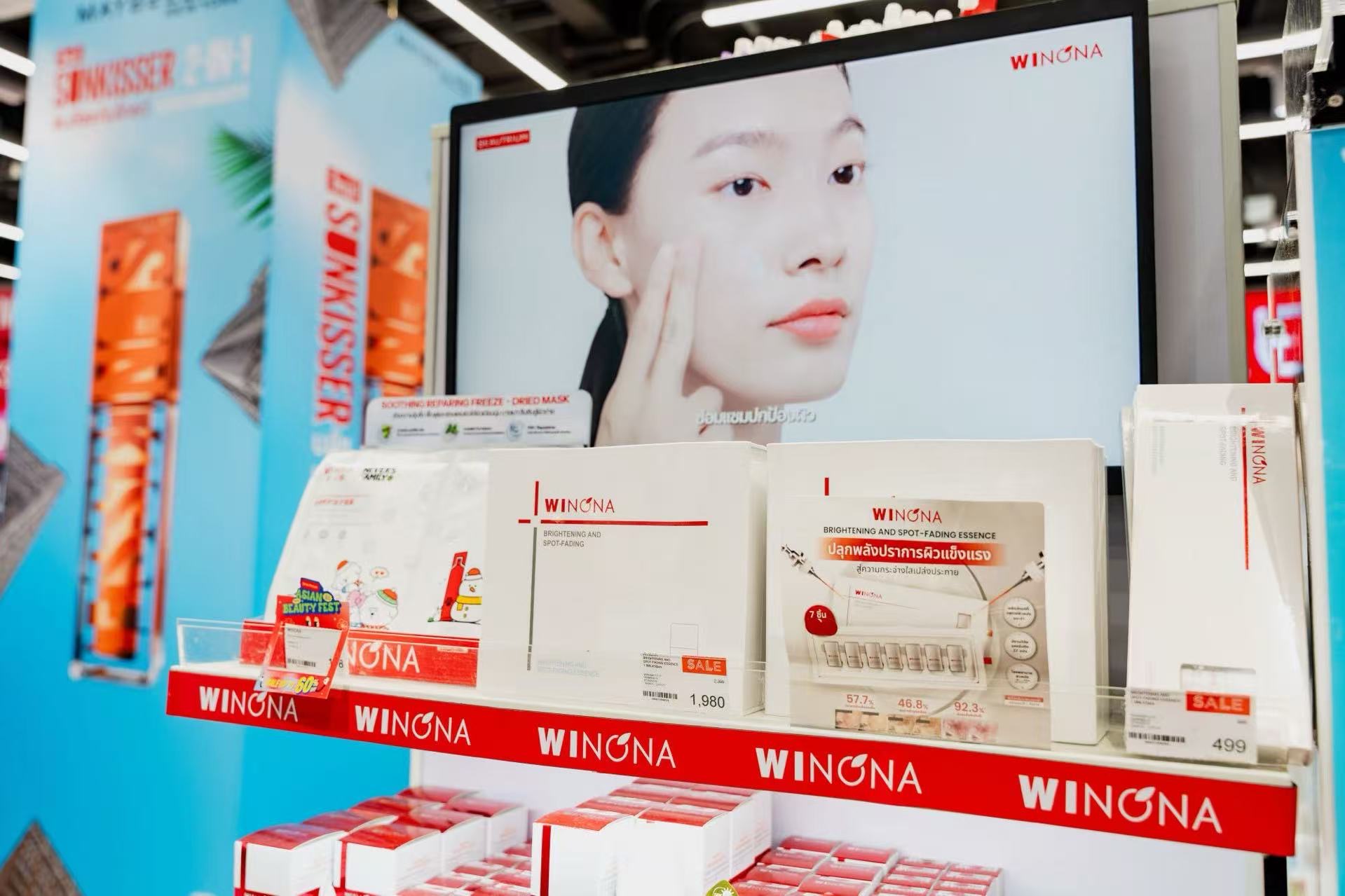
中国功效护肤领军企业贝泰妮(300957)集团,正以泰国为战略支点,加速其品牌薇诺娜在东南亚市场的国际化征程。值此中泰建交50周年之际,集团 在"山海有灵.豫园灯会暨2025中泰文化月"活动中惊艳亮相,不仅展示了其品牌魅力,更凸显了其聚焦东南亚市场的决心与成果。 此次在国家级文化交流盛典"中泰文化月"中倾力打造专属展区,不仅是贝泰妮对泰国市场持续躬耕的巩固与升级,更是集团以曼谷为枢纽,撬动整个东南亚 新兴市场潜力的关键一步。未来,贝泰妮将继续植根这片活力热土,依托中国科研实力与可持续发展理念,书写中国化妆品品牌走向世界的崭新篇章。 中泰命运共同体的建设,正伴随着两国建交50周年的春风不断深化走实。作为此次"中泰文化月"的重要组成部分,贝泰妮集团在曼谷暹罗天地ICONSIAM呈 现了"山海同薇植韵东方"主题特展。为期一周的沉浸式体验,通过光影互动、产品体验、皮肤检测等内容,向全球消费者生动传递了薇诺娜品牌所蕴含 的"中国植物成分"科技魅力与东方美学底蕴。这场根植于中国云南生物多样性的品牌展示,成为连接中泰文化、深化友谊的又一纽带,也为其在东南亚市场 的持续发展注入了文化动能。 贝泰妮聚力泰国市场与高规格亮相中泰 ...

化妆品医美行业周报:再生药械再添两员,轻医美概念方兴未艾-20250713
Shenwan Hongyuan Securities· 2025-07-13 07:12
Investment Rating - The report maintains a positive outlook on the cosmetics and medical beauty industry, indicating a "Buy" recommendation for several companies within the sector [2][14]. Core Insights - The cosmetics and medical beauty sector has shown weaker performance compared to the market, with the Shenwan Beauty Care Index rising by 1.5% from July 4 to July 11, 2025, which is below the market average [3][5]. - The introduction of new products in the regenerative medicine sector, particularly in the "童颜针" (youthful needle) category, is expected to enhance consumer interest and expand the market [2][8]. - The report highlights strong anticipated earnings growth for several key companies in the cosmetics sector for the second quarter of 2025, with notable increases in revenue and net profit for brands like 上美股份 (Shangmei), 丸美股份 (Marubi), and 珀莱雅 (Proya) [9][10][11]. Summary by Sections Industry Performance - The cosmetics and medical beauty sector has underperformed the market, with specific indices showing varied performance, such as the Shenwan Cosmetics Index increasing by 2.6% [3][5]. - The report notes that the demand for cosmetics is recovering, with a 4.1% year-on-year increase in retail sales for the first five months of 2025 [19][20]. Company Performance - 上美股份 (Shangmei) is expected to see a revenue increase of 16% and a net profit increase of 25% in the first half of 2025 [10]. - 丸美股份 (Marubi) anticipates a 22% revenue growth and a 28% increase in net profit for the second quarter of 2025 [10]. - 珀莱雅 (Proya) is projected to achieve a 10% revenue growth and a 15% increase in net profit for the second quarter of 2025 [10]. - 毛戈平 (Mao Geping) expects a significant revenue increase of 38% and a net profit increase of 35% in the first half of 2025 [10]. - 若羽臣 (Ruoyuchen) forecasts a remarkable 70% revenue growth and a 75% increase in net profit for the second quarter of 2025 [10]. Market Trends - The report emphasizes the ongoing trend of domestic brands gaining market share, with national brands occupying five of the top ten positions in the skincare market [32]. - The regenerative medicine sector is expanding, with new products enhancing consumer engagement and market growth potential [2][8]. Investment Recommendations - The report recommends focusing on companies with strong brand matrices and high growth potential, such as 上美股份 (Shangmei), 珀莱雅 (Proya), and 丸美股份 (Marubi) [14]. - It suggests monitoring companies that leverage e-commerce and social media platforms effectively, such as 若羽臣 (Ruoyuchen) and 毛戈平 (Mao Geping) [14].




衡美健康北交所IPO受理 市场总局助推保健食品企业风险防控能力【一周财经】
Sou Hu Cai Jing· 2025-07-06 01:27
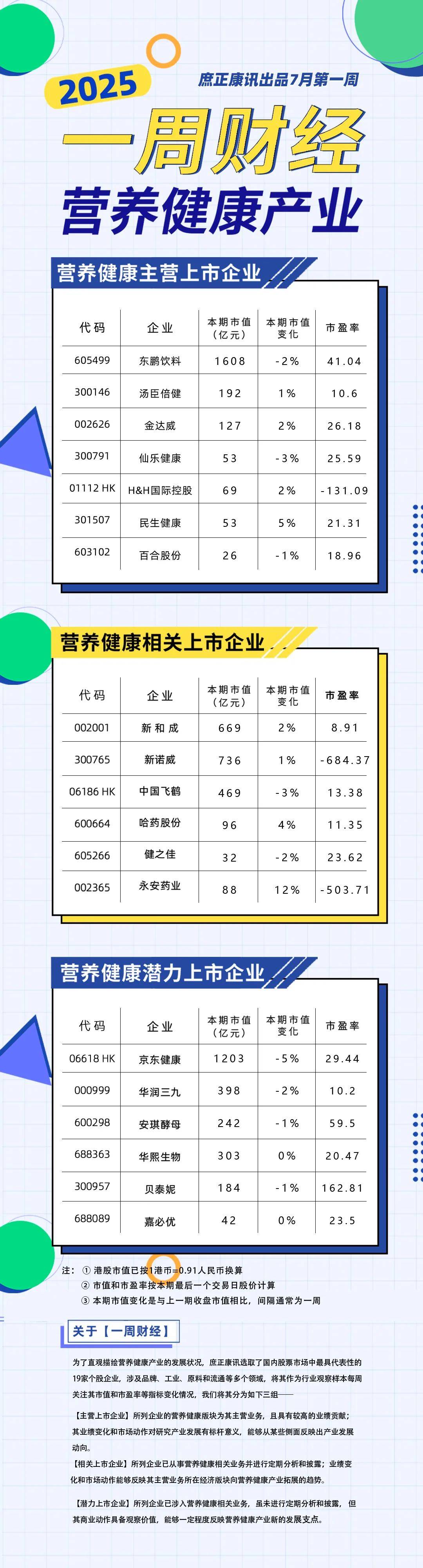
Core Insights - The article discusses recent developments in the nutrition and health industry, highlighting regulatory changes, new product approvals, and market trends that could impact investment opportunities [2][3][4][5][6]. Regulatory Developments - The State Administration for Market Regulation issued a guideline clarifying the definition of commercial advertising under the Advertising Law, addressing ongoing disputes in advertising enforcement [2]. - The National Health Commission approved D-alloheptulose and four other substances as new food raw materials, indicating a push for innovation in the nutrition sector [3]. - The market regulator released multiple responses to proposals regarding health food regulations, signaling a focus on traditional Chinese medicine formulations as a potential growth area [4]. Market Trends and Investment Opportunities - Yangtuo Technology Inc. submitted an IPO application to the Hong Kong Stock Exchange, aiming to raise funds for market expansion and supply chain optimization, reflecting growing investor interest in the nutrition and health sector [5]. - A report on 68 nutrition and health companies showed an average market value increase of 20% in the first half of the year, driven by rising consumer health awareness and demand for nutritional products [6]. Company Performance - New Hope Liuhe (002001) projected a net profit of 3.3 billion to 3.75 billion yuan for the first half of 2025, representing a year-on-year growth of 50% to 70% [12]. - Brother Technology (002562) expects a net profit of 60 million to 75 million yuan for the same period, marking an increase of 325% to 431% compared to the previous year [13]. New Product Launches - Guangji Pharmaceutical (000952) received a notice of administrative penalty for information disclosure violations, indicating regulatory scrutiny in the sector [14]. - TCM brand Tongrentang launched its first OTC glucosamine product, expanding its product line in the bone and joint health category [14].


化妆品医美行业25Q2业绩前瞻:新消费长坡厚雪,美护板块强者恒强
Shenwan Hongyuan Securities· 2025-07-01 14:55
Investment Rating - The report rates the cosmetics and medical beauty industry as "Positive" [2][3] Core Viewpoints - The cosmetics retail sales growth for January to May 2025 is 4.1%, an increase of 2 percentage points compared to the same period last year, indicating a steady recovery in demand [3] - The performance of leading brands remains strong, with double-digit growth, supported by the theme of self-care in new consumption trends, leading to a positive outlook for the first half of 2025 [3] - The 618 shopping festival saw strong performances from domestic brands, with notable rankings on platforms like Tmall and Douyin [3] Summary by Sections Cosmetics Industry Outlook - The report anticipates significant revenue and net profit growth for major companies in Q2 and H1 2025, with specific forecasts: - Up Beauty Co. is expected to see a revenue increase of 16% and a net profit increase of 25% [3] - Marubi is projected to grow revenue by 22% and net profit by 28% in Q2 2025 [3] - Proya is expected to achieve a revenue growth of 10% and net profit growth of 15% in Q2 2025 [3] Key Companies Performance - Notable companies and their expected performance include: - Mao Geping is projected to have a revenue increase of 38% and net profit increase of 35% in H1 2025 [3] - Ruibin is expected to see a revenue increase of 15% and net profit increase of 15% in Q2 2025 [3] - Huaxi Biological is expected to maintain stable performance with a 0% revenue growth and a 10% net profit increase in Q2 2025 [3] Investment Recommendations - The report recommends focusing on companies with strong brand matrices and comprehensive product layouts, such as Up Beauty Co., Marubi, and Proya, which are expected to benefit from the live e-commerce traffic [3] - It also highlights the importance of niche market players like Ruibin and Mao Geping, who are positioned to capitalize on the rise of personal care and domestic beauty trends [3] - For the medical beauty sector, the report suggests focusing on companies with high R&D barriers and strong profitability, recommending companies like Aimeike and Langzi [3] E-commerce and Other Segments - The report suggests monitoring e-commerce companies like Ruibin, which is expected to see significant growth in revenue and net profit [3] - In the maternal and infant sector, Kid King is projected to exceed market expectations with a revenue increase of 10% and a net profit increase of 70% in Q2 2025 [3]




贝泰妮(300957) - 2025年6月投资者关系活动记录表
2025-07-01 13:36
Group 1: Company Developments - The company has successfully registered 3 new raw materials, including the first single new raw material, Long-stem Wintergreen Glycoside, bringing the total to 16 registered cosmetic raw materials [3] - The main brands, including Winona and Aikeman, have products featured in the 618 shopping festival livestream hosted by Li Jiaqi [3] Group 2: Product Launches - Winona's new product "Little Ice Ton" features high-energy technology for cooling and moisturizing, while the "Clear Whitening Sunscreen" targets sensitive skin with sun protection and whitening benefits [3] - Aikeman has launched the "White Moonlight" series, which includes products aimed at reducing spots and tightening skin [3] Group 3: Brand Activities - Aikeman participated in the "Blue UP" salon focusing on marine biodiversity protection, showcasing the company's commitment to environmental sustainability [3] - The company emphasizes its eco-friendly product development, such as the "Little King Kong" physical sunscreen that avoids coral reef pollution [3] Group 4: Financial Performance - The company's overseas revenue grew by over 550% in 2024, accounting for 1.37% of total revenue [4] - The top five online self-operated stores contributed approximately 58.15% to online sales revenue, with a two-year repurchase rate of 38.76% for one Tmall store and 31.13% for one Douyin store [4]
研判2025!中国皮肤学级护肤品行业市场政策、产业链图谱、发展现状及发展趋势分析:18-35岁的年轻女性为核心消费人群[图]
Chan Ye Xin Xi Wang· 2025-07-01 01:23
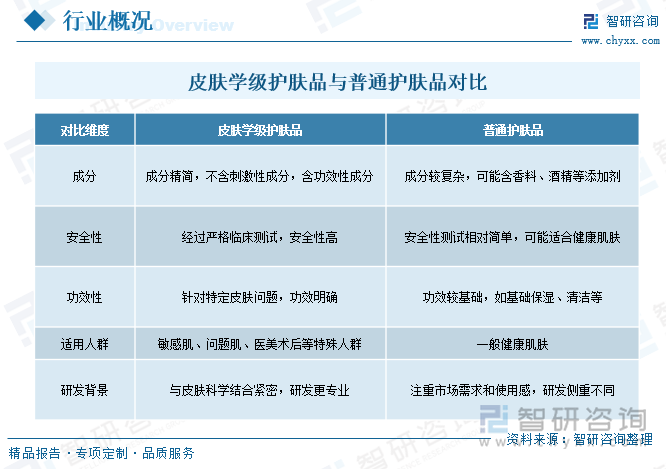
Core Viewpoint - The demand for dermatological skincare products in China is rapidly increasing due to rising consumer health awareness and income levels, with the market expected to reach 22.528 billion yuan in 2024, reflecting a year-on-year growth of 21.13% [1][12]. Overview - Dermatological skincare products are developed based on dermatology and skin structure, aimed at addressing specific skin issues. They are characterized by simplified ingredients, higher safety, and clearer efficacy compared to regular skincare products [2][3]. Market Policy - The Chinese government has implemented a series of regulations to enhance the development of the cosmetics industry, including dermatological skincare products, promoting standardization and high-quality growth [5][6]. Industry Chain - The upstream of the dermatological skincare industry includes suppliers of active ingredients, moisturizers, oils, plant extracts, and production equipment. The downstream consists of hospitals, pharmacies, supermarkets, beauty salons, brand counters, and e-commerce platforms [7][10]. Development Status - The market for dermatological skincare products is experiencing exponential growth, driven by increasing skin issues among consumers and a shift towards scientific skincare. Despite rapid development, the market penetration in China remains low compared to mature overseas markets, indicating significant future growth potential [1][12]. Competitive Landscape - The dermatological skincare market in China is becoming increasingly competitive, with numerous companies entering the space. Key players include Peirfaer (Shanghai) Cosmetics Trading Co., L'Oréal (China) Co., Shenzhen Haichuang Biotechnology Co., and others [14][16]. Representative Company Analysis - Yunnan Betaini Biotechnology Group Co., established in 2010, focuses on skin health and has gained recognition for its "Winona" brand, achieving a revenue of 5.736 billion yuan in 2024, with skincare products accounting for 83.70% of total revenue [16]. - Beijing Andeputai Medical Technology Co., founded in 2010, specializes in solutions for problematic skin and integrates global resources for medical research and product development [18]. Development Trends - The trend of "minimalist skincare" is emerging, with consumers favoring simplified formulations. Additionally, domestic brands are leveraging cross-border e-commerce to expand internationally, supported by capital mergers to enhance global competitiveness [21].
平台与品牌格局变革,美妆618平稳收官
HUAXI Securities· 2025-06-22 14:08
Investment Rating - Industry rating: Recommended [5] Core Insights - The beauty sector experienced a stable conclusion during the 618 shopping festival, with significant changes in platform and brand dynamics driven by reduced commission policies and interest-based content ecosystems [1][2] - The total GMV for beauty products across four major e-commerce platforms (Taobao, JD, Douyin, Kuaishou) during the 618 period was between 600-700 billion yuan, reflecting a year-on-year growth of over 10% [1] - Taobao maintained the largest market share at 41.3%, followed by Douyin at 35.7%, JD at 14.8%, and Kuaishou at 8.2% [1][13] Summary by Sections E-commerce Platform Dynamics - Douyin's beauty segment is rapidly growing, supported by merchant subsidies and interest-driven consumer engagement, achieving double-digit growth [2] - Douyin's promotional strategies included a 1.4 billion yuan subsidy for merchants in May, with individual merchant reductions reaching up to 2.99 million yuan [2] Skincare and Makeup Categories - In the skincare category, domestic brands like Proya and Han Shu led the market, maintaining their top positions on Taobao and Douyin [3] - The top five brands in the skincare category on Taobao remained stable, with Proya and Han Shu continuing to dominate [3] - In the makeup and fragrance category, new domestic brands are emerging, with Ti Luo Wei achieving rapid growth by focusing on base makeup products [4] International and Domestic Brand Strategies - International brands are performing well due to localized marketing strategies and a willingness to engage with local consumers [8] - Domestic brands are expected to break out of the competitive cycle focused on ingredients and efficacy, emphasizing brand influence and comprehensive user experience [8] Investment Recommendations - Focus on domestic companies with strong brand equity and comprehensive channel strategies, particularly Proya and Han Shu [9] - Highlight technology-driven skincare brands like Betaini and Juzi Biology that target specific consumer needs [9] - Consider daily chemical brands with strong cost-performance ratios and excellent management of emerging channels, such as Runben and Dengkang [9]


商贸零售行业:5月社零环比提速,消费品以旧换新政策持续显效
Dongxing Securities· 2025-06-17 07:21
Investment Rating - The industry investment rating is "Positive" [6] Core Viewpoints - In May 2025, the total retail sales of consumer goods increased by 6.4% year-on-year, with a month-on-month acceleration primarily due to the early timing of the "6·18" promotional event [1] - Essential consumption categories showed steady growth, while discretionary categories continued to recover, with significant increases in sales for home appliances and furniture driven by government policies [2][3] - Online retail channels experienced robust growth, while offline channels showed structural differentiation, with a continued preference for high-cost performance products among consumers [4] Summary by Sections Retail Sales Performance - In May 2025, the total retail sales of consumer goods reached a year-on-year growth of 6.4%, with a month-on-month increase of 1.3 percentage points compared to April [1] - Cumulative retail sales from January to May 2025 showed a year-on-year growth of 5.0%, indicating a steady recovery in consumption [1] Consumption Types - Essential consumption maintained steady growth, with food, beverages, and daily necessities showing year-on-year sales increases of 14.6%, 0.1%, and 8.0% respectively [2] - Discretionary consumption categories, such as cosmetics and apparel, showed signs of recovery, with notable performance in gold and jewelry sales due to rising gold prices [2][3] Policy Impact - High-growth categories benefited from supportive consumption policies, with home appliances sales increasing by 53.0% year-on-year, furniture by 25.6%, and gold and silver jewelry by 21.8% [3] - The impact of government subsidies on consumer purchases was significant, particularly in the home improvement sector [3] Retail Channel Dynamics - Online retail sales grew by 8.5% year-on-year in the first five months of 2025, with physical goods online retail accounting for 24.5% of total retail sales [4] - Offline retail channels showed a mixed performance, with convenience stores and specialty stores growing at 8.5% and 6.3% respectively, while department stores lagged behind [4] Investment Strategy - The report suggests focusing on durable goods sectors benefiting from policy support and companies with strong channel integration and product competitiveness [4]

国货美妆出海东南亚专题研究:供应链、本土化融合,出海重塑国货美妆产业格局
Shenwan Hongyuan Securities· 2025-06-15 06:47
Investment Rating - The report maintains a positive outlook on the domestic beauty and skincare industry, particularly focusing on the potential of Chinese brands expanding into Southeast Asia [4]. Core Insights - The domestic skincare market is entering a steady growth phase, with the market size projected to increase from CNY 244.9 billion in 2019 to CNY 271.2 billion by 2024, reflecting a CAGR of 2.1%. The color cosmetics market is expected to grow from CNY 59.3 billion to CNY 62.0 billion during the same period, with a CAGR of 0.9% [6][20]. - Southeast Asia is positioned as a crucial trade hub with high economic growth rates, where countries like Indonesia, Malaysia, and Vietnam are expected to maintain GDP growth around 5% from 2024 to 2026, outpacing developed nations by 1.5%-2% [6][8]. - The increasing e-commerce penetration in Southeast Asia is driving online beauty consumption, with Indonesia's e-commerce sales for skincare rising from 1.3% in 2016 to 20.9% in 2021 [6][8]. - The Southeast Asian market exhibits a layered consumer demand, with high-end brands having potential in Singapore, while mid-range brands can thrive in Malaysia, and cost-effective products are favored in Indonesia, Thailand, and Vietnam [6][8]. Summary by Sections Supply Chain Advantages - Domestic beauty brands are enhancing their supply chain capabilities, which allows them to explore new markets abroad. The trend of outsourcing to export-oriented brands is becoming a viable strategy for differentiation [6][20]. - The geographical advantages and high growth potential of Southeast Asia make it an attractive market for beauty consumption [6][29]. Production and Channel Flexibility - The report highlights the role of OEM/ODM factories in enabling brands to scale quickly in Southeast Asia, reducing investment risks and allowing brands to focus on marketing [46]. - The rise of online sales channels, particularly through platforms like Shopee and Lazada, is transforming the beauty retail landscape in Southeast Asia, with significant sales contributions from these platforms [60]. Consumer Demand Segmentation - The report identifies three tiers of consumer demand in Southeast Asia, suggesting that high-end brands can succeed in Singapore, while mid-range brands can find opportunities in Malaysia, and budget-friendly products are suitable for Indonesia and Vietnam [6][8]. Industry Trends - The report emphasizes the importance of localizing operations and leveraging supply chain advantages for Chinese beauty brands entering Southeast Asia, with several companies already establishing a presence in the region [7][48].
2025年美容护理中期投资策略:领跑新消费,美妆个护全面崛起
Shenwan Hongyuan Securities· 2025-06-10 04:18
Group 1 - The beauty and personal care sector has shown strong performance in Q1 2025, with the SW Beauty Care Index rising by 13.4%, leading all 31 SW primary industries [4][10][12] - The cosmetics segment is focusing on enhancing brand matrices and introducing new ingredients, benefiting from an optimized competitive landscape [4][6] - The medical beauty market is evolving with new products stimulating consumer interest, and domestic companies are expected to become major competitors in the light medical beauty sector [4][6] Group 2 - The e-commerce sector is witnessing new consumption models and brands, which are helping to drive growth in the industry [4][6] - The report recommends several companies in the cosmetics sector, including Up Beauty and Proya, which have low PE multiples and strong growth potential [4][6] - In the medical beauty segment, companies with high R&D barriers and strong profitability, such as Aimeike, are highlighted as key investment opportunities [4][6] Group 3 - The personal care market is projected to reach CNY 283.3 billion by 2024, with a compound annual growth rate (CAGR) of 8.4% from 2023 to 2028 [32][34] - Domestic brands are increasingly replacing foreign brands in the personal care sector, with a notable rise in innovative products and marketing strategies [32][36] - The high-end market is experiencing significant growth, with premium products seeing a 27% increase in average transaction value in H2 2024 [44]