
BMW(BMWYY)

Search documents
合资车企纷纷牵手中国智驾
Ren Min Ri Bao· 2025-08-11 20:27
Group 1 - The core viewpoint of the articles highlights the trend of joint ventures between foreign automotive companies and Chinese tech firms to enhance smart driving capabilities in vehicles, reflecting a shift in the competitive landscape of the automotive industry [1][2] - FAW Audi's recent launch of the Q6L e-tron and A5L models equipped with Huawei's advanced driving technology signifies the growing adoption of Chinese smart driving solutions among joint venture automakers [1] - BMW's collaboration with Momenta aims to develop new intelligent driving assistance solutions tailored for the Chinese market, showcasing a commitment to local innovation and addressing specific consumer needs [1][2] Group 2 - The technological edge of Chinese companies in the smart driving sector is a significant factor driving foreign automakers to adopt local solutions, with Momenta's innovative "end-to-end flywheel model" reducing system interaction delays [2] - The partnerships allow joint venture companies to rapidly enhance their smart technology capabilities to meet the demands of the Chinese market while providing Chinese firms with opportunities to enter international supply chains [2] - The collaboration between foreign and Chinese companies is expected to leverage the strengths of the Chinese automotive supply chain, integrating unique features into their products and enhancing competitiveness in electric and intelligent vehicle markets [2]
宝马召回超23万辆汽车 超90%为纯电动车型i系列
Cai Jing Wang· 2025-08-11 07:53
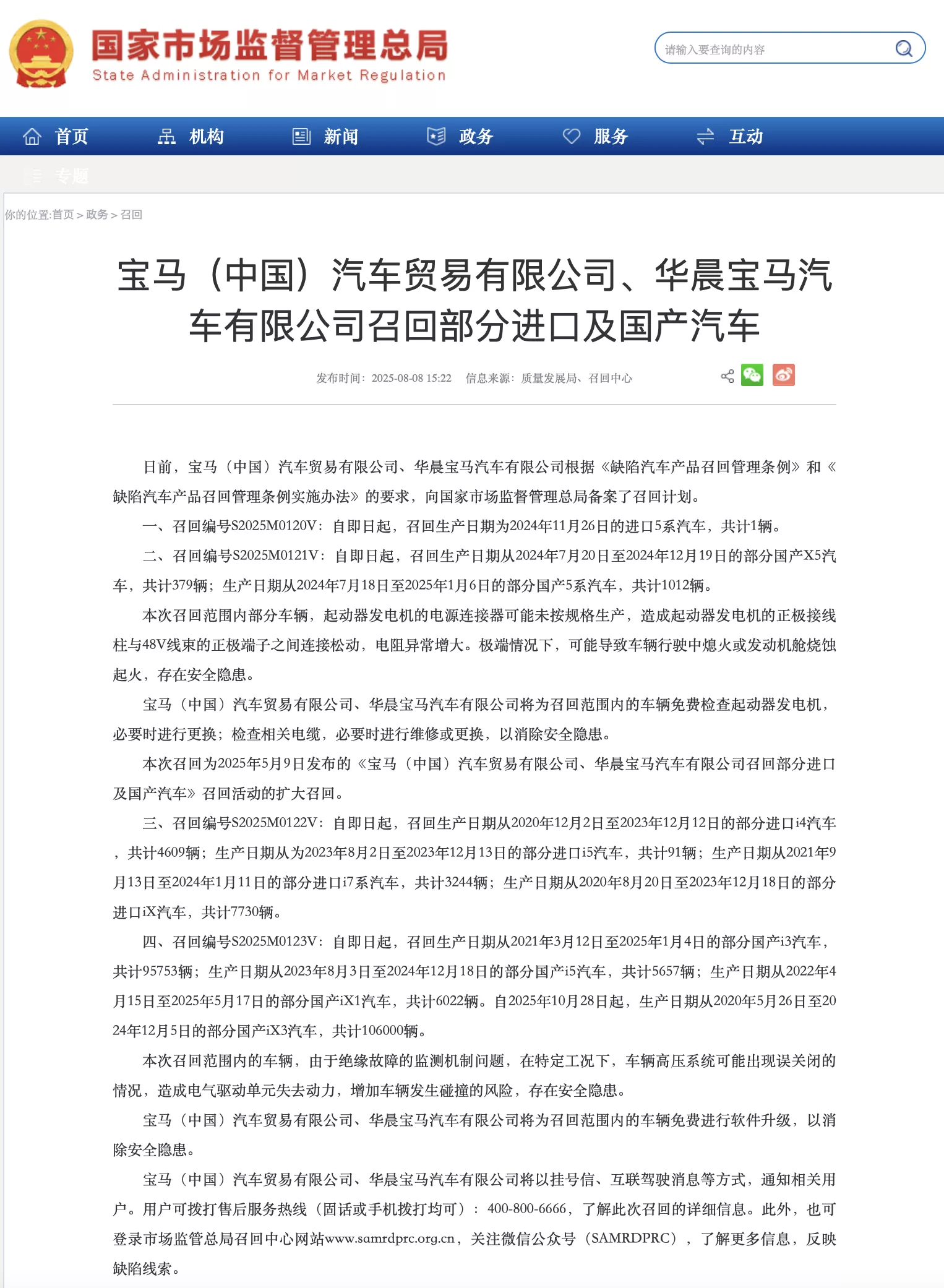
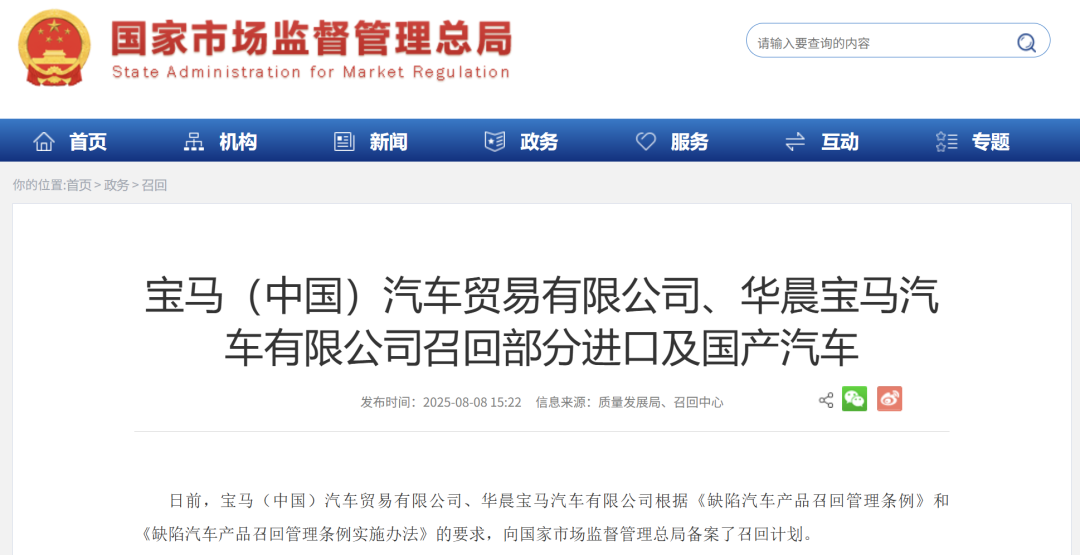
Core Viewpoint - BMW (China) Automotive Trade Co., Ltd. and Brilliance BMW Automotive Ltd. will recall over 230,000 vehicles due to safety hazards related to the starter generator connection and high-voltage system issues [1][4]. Recall Details - The recall primarily involves electric i-series models, including domestic i3, i5, and imported i4, i7, and iX models, with significant numbers from the ix3 and i3 production runs [4]. - The ix3 model, produced from May 2020 to December 2024, has a recall count of 106,000 units, while the i3 model, produced from March 2021 to January 2025, has 95,800 units recalled [4]. Previous Recalls - BMW has conducted multiple recalls this year, including 80 imported 5 Series and 16,813 domestic 5 Series vehicles in May, and 3,736 imported X3 M40i and X4 M40i vehicles in April due to software issues [5][9]. - In total, BMW has recalled motorcycles three times this year for various safety concerns [9]. Sales Performance - BMW's sales in China have been declining, with a 13.4% drop in 2024 to 714,500 units, and a 15.5% decrease in the first half of this year compared to the previous year [11]. - The company reported a total of 317,900 units sold in the first half of 2023, reflecting ongoing challenges in the Chinese market [11]. Financial Performance - In Q2 2025, BMW's group revenue decreased by 8.2% to €33.93 billion, with a significant drop in EBIT by 31.4% to €2.66 billion [14][15]. - The automotive segment's revenue also fell by 8.2% to €29.44 billion, indicating pressure on the company's financial performance [14]. Management Changes and Future Plans - Birgit Böhm-Wannenwetsch has been appointed as the new CEO of Brilliance BMW, marking a significant leadership change [16]. - BMW plans to invest in the Chinese market, with over 20 new models set to launch in 2026 and 2027, including the first new-generation model to be produced in Shenyang [16].

消除隐患保障行驶安全 五家车企宣布召回部分车辆
Zheng Quan Ri Bao· 2025-08-10 16:47
Core Viewpoint - Recent announcements from the State Administration for Market Regulation highlight multiple vehicle recalls by automakers including Ferrari, GAC Toyota, FAW Toyota, BMW, and Stellantis due to safety hazards, emphasizing the importance of China's vehicle defect recall mechanism in protecting consumer rights and ensuring road safety [1][5][7] Group 1: Recall Details - BMW's recall involves over 230,000 vehicles, focusing on electrical safety and high-voltage system risks, with issues stemming from improperly manufactured starter generator connectors that could lead to engine stalling or fire [2] - GAC Toyota's recall includes over 90,000 vehicles, with issues related to instrument panel control program settings causing blackouts and insufficient strength in spiral springs due to improper heat treatment during manufacturing [3] - FAW Toyota's recall affects over 96,000 vehicles, addressing similar instrument panel program issues, with solutions involving program upgrades and inspections [3] - Stellantis is recalling 3,339 imported vehicles due to safety-related issues with the air conditioning system, while Ferrari is recalling 381 imported Purosangue vehicles due to potential short circuits in the fuse box [4] Group 2: Recall Mechanism and Communication - The recent recalls reflect the effective operation of China's vehicle defect recall system, supported by regulations that define defective products, recall procedures, and corporate responsibilities [5] - Automakers have demonstrated prompt responses and targeted solutions, offering free services such as part replacements and software upgrades to minimize consumer costs and ensure safety [5][6] - Effective communication channels are crucial for the success of recalls, with automakers notifying affected owners directly and providing platforms for information queries, enhancing transparency and consumer awareness [6]



利润集体大幅下滑,BBA上半年交出最“惨”财报
Jing Ji Guan Cha Bao· 2025-08-10 05:12
Core Insights - The German luxury car brands "BBA" (Mercedes-Benz, BMW, Audi) reported significant profit declines in the first half of 2025, with Mercedes-Benz's net profit dropping by 55.8%, Audi's by 37.5%, and BMW's by 29% [2][3][4] - The brands are facing dual challenges from U.S. tariffs and declining sales in the Chinese market, exacerbated by fierce competition from local luxury brands and an overall price war in China [2][3][4] Financial Performance - Mercedes-Benz's revenue fell to €66.377 billion, down 8.6%, with net profit dropping from €6.087 billion to €2.688 billion [3] - BMW's sales revenue decreased to €67 billion, also down 8%, with a net profit of €4 billion, a 29% decline [3] - Audi's revenue increased by 5.3% to €32.57 billion, but net profit fell to €1.346 billion, a 37.5% drop [3] Impact of U.S. Tariffs - The U.S. government's 25% punitive tariffs on EU-imported cars have significantly impacted BBA's profits, with Audi reporting losses exceeding €600 million due to tariffs and transformation costs [3][4] - Mercedes-Benz estimated a loss of €362 million due to the tariffs, which affected its core automotive business profit margin [3][4] Sales Decline in China - BBA's sales in China have been declining, with Mercedes-Benz's sales down 14% to 293,200 units, Audi's down 10.2% to 287,600 units, and BMW's down 15.5% to 318,000 units [4][5] - The shift towards electric and smart vehicles in China has intensified competition, with local brands gaining market share [4][5] Electric Vehicle Sales - Mercedes-Benz's electric vehicle sales fell by 14% to 87,300 units, while Audi's in China dropped by 23.5% to 7,897 units [5] - BMW's electric vehicle sales increased by 18.5% to 318,900 units globally, but it still lacks competitive products in the Chinese market [5] Adjusted Performance Expectations - Both Mercedes-Benz and Audi have lowered their full-year performance expectations due to ongoing challenges, with Audi revising its revenue forecast down to €65-70 billion [5][6] - Mercedes-Benz anticipates a return on sales of 4%-6%, down from an initial forecast of 6%-8% [5][6] Strategic Responses - BBA is increasing local production in the U.S. to mitigate tariff impacts, with Audi planning a $4.6 billion investment in a new factory [6] - In China, BBA is focusing on deep localization of technology, products, and supply chains to strengthen its market position [6][7] Product Development and Partnerships - BBA is accelerating the launch of new products, especially electric vehicles, with BMW planning to introduce over 10 new models in China by 2025 [7] - Collaborations with local suppliers for smart technology are being prioritized, with BMW partnering with Huawei and Audi also collaborating with the tech giant [7][8] Market Outlook - The luxury car market is facing a new competitive landscape, with BBA needing to adapt to the challenges posed by local brands and changing consumer preferences [9] - The era of high double-digit growth for all brands is perceived to be over, necessitating strategic adjustments for sustained development [9]
台湾人口连续19个月负增长|首席资讯日报
首席商业评论· 2025-08-10 03:26
Group 1 - The International Federation of Robotics Chairman, Takashi Ito, stated that China remains the world's leading market for industrial robots, experiencing growth despite a global decline in installation volumes [2] - The film "Nanjing Photography Studio" has surpassed 2.1 billion yuan in box office revenue as of August 10 [3] - Beijing's new housing policy allows for unlimited purchases outside the Fifth Ring Road, benefiting the new housing market, particularly in areas with high potential [4] Group 2 - The impact of artificial intelligence on the U.S. financial market is significant, with Nvidia reaching a market value of nearly 4.5 trillion yuan, while investors are concerned about potential disruptions to certain industries [5] - The Western Land-Sea New Corridor has seen cumulative imports and exports exceed 4 trillion yuan since its implementation in August 2019 [6] - The International Olympic Committee welcomed the establishment of a special task force by the U.S. government for the 2028 Los Angeles Olympics, emphasizing its importance for safety and logistics [7] Group 3 - Over 5.12 million people participated in subsidized vocational skills training in China in the first half of the year, with 1.85 million obtaining advanced vocational qualifications [8] - Wahaha is eliminating distributors with annual sales below 3 million yuan, leading to disputes over unsettled payments and management concerns [9] - Taiwan's population has experienced negative growth for 19 consecutive months, with the elderly population reaching 19.64% of the total, indicating a transition to a "super-aged society" [10] Group 4 - The total market capitalization of cryptocurrencies has surpassed 4 trillion yuan, with Ethereum's market cap exceeding 500 billion yuan [11] - BMW plans to recall over 230,000 vehicles in China for software upgrades to address safety issues, highlighting quality control challenges amid its electric transformation [12]


宝马突发!集中召回!
Zhong Guo Ji Jin Bao· 2025-08-09 11:27
Core Viewpoint - BMW and Brilliance BMW are recalling over 230,000 vehicles in China due to safety hazards related to the starter generator and high-voltage system [1][3][4] Group 1: Recall Details - The recall includes various models, primarily the i-series, such as the domestic i3, iX1, i5, and imported i4, i7, iX [2][3] - Specific recall numbers include: - S2025M0120V: 1 imported 5 Series vehicle [3] - S2025M0121V: 1,012 domestic 5 Series and 379 domestic X5 vehicles [3] - S2025M0122V: 4,609 imported i4, 91 imported i5, 3,244 imported i7, and 7,730 imported iX vehicles [4] - S2025M0123V: 95,753 domestic i3, 5,657 domestic i5, 6,022 domestic iX1, and 106,000 domestic iX3 vehicles [4] Group 2: Safety Concerns - The recall is due to potential issues with the starter generator's power connector, which may lead to vehicle stalling or fire hazards [3][4] - Additionally, there are concerns regarding the high-voltage system potentially shutting down unexpectedly, increasing the risk of collisions [4] Group 3: Market Performance - BMW's sales in China dropped by 15.5% in the first half of the year, indicating a decline in competitiveness in the high-end vehicle market [6][7] - In contrast, BMW's sales in Europe and North America showed growth, with increases of 8.2% and 3.4% respectively [7] Group 4: Strategic Initiatives - BMW is taking measures to address sales declines, including leadership changes at Brilliance BMW, with the appointment of the first female CEO [7] - The company is also enhancing its technological capabilities through partnerships, such as with Alibaba for AI development and with Momenta for intelligent driving solutions [8]
宝马突发!集中召回!
中国基金报· 2025-08-09 11:20
Core Viewpoint - BMW plans to recall over 230,000 vehicles due to potential safety hazards related to starter generator connections and high-voltage system malfunctions [2][4][11] Recall Details - The recall includes various models, primarily the i series, such as the domestic i3, iX1, i5, and imported i4, i7, iX [4][6] - Specific recall numbers and details include: - S2025M0120V: 1 imported 5 series vehicle from November 26, 2024 [7] - S2025M0121V: 379 domestic X5 and 1,012 domestic 5 series vehicles produced between July 20, 2024, and December 19, 2024 [7] - S2025M0122V: 4,609 imported i4, 91 imported i5, 3,244 imported i7, and 7,730 imported iX vehicles produced between December 2, 2020, and December 12, 2023 [8] - S2025M0123V: 95,753 domestic i3, 5,657 domestic i5, 6,022 domestic iX1, and 106,000 domestic iX3 vehicles produced between May 26, 2020, and December 5, 2024 [9] - BMW will provide free inspections and necessary replacements or repairs to eliminate safety risks [7][10] Sales Performance - BMW's sales in China dropped by 15.5% in the first half of the year, with total sales of 317,900 vehicles [11][13] - The company has experienced a high recall frequency, with previous recalls including 16,813 domestic 5 series and 9,953 X5 vehicles [12] - Global sales for BMW Group's three brands (BMW, MINI, Rolls-Royce) were 1.207388 million vehicles, a slight decrease of 0.5% year-on-year [13] Strategic Measures - To address declining sales, BMW has made significant personnel changes, including the appointment of Birgit Böhm-Wannenwetsch as the first female CEO of Brilliance BMW starting August 1, 2025 [14] - BMW is enhancing its strategic partnerships, including a collaboration with Alibaba to develop AI engines for new models in the Chinese market [14]

暴跌69%,豪车天塌了!
商业洞察· 2025-08-09 09:24
Core Viewpoint - The BBA (Benz, BMW, Audi) luxury car manufacturers are facing significant challenges in the electric vehicle era, with their sales and profits plummeting, indicating a shift in consumer preferences towards domestic electric vehicles [4][5][6]. Group 1: BBA Financial Performance - BMW's net profit fell by nearly 30%, while Audi's profit dropped by 37.5%, and Mercedes-Benz's Q2 net profit plummeted by 69% [4][5][11]. - Mercedes-Benz's Q2 net profit decreased from €3 billion to €957 million, a drop of 68.7%, and its sales in China fell by 19% [11][12]. - Audi's operating profit fell by 45.2% to €1.087 billion, and its net profit dropped by 37.5% to €1.346 billion, with a 6% decline in vehicle deliveries [17][18]. Group 2: Market Dynamics - In the first half of the year, domestic car sales in China reached 9.27 million units, a 25% increase, contrasting sharply with the decline in BBA sales [8][34]. - Mercedes-Benz's electric vehicle sales in China fell by 66%, with its market share in the pure electric vehicle segment dropping to 0.16% [13][12]. - Audi's electric vehicle sales also declined by 23.5%, indicating a broader trend of decreasing demand for traditional luxury vehicles [18]. Group 3: Strategic Shifts - BBA manufacturers are struggling to adapt to the electric vehicle market, with Audi retracting its plans for full electrification due to poor sales performance [18][28]. - The luxury car market is witnessing a significant transformation, with domestic brands rapidly gaining market share and consumer trust, while BBA brands are losing their premium status [32][36]. - The shift in consumer preferences towards more affordable and technologically advanced domestic electric vehicles is evident, as BBA brands are unable to compete effectively [37].
突发!超23万辆宝马因安全隐患被召回,i系列成“重灾区”
Guo Ji Jin Rong Bao· 2025-08-09 08:13
Core Viewpoint - BMW (China) Automotive Trade Co., Ltd. and Brilliance BMW Automotive Ltd. have announced a recall of over 230,000 vehicles due to safety hazards related to starter generator connections and high-voltage system malfunctions [1][4]. Recall Details - The recall is divided into four categories, with specific vehicle models and production dates outlined for each [2][3]. - The first recall involves 1 imported 5 Series vehicle produced on November 26, 2024 [2]. - The second recall includes 1,012 units of the domestic 5 Series and 379 units of the domestic X5, produced between July 20, 2024, and December 19, 2024 [2]. - The third recall encompasses 4,609 imported i4 vehicles and 7,730 imported iX vehicles, among others, produced between December 2, 2020, and December 18, 2023 [3]. - The fourth recall affects 95,753 domestic i3 vehicles, making it the most affected model, along with other domestic models [3]. Safety Concerns - The vehicles in the recall may experience issues such as loose connections in the starter generator, which could lead to engine stalling or fire hazards [2][4]. - BMW will provide free software upgrades to address the high-voltage system malfunction that could lead to loss of power and increased collision risk [4]. Market Performance - BMW's recall frequency has been high, with over 4 million vehicles recalled last year due to various issues [4]. - In 2024, BMW's deliveries in China fell by 13.4% to 714,500 units, marking the largest decline among luxury brands [4]. - In the first half of the year, BMW's sales in Asia dropped by 11.1%, with a significant 15.5% decline in the Chinese market, despite it being the largest single market for the company [4]. Strategic Initiatives - To counter declining sales, BMW has intensified its local ecosystem development, including partnerships with Huawei and Alibaba for AI and smart driving technologies [5]. - Collaborations with CATL and EVE Energy aim to accelerate the production of cylindrical battery cells [5]. - BMW has also partnered with Momenta to develop new intelligent driving assistance solutions tailored for the Chinese market [5].
突发!超23万辆宝马因安全隐患被召回 i系列成“重灾区”
Guo Ji Jin Rong Bao· 2025-08-09 08:11
Core Viewpoint - BMW (China) Automotive Trade Co., Ltd. and Brilliance BMW Automotive Ltd. have announced a recall of over 230,000 vehicles due to safety hazards related to starter generator connections and high-voltage system malfunctions [1][2][3] Recall Details - The recall includes multiple models such as the domestic i3, iX1, i5, and imported i4, i7, iX, with specific recall numbers and production dates outlined [1][2] - The total number of vehicles recalled includes: - 1 imported 5 Series vehicle [1] - 1,391 domestic X5 and 5 Series vehicles [1] - 4,609 imported i4 vehicles [2] - 9,575 domestic i3 vehicles [2] - 106,000 domestic iX3 vehicles [2] Safety Concerns - The vehicles in the recall may experience issues such as loose connections in the starter generator, which could lead to engine stalling or fire hazards [1][3] - BMW will provide free software upgrades to address the high-voltage system malfunction that could lead to loss of power and increased collision risk [3] Market Performance - BMW's sales in China have declined, with a 13.4% drop in total deliveries in 2024, making it the largest decline among luxury brands [3] - In the first half of the year, BMW's sales in Asia fell by 11.1%, with a significant 15.5% drop in the Chinese market [3] Strategic Initiatives - To counteract declining sales, BMW has initiated several local partnerships and technology integrations, including collaborations with Huawei and Alibaba for AI development, and partnerships with CATL and EVE Energy for battery production [4]