Intel(INTC)

Search documents
美股异动|英特尔盘前跌逾1% 台积电据称已对罗唯仁提起诉讼
Xin Lang Cai Jing· 2025-11-25 10:00
Core Viewpoint - Intel's stock price dropped by 1.23% to $35.35 in pre-market trading following a lawsuit filed by TSMC against former senior vice president Luo Wei-ren, who is accused of potentially leaking TSMC's trade secrets to Intel [1]. Group 1: Company Performance - Intel's closing price on November 24 was $35.79, reflecting an increase of 3.74% [1]. - The pre-market price on November 25 was $35.35, indicating a decrease of $0.44 [1]. - The stock reached a high of $36.155 and a low of $34.685 during the trading session [1]. - The trading volume was 104 million shares, with a total transaction value of $3.709 billion [1]. - Intel's market capitalization stands at $170.718 billion [1]. Group 2: Financial Metrics - The price-to-earnings (P/E) ratio is reported at 596.50, indicating a loss [1]. - The price-to-book (P/B) ratio is 1.604 [1]. - The stock has a 52-week high of $42.480 and a low of $17.665 [1].


聪明钱动向:美国对冲基金现在都在做空哪些股票?
Feng Huang Wang· 2025-11-25 08:11
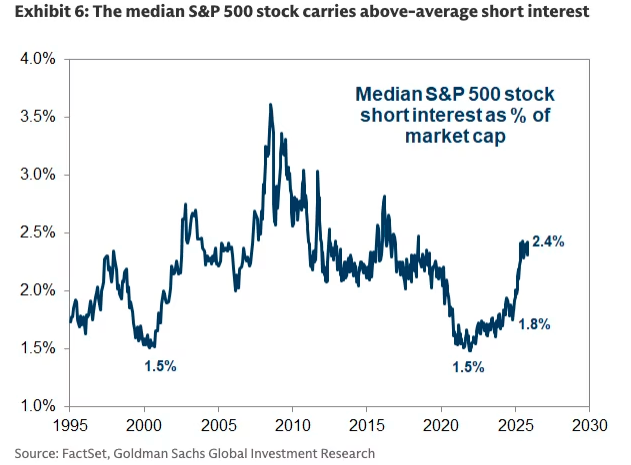
Market Overview - The recent volatility in the US stock market has led to a surge in Oracle CDS trading, with hedge funds focusing on when and where to short the market [1] - Goldman Sachs' latest hedge fund positioning report reveals that "smart money" is not yet ready to short major AI companies, but some institutions are targeting weaker players in the sector [1] Short Selling Trends - The short position in the S&P 500 is currently at 2.4% of total market capitalization, placing it in the 99th percentile over the past five years, significantly above the long-term average since 1995 [1] - The Nasdaq 100 index has a slightly higher short ratio of 2.5%, while small-cap stocks in the Russell 2000 index have a median short ratio of 5.5% [3] Sector Analysis - The utilities sector has seen a notable increase in short positions, rising by 0.3 percentage points to 3.2%, marking one of the highest levels in its history [5][6] - The demand for utility stocks has increased due to their attractiveness in supporting AI data centers, which require high energy consumption [8] Individual Stocks of Interest - Tesla remains the most shorted stock, with JPMorgan surprisingly appearing as the fourth most shorted [10] - Oracle has a short position of $5.4 billion, Intel at $4.6 billion, and General Electric at $4.1 billion, although these amounts represent a small percentage of their overall market capitalizations [12] Emerging Short Opportunities - Bloom Energy is highlighted as the most shorted stock among US companies with a market cap of at least $25 billion, with its stock price having surged significantly before recent declines [12] - Other heavily shorted stocks include Strategy, CoreWeave, Coinbase, Live Nation, Robinhood, and Apollo [14] Hedge Fund Positioning - Goldman Sachs' report is based on data from 982 hedge funds, with total equity positions amounting to $4 trillion, including $2.6 trillion in long positions and $1.4 trillion in short positions [14] - Major long positions among hedge funds include Amazon, Microsoft, Meta, Nvidia, and Alphabet [14]

TrendForce集邦咨询:AI催生超大封装需求 ASICs有望从CoWoS转向EMIB技术
智通财经网· 2025-11-25 05:47
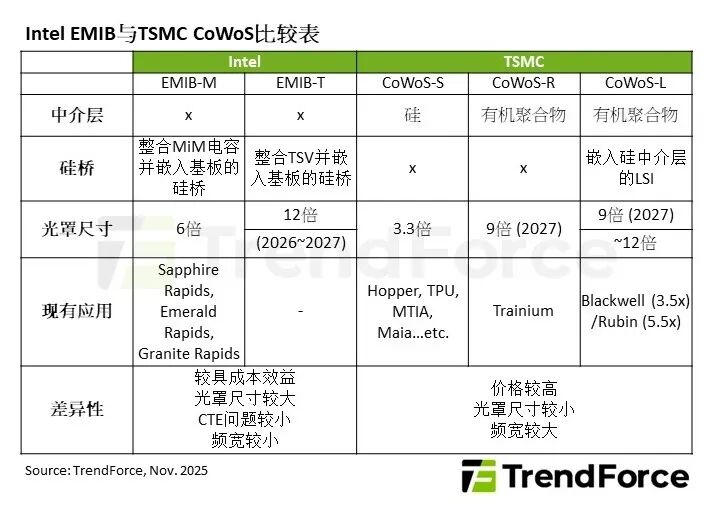
Core Insights - The demand for AI HPC (High-Performance Computing) is driving the need for advanced packaging solutions, particularly TSMC's CoWoS technology, but some cloud service providers (CSPs) are considering Intel's EMIB technology due to increasing chip integration requirements and packaging area demands [1][2]. Group 1: Technology Comparison - TSMC's CoWoS solution connects different functional chips using an interposer, while Intel's EMIB simplifies the structure by embedding silicon bridges directly into the substrate, resulting in higher yield rates [3][7]. - EMIB technology has advantages over CoWoS in terms of thermal expansion coefficient (CTE) issues, as it has a lower silicon ratio and fewer contact areas, reducing the risk of warping and reliability challenges [3][7]. Group 2: Market Dynamics - The current market for advanced packaging is facing capacity shortages and high costs associated with CoWoS, leading companies like Google and Meta to explore Intel's EMIB solutions [2][8]. - Intel's EMIB technology is expected to support larger die sizes and provide cost-effective solutions by eliminating the expensive interposer layer, making it attractive for AI customers [7][8]. Group 3: Future Prospects - EMIB is projected to achieve significant advancements in mask size, with EMIB-M already providing 6x mask size and expected to reach up to 12x by 2027, while CoWoS technologies are limited to lower mask sizes [4][7]. - Intel's Foundry Services (IFS) has been developing EMIB technology since 2021, and with major clients like Google and Meta showing interest, this could lead to substantial growth for IFS [8].

研报 | AI催生超大封装需求,ASICs有望从CoWoS转向EMIB技术
TrendForce集邦· 2025-11-25 05:01
Core Insights - The article discusses the increasing demand for AI HPC (High-Performance Computing) and the shift from TSMC's CoWoS solution to Intel's EMIB technology by cloud service providers (CSPs) due to capacity shortages and cost considerations [2][3][4]. Group 1: Technology Comparison - TSMC's CoWoS solution connects different functional chips using an interposer, while Intel's EMIB simplifies the structure by embedding silicon bridges directly into the substrate, leading to higher yield rates [4][6]. - EMIB technology has advantages such as a lower coefficient of thermal expansion (CTE) issue, which reduces the risk of warping and reliability challenges compared to CoWoS [4][6]. - EMIB can achieve larger die sizes, with EMIB-M supporting up to 6 times the mask size, while CoWoS-L is expected to reach 9 times by 2027 [6]. Group 2: Market Dynamics - The demand for CoWoS is facing challenges such as capacity shortages and high costs, leading CSPs like Google and Meta to explore Intel's EMIB solutions [3][7]. - Intel's EMIB technology is being adopted in its server CPU platforms, and companies like Google and Meta are considering it for their products, indicating a potential shift in market dynamics [7][8]. - NVIDIA and AMD, which require high bandwidth and low latency, are likely to continue using CoWoS as their primary packaging solution [7].

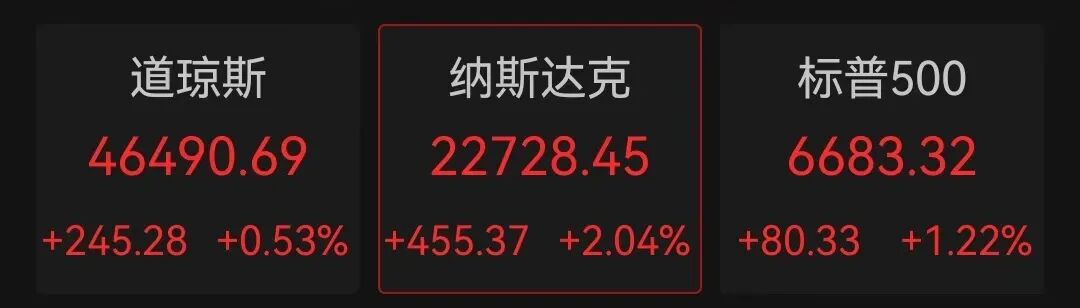
美股三大指数集体收涨 纳指涨2.69%





Xin Lang Cai Jing· 2025-11-24 21:09
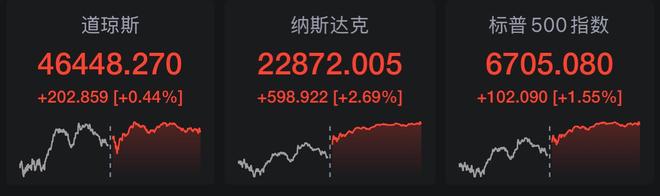
Core Viewpoint - The U.S. stock market experienced a collective rise on Monday, with significant gains in major indices, particularly driven by large technology stocks [1] Group 1: Market Performance - The Dow Jones Industrial Average increased by 0.44% [1] - The Nasdaq Composite rose by 2.69% [1] - The S&P 500 index gained 1.55% [1] Group 2: Individual Stock Movements - Broadcom surged over 11%, marking its best single-day performance since April, adding $178 billion to its market capitalization [1] - Tesla and Google both saw increases of over 6% [1] - AMD rose by more than 5% [1] - Meta and Intel increased by over 3% [1] - Amazon, Nvidia, and Netflix all gained over 2% [1] - Apple and Qualcomm rose by over 1% [1] - Microsoft and Oracle had slight increases [1]
深夜,全线大涨!中国资产大爆发
Mei Ri Jing Ji Xin Wen· 2025-11-24 16:19
Group 1: Major Tech Stocks Performance - Major tech stocks showed a positive trend, with Tesla rising by 6.36%, Google by 5.49%, Facebook by 3.37%, Amazon by 2.51%, Apple by 0.83%, Microsoft by 0.6%, and Nvidia by 0.2% [2][3] - The Philadelphia Semiconductor Index surged by 3.66%, with Broadcom increasing over 9%, Micron Technology rising by 6.71%, AMD up by 4.05%, and Intel gaining 3.57% [2][5] Group 2: Novo Nordisk's Clinical Trial Results - Novo Nordisk experienced a significant decline of 6.58%, with shares dropping nearly 10% after the company announced that its drug semaglutide did not meet efficacy targets in late-stage trials for Alzheimer's disease [5][6] - The trials aimed to slow cognitive decline in patients by at least 20%, but no significant improvement was observed among thousands of participants [6][7] Group 3: Nasdaq China Golden Dragon Index - The Nasdaq China Golden Dragon Index rose by 2.56%, with notable individual stock performances including Hesai Technology up over 18%, Canadian Solar near 9%, Baidu up 7.84%, and Bilibili rising by 6.96% [9][10] Group 4: Market Outlook and Predictions - Morgan Stanley's chief U.S. equity strategist, Michael Wilson, expressed optimism about the U.S. stock market, suggesting that the recent downturn may soon end and reaffirming a bullish outlook for next year [11][12] - Wilson predicts the S&P 500 index will rebound to 7,800 points in a year, representing an approximate 18% increase from current levels, driven by a potential interest rate cut cycle by the Federal Reserve and an AI-driven efficiency revolution [12][13] - Goldman Sachs anticipates the Federal Reserve will implement a third consecutive rate cut in December, with further cuts expected in 2026, as inflation trends and labor market cooling provide room for policy easing [12][14]



今夜,暴涨!
中国基金报· 2025-11-24 16:14
Group 1 - The core viewpoint of the article highlights a significant rise in technology stocks, particularly in the U.S. markets, with the Nasdaq index surging nearly 2% [2][3] - Major semiconductor companies like AMD and Micron, along with tech giants such as Tesla and Alphabet, saw substantial stock price increases, contributing to the overall market rally [3] - The market sentiment is largely influenced by rising expectations for a potential interest rate cut by the Federal Reserve, with the probability of a cut next month reaching nearly 80% [4][5] Group 2 - The article notes that the Boston Fed President Susan Collins does not see an urgent need for rate cuts, while New York Fed President John Williams indicated that there may be reasons for a cut in the near term [5] - Analysts express that the current economic data is subject to various interpretations due to delays in official data releases, complicating the economic outlook [7] - Chinese stocks also performed well, with the China concept stock index rising approximately 2.5%, and Xiaomi's ADR increasing over 4% following a significant share buyback by its founder Lei Jun [7][8]





台积电核心老臣被曝携20箱机密文件投奔英特尔被调查违反商业秘密,英特尔CEO陈立武称谣言
Sou Hu Cai Jing· 2025-11-24 11:44
Core Insights - The recent retirement of TSMC's senior vice president, Luo Wei-ren, and his subsequent move to Intel has raised concerns regarding the potential transfer of confidential documents related to advanced semiconductor processes [2] - Intel's CEO, Pat Gelsinger, publicly denied allegations that Luo brought confidential files with him, asserting that the company respects intellectual property rights [2] - Luo's extensive experience in both TSMC and Intel positions him as a valuable asset for Intel, particularly in managing wafer production and enhancing operational efficiency [3] Group 1 - Luo Wei-ren retired from TSMC in July 2023 and joined Intel as a vice president of R&D, amid rumors of him carrying over 20 boxes of confidential documents related to TSMC's advanced processes [2] - Intel aims to leverage Luo's expertise to improve collaboration with U.S. clients at TSMC's Arizona facility, with expected partnerships including Microsoft and Tesla, and potentially Nvidia and Qualcomm in the future [3] - Luo's career at TSMC included significant advancements in semiconductor technology, leading to over 15,000 patents and establishing TSMC's leadership in 2nm and 1.4nm process technologies [3] Group 2 - This incident is not the first time TSMC has faced allegations related to trade secrets, as the company previously reported cases of employees involved in stealing confidential information about its 2nm chip technology [4] - The ongoing scrutiny surrounding Luo's transition to Intel is heightened by TSMC's recent legal challenges regarding intellectual property theft [4]
人形机器人的落地难题,竟被一顿「九宫格」火锅解开?
机器之心· 2025-11-24 07:27
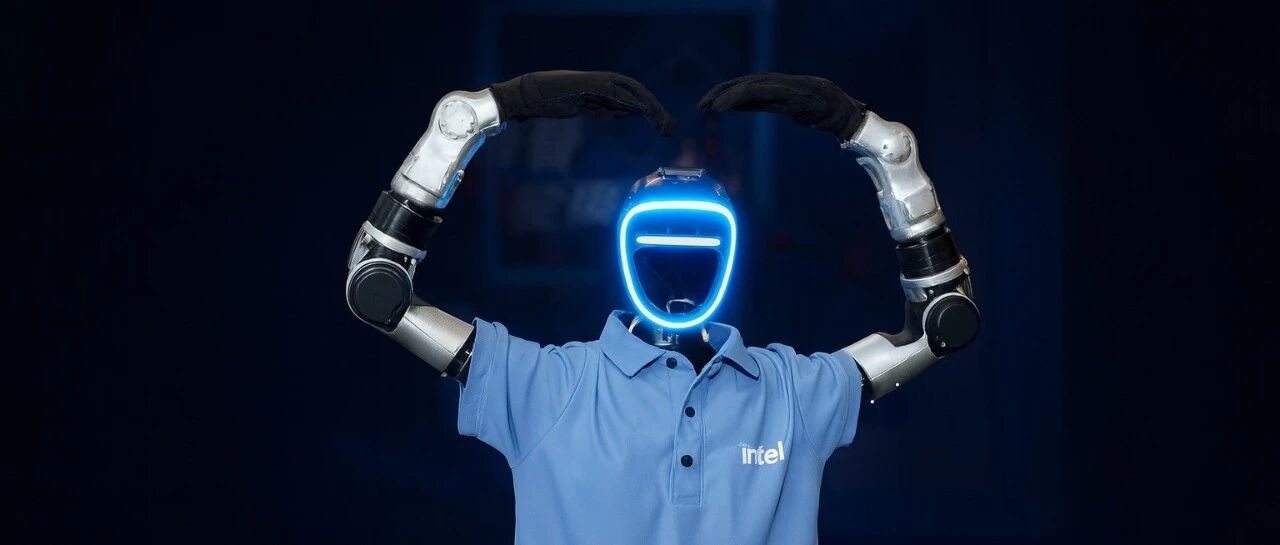
Core Viewpoint - The article discusses the challenges and advancements in embodied intelligence, emphasizing the need for leading chip companies like Intel to overcome computational architecture barriers for large-scale applications [2][8]. Group 1: Challenges in Embodied Intelligence - Recent demonstrations of humanoid robots, such as Tesla's Optimus and Russia's AI robot "Eidol," have faced criticism for their performance, highlighting the gap between theoretical capabilities and practical applications [3][4][7]. - The primary obstacle for these robots entering production lines is the computational platform, which is identified as a significant barrier to the deployment of embodied intelligence [9][12]. - Current humanoid robots typically use a "brain + cerebellum" architecture, where the "brain" handles complex modeling tasks, while the "cerebellum" manages real-time control, requiring high-frequency operations [9][10]. Group 2: Computational Requirements - The demand for computational power has surged due to the integration of motion generation models and multimodal perception, with many companies struggling to meet the required performance levels [10][11]. - Companies often resort to using multiple systems for different tasks, leading to inefficiencies and delays in communication, which can result in operational failures [10][11]. - The return on investment (ROI) is a critical consideration for manufacturers, necessitating robots that are not only effective but also stable, safe, cost-efficient, and energy-efficient [10][11]. Group 3: Intel's Solutions - Intel proposes a "brain-cerebellum fusion" solution using a single System on Chip (SoC) that integrates CPU, GPU, and NPU, allowing for unified intelligent cognition and real-time control [13][14]. - The Core Ultra processor achieves approximately 100 TOPS of AI computing power while maintaining similar power consumption levels, enabling faster responses and improved privacy [17]. - The integrated GPU provides 77 TOPS of AI computing power, capable of handling large-scale visual and modeling tasks effectively [18]. Group 4: Software and Ecosystem - Intel offers a comprehensive software stack that includes operating systems, drivers, SDKs, and real-time optimizations, facilitating easier development for hardware manufacturers [24][26]. - The oneAPI framework allows developers to write code once and run it across various hardware platforms, promoting interoperability and efficiency [27]. - Intel's open approach to technology enables companies to adapt existing systems without being locked into specific vendors, fostering innovation in the embodied intelligence sector [31].
TMT行业周报(11月第3周):国内外大模型厂商加速抢占C端入口-20251124
Century Securities· 2025-11-24 06:33
Investment Rating - The report does not explicitly state an investment rating for the industry, but it highlights strong performance and growth potential for leading companies in the AI sector, particularly those with established ecosystems like Alibaba and Google [3][4]. Core Insights - Major players in the AI sector, such as Alibaba and Google, are rapidly expanding their consumer-facing applications, indicating a strategic shift towards the C-end market. Alibaba's Qwen3-based Qianwen app and Google's Gemini 3 model are examples of this trend [3][4]. - Nvidia reported exceptional quarterly earnings, with revenues of $57 billion, a year-on-year increase of 62%. This performance alleviates concerns about an "AI bubble" and suggests a robust growth trajectory for AI-related infrastructure [3][4]. - The report emphasizes the increasing concentration of market share among leading AI model providers, predicting that top firms will continue to expand their token shares in the market [3][4]. Weekly Market Review - The TMT sector experienced declines across various sub-industries, with the media sector down by 1.25%, communication by 2.51%, computing by 2.74%, and electronics by 5.89%. Conversely, the marketing agency sub-industry saw a significant increase of 9.60% [3][4]. - Notable declines were observed in the semiconductor equipment and materials sectors, with decreases of 7.19% and 7.08%, respectively [3][4]. Industry News and Key Company Announcements - Alibaba's Qianwen app, launched on November 17, marks a significant move into the consumer AI application space, integrating with various services like maps and shopping [3][4]. - Google's Gemini 3 model has achieved top performance in AI benchmarks, showcasing its advanced multimodal capabilities and integration with Google's existing applications [3][4]. - Nvidia's strong financial results and optimistic future guidance suggest a continued upward trend in AI infrastructure investments, with expectations of reaching $65 billion in Q4 revenue [3][4]. Company-Specific Developments - Nvidia's data center revenue grew by 66% year-on-year, indicating strong demand for AI computing power [3][4]. - Xiaomi has invested heavily in AI, with plans to release multiple AI models and applications, reflecting a broader trend of tech companies enhancing their AI capabilities [3][4]. - OpenAI's collaboration with Target aims to enhance retail experiences through AI, further demonstrating the integration of AI into various sectors [3][4].