Coca-Cola(KO)

Search documents
雪碧超过百事可乐,成美国第三大饮料,怎么做到的?
3 6 Ke· 2025-05-19 09:43
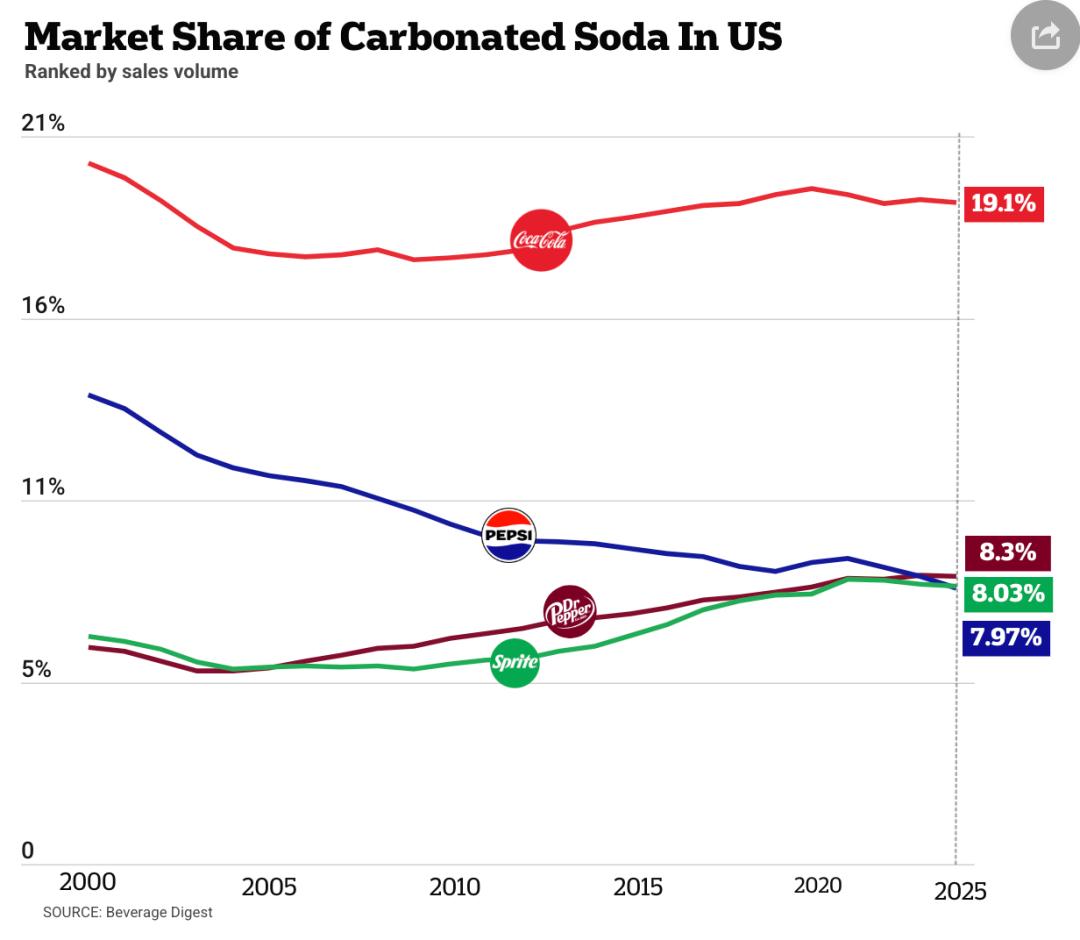
Core Insights - Dr. Pepper has surpassed Pepsi to become the second-largest soda brand in the U.S. due to its unique flavor combination and strong ties to college sports culture, as well as viral marketing on platforms like TikTok [2] - Pepsi has recently been overtaken by Sprite in the U.S. carbonated soft drink market, highlighting a decline in the market share of its flagship product, classic Pepsi [2] Group 1: Sprite's Product Launch and Marketing Strategy - Coca-Cola launched Sprite Chill in April 2024, a new product that combines cherry and lime flavors with a patented cooling agent to enhance the drinking experience [2] - Sprite Chill targets modern consumers, especially Gen Z, who seek novelty and multi-sensory experiences in beverages, positioning the drink as a symbol of "coolness" and self-confidence [3] - The product generated over $50 million in retail sales within 21 weeks of launch and surpassed $100 million in sales over the past 12 months, leading Coca-Cola to make it a permanent product [5] Group 2: Rebranding and Cultural Resonance - Sprite has revived its "Obey Your Thirst" slogan from 1994, aligning it with Gen Z's values of authenticity and individuality, which resonate with their aversion to commercialization [6][7] - The rebranding includes a new advertisement featuring NBA star Anthony Edwards, creating a connection between past and present basketball icons [7] - Sprite has introduced limited-edition packaging with QR codes leading to interactive online experiences, enhancing engagement with young consumers [9] Group 3: Integration of Sports and Hip-Hop Culture - Sprite has successfully integrated sports and hip-hop culture into its marketing strategy, collaborating with top athletes and artists to maintain cultural relevance among younger audiences [12] - The brand has sponsored events like the Unrivaled women's one-on-one basketball league and partnered with athletes like Sha'Carri Richardson to reinforce its image of authenticity [15] - Sprite's ongoing commitment to hip-hop culture includes initiatives like the "Thirst for Yours" project and the "Hip-Hop 50" summer campaign, celebrating the genre's history and engaging with fans through interactive content [16] Group 4: Market Position and Cultural Reflection - Sprite's rise to surpass Pepsi reflects changing consumer preferences and the evolving landscape of popular culture, emphasizing the importance of brands being rooted in cultural movements rather than merely chasing trends [18] - The shift in market positions between Sprite and Pepsi serves as a reminder that brands must respect cultural fluidity to remain relevant [18]


段永平抄底英伟达?巴菲特大幅减持银行!高毅、景林、高瓴加仓中国!大佬最新持仓揭晓!
私募排排网· 2025-05-19 06:09
| 排序 | 美股简称 | 美股代码 | | 持有机构 合计持仓股数 日力) | 持股环比 450 | 持仓市值 亿美元 | 机构持股比例 | 季度涨跌 | | --- | --- | --- | --- | --- | --- | --- | --- | --- | | 1 | 英伟达 | NVDA | 4852 | 16724.78 | -4.13% | 23852.88 | 68.33% | 0.76% | | 2 | 英语 | AAPL | 5349 | 9504.29 | -2.59% | 20794.62 | 63.62% | -14.75% | | 3 | 微软 | MSFT | 5503 | 5372.44 | -2.58% | 20167.6 | 72.27% | -10.94% | | 4 | 亚马逊 | AMZN | 5226 | 6854.13 | -1.58% | 13040.66 | 64.58% | -13.28% | | 5 | 博通 | AVGO | 3598 | 3603.09 | -2.94% | 7972.55 | 76.63% | 30.99% | | 6 | | | ...


关税缓和,资金回流!股市如何让小钱变成大钱?用好钱的“繁殖力”
券商中国· 2025-05-17 23:20
Core Viewpoint - The article emphasizes the importance of saving and prudent investment strategies, highlighting that wealth accumulation is a gradual process rather than a pursuit of quick riches [2][5]. Group 1: Importance of Saving - Saving every penny is crucial for building initial capital, as illustrated by Warren Buffett's anecdote about picking up a penny, which he equates to getting closer to a billion [3]. - Buffett's frugality is showcased through his choice to drive an old car instead of spending $20,000 on a new one, demonstrating the power of compound interest over time [3][4]. Group 2: Investment Strategies - The article discusses the concept of a "failure cycle" where overspending leads to debt accumulation, emphasizing the need to avoid high-interest debt, particularly from credit cards [4][5]. - It suggests that individuals should match their consumption with income and avoid irrational borrowing for consumption, which can hinder wealth accumulation [5]. Group 3: The Power of Compound Interest - The article highlights the extraordinary "reproductive power" of money, where initial capital can grow significantly through wise investments, as illustrated by Buffett's investment strategies [6]. - Buffett's successful investments in traditional industries, despite missing out on tech booms, demonstrate that consistent, sound investment in stable companies can yield substantial returns over time [6]. Group 4: Investment in Stable Companies - The article advocates for investing in companies with high cash flow, high dividend yield, and low valuation, as these are more likely to provide reliable returns [7]. - It contrasts the excitement of investing in transformative companies with the reliability of investing in stable, established firms, suggesting that the latter is a more prudent approach for ordinary investors [7].

全球百强品牌总价值突破10万亿美元 中外品牌深度融合
Zhong Guo Jin Rong Xin Xi Wang· 2025-05-16 13:31
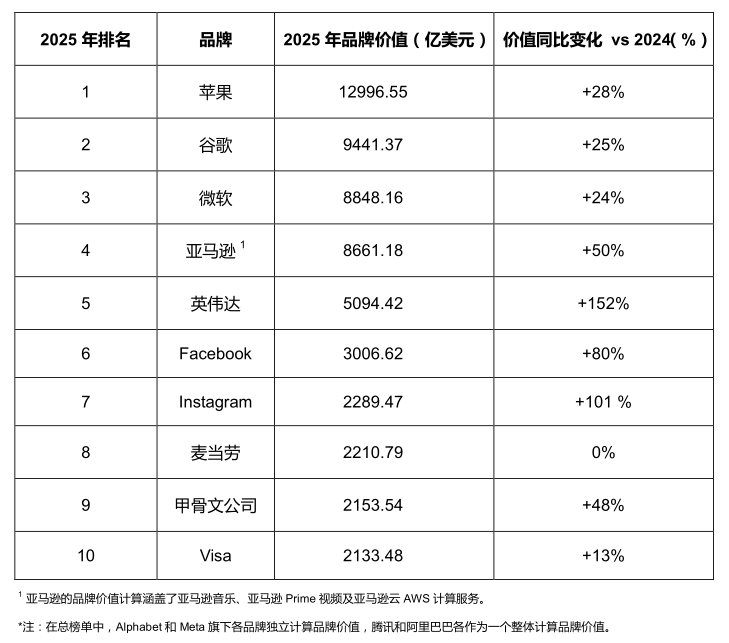
Core Insights - The total value of the top 100 global brands reached $10.7 trillion in 2025, marking a 29% year-on-year increase, primarily driven by strong performance from technology-driven brands [1][2]. Company Highlights - Apple retained its position as the most valuable brand with a value of $1.3 trillion, a 28% increase from 2024, accounting for over 12% of the total value of the top 100 brands [2][4]. - Google and Microsoft followed, with brand values of $944.1 billion (+25%) and $884.8 billion (+24%) respectively [2]. - Notable growth was observed in Nvidia, which saw a 152% increase in brand value to $509.4 billion, and Instagram, which grew by 101% to $228.9 billion [2][4]. - Chinese brands made a significant impact, with 12 brands listed and a total value increase of 26%, ranking second globally in growth [2][4]. Industry Trends - The retail sector continued its growth trend from 2022, with an overall brand value increase of 48% [4]. - In contrast, the apparel, food and beverage, and personal care sectors experienced stagnation or decline in brand value [4]. - The luxury goods sector, which had maintained growth since 2020, saw a 2% decline in 2025, possibly due to a shift in consumer preferences towards lifestyle experience products [4]. - The alcoholic beverage sector faced a significant impact from younger consumers, with a decline of 11% [4]. Brand Evolution - Since 2006, nearly 71% of the value created by the top 100 brands has come from brands that disrupt industry norms or innovate [3][5]. - The BrandZ ranking reflects the globalization of the Chinese economy, showcasing how brands that meet or redefine consumer needs have reshaped the global brand landscape [5][6].



碳酸饮料正在加速“消亡”
Xin Lang Cai Jing· 2025-05-16 02:29
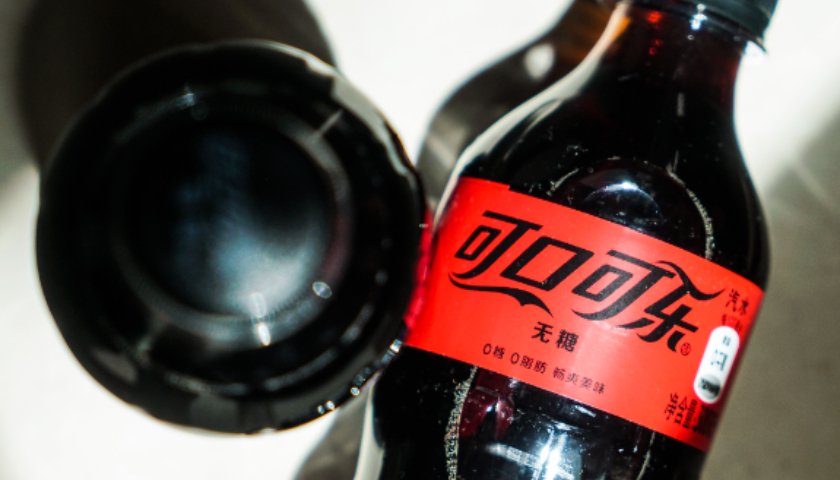
Core Insights - Coca-Cola's two major operators in China, China Foods and Swire Coca-Cola, reported disappointing performances in the past year, with Swire Coca-Cola's revenue declining by 4.02% to 11.546 billion yuan and China Foods' revenue down by 9% to 11.335 billion yuan in the first half of 2024 [1] - The overall beverage market in China grew by 6.2%, but carbonated drinks are losing popularity, with a notable shift towards healthier alternatives like ready-to-drink tea and functional beverages [2][4] - The trend towards health consciousness is evident, with 68% of consumers expressing a desire to reduce sugar intake, leading to a decline in carbonated drink consumption [4][5] Industry Performance - Swire Coca-Cola's total sales in mainland China fell by 1% year-on-year, and the number of active retail outlets also decreased by 1% [2] - PepsiCo's second-quarter revenue reached $22.5 billion, with a mere 0.8% year-on-year growth, and global sales of Pepsi declined by 3%, marking the eighth consecutive quarter of sales decline [2] - The beverage industry in China saw a production increase of 7.5% in 2024, with total revenue growing by 4.8% to 534.8 billion yuan [12] Market Trends - The market share of carbonated drinks in convenience stores has dropped from 50% to 25%, replaced by various tea drinks and sugar-free beverages [4] - The sales of sugar-free Coca-Cola grew by 11% in 2022, but the market share of sugar-free soda in convenience stores has decreased from 6.25% in Q3 2022 to 4.13% in Q2 2024 [6][7] - The sugar-free beverage market is becoming saturated, with growth rates slowing down significantly from 40% (2014-2019) to an expected 12% by 2025 [6] Consumer Behavior - Consumers are increasingly scrutinizing food labels, with 46% regularly checking ingredient lists, and the preference for sugar-free options is particularly strong among younger demographics [6] - The rise of new brands in the sugar-free segment, such as Yuanqi Forest, has led to a significant market share shift away from traditional carbonated drink giants [7][10] - The popularity of new beverage categories, including functional drinks and traditional Chinese health drinks, is on the rise, with sales of Chinese herbal drinks expected to grow by over 182% in 2024 [6] Strategic Responses - Coca-Cola is attempting to pivot from being solely a carbonated drink company to a diversified beverage brand, launching products like Simply Pop, a prebiotic soda series, and expanding into tea and coffee markets [13][10] - The company is also focusing on enhancing its presence in the food service sector, with over 25,000 new sales points and nearly 600,000 refrigeration units planned for 2024 [9] - The competitive landscape is shifting, with new brands leveraging social media and e-commerce to capture market share, particularly among younger consumers [14][15]
13F报告显示,巴菲特旗下伯克希尔哈撒韦一季度清仓花旗,减持美国银行,重仓苹果、美国运通、可口可乐、美银、雪佛龙。


news flash· 2025-05-15 20:22
Core Insights - Berkshire Hathaway, led by Warren Buffett, has completely exited its position in Citigroup during the first quarter [1] - The company has reduced its stake in Bank of America while maintaining significant investments in Apple, American Express, Coca-Cola, Bank of America, and Chevron [1] Company Actions - Berkshire Hathaway has sold all shares of Citigroup, indicating a strategic shift away from this financial institution [1] - The reduction in Bank of America holdings suggests a cautious approach towards the banking sector [1] - The firm continues to heavily invest in technology and consumer goods, with Apple and Coca-Cola being key holdings [1] Investment Strategy - The focus on maintaining large positions in Apple and American Express highlights a preference for companies with strong brand loyalty and growth potential [1] - The investment in Chevron reflects an interest in energy sector stability amidst fluctuating market conditions [1]
5月16日电,巴菲特旗下伯克希尔哈撒韦清仓花旗,减持美国银行,重仓苹果、美国运通、可口可乐、美银、雪佛龙。
news flash· 2025-05-15 20:18
智通财经5月16日电,巴菲特旗下伯克希尔哈撒韦清仓花旗,减持美国银行,重仓苹果、美国运通、可 口可乐、美银、雪佛龙。 ...
“娃哈哈纯净水由今麦郎代工”冲上热搜 代工模式在饮料行业常见吗?
Mei Ri Jing Ji Xin Wen· 2025-05-15 14:05
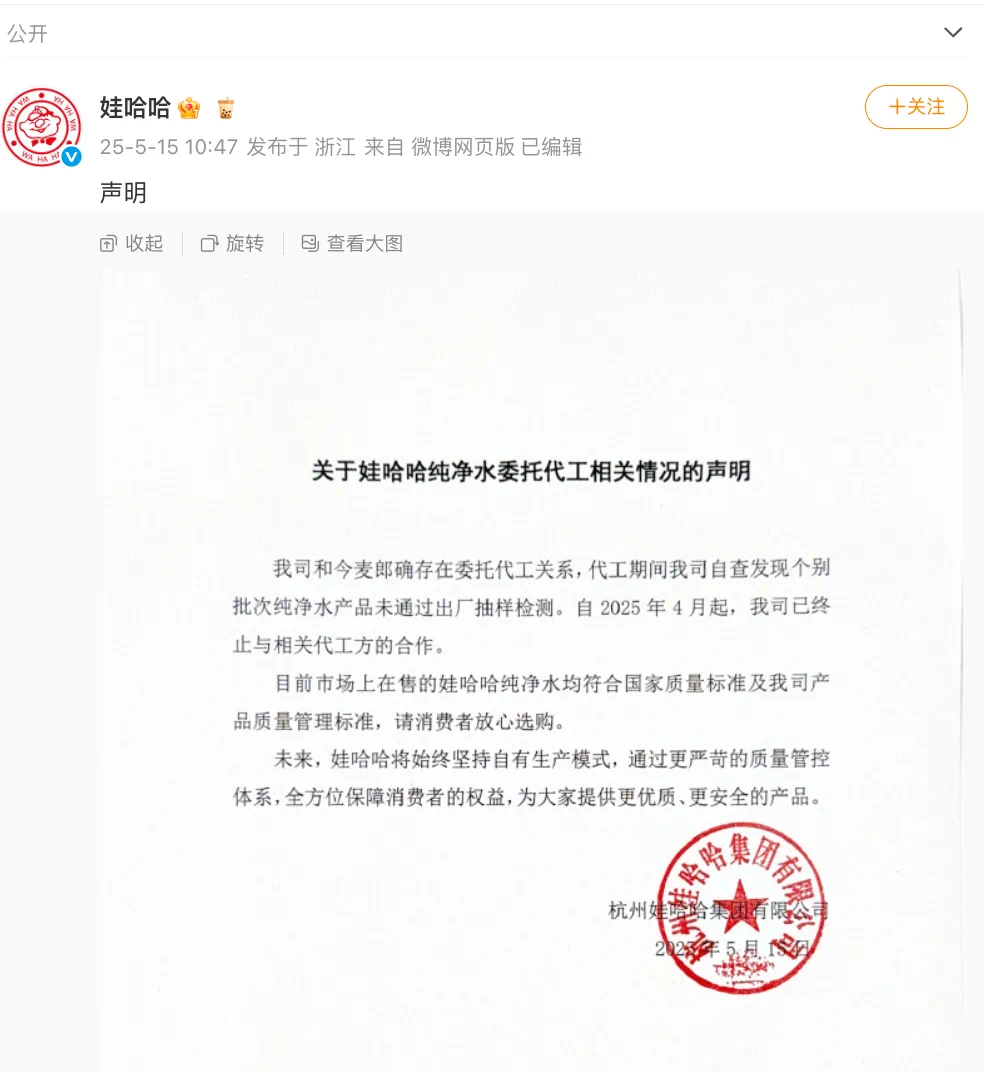
Core Viewpoint - The controversy surrounding Wahaha's bottled water being produced by Jinmailang highlights the common practice of contract manufacturing in the beverage industry, with Wahaha confirming its partnership with Jinmailang and announcing the termination of this relationship by April 2025 [1][4]. Group 1: Contract Manufacturing in the Beverage Industry - Contract manufacturing is a prevalent practice in the beverage and fast-moving consumer goods (FMCG) sectors, with many products in supermarkets being produced by third-party manufacturers [5]. - Companies like Wahaha resort to contract manufacturing when facing temporary capacity constraints, while others may use it to expand into new markets without the immediate need for their own production facilities [5][6]. - New and smaller brands often choose contract manufacturing to minimize costs and risks associated with entering the market, as establishing their own production facilities can be complex and costly [5][6]. Group 2: Major Players and Their Strategies - Major beverage companies, such as Coca-Cola and Pepsi, utilize contract manufacturing in China, partnering with local bottlers for production, which is part of their global strategy [6]. - The relationship between large companies and their contract manufacturers often evolves into a deep partnership, where manufacturers may exclusively produce for these brands [6][7]. Group 3: Advantages of In-House Production - While contract manufacturing is common, companies like Wahaha are investing in their own production facilities to ensure stable supply chains and maintain control over their products [7][8]. - Owning production facilities allows companies to protect proprietary recipes and reduce long-term costs compared to relying on contract manufacturers [7][8]. - The trend towards in-house production is evident in companies like Genki Forest, which has invested over 6 billion yuan in its own factories, moving away from contract manufacturing as their market stabilizes [7][8].


美国营养科学的悲剧
Hu Xiu· 2025-05-15 13:28
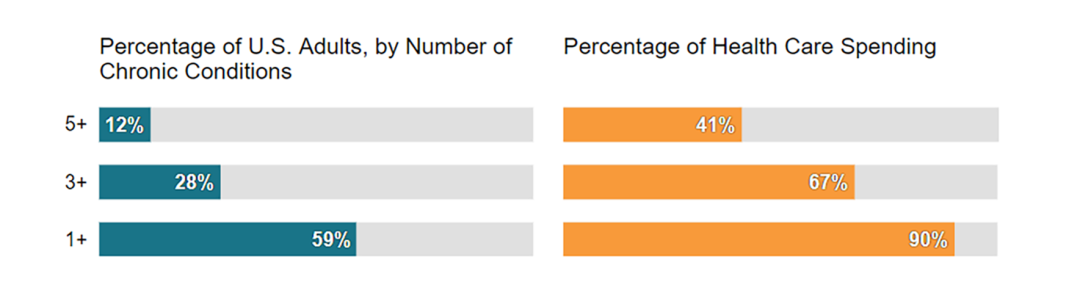
Core Argument - The article discusses the corruption of science in the United States, particularly in the fields of nutrition and health, due to the influence of big capital and military funding, which has transformed science from a creative force for human progress into a destructive one [1][2]. Group 1: Nutrition Science Critique - Nutrition science is essential for human health, yet nearly half of American adults suffer from diet-related chronic diseases, leading to significant mortality [2][3]. - A significant portion of chronic disease patients (12% of adults) accounts for over 40% of national healthcare spending [3]. - The article highlights scandals in nutrition research, such as the case of Brian Wansink, whose academic misconduct revealed deeper issues of corruption in food and health research [3][4][5]. Group 2: Government Dietary Guidelines - The U.S. government releases dietary guidelines every five years, which significantly influence American eating habits and are foundational for nutrition education and food assistance programs [8][9]. - The latest guidelines received unprecedented public attention, with 29,000 comments, indicating widespread concern over their scientific validity and potential conflicts of interest [12]. - Criticism arose regarding the reliance on data from health organizations funded by food and pharmaceutical companies, undermining the credibility of the guidelines [12][16]. Group 3: Sugar Industry Influence - Evidence suggests that the sugar industry has historically influenced nutrition and heart disease research, leading to misleading dietary recommendations [17][18]. - Internal documents reveal that the sugar industry funded research to downplay sugar's role in heart disease while promoting saturated fats as the primary culprit [17][18]. - The article emphasizes that the corruption in nutrition science has long-term implications for public health policies, contributing to the obesity epidemic in the U.S. [19]. Group 4: Corporate Influence on Research - Companies like Coca-Cola have funded research to shift blame for obesity from sugary drinks to lack of exercise, manipulating scientific discourse [20][21]. - The Global Energy Balance Network, funded by Coca-Cola, falsely claimed that obesity was primarily due to insufficient physical activity, rather than dietary intake [20][21]. - Investigations revealed that influential scientists collaborated with corporations to promote misleading scientific narratives, further complicating public health messaging [22][23]. Group 5: Nutritional Reductionism - The article critiques the reductionist approach in nutrition science, which focuses on isolated nutrients rather than whole foods, leading to misleading conclusions about health [37][41]. - This reductionism has been shaped by corporate interests, which prioritize profit over comprehensive food research, ultimately threatening public health [42].
巴菲特捡烟蒂到投资优质公司,对投资A股的启发
雪球· 2025-05-15 08:57
Investment Philosophy Evolution and Core Insights - The transition from "cigar butt" strategy to focusing on "quality companies" reflects a self-renewal of value investment theory and adaptation to market conditions and capital scale changes [2][3] - Early "cigar butt" strategy emphasized safety margin and liquidation logic, with investments based on market price being lower than liquidation value, but these companies often lacked growth potential [3][4] - The mid-term shift to "quality companies" highlighted the importance of economic moats and pricing power, exemplified by the acquisition of See's Candies, which contributed over $1.3 billion in profits [5][6] - The later phase of large-scale investment utilized low-cost long-term funds to build investment leverage, with Berkshire's cash reserves reaching $334.2 billion in 2024 [7][8] Core Insights and Investment Implications - The evolution of investment philosophy from "price" to "quality" emphasizes that intrinsic value, such as brand and management, is more decisive than short-term financial data [9] - Risk control involves a dynamic balance of leverage and scale, with a shift away from leveraged investments as capital scales increased [10] - A long-term perspective is crucial, as demonstrated by Buffett's holdings in Coca-Cola and Apple, which underline the importance of holding quality assets for compounding returns [11] Applicable Methods and Cases for A-shares - Core methodology includes selecting companies with economic moats, such as brand premium exemplified by Kweichow Moutai with a gross margin of 91.5% and ROE of 33% [12][17] - Dynamic assessment of safety margins involves evaluating low valuations with high growth potential, as seen in Hengrui Medicine, which has a dynamic PE of approximately 44 times [14] - Long-term holding and contrarian positioning are illustrated by Wuliangye, currently valued at a dynamic PE of about 8.7 times, with strong brand resilience and expected profit growth [15][16] Practical Cases - Kweichow Moutai demonstrates brand monopoly and cash flow strength, with projected revenue of 170.9 billion in 2024, reflecting a year-on-year increase of 15.7% [17][18] - Contemporary leaders in the new energy sector, such as CATL, hold a global market share of 37% in power batteries, with production capacity planned to reach 670 GWh in 2024 [19][20] - Longi Green Energy, a leader in photovoltaic technology, is expected to benefit from efficiency breakthroughs in HJT battery production [20] Conclusion - The evolution of Buffett's investment approach signifies a shift from "valuation arbitrage" to "value creation," emphasizing the focus on economic moats and dynamic valuation assessments [21] - The insights gained can guide A-share investors to select targets in consumption, healthcare, and new energy sectors, aiming for "reasonable price entry and long-term holding" to achieve compounding growth [21]