Morgan Stanley(MS)

Search documents
港股IPO“井喷”,大摩和高盛依旧是最大赢家
Hua Er Jie Jian Wen· 2025-11-30 11:41
数据显示,西方银行在今年的香港股权交易中占据了绝对优势。摩根士丹利亚太区全球资本市场主管 Saurabh Dinakar表示:"我们看到中国公司在香港的股权发行出现了相当强劲的转变。" 彭博的数据涵盖了IPO和已上市公司的后续股票发售。今年的大型交易包括全球最大电池制造商宁德时 代(CATL)46亿美元的股票增发,以及矿业公司紫金黄金(Zijin Gold)的IPO。这些交易的成功执 行,巩固了摩根士丹利和高盛在承销排行榜上的领先位置。 尽管中资券商在本土市场的影响力日益增强,但在今年香港股权资本市场的强劲复苏浪潮中,以摩根士 丹利和高盛为首的华尔街投行依然是最大的赢家,巩固了它们在亚洲金融中心交易舞台上的主导地位。 随着大量中国公司赴港融资,以及海外投资者对中国股票的兴趣重燃,香港资本市场正迎来显著复苏。 根据路透伦敦证券交易所集团(LSEG)的数据,今年迄今,在香港上市的股权资本市场(ECM)活动 总额已达到731亿美元,较2024年同期飙升232%,首次公开募股(IPO)的融资额有望创下四年来新 高。 在这场资本盛宴中,美国投行攫取了最大份额。据彭博汇编的数据,截至今年11月底,摩根士丹利在香 港的股票 ...


Global Markets Brace for Shifts: India Eyes Rebound, China Slows, Yen Volatile, and Bitcoin ETFs Surge
Stock Market News· 2025-11-30 02:38
Group 1: Market Outlook - Major Wall Street institutions forecast a significant turnaround for Indian markets in the coming year, driven by stabilizing corporate earnings, robust policy support, and increased domestic investment [2][6] - Morgan Stanley projects the Sensex could reach 107,000 by December 2026 in a bull-case scenario, while Goldman Sachs expects India to lead emerging markets with a 13% Compound Annual Growth Rate (CAGR) over the next decade [2][6] - In contrast, China's economic slowdown is deepening, with factory activity in contraction for the eighth consecutive month, as indicated by a manufacturing PMI of 49.2 [3][6] Group 2: Currency and Cryptocurrency Trends - The Japanese Yen is experiencing significant volatility, with Finance Minister Satsuki Katayama expressing urgency over its rapid swings, attributed to the Bank of Japan's ultra-loose monetary policy [4][6] - BlackRock's Bitcoin ETFs have become a top revenue source, with the iShares Bitcoin Trust accumulating $70 billion in assets since its launch in January 2024, despite experiencing $2.35 billion in withdrawals recently [5][6] Group 3: U.S. Economic and Labor Trends - In the U.S., homeowners are refinancing mortgages as rates hover near three-year lows, with a 19% increase in refinancing applications from the prior year [7] - The U.S. labor market is facing a sailor shortage, with some maritime jobs offering up to $100,000 in the first year, while research indicates that a college degree no longer guarantees faster job placement for young adults [8][9]



市场“大扫除”完毕!高盛:波动性回落+股市广度改善 美股以更清晰格局步入12月
Zhi Tong Cai Jing· 2025-11-29 00:16
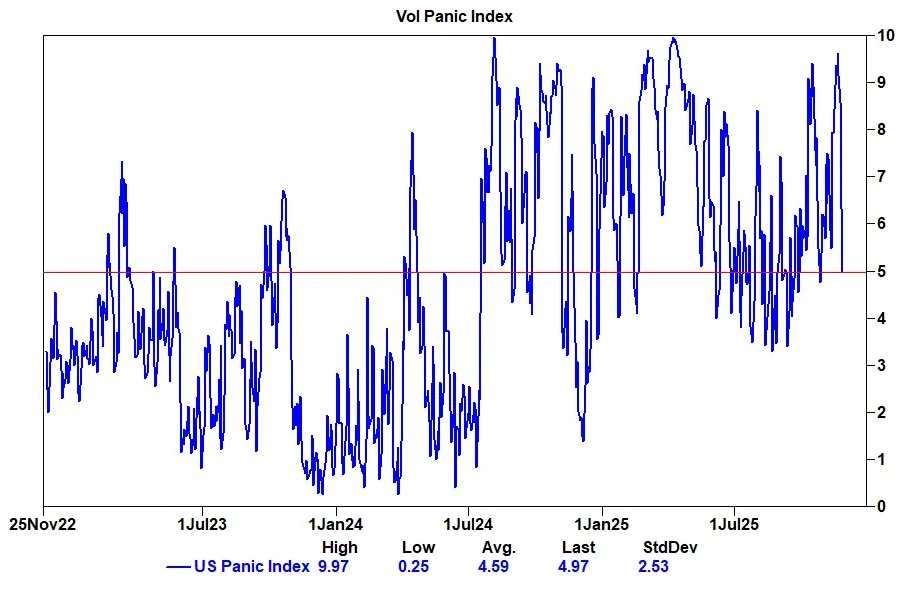
Group 1: Market Overview - The S&P 500 index ended November nearly flat, but signs of recovery are emerging as volatility decreases and market breadth improves [1] - Market breadth, measured by the five-day average of advancing and declining stocks in the S&P 500, rebounded from a low of -150 to around +150 before Thanksgiving, indicating a significant shift in market participation [1] - The "volatility panic index" is currently around 5, slightly above its three-year average and significantly lower than its peak earlier in November [1] Group 2: Systematic Strategies and Positioning - Approximately $16 billion in S&P 500-related sell-offs occurred over the past month, exacerbating previous market declines [3] - Following the market's digestion of this risk-off phase, the expectation for the upcoming month has shifted to a slight net buying scenario of about $4.7 billion [3] - Major U.S. stock indices experienced significant gains after a period of volatility, with the Dow Jones up 3.18%, S&P 500 up 3.73%, and Nasdaq up 4.91% [3] Group 3: Wall Street Outlook for 2026 - Multiple top investment banks have released forecasts for the S&P 500 index for the end of 2026, with a consensus that the index will continue to rise due to AI investment trends, a shift to accommodative monetary policy, and broadening profit growth [4] - JPMorgan and Deutsche Bank set ambitious targets for the S&P 500, with JPMorgan forecasting a target of 7,500 points, potentially exceeding 8,000 points if the Fed continues to lower interest rates [4][5] - Deutsche Bank predicts a 14% increase in earnings per share for the S&P 500 next year, driven by AI's growth potential extending beyond major tech stocks to other sectors [5][6] Group 4: Sector-Specific Insights - Analysts from Morgan Stanley express optimism about sectors such as consumer discretionary, healthcare, financials, industrials, and small-cap stocks, anticipating that the recent market sell-off is nearing its end [6] - UBS forecasts that the AI-driven market rally will persist until 2026, with a target of 7,500 points for the S&P 500, supported by strong corporate earnings growth [6] - Barclays raised its 2026 S&P 500 target to 7,400 points, citing strong performance from large tech stocks despite a sluggish macroeconomic growth environment [7]


外资抢筹中国科技资产
2 1 Shi Ji Jing Ji Bao Dao· 2025-11-28 23:29
Core Viewpoint - A significant shift in foreign investment attitudes towards Chinese technology stocks is observed, with major investment banks expressing bullish outlooks for the sector and foreign limited partners accelerating their return to China's primary market, focusing on technology investments [1][2][6]. Group 1: Positive Outlook from Foreign Institutions - UBS sets a target for the Hang Seng Tech Index at 7100 points for the end of 2026, indicating a nearly 27% upside from the closing price of 5599 points on November 28 [2]. - Morgan Stanley raises its target for the CSI 300 Index to 4840 points by December 2026, suggesting moderate growth potential amid stable valuations [3]. - JPMorgan upgrades its rating on Chinese stocks to "overweight," anticipating a higher likelihood of significant gains in the coming year due to AI proliferation and consumption stimulus [3]. Group 2: Increased Foreign Capital Inflow - Foreign capital inflow into the Chinese stock market reached $50.6 billion in the first ten months of 2025, significantly surpassing the total of $11.4 billion for 2024, marking over a threefold increase [4]. - The technology sector is highlighted as a key focus for foreign investment, with foreign holdings in the electronics sector increasing, reaching a market value of 391.5 billion yuan by September 30, 2025 [4]. Group 3: Strategic Investment Focus - Foreign institutions are primarily focusing on structural investments in sectors such as semiconductors, AI applications, and communication equipment [4][6]. - AI emerges as a central theme for foreign investment strategies, with firms like Lisi Capital and Source Code Capital establishing funds specifically targeting early-stage AI projects [7]. Group 4: Long-term Investment Logic - The shift in foreign investment sentiment towards Chinese technology stocks is viewed as a long-term strategic reassessment rather than a short-term tactical play, driven by significant advancements in technology innovation [6][8]. - Experts believe that as China's economy continues to recover and innovation accelerates, the trend of increasing foreign allocation to Chinese technology stocks is likely to persist, positioning the tech sector as a crucial market focus [8].


The market looks pretty good at least for the next 4-5 months, says Morgan Stanley's Jim Lacamp
Youtube· 2025-11-28 16:46
Market Outlook - The Nasdaq is expected to break a seven-month win streak, while the Dow and S&P aim to maintain their six-month win streaks as the year ends [1] - The market conditions are strong heading into the end of the year, with significant buying activity from hedge funds observed recently [3][4] - An 86% chance of a Federal Reserve rate cut in December is indicated by Fed funds futures, despite Morgan Stanley's skepticism [5] Inflation and Economic Indicators - Recent reports show inflation is under control, contrasting earlier signals of rising inflation [7] - The market is characterized by volatility driven by news, but overall trends remain positive, with the NASDAQ surpassing its 50-day moving average [8] Investment Strategy - Investors are advised to focus on value sectors such as financials, energy, and healthcare, which are showing relative strength [10] - Caution is recommended regarding unprofitable tech stocks and meme stocks, as the market is removing speculative elements [11] Presidential Cycle Considerations - Historically, the second year of a presidential cycle tends to see corrections starting around mid-March, but upcoming tax cuts and deregulation may mitigate this trend [13][14] - The market may experience a strong start in the new year, with potential for gains, but volatility is expected throughout [16][17] Asset Allocation - Stocks are viewed positively from an asset allocation perspective, despite the potential for a more subdued GDP growth around 2% [16][18]

The market looks pretty good at least for the next 4-5 months, says Morgan Stanley's Jim Lacamp
CNBC Television· 2025-11-28 16:46
Market Outlook - The market has been volatile and news-driven, especially in the AI space [2] - Market conditions are strong towards the end of the year and potentially through February [3] - Hedge funds have shown significant buying volume [4] - The market may experience low volatility due to the absence of major news cycles [4] - A Federal Reserve rate cut is anticipated, with Fed funds futures indicating an 86% chance [5] - The market is expected to perform well over the next four to five months [5] - GDP growth is expected to be around 2% [16] Investment Strategy - Investors should be mindful of market rotation, with value areas like financials, energy, and healthcare showing relative strength [9][10] - Technology stocks, while still showing growth, may need to consolidate [11] - Investors should avoid unprofitable tech names and meme stocks [11] - Metals are viewed positively, despite expected volatility [14] - Energy plays can satisfy both the AI growth story and the natural resources value story [15] Potential Risks and Considerations - The second year of a presidential cycle historically sees a correction, typically starting in mid-March [13] - Tax cuts and deregulation may mitigate the typical weakness in the second year of a presidential cycle [14] - The economy has "ankle weights" and will experience news-driven events that create volatility [17]

外资“唱多”中国资产,硬科技成为新坐标
2 1 Shi Ji Jing Ji Bao Dao· 2025-11-28 13:36
Core Viewpoint - Foreign institutions are showing a significant shift in attitude towards Chinese technology stocks, with major investment banks like UBS, Goldman Sachs, Morgan Stanley, and JPMorgan expressing bullish views on the sector [1][3][4]. Group 1: Market Outlook - UBS has set a target for the Hang Seng Tech Index at 7100 points for the end of 2026, representing a nearly 27% increase from the closing price of 5599 points on November 28 [3]. - Morgan Stanley has raised its target for the CSI 300 Index to 4840 points by December 2026, indicating a stable growth outlook for Chinese stocks amid moderate earnings growth [4]. - JPMorgan has upgraded its rating on Chinese stocks to "overweight," suggesting a higher likelihood of significant gains in the coming year, particularly driven by AI adoption and consumption stimulus [4]. Group 2: Foreign Capital Inflow - In the first ten months of 2025, foreign capital inflow into the Chinese stock market reached $50.6 billion, significantly surpassing the $11.4 billion for the entire year of 2024, marking an increase of over three times [5]. - The technology sector has become a focal point for foreign investment, with foreign holdings in the electronics sector increasing, reaching a market value of 391.5 billion yuan by September 30, 2025 [5]. - Notable increases in foreign investment have also been observed in the new energy sector, with holdings in CATL rising to 265.66 billion yuan, an increase of over 100 billion yuan from the previous quarter [5]. Group 3: Investment Strategies - Foreign investors are focusing on structural allocations in the technology sector, particularly in semiconductors, AI applications, and communication equipment [5][6]. - The trend of foreign limited partners (LPs) returning to the Chinese primary market is evident, with significant investments being made in the hard technology sector, especially in AI [6][7]. - AI has emerged as a core investment focus, with various funds targeting early-stage AI projects and related sectors, indicating a long-term strategic shift rather than short-term speculation [7][8]. Group 4: Future Expectations - Experts believe that the trend of increasing foreign allocation to Chinese technology stocks is likely to continue, driven by ongoing economic recovery and innovation momentum in China [8]. - The focus on AI applications, semiconductors, and electronic components is expected to attract further foreign investment, as China develops its autonomous computing ecosystem [8].


科技估值低+“反内卷”持续落地,外资行继续看涨中国股市!
Hua Er Jie Jian Wen· 2025-11-28 10:36
Core Viewpoint - Major foreign banks, including UBS, JPMorgan, and Morgan Stanley, express confidence in the Chinese stock market for 2026, driven by various factors such as "anti-involution" policies, AI development, global macroeconomic improvements, and differentiated consumer recovery [1][2]. Group 1: JPMorgan's Outlook - JPMorgan projects a target of 5200 points for the CSI 300 index by the end of 2026, indicating a potential upside of approximately 17% based on a price-to-earnings ratio of 15.9 times [2]. - In bullish scenarios, the index could reach 6010 points, while in bearish scenarios, it may drop to 4000 points [2]. Group 2: UBS's Insights - UBS anticipates that the A-share market will reach new heights in 2026, with overall profit growth expected to rise from 6% in 2025 to 8% [1][3]. - The firm highlights the relative attractiveness of A-shares, noting that the equity risk premium is significantly higher than historical averages, making it appealing compared to other markets [3]. Group 3: Morgan Stanley's Perspective - Morgan Stanley views 2026 as a "stable year" following high returns in 2025, with limited upside for indices and moderate growth in corporate earnings [5]. - The firm expects a return to higher valuation norms as China stabilizes its position in global tech competition and trade tensions ease [5]. Group 4: Key Investment Themes - The report identifies four core investment themes for 2026, including the execution of "anti-involution" policies, which are expected to enhance industry competition and improve profit margins for CSI 300 constituents [4]. - The growth of global AI infrastructure capital expenditures is projected to benefit Chinese suppliers, particularly as domestic AI commercialization progresses [4]. - A favorable global macro environment is anticipated, with looser fiscal and monetary policies in developed markets supporting Chinese companies, especially those with high export ratios [4]. - A K-shaped recovery in consumer spending is expected, benefiting both low-end and luxury sectors, presenting investment opportunities [4]. Group 5: Capital Flow Trends - UBS notes a structural shift in the capital landscape, with residents reallocating savings from real estate and low bank deposit rates towards the A-share market [6]. - Long-term capital inflows are increasing, with insurance funds' equity and fund holdings rising by 1.5 trillion yuan by the end of Q3 2025 [6]. - Initiatives aimed at enhancing the quality and investment value of listed companies, such as increased cash dividends and stock buybacks, are making A-shares more attractive to long-term investors [6].
How Is Morgan Stanley's Stock Performance Compared to Other Capital Market Stocks
Yahoo Finance· 2025-11-28 09:47
Core Insights - Morgan Stanley (MS) is a leading global financial services firm with a market cap of approximately $268.1 billion, operating across Institutional Securities, Wealth Management, and Investment Management [1][2] Financial Performance - MS shares are currently trading 2.2% below their 52-week high of $171.77, achieved on November 12, with a 12.7% increase over the past three months, outperforming the SPDR S&P Capital Markets ETF (KCE), which declined by 7.5% in the same period [3] - Over the past year, MS has risen by 27.9% and 33.6% year-to-date (YTD), while KCE has seen a 2.3% decline over the past 52 weeks and a 5.2% gain YTD [4] Business Strategy - The increase in MS shares in 2025 is attributed to a strengthened and diversified business model, with a shift towards wealth and asset management, reducing reliance on volatile capital-market revenues [5] - Consistently stronger-than-expected earnings results, driven by robust investment banking and growing client assets, have enhanced investor confidence in the firm [5] Competitive Position - Morgan Stanley is categorized as a "mega-cap stock," reflecting its significant scale and influence within the financial sector, supported by a strong competitive position and diversified revenue base [2]
摩根士丹利中国邢自强:科技创新与消费提振双轮驱动,中国经济前景可期
Xin Lang Zheng Quan· 2025-11-28 08:17
Group 1 - The conference on November 28, 2025, gathered experts and analysts to explore investment strategies through economic cycles [1] - Morgan Stanley's Chief Economist for China, Xing Ziqiang, highlighted China's significant achievements in technological innovation and its critical role in the new technological revolution [3] - The "14th Five-Year Plan" aims for high-quality and sustainable growth driven by technological innovation and domestic demand [3] Group 2 - Xing emphasized that technological innovation is the core engine of economic development, showcasing China's breakthroughs in sectors like semiconductors, green energy, artificial intelligence, and 6G during the "13th" and "14th Five-Year Plans" [3] - The "14th Five-Year Plan" also focuses on improving people's livelihoods and boosting consumption, with a target to increase the share of household consumption in GDP [4] - The plan includes a proposal to provide monthly subsidies of approximately 1,000 RMB to farmers and migrant workers, aiming to enhance consumption confidence and push household consumption beyond 10 trillion USD by 2030 [4] Group 3 - Xing proposed a "source and save" approach for fiscal sustainability, suggesting the activation of state-owned assets and optimizing fiscal expenditure to better allocate resources towards social welfare [4] - The long-term positive fundamentals of the Chinese economy remain unchanged, with technological self-reliance and domestic demand expansion expected to create new growth momentum [4] - Continuous policy consensus and deepening reforms will provide significant opportunities for global investors in the Chinese financial market [4]