XPENG(XPEV)

Search documents
12月首周国内乘用车销量承压,出海持续加速
SINOLINK SECURITIES· 2025-12-14 12:37
Investment Rating - The report suggests a focus on opportunities arising from the themes of international expansion and smart technology, particularly in the automotive sector [1]. Core Insights - Short-term domestic demand is low, with retail sales of passenger vehicles declining year-on-year. However, exports of passenger vehicles have shown strong growth, indicating that international markets will be a long-term focus for the industry [1][12]. - The smart technology and robotics sectors are accelerating, with significant advancements in intelligent driving and AI integration in vehicles [15][18]. - The report recommends investing in companies like BYD, Geely, and Li Auto for international expansion, and companies like Horizon Robotics and Top Group for smart technology and robotics [1][18]. Summary by Sections Weekly Perspective - Domestic demand is weak, with November retail sales of passenger vehicles down 15.8% year-on-year. The report notes that the expected policy incentives have not yet materialized, contributing to this decline [11]. - Passenger vehicle exports reached 594,000 units in November, a 50% increase year-on-year, indicating a robust international market [12]. Industry Data Tracking - The Shanghai Composite Index decreased by 0.08%, while the automotive index increased by 0.16% this week. Notable stock performances included Superjet Co. (+39.0%) and Huamao Technology (+28.5%) [2][19]. - In November, wholesale passenger vehicle sales were 2.991 million units, a 1.7% increase year-on-year, while new energy vehicle sales were 1.694 million units, up 17.6% [4][34]. Industry Dynamics - The report highlights the rapid development of smart technology in vehicles, with over 60% penetration of L2 and above driving assistance systems in the market. The trend towards AI-driven smart cockpits is also noted [15]. - Robotics technology is advancing, with new products being launched by domestic manufacturers, indicating a shift towards commercialization in this sector [16][18].




十大关键词回顾2025年中国汽车市场
Xin Lang Cai Jing· 2025-12-14 10:06
Core Insights - The Chinese automotive industry is undergoing a structural transformation in 2025, shifting from price competition to technology-driven growth, and from domestic focus to global expansion, marking a new development stage [1] Group 1: Price War Aftermath - The price war in the automotive industry has entered its third year, with profit margins dropping to 4.5% in the first three quarters of 2025, below the 6% average of downstream industrial enterprises [3] - There are signs of easing in the price war, indicating a shift from vicious competition to rational development, as companies recognize that quality, service, and technological innovation are essential for long-term success [3] Group 2: 60-Day Payment Terms - Major automotive companies have adopted a 60-day payment term, reflecting a significant change in the industry ecosystem and addressing long-standing payment issues that strained supply chains [6] - This shift enhances the credit system within the supply chain, allowing suppliers to invest more in innovation and quality improvement, thus fostering a healthier industry environment [6] Group 3: 5-Second Acceleration Standard - A new regulation proposes that new vehicles must achieve a 0-100 km/h acceleration time of no more than 5 seconds, marking a fundamental shift in competitive logic within the automotive industry [9] - This standard encourages companies to focus on safety, user experience, and practical technology rather than extreme performance metrics [9] Group 4: 50% Penetration Rate of New Energy Vehicles - By November 2025, new energy vehicles accounted for 53.6% of domestic passenger car sales, indicating a shift from policy-driven to market-driven growth in the sector [11] - This milestone signifies that new energy vehicles have become mainstream, reshaping the industry landscape and prompting traditional automakers to accelerate their electrification strategies [11] Group 5: Subsidy Phase-Out - The phase-out of subsidies for new energy vehicles is set to begin in 2026, transitioning the industry from reliance on government support to market-driven growth [14] - This change is expected to enhance market competition and compel companies to improve product quality and cost control [14] Group 6: New Normal in Exports - In 2025, China's automotive exports are projected to exceed 6.8 million units, maintaining the top position globally for the third consecutive year, with a significant increase in new energy vehicle exports [16] - The export model is evolving from product trade to a more integrated approach involving industry chain and technology exports [16] Group 7: Smart Driving Popularization - 2025 marks the year of smart driving technology's widespread adoption, with significant advancements in urban navigation assistance systems [19] - Regulatory measures are being implemented to ensure safety and compliance, balancing innovation with social responsibility [19] Group 8: Joint Venture Counterattack - Traditional joint venture brands are launching a "localization 2.0" strategy to regain market share in the new energy era, focusing on deep localization and embracing electrification [21] - This strategy enhances competition and provides consumers with more quality choices while integrating the supply chain into the local ecosystem [21] Group 9: Battery Safety Concerns - Battery safety issues have escalated to a regulatory priority, with new standards mandating thermal monitoring and warning systems for battery packs [24] - These regulations aim to enhance safety and accountability in the industry, pushing companies to prioritize safety investments [24] Group 10: Retreat of Hidden Door Handles - The decline of hidden door handles reflects a broader industry reconsideration of "over-design" in automotive engineering, emphasizing safety and practicality over aesthetics [27] - New regulations require mechanical release functions for door handles, signaling a shift towards user-centric design principles [27]





招聘市场回暖!脉脉高聘:字节招聘量断层领先 AI科学家平均月薪12.7万元
Mei Ri Jing Ji Xin Wen· 2025-12-14 06:22
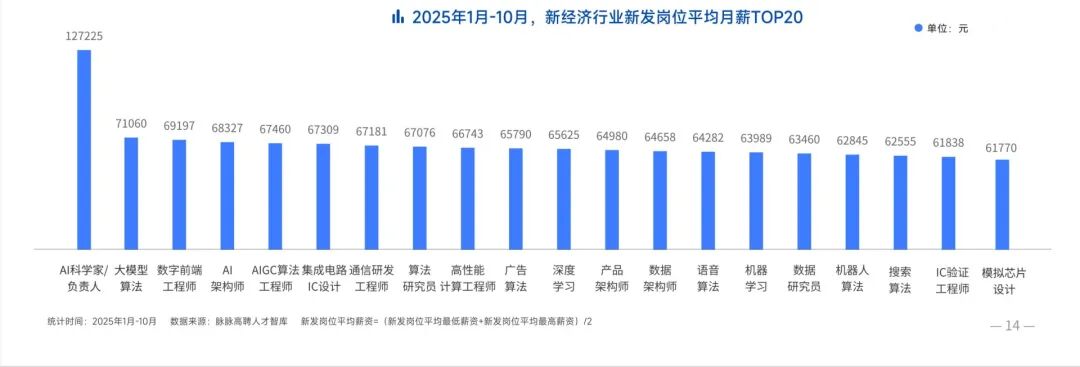
Group 1 - The report indicates that the average monthly salary for the top 20 high-paying positions in 2025 exceeds 60,000 yuan, with AI research and development roles dominating the list [1][2][3] - ByteDance leads in new job postings, followed by Meituan and Alibaba, with Tencent in fourth place and Xiaohongshu surpassing JD.com, NetEase, and Ant Group to enter the top five [1][6] - Chasing has the highest growth rate in new job postings, exceeding 300%, indicating a significant demand for talent in the AI sector [1][8] Group 2 - The job market is showing signs of recovery, with the talent supply-demand ratio in the new economy sector rising to 2.23, meaning 2.23 individuals are competing for one position [2] - From January to October 2025, the number of new AI job postings surged by 543% year-on-year, with a monthly increase of over 11 times in September alone [2] - The most in-demand technical positions in the new economy sector include algorithm engineers and large model algorithms, with high-performance computing engineers being the most scarce [2][3] Group 3 - AI positions dominate the high-paying job market, with AI algorithm engineers earning nearly 18% more than regular algorithm engineers, and AI product managers earning 20% more than their counterparts [2][3] - The average monthly salary for AI scientists/managers is 127,225 yuan, with large model algorithm positions and digital front-end engineers following closely [3][5] - Hardware technology roles such as integrated circuit design and IC verification engineers also maintain competitive salaries, reflecting the broad application of algorithm technology [5] Group 4 - The demand for AI talent is particularly strong in the smart hardware and internet sectors, with companies like Huawei, OPPO, and Xiaomi entering the top 20 for AI job demand [10] - The automotive and transportation industries, including companies like Xiaopeng Motors and Didi, are also showing significant demand for AI positions [10] - The transformation of organizational structures in the AI era is emphasized, with a call for HR to embrace advanced AI tools and redefine operational efficiency [10]


【策略报告】智能汽车2026年策略报告:L4 RoboX爆发元年!
东吴汽车黄细里团队· 2025-12-13 15:42
Group 1 - The article discusses the evolution of the intelligent driving industry over the past decade, identifying it as a 0-1 introduction phase characterized by iterative development of hardware and software, with each major upgrade representing a paradigm shift [4][11][17] - The industry is segmented into three phases: 2015-2017 as the initial investment phase with high valuations for any involvement in intelligent driving; 2018-2019 as a downturn period with limited domestic alternatives; and 2020-2022 as a phase where companies like Tesla thrived due to hardware advancements [4][11][28] - The current phase from 2023-2025 is described as a "dark before dawn" period, lacking major trends but presenting annual opportunities, with a shift from an electric vehicle pricing model to an AI-driven pricing model [5][11][12] Group 2 - The outlook for the next five years (2026-2030) emphasizes 2026 as a pivotal year for intelligent driving, marking the transition to a B-end commercial model for autonomous vehicles, while consumer adoption is expected to ramp up by 2028 [6][46] - Key drivers for investment opportunities in L4 RoboX include advancements in technology, cost reductions in vehicle BOM and intelligent driving kits, and regulatory support for L4 licenses in major cities [6][8][46] - The article outlines a new valuation framework for intelligent driving, focusing on the revenue-generating capacity of intelligent vehicles based on their ownership and capability levels [6][8][46] Group 3 - The article highlights the differences in the 2026 market compared to previous years, noting a stronger emphasis on AI logic over automotive logic, and a shift in focus from hardware opportunities to software breakthroughs [7][14] - Important catalysts for 2026 include model iterations from major players like Tesla and Xiaopeng, the rollout of RoboX services, and the introduction of new national standards for L3-L4 vehicles [8][14] - Investment strategies should prioritize B-end software companies over C-end hardware firms, with specific recommendations for stocks in both H-shares and A-shares markets [8][14]

智能汽车2026年策略报告:L4RoboX爆发元年-20251213
Soochow Securities· 2025-12-13 07:52
Group 1 - The report identifies 2026 as a pivotal year for intelligent driving, marking the transition to a commercial model for B-end autonomous vehicles, with a potential explosion in C-end adoption expected by 2028 [3][45] - Three core drivers for L4 RoboX investment opportunities are highlighted: technological advancements, cost reductions, and operational improvements, particularly in first-tier cities [3][6] - The report proposes a new valuation framework for L4 RoboX, emphasizing the revenue-generating capacity of intelligent vehicles based on their ownership and capability levels [3][6] Group 2 - The past decade of intelligent driving is characterized as a 0-1 introduction phase, with significant hardware and software iterations leading to major capability upgrades [4][11] - The report outlines three distinct phases of intelligent driving development from 2015 to 2025, detailing the evolution from initial high valuations to a focus on performance and software opportunities [4][21] - The transition from hardware-centric to software-centric investment strategies is emphasized, with a shift towards AI-driven pricing models for intelligent vehicles [4][32] Group 3 - Key catalysts for 2026 include significant model iterations from major players like Tesla and Xiaopeng, as well as the acceleration of RoboX deployments by various companies [7][45] - The report suggests a focus on B-end software companies over C-end hardware companies for investment, highlighting specific stocks in both H-shares and A-shares markets [7][45] - The RoboX commercial model is expected to rely on a combination of technological breakthroughs, cost management, and effective operational strategies, including regulatory support [65][66] Group 4 - The report outlines the expected market dynamics for intelligent driving from 2026 to 2030, predicting a shift towards a new pricing system that values results over processes [47][48] - The intelligent vehicle market is anticipated to undergo significant transformations, with RoboX expected to redefine the automotive landscape and create new revenue streams [47][61] - The report emphasizes the importance of hardware sales as a precursor to software monetization in the intelligent vehicle sector, advocating for a focus on user value creation [51][53]
“卖车须明码标价”,市场监管总局征求意见:不得用虚假“市场价”“厂商指导价”等进行宣传!比亚迪小鹏北汽迅速响应
新浪财经· 2025-12-13 07:39
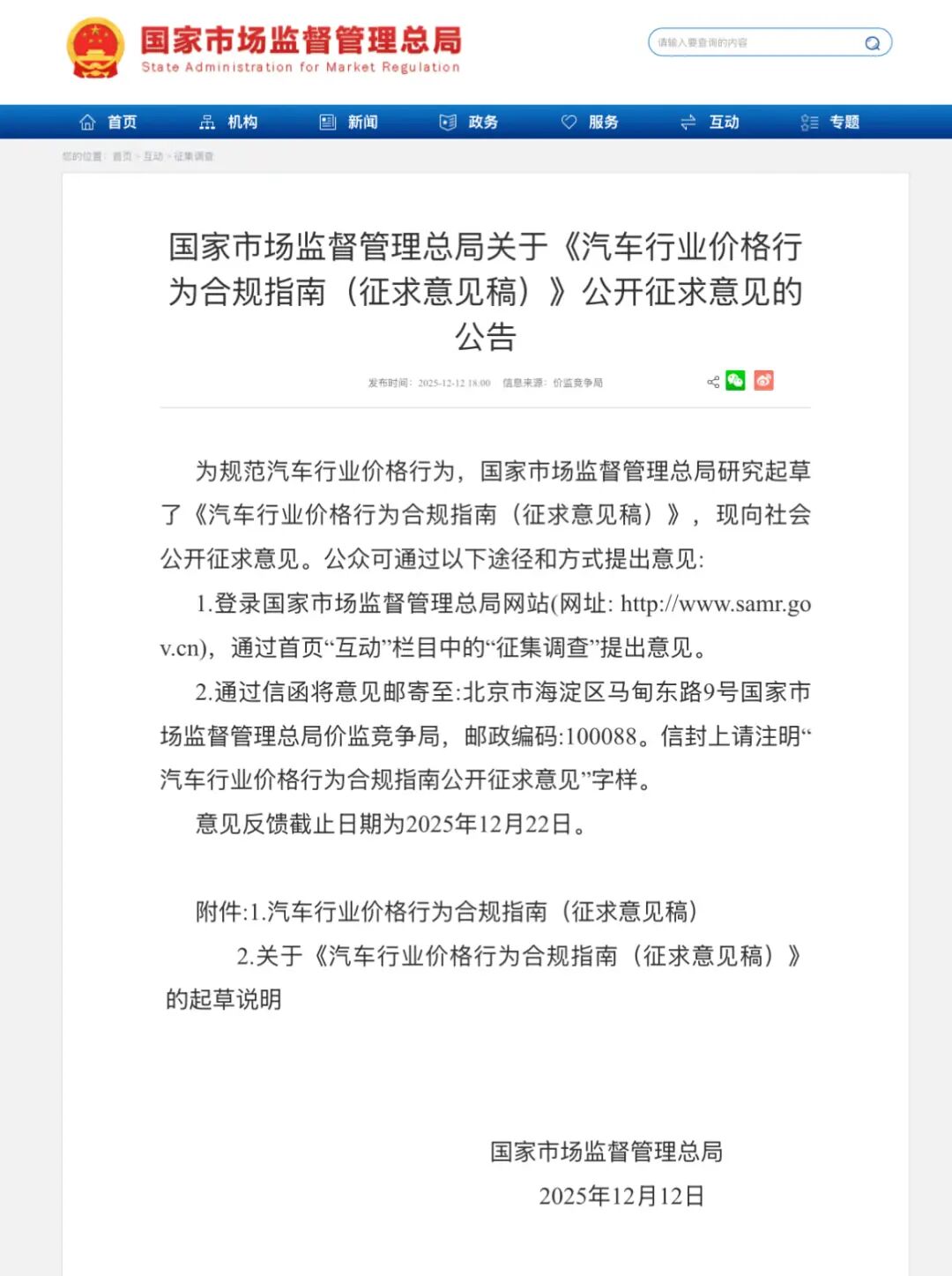
Core Viewpoint - The article discusses the draft of the "Automotive Industry Price Behavior Compliance Guidelines," which aims to standardize pricing practices in the automotive sector and ensure compliance with legal regulations [2][13]. Group 1: Overall Principles and Requirements - The guidelines consist of five chapters and 28 articles, outlining the purpose, basis, and scope of application, while encouraging industry associations to enhance self-discipline [2]. - The guidelines emphasize the need for fair pricing practices and compliance with legal standards, aiming to prevent unlawful pricing behaviors [14]. Group 2: Pricing Behavior Norms for Automotive Manufacturers - Manufacturers are required to implement comprehensive price management covering all aspects from vehicle sales to financial services [3]. - Clear and transparent promotional and pricing behaviors are mandated, including well-defined rebate policies and respect for dealers' pricing autonomy [3][14]. - The guidelines prohibit unfair pricing practices, such as price discrimination among similar trading conditions and collusion between manufacturers [5][14]. Group 3: Requirements for Automotive Sales Enterprises - Sales enterprises must ensure transparent pricing, including clear labeling of prices and services, and must not engage in misleading promotional practices [5][15]. - The guidelines specify that sales enterprises should not use deceptive pricing methods to mislead consumers, including false comparisons and unfulfilled pricing commitments [7][15]. - A risk warning mechanism is encouraged to alert consumers about significant price discrepancies [8]. Group 4: Internal Compliance Management - Automotive companies are advised to establish a systematic internal price compliance management framework to prevent pricing violations [10]. - The guidelines outline six core mechanisms for price management, including decision-making, contract management, and risk prevention [10]. - Continuous improvement and adherence to legal changes are emphasized to ensure effective execution of compliance measures [10]. Group 5: Industry Response - BYD has expressed its commitment to adhere to the guidelines, focusing on optimizing its pricing management and compliance systems [16][17]. - BAIC Group supports the guidelines, aiming to create a unified and competitive market environment while ensuring compliance in pricing practices [18]. - XPeng Motors has also shown strong support for the guidelines, pledging to enhance transparency and compliance in its pricing and sales processes [20].


何小鹏立“赌约”:明年8月底前达到特斯拉FSD效果
Mei Ri Jing Ji Xin Wen· 2025-12-13 06:46
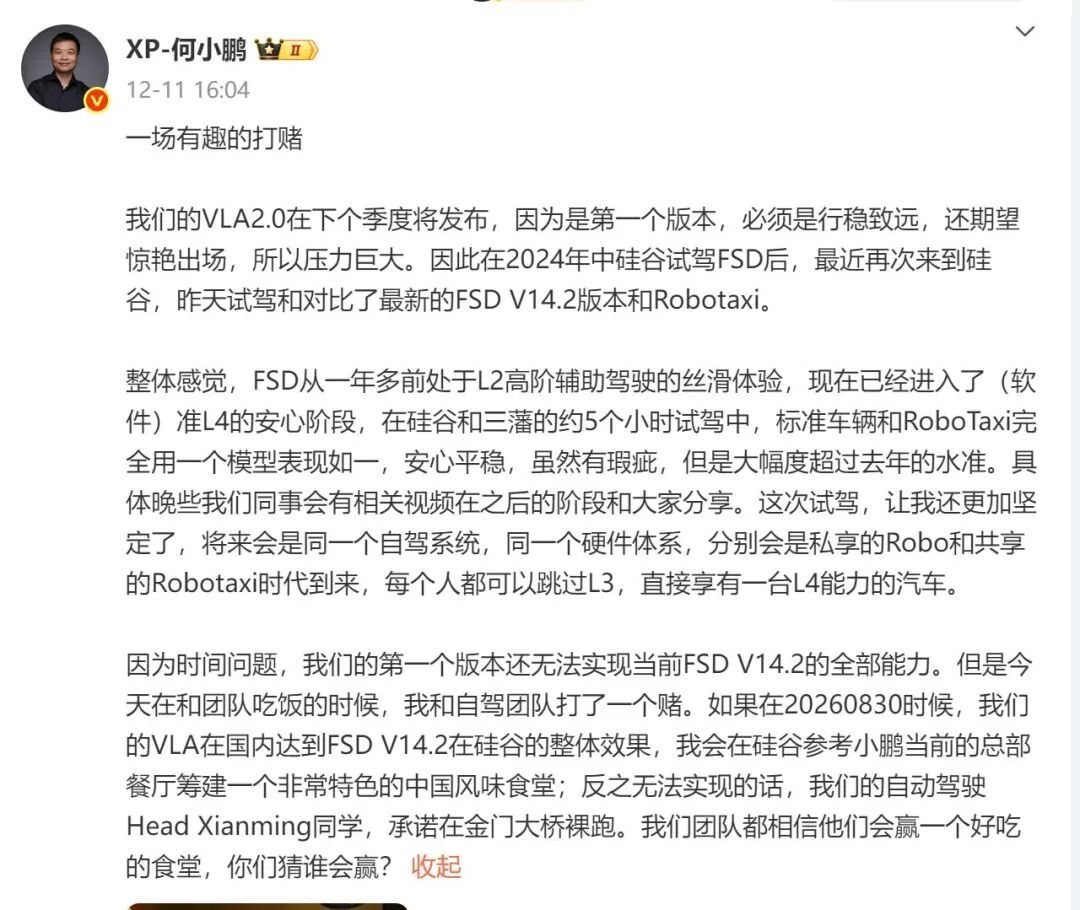
Core Viewpoint - Xiaopeng Motors is set to release its VLA 2.0 (Vision-Language-Action) model in the next quarter, with significant pressure on its first version [1] - A bet was placed by Xiaopeng's chairman with the autonomous driving team, aiming to match Tesla's FSD V14.2 performance by August 30, 2026, or face a challenge [1] Group 1: VLA Model and Industry Perspectives - The VLA model is seen as an advanced end-to-end solution, integrating visual perception (V), action execution (A), and a language model (L) to enhance decision-making and environmental understanding [5][11] - The industry has shifted from relying on LiDAR and high-precision maps to adopting AI-driven models like VLA, with a notable divergence in development paths emerging by 2025 [4][11] - Li Auto's VP emphasized the importance of real-world data over model architecture, asserting that VLA is the best solution due to their extensive data collection from millions of vehicles [6][8] Group 2: Diverging Technical Approaches - Huawei's approach focuses on the World Action (WA) model, which bypasses the language processing step, aiming for direct control through visual inputs [8][10] - The World Model concept allows AI systems to simulate the physical world, enhancing predictive capabilities and decision-making in autonomous driving [9][11] - Companies like NIO and SenseTime are also exploring the World Model approach, indicating a broader industry trend [10] Group 3: Future Integration and Evolution - There is a growing trend towards integrating VLA and World Models, with both technologies not being mutually exclusive but rather complementary [11][12] - Xiaopeng's second-generation VLA model aims to combine VLA and World Model functionalities, enhancing data training and decision-making processes [14][15] - The automotive industry anticipates further iterations in autonomous driving technology architecture over the next few years, potentially stabilizing by 2028 [15]

中汽协解读!比亚迪、小鹏等车企表态
Shang Hai Zheng Quan Bao· 2025-12-13 06:35
Core Viewpoint - The National Market Supervision Administration has drafted the "Guidelines for Compliance of Pricing Behavior in the Automotive Industry" to standardize pricing practices in the automotive sector, focusing on compliance from vehicle production to sales behavior [1][4]. Group 1: Guidelines Overview - The guidelines detail pricing behavior norms for automotive manufacturers, covering all aspects from vehicle production to parts sales and pricing strategies [4]. - Key components include full-process price management, clear promotional and pricing behaviors, legal actions against unfair pricing, restrictions on price discrimination, and regulations on parts and service fees [5]. Group 2: Industry Response - The China Automotive Industry Association emphasizes the need for manufacturers to establish internal compliance mechanisms to avoid irrational competition and protect brand integrity [6]. - BYD and other automotive companies have publicly committed to adhering to the guidelines, ensuring consumer protection and promoting fair competition [7][11]. - Companies like Xiaopeng Motors and BAIC Group have also expressed their support, pledging to enhance their pricing management and compliance systems [11][12]. Group 3: Industry Challenges - The automotive industry has faced severe "involution" competition, negatively impacting overall profitability, with the sales profit margin recorded at 3.9% in October 2025, the lowest in five years [15].
何小鹏立“赌约”:明年8月底前达到特斯拉FSD效果!理想高管回应宇树王兴兴质疑,多家车企押注的VLA,靠谱吗?
Mei Ri Jing Ji Xin Wen· 2025-12-13 06:31
Core Viewpoint - Xiaopeng Motors is set to release its VLA 2.0 (Vision-Language-Action) model in the next quarter, with significant pressure on its development as it is the first version [1] Group 1: VLA Model Development - Xiaopeng's chairman, He Xiaopeng, has made a special bet with the autonomous driving team, promising to establish a Chinese-style cafeteria in Silicon Valley if the VLA system matches Tesla's FSD V14.2 performance by August 30, 2026 [3] - The VLA model is seen as an advanced end-to-end solution, integrating visual perception, action execution, and language processing to enhance decision-making capabilities [7][12] - The VLA model aims to overcome traditional model limitations by incorporating a reasoning chain through language models, enhancing its adaptability to complex driving environments [7][12] Group 2: Industry Perspectives - There is a divergence in the industry regarding the development paths of VLA and world models, with companies like Li Auto and Xiaopeng favoring the VLA approach [6][12] - Li Auto's VP, Lang Xianpeng, emphasizes the importance of real-world data in developing effective autonomous driving systems, arguing that the VLA model is superior due to its data-driven approach [8][9] - Huawei and other companies are pursuing a world model approach, which focuses on direct control through visual inputs without the intermediary language processing [9][10][11] Group 3: Future Integration and Trends - Despite differing opinions, VLA and world models are not mutually exclusive and may increasingly integrate as both technologies evolve [12][17] - The future of autonomous driving technology is expected to see further iterations and stabilization by 2028, with a potential convergence of VLA and world model methodologies [17]

比亚迪、小鹏、北汽,集体表态
中国基金报· 2025-12-13 05:27
Core Viewpoint - The National Market Supervision Administration has released a draft guideline for price behavior compliance in the automotive industry, aiming to establish clear standards for pricing practices and enhance fair competition within the sector [2][3]. Group 1: Guidelines Overview - The draft guideline consists of five chapters and 28 articles, detailing compliance requirements for price behavior from vehicle production to sales, including pricing strategies and sales practices [3][6]. - It emphasizes the need for automotive sales enterprises to adhere to clear pricing and avoid misleading promotions, addressing significant issues in new car sales [6]. Group 2: Industry Response - Multiple automotive companies, including BYD and Xpeng Motors, have expressed their support for the guideline, committing to enhance their pricing management and compliance systems in line with the new standards [5][9][11]. - BYD stated that the guideline provides clear guidance for maintaining fair competition and protecting consumer rights, while also promoting sustainable development in the industry [7][9]. - Xpeng Motors pledged to ensure transparency and compliance in all pricing and sales processes, reinforcing consumer rights against price fraud and unfair competition [11]. Group 3: Association Insights - The China Association of Automobile Manufacturers highlighted the importance of legal and compliant operations, urging companies to establish robust internal price compliance mechanisms to prevent irrational competition and protect brand integrity [13]. - The association noted that adhering to these guidelines can enhance consumer trust and promote a healthy competitive environment in the automotive industry [13].