
XPENG(XPEV)

Search documents
AI智能汽车2月投资策略:北美L4或松绑,第三方智驾供应商多点开花,看好智能化
Soochow Securities· 2026-02-04 13:13
Core Conclusions - The report highlights a potential loosening of regulations for L4 commercialization in North America, with discussions to increase the annual deployment limit of vehicles without traditional controls from 2,500 to 90,000 [2] - The report emphasizes the importance of monitoring the outcomes of the U.S. hearings and the potential unification of federal and state regulations, as well as the initial operational safety and reliability of Tesla's no-safety-driver Robotaxi service launched in Austin [2][11] - Investment recommendations favor B-end software companies over C-end hardware companies, with specific stock picks in both H-shares and A-shares [2] AI Smart Car Investment Framework - The report outlines a spiral upward iteration of hardware and software, indicating that each significant capability upgrade represents a paradigm shift in thinking [7] - The timeline for L1 to L4 development is projected, with significant advancements expected by 2030, particularly in the areas of E/E architecture upgrades and high-computing chips [8][10] L4 RoboX Monthly Tracking - Tesla's Robotaxi business is rapidly advancing, particularly in Austin, with plans for expansion into other regions like California and New York [22] - The report details the growth of Tesla's Robotaxi fleet, with a notable increase in operational area from 20 square miles to 243 square miles in Austin [24] - Comparatively, Waymo's operational area expansion is characterized by a more gradual approach, with a broader geographic footprint but less rapid growth in individual regions [25] L2-L3 Smartization C-end Monthly Tracking - The report forecasts a total retail sales volume of 22 million vehicles in 2026, reflecting a year-on-year decrease of 3.2% [39] - It provides detailed projections for passenger car sales, including a breakdown of domestic and new energy vehicle sales, with expected penetration rates for new energy vehicles reaching 60% by 2026 [39][41] Smartization Supply Chain Tracking - The report identifies key players in the smart vehicle supply chain, including B-end unmanned vehicle manufacturers and core upstream suppliers such as chip manufacturers and sensor providers [2] - It emphasizes the importance of collaboration between technology providers and vehicle manufacturers to enhance the overall smart vehicle ecosystem [20]


小鹏汽车-W发行7170股A类普通股以满足限制性股份单位
Zhi Tong Cai Jing· 2026-02-04 11:14
小鹏汽车-W(09868)发布公告,根据于2020年6月28日采纳及2020年8月20日获本公司股东批准的2019年 股权激励计划以及根据于2025年3月18日采纳及2025年6月27日获本公司股东批准的2025年股份激励计划 而发行7170股A类普通股以满足限制性股份单位。 ...
小鹏汽车(XPEV):跟踪报告:1月销量承压,静待AI应用场景逐步兑现
EBSCN· 2026-02-04 11:08
2026 年 2 月 4 日 公司盈利预测与估值简表 公司研究 1 月销量承压,静待 AI 应用场景逐步兑现 ——小鹏汽车(XPEV.N)跟踪报告 要点 1 月交付量数据披露:2 月 1 日小鹏汽车披露 1 月交付量数据,1 月小鹏汽车交 付量同比-34.1%/环比-46.6%至 20,011 辆。我们判断,小鹏汽车 1 月销量承压 主要由于补贴政策退坡、新老产品切换导致。 一车双能战略升级,关注四大物理 AI 产品量产落地:1 月 8 日小鹏召开 2026 全球新品发布会,以"AI 驱动全球化出行革新"为核心,1)正式发布四款新车: 2026 款 P7+(纯电+超级增程)、G7 超级增程、2026 款 G6、2026 款 G9,其 中,P7+与 G7 首次引入超级增程版本;2)宣布 2026 年小鹏品牌规划,主要包 含第二代 VLA(实现从视觉信号到动作指令的端到端直接生成,预计 1Q26E 上 车)、Robotaxi(搭载第二代 VLA 并已通过第三方测试机构场地测试,将于 2026 年开启运营)、人形机器人(量产版已完成首台下线测试,将于 2026 年规模量 产)、飞行汽车(将于 2026 年规模量产) ...
小鹏汽车(09868) - 翌日披露报表
2026-02-04 11:03
FF305 翌日披露報表 (股份發行人 ── 已發行股份或庫存股份變動、股份購回及/或在場内出售庫存股份) 表格類別: 股票 狀態: 新提交 公司名稱: 小鵬汽車有限公司(於開曼群島註冊成立以不同投票權控制的有限公司) 呈交日期: 2026年2月4日 如上市發行人的已發行股份或庫存股份出現變動而須根據《香港聯合交易所有限公司(「香港聯交所」)證券上市規則》(「《主板上市規則》」)第13.25A條 / 《香港聯合交易所有限公司GEM證券 上市規則》(「《GEM上市規則》」)第17.27A條作出披露,必須填妥第一章節 。 | 第一章節 | | | | | | | | --- | --- | --- | --- | --- | --- | --- | | 1. 股份分類 不同投票權架構公司普通股 | 股份類別 | A | 於香港聯交所上市 | 是 | | | | 證券代號 (如上市) 09868 | 說明 | A類普通股 | | | | | | A. 已發行股份或庫存股份變動 | | | | | | | | | | 已發行股份(不包括庫存股份)變動 | 庫存股份變動 | | | | | 事件 | 已發行股份(不包括 ...
小鹏云端实战验证,真武810E全面赋能国产智驾训推
NORTHEAST SECURITIES· 2026-02-04 10:14
Investment Rating - The industry investment rating is "Outperform the Market" [6] Core Insights - The launch of the "Zhenwu 810E" AI chip by PingTouGe has enabled over 400 clients, including Xiaopeng Motors, showcasing a comprehensive self-research layout from top-tier chips to cloud and large models [1] - The collaboration between Xiaopeng Motors and Alibaba Cloud has established the largest autonomous driving computing center in China, significantly reducing the training time for autonomous driving models from 7 days to under 1 hour [2] - The Zhenwu 810E chip addresses critical needs in autonomous driving training with massive memory and strong interconnect capabilities, supporting large model training essential for advanced AI applications [4] Summary by Sections Industry Overview - The report highlights the rapid development of domestic autonomous driving computing capabilities, with a focus on the Zhenwu 810E chip's deployment in large-scale clusters [1][4] Market Data - The industry comprises 461 constituent stocks with a total market capitalization of 78,455 billion, a circulating market value of 40,598 billion, and an average price-to-earnings ratio of 61.45 [4] Performance Metrics - The absolute returns over 1 month, 3 months, and 12 months are 6%, 6%, and 57% respectively, indicating strong performance relative to the market [6]

小鹏押注“物理AI”
Hua Er Jie Jian Wen· 2026-02-04 09:43
2026年开年,小鹏汽车的组织变革比往年来得更猛烈一些。 2月3日,华尔街见闻了解到,小鹏正式将自动驾驶中心与智能座舱中心进行战略性合并,新部门被命名 为——通用智能中心。小鹏方面向华尔街见闻表示:"这一调整属实。" 例如,当系统感知到驾驶员疲劳时,不再只是座舱屏幕提醒,还能联动智驾系统主动降低车速、调整行 车路线。遇到道路施工时,智驾系统自动避让的同时,座舱可能会同步播报路况信息,甚至可以调整空 调和音乐,提供连贯的智能体验。 前述两个部门原本为并行的一级部门,调整之后,原自动驾驶业务负责人刘先明,被委任为该中心的一 号位,直接向董事长兼CEO何小鹏汇报。 在外界看来,这或许只是一次普通的资源整合,但行业人士眼中,这标志着小鹏汽车正式终结了过去十 年智驾与智舱双轨并行的研发范式,全面切换至以物理AI为核心的单轨驱动时代。这也是眼下一众车 企发力的方向。 长期以来,智能汽车的软硬件架构被划分为智驾和智舱两块高地。在小鹏的研发序列中,自动驾驶中心 负责"手脚和眼睛",智能座舱中心负责"嘴巴和耳朵"。尽管这种分工在早期能确保业务专业性,但随着 端到端大模型的普及,两者的界限正变得模糊。 在传统的分布式架构下,智驾 ...
7年贷+减配,买车“套路”大揭秘
3 6 Ke· 2026-02-04 08:51
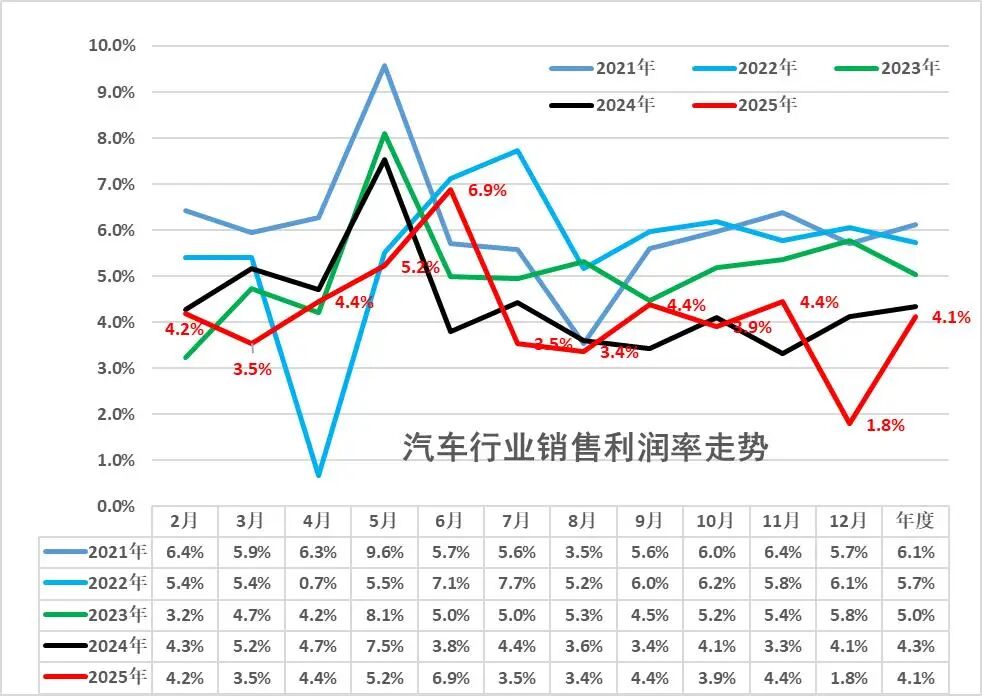
20多个品牌、超75款车疯狂促销。2026年刚开年,车圈就跟打了鸡血一样!什么"现金直降"、"零首付开走"、"月供一千三"的广告满天飞,好像不买就亏 了。 这波热闹促销的背后,其实藏着一个让行业都沉默的数据:去年12月,整个汽车行业的销售利润率,只剩下1.8%了。 什么概念?比去年同期直接腰斩, 甚至低于很多保本理财的收益。 数据来源:崔东树 就算看全年,平均利润4.1%,也是连续两年趴在地板上,低于工业平均的5.9%。 车是越造越多,2025年产了3478万台,增长10%,但"增产不增利",终究是压着车企喘不过气。 那么问题来了:利润都去哪了?车企为了活下去,使出的招数会不会影响我们买车? 三座大山压垮车企 利润薄得像张纸,有哪些大山正在压垮车企? 第一座山:原材料大涨。 来看瑞银刚出的这份研报,过去三个月,铝价涨了,单车成本多出约600块;铜价涨了,又多出1200块。但这都是小头,波动最大的是锂,一辆装80度电 池的纯电车,光锂成本就涨了约3800元! 仅金属部分,一辆电车成本就多出5600元。 你以为这就完了?更狠的还在后面——内存。 蔚来李斌之前预警得一点没错:到2026年,车企最大的成本压力可能不是 ...



Automakers in China roll-out longer-term financing plans to spur demand
Reuters· 2026-02-04 08:49
Automakers in China are extending repayment terms for customers to as long as eight years to woo consumers amid stagnant demand in the world's largest auto market. ...

【新能源】2026年1月新能源乘用车厂商批发销量快讯
乘联分会· 2026-02-04 08:31
Core Viewpoint - The article predicts a 25% growth in sales for Chinese new energy passenger vehicle manufacturers by 2025, aligning with the growth expectations set for the "14th Five-Year Plan" period [2]. Group 1: Market Predictions - The end of the new energy vehicle purchase tax exemption policy in December 2025 is expected to lead to a recovery period in January 2026, with some consumers likely to make purchases in December to benefit from the policy [2]. - January 2023 saw a decline of 8% in new energy vehicle sales due to the withdrawal of subsidies, while January 2024 experienced a positive growth despite the anticipated policy changes [2]. - The late timing of the 2026 Spring Festival and contributions from exports have positively influenced January's sales performance [2]. Group 2: Sales Data - According to the latest data from the Passenger Car Association, manufacturers with sales exceeding 10,000 units in December accounted for 93% of the total new energy passenger vehicle wholesale sales for that month [3]. - Preliminary data for January indicates that these manufacturers achieved sales of 830,000 units, leading to an estimated total of 900,000 new energy passenger vehicles sold nationwide in January, reflecting a 1% year-on-year growth [4][3]. Group 3: Leading Manufacturers - Key manufacturers such as GAC Aion, XPeng Motors, and Great Wall Motors reported significant sales figures in January, with GAC Aion leading at 21,635 units sold [8]. - Other notable performances include XPeng Motors with 20,011 units, Great Wall Motors with 18,019 units, and FAW Hongqi with 8,265 units [8]. - The total estimated sales for manufacturers exceeding 10,000 units in January amounted to 832,461, representing 93% of the total market share for that month [8].





登春晚、进工厂!车企“造人”从技术演示进入量产冲刺阶段
Xin Lang Cai Jing· 2026-02-04 08:29
Group 1 - The automotive industry is undergoing a transformation with the integration of "vehicles, people, and machines," leading to a significant shift towards intelligent robotics [1] - The "Wuyou" AI traffic management robot by Moja Robotics has officially started operations, collaborating with traffic police to manage traffic and identify violations [1] - Xiaopeng Motors has merged its autonomous driving and smart cockpit departments into a new General Intelligence Center, indicating a strategic focus on AI in automotive and robotics [1][2] Group 2 - Tesla's third-generation humanoid robot, Optimus V3, is set to be mass-produced, with an expected annual output of one million units, showcasing a shift from demonstration to production in the humanoid robot race [2] - Over twenty automotive companies globally are investing in humanoid robotics, with some already integrating these robots into their factories [2] - Li Auto has confirmed a leadership change to focus on humanoid robotics, with new job postings indicating a push for expertise in embedded software and motor development [2] Group 3 - Seres has established a new company focused on intelligent robotics and AI software development, marking its entry into the "automotive + AI + robotics" ecosystem [3] - Morgan Stanley has significantly raised its forecast for humanoid robot sales in China, predicting a 133% year-on-year increase to 28,000 units in 2023, with long-term projections reaching 260,000 units by 2035 [3] Group 4 - The automotive manufacturing sector is seen as a key area for the application of embodied robots due to its large scale and established automation [4] - Challenges remain for the integration of embodied robots in automotive manufacturing, including the maturity of core technologies and high operational costs [4] - The application of embodied robots in the automotive sector is expected to accelerate, driven by policy, market demand, and technological advancements [4]