XPENG(XPEV)

Search documents
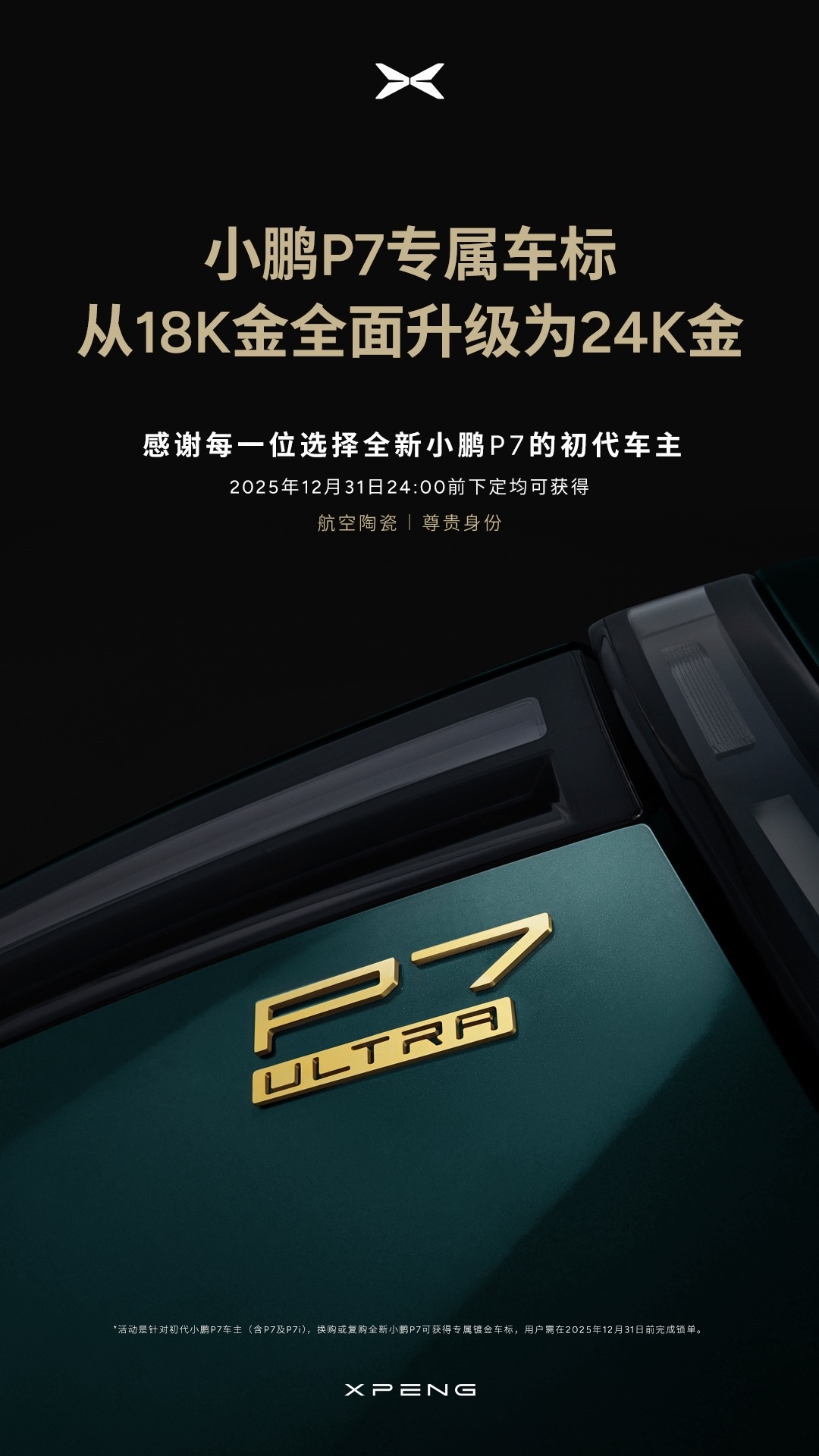
全新小鹏 P7 专属车标免费从 18K 金升级为 24K 金
Xin Lang Cai Jing· 2025-11-25 05:22
Group 1 - The core message of the article highlights the launch and promotional activities surrounding the new XPeng P7, targeting existing P7 owners for trade-in or repurchase incentives [3][6][12] - The new XPeng P7 was officially launched on August 27, featuring three configurations: 820km ultra-long range, 750km high-performance, and 702km long range, all equipped with an 800V architecture and 5C battery, achieving 0-100 km/h acceleration in 3.7 seconds [6][9] - The pricing for the new XPeng P7 models is as follows: 702km long range at 219,800 yuan, 820km ultra-long range at 239,800 yuan, 750km four-wheel drive high-performance at 259,800 yuan, and the four-wheel drive Pengyi model at 301,800 yuan, with various limited-time offers on features [8][9] Group 2 - XPeng Motors announced the production of the 10,000th unit of the new XPeng P7 in September, indicating strong demand and production capability [11] - The company has also started delivering orders for the co-pilot zero-gravity seats, enhancing the comfort of the new XPeng P7 [12]


汽车周报:反弹科技先行,重视T链真落地企业-20251125
Shenwan Hongyuan Securities· 2025-11-25 04:12
Investment Rating - The report maintains a positive outlook on the automotive industry, highlighting potential investment opportunities in technology-driven companies and the robotics supply chain [5][6]. Core Insights - The automotive industry is experiencing a rebound, particularly in the robotics sector, with companies like Tesla and Xpeng leading the way. The report suggests focusing on technology leaders and related robotics companies [5][6]. - The report emphasizes the importance of the upcoming 2026 timeline for the realization of technological advancements in the automotive sector, particularly in electric vehicles and AI integration [6][7]. - The report notes a significant decline in average daily retail sales of passenger vehicles, down 9% year-on-year, indicating a challenging market environment [5][51]. - The Guangzhou Auto Show showcased a shift in competition from individual models to comprehensive technology ecosystems, reflecting the industry's evolution towards system-level competition [10][24]. Industry Updates - The report indicates that the average daily retail sales of passenger vehicles in the second week of November were 67,000 units, a decrease of 9% compared to the same period last year [5][51]. - The automotive industry index fell by 4.89% this week, underperforming compared to the Shanghai Composite Index, which declined by 3.77% [11][14]. - The report highlights that 20 stocks in the automotive sector rose while 251 fell, with the largest gainers being Tianpu Co., Luochang Technology, and Zhejiang Rongtai [17][19]. Market Conditions - The total transaction value in the automotive sector for the week was 421.1 billion yuan, reflecting an 18.56% decrease from the previous week [5]. - The report notes a decrease in both traditional and new energy raw material price indices, indicating potential cost pressures for manufacturers [5]. - The report identifies key events, including the Guangzhou Auto Show, which highlighted the acceleration of brand clearing and systemic competition in the automotive market [8][9]. Investment Recommendations - The report recommends focusing on domestic leading manufacturers such as NIO, Xiaomi, and Xpeng, as well as component companies with strong performance and growth potential [5][6]. - It suggests that companies with strong performance growth and capabilities in robotics or overseas expansion, such as Xingyu Co., Fuyao Glass, and Newquay Co., should be closely monitored [5][6]. - The report also emphasizes the importance of state-owned enterprise reforms and their potential impact on companies like SAIC and Dongfeng [5].




中概股大爆发,百度涨超7%,阿里巴巴涨超5%,机构:港股科技股有望营收与盈利共振上行
Ge Long Hui· 2025-11-25 03:47
Core Viewpoint - Chinese concept stocks experienced a collective surge, with the Nasdaq China Golden Dragon Index rising by 2.82% on November 24, 2023, driven by expectations of a potential interest rate cut by the Federal Reserve in December [1] Group 1: Market Performance - Major Chinese stocks saw significant gains: Baidu increased by over 7%, Bilibili by over 6%, Alibaba by over 5%, NetEase by over 4%, and NIO by over 3% [1] - The probability of a 25 basis point rate cut by the Federal Reserve in December rose to 82.9%, a substantial increase from previous forecasts [1] Group 2: Industry Outlook - CITIC Securities indicated that with macroeconomic improvements, Hong Kong stocks are expected to transition from "earnings recovery" to "revenue expansion," creating a sustainable upward trend in both revenue and profit [1] - The Hong Kong stock market is poised to benefit from the outflow of liquidity from domestic and international markets, alongside the ongoing AI narrative, as more high-quality leading A-share companies list in Hong Kong [1] Group 3: Index and ETF Information - The National Index Hong Kong Stock Connect Technology Index selects 30 leading technology companies based on market capitalization, R&D investment, and revenue growth, including Tencent, Alibaba, Xiaomi, Meituan, SMIC, and BYD [5][8] - The index requires constituent stocks to have a compound revenue growth rate exceeding 10% over the past two years or an R&D expense ratio above 5%, balancing scale and growth potential [5] - The latest valuation of the Hong Kong Technology Index is 22.92 times PE, positioned at the 15th percentile since its inception [12] Group 4: Key Constituents - The top five constituents of the Hong Kong Stock Connect Technology Index include Alibaba (18.03%), Tencent (15.27%), Xiaomi (11.83%), Meituan (9.10%), and SMIC (6.80%) [9] - The index has a high concentration, with the top five stocks accounting for over 61% and the top ten nearly 80% of the total weight [7] Group 5: Future Market Sentiment - Huatai Securities noted that the sentiment in the Hong Kong stock market remains pessimistic, indicating a balanced risk profile, suggesting that investors may gradually build positions [20] - CITIC Securities anticipates that the "money-making effect" in the Chinese stock market will continue, with domestic investors likely to increase their allocation to Hong Kong stocks due to current underexposure [20]



国泰海通:车企布局具身智能拓展新空间 多款新能源车型集中亮相
智通财经网· 2025-11-25 03:45
Group 1 - The 2025 Guangzhou International Auto Show opened on November 21, focusing on the latest achievements in electrification and intelligence, showcasing 1,085 vehicles, including 629 new energy vehicles, which accounted for 58% of the total [1] - The theme of the exhibition is "New Technology, New Life," with 93 new models launched, reflecting the strong momentum of industry transformation [1] Group 2 - Companies like XPeng, Changan, and GAC showcased their latest achievements in embodied intelligence, with XPeng presenting the humanoid robot IRON, featuring a design based on "skeleton-muscle-skin" and an AI chip with 2,250 TOPS computing power, planned for mass production by the end of 2026 [2] - Changan plans to release its first in-car component robot by 2026, focusing on four scenarios: factory, store, home, and special applications [2] - GAC introduced the fourth-generation GoMate Mini humanoid robot, expecting to achieve over 10 billion yuan in industry chain output value by 2030 [2] Group 3 - Leap Motor showcased its ABCD series of models, with the A10 making its debut, designed with a "technology natural aesthetics 2.0" concept, measuring over 4,200 mm in length and 2,600 mm in wheelbase, with a space utilization rate of 88.1% [3] - Changan officially launched the new Q05 model at the auto show, equipped with the Tian Shu intelligent driving system, which achieved zero accidents during a 3,000 km intelligent driving challenge [3] - XPeng's first super-extended range model, the X9, was launched on November 20, with a price range of 309,800 to 329,800 yuan, featuring a 1.5T range extender and a 63.3 kWh battery, achieving a pure electric range of 452 km and a comprehensive range exceeding 1,600 km [3] - The X9 set a historical record for order volume within one hour of its launch, with northern region orders exceeding 50% for the first time [3]



深夜,美股大涨
财联社· 2025-11-25 00:07
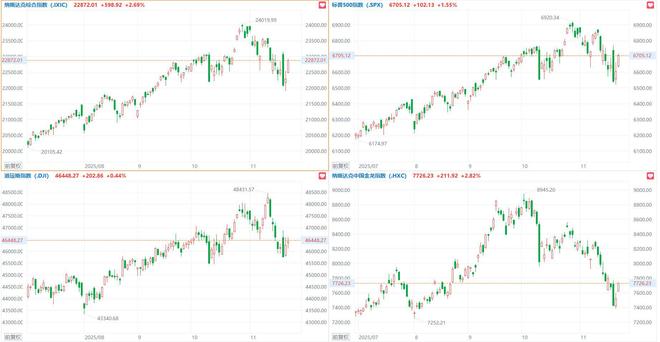
Market Overview - On November 24, US stock markets experienced a collective rebound, with the Nasdaq Composite Index rising by 2.69% to 22,872.01 points, marking the largest single-day gain since May [1] - The Dow Jones Industrial Average increased by 0.44% to 46,448.27 points, while the S&P 500 Index rose by 1.55% to 6,705.12 points [1] Key Stock Performances - Major tech stocks saw significant gains, with Google rising over 6% due to positive investor sentiment regarding its leadership in artificial intelligence, particularly following the release of its latest AI model, Gemini 3 [2] - Other notable performers included Broadcom, which surged over 11%, and Micron Technology, which increased nearly 8% [2] - The Philadelphia Semiconductor Index rose by 4.63%, with all 30 component stocks closing higher, including Credo Technology, which jumped 13% [4][6] Federal Reserve Insights - Federal Reserve Governor Christopher Waller expressed support for a potential interest rate cut in December, a sentiment echoed by New York Fed President John Williams [1] - The CME Group's FedWatch Tool indicated an 81% probability of a 25 basis point rate cut in December [3] Chinese Stocks Performance - The Nasdaq Golden Dragon China Index rose by 2.82%, with notable gains in Chinese stocks such as Hesai, which increased by 18.08%, and XPeng, which rose by 2.8% [7] - Conversely, Legend Biotech and Bawang Tea both experienced declines of 3.62% and 2.56%, respectively [8]



时报观察丨人形机器人站上车展C位的冷思考
Zheng Quan Shi Bao· 2025-11-24 23:18
Group 1 - Major automotive companies are increasingly venturing into the humanoid robot sector, showcasing a shift in focus from traditional automotive innovations to robotics at the 2025 Guangzhou International Auto Show [1] - Companies like GAC Group and XPeng Motors presented their humanoid robots, indicating a trend where humanoid robots are becoming a key selling point amidst a temporary lull in smart automotive technology advancements [1] - The underlying technology for smart cars and humanoid robots shares commonalities, allowing automotive companies to leverage their expertise in intelligent manufacturing and user engagement to explore new revenue streams in robotics [1] Group 2 - The commercial logic and developmental stage of humanoid robots differ significantly from that of automobiles, requiring substantial investment and a long return cycle, which could strain cash flow if pursued blindly by automotive companies [2] - The Chinese automotive industry is currently facing challenges, with an overall profit margin of only 4.5% in the first nine months, which is below the average for downstream industrial enterprises [2] - A strategic approach to humanoid robot development should be based on technological applicability and genuine market demand rather than merely chasing trends, emphasizing the need for a balance between innovation investment and financial health [2]

广州车展新趋势:新能源大六座排队登场 纯电车企回手拥抱油箱
Nan Fang Du Shi Bao· 2025-11-24 23:16
Core Viewpoint - The 2025 Guangzhou Auto Show highlights a surge in the launch of large six-seat SUVs by various automakers, reflecting both market demand and a potential lack of innovation in the industry [2][3][7]. Group 1: Large Six-Seat SUVs - Numerous automakers are introducing large six-seat SUVs at the Guangzhou Auto Show, indicating a competitive market segment with varying price points and features [3][4]. - The entry price for these SUVs is below 300,000 yuan, with models like the Geely Galaxy M9 starting at 180,000 yuan and offering advanced features such as the new generation Raytheon electric hybrid system [4]. - Higher-end models above 300,000 yuan include the Zhiji LS9 priced at 322,800 yuan, showcasing futuristic designs and advanced technology [5][6]. Group 2: Market Dynamics and Concerns - Industry insiders express skepticism about the practicality of large six-seat SUVs, suggesting that many features may not align with consumer needs, leading to potential forced consumption [7][8]. - The competitive landscape is described as "overheated," with automakers rushing to enter the large six-seat SUV market to avoid missing out on perceived opportunities [8]. Group 3: Return of Traditional Fuel Vehicles - A noticeable trend at the auto show is the return of traditional fuel vehicles, with many brands that previously focused on electric vehicles now introducing hybrid and fuel models [9][11]. - The market is expected to see a coexistence of electric and hybrid vehicles, with predictions indicating that internal combustion engine vehicles will still account for about one-third of new car sales by 2040 [10][15]. - Companies like Chery and Geely emphasize their commitment to maintaining a strong presence in the fuel vehicle market, even as they expand their electric offerings [12][14]. Group 4: Consumer Preferences and Market Viability - The rise of hybrid and extended-range vehicles is seen as a response to consumer concerns over range anxiety and charging infrastructure, particularly in regions where electric vehicle adoption is slower [13]. - The profitability of hybrid models is highlighted, with companies like Li Auto achieving financial success through their hybrid offerings [13][14]. - The automotive industry is expected to maintain a diverse energy mix, with both electric and hybrid vehicles playing significant roles in the market [16][17].

纳指大涨2.69%,特斯拉、谷歌涨超6%,中国指数涨2.82%
Ge Long Hui A P P· 2025-11-24 22:27
Market Performance - The three major U.S. stock indices closed higher, with the Dow Jones up 0.44%, the S&P 500 up 1.55%, and the Nasdaq Composite up 2.69% [1] - Large-cap tech stocks saw significant gains, with Tesla and Google both rising over 6% [1] Sector Highlights - Semiconductor stocks performed strongly, with Broadcom's stock increasing by 11%, marking its largest gain since April, adding $178 billion to its market capitalization [1] - The Philadelphia Semiconductor Index rose by 4.6%, with Micron Technology up nearly 8%, AMD up over 5%, and Nvidia up over 2% [1] Chinese Stocks - The Nasdaq Golden Dragon China Index increased by 2.82%, with notable gains in popular Chinese concept stocks [1] - Key performers included WeRide up 14.72%, Pony.ai up 12.51%, and Canadian Solar up 10.16% [1] - Other significant increases were seen in Daqo New Energy up 8.89%, Global Data up 8.38%, Baidu up 7.44%, and Bilibili up 6.80% [1]


直击第二十三届广州国际汽车展览会:自主品牌站C位 产业链加速融合
Zheng Quan Ri Bao Zhi Sheng· 2025-11-24 16:40
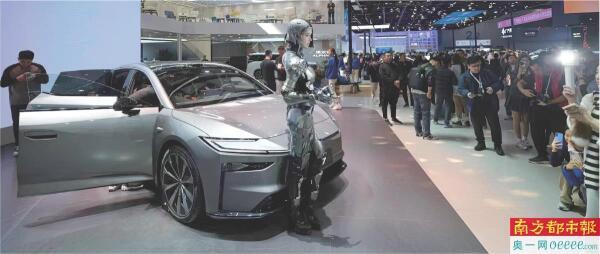
Core Insights - The 23rd Guangzhou International Auto Show showcased a significant increase in visitor turnout and featured 1,085 vehicles, including 93 global debuts and 629 new energy vehicles, highlighting the strong presence of domestic brands and the acceleration of localization strategies by foreign brands [1][2] Industry Trends - The Chinese automotive market has crossed the critical point of electric vehicle (EV) adoption, with cumulative sales of new energy vehicles reaching 12.943 million units from January to October 2025, marking a 32.7% year-on-year increase and a market penetration rate exceeding 52.9% [2] - The shift towards electric and intelligent vehicles is no longer optional but essential, driving profound changes in product development, supply chain management, and overall industry ecology [2][4] Company Developments - Great Wall Motors unveiled its VLA advanced driver-assistance model, emphasizing the evolution of driving technology and user experience [3] - Ford and Buick are adapting their strategies to local market demands, with Ford's Mustang featuring a localized architecture and advanced technology, while Buick integrates local innovations for enhanced user experience [3] Innovation in the Supply Chain - The auto show highlighted the importance of collaboration across the automotive supply chain, with companies like Jiangsong Technology showcasing innovative solutions such as vertical parking systems with fire safety features and automated charging robots [5] - Xpeng Motors is venturing into humanoid robotics, demonstrating a bionic robot that integrates automotive technology and AI capabilities, indicating a trend towards multi-functional applications of automotive technology [6] - CATL presented its latest battery technology solutions, emphasizing the shift of core supply chain companies from mere suppliers to co-creators in the automotive ecosystem [6]

华为全新序列启境、奕境品牌发布!吉利、小米、小鹏发布三季度财报!岚图泰山、小鹏X9超级增程等新车上市!丨一周大事件
电动车公社· 2025-11-24 16:21
Core Insights - The article highlights the recent developments in the electric vehicle (EV) market, focusing on new model launches and significant financial results from key players in the industry. New Car Launches - Lantu Taisan was launched with a price range of 379,900 to 509,900 yuan, featuring advanced technologies such as a three-chamber air suspension and dual 16° rear-wheel steering [5][6][14] - The new Galaxy Starship 7 EM-i was launched at a limited-time price of 95,800 to 123,800 yuan, offering enhanced safety and comfort features [15][16][31] - Dongfeng Xinghai S7 was launched with a price range of 105,900 to 135,900 yuan, featuring a spacious design and competitive electric range [32][40] - The new Xiangjie S9 was launched with a price range of 309,800 to 369,800 yuan, offering a luxurious interior and advanced driving assistance systems [41][56] - Xiaopeng X9 range-extended version was launched at a price of 309,800 to 329,800 yuan, featuring high-performance specifications and advanced AI capabilities [57][66] - Changan Q05 was launched with a price range of 79,900 to 109,900 yuan, featuring a compact SUV design and advanced connectivity options [69][75] - Tesla Model S/X was relaunched with prices of 882,900 and 942,900 yuan respectively, featuring minor updates and improved comfort [76][82] - Lantu Dreamer Mountain River was launched at a price of 709,900 yuan, featuring a luxurious MPV design and advanced technology [88][94] - MG4 semi-solid state version was launched at a limited-time price of 99,800 yuan, featuring innovative battery technology [95][101] - Ford Mustang Mach-E began pre-sales with a price range of 229,800 to 282,800 yuan, featuring a rugged design and advanced technology [102][111] - Deep Blue L06 began pre-sales with a limited-time price range of 132,900 to 154,900 yuan, featuring a sporty design and advanced driving features [114][123] - Leap A10 made its global debut and opened for blind orders, featuring a competitive price and advanced technology [125][133] - Extreme Stone ADAMAS began blind orders at a price of 998,800 yuan, featuring a luxurious SUV design [134][141] - GAC Aopai SSR Cloud Pattern Gold Edition was launched at a price of 1,486,000 yuan, featuring a unique design and high-performance specifications [142][149] - Leado L90 Black Knight Edition was launched at a price of 306,800 yuan, featuring a sporty design and advanced electric capabilities [150][155] - Ora 5 began pre-sales with a price range of 109,800 to 142,800 yuan, featuring a retro design and advanced technology [156][165] - Volkswagen Passat ePro and new Tiguan L plug-in hybrid models were showcased, indicating Volkswagen's commitment to the Chinese market [166][173] Company Dynamics - Geely Auto reported a record revenue of 89.2 billion yuan for Q3, a 27% year-on-year increase, with a net profit of 3.96 billion yuan [3][174][177] - Xiaopeng Motors reported a Q3 revenue of 20.38 billion yuan, a 101.8% year-on-year increase, with a gross margin of 20.1% [3][179][182] - Xiaomi's automotive and AI business achieved profitability for the first time in a single quarter, with revenues of 29 billion yuan [3][184][187] - The launch of the Qiji and Yijing brands marks a significant step in Huawei's automotive strategy, focusing on high-end intelligent mobility solutions [3][188][191]