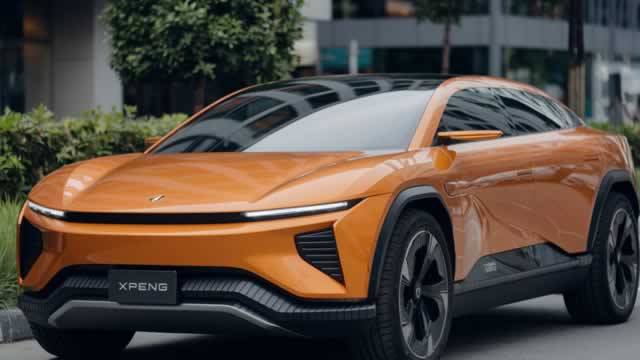
XPENG(XPEV)

Search documents
小鹏汽车(09868) - 授出限制性股份单位
2026-01-16 10:24
香港交易及結算所有限公司及香港聯合交易所有限公司對本公告的內容概不負責,對其準確性或完整性亦 不發表任何聲明,並明確表示概不會就因本公告全部或任何部分內容而產生或因倚賴該等內容而引致的任 何損失承擔任何責任。 授出限制性股份單位 限制性股份單位授出的詳情如下: 授予日期 2026年1月16日 所授予限制性股份單位 總數 1,309,838 所授予限制性股份單位 的購買價格 零 A類普通股於授予日期 的收市價格; 每股80.450港元 1 董事會宣佈,於 2026 年 1 月 16 日,本公司根據 2025 年股份激勵計劃向 69 名僱員授出 (「限制性股份單位授出」)合共 1,309,838 股限制性股份單位(代表相同數量的 A 類 普通股),惟須待承授人接納後,方可作實。概無限制性股份單位授出須經本公司股 東批准,且概無承授人為本公司董事、最高行政人員或主要股東,亦非前述各方的聯 繫人。 限制性股份單位授出受 2025 年股份激勵計劃及本公司與各承授人訂立的獎勵協議的條 款及條件規限。2025 年股份激勵計劃的主要條款載於本公司日期為 2025 年 5 月 12 日 的委託投票說明書╱通函。 香港聯交所已經 ...
美股中概股盘前涨跌互现,蔚来涨1%,阿里巴巴跌0.5%
Mei Ri Jing Ji Xin Wen· 2026-01-16 09:23
Group 1 - U.S. Chinese stocks showed mixed performance in pre-market trading on January 16, with NIO rising by 1% [1] - Alibaba experienced a decline of 0.5% in pre-market trading [1] - Xpeng Motors and Trip.com also saw decreases, with Xpeng down by 0.8% and Trip.com down by 2% [1]


大连小鹏汽车销售服务有限公司成立,注册资本500万人民币
Sou Hu Cai Jing· 2026-01-16 08:03
Core Viewpoint - Recently, Dalian Xiaopeng Automobile Sales Service Co., Ltd. was established, indicating Xiaopeng Motors' expansion in the automotive sales sector, particularly in new energy vehicles [1] Group 1: Company Overview - Company Name: Dalian Xiaopeng Automobile Sales Service Co., Ltd. [1] - Legal Representative: Zhao Dawu [1] - Registered Capital: 5 million RMB [1] - Ownership: Fully owned by Xiaopeng Automobile Sales Co., Ltd. [1] Group 2: Business Scope - The company’s business scope includes: - Automobile sales - New energy vehicle sales - Sales of electric vehicle accessories - Motor vehicle charging sales - Battery and tire sales - Car rental services - Vehicle maintenance and repair services - Second-hand car brokerage [1] Group 3: Company Registration Details - Type: Limited liability company (wholly owned by a legal entity) [1] - Business Duration: Until January 15, 2026, with no fixed term [1] - Registration Authority: Dalian Ganjingzi District Market Supervision Administration [1] - Address: No. 52, H1 District, Quanshui, Ganjingzi District, Dalian, Liaoning Province [1]
小鹏汽车在大连成立新销售服务公司,注册资本500万
Zhong Guo Neng Yuan Wang· 2026-01-16 07:32
Group 1 - A new company, Dalian Xiaopeng Automobile Sales Service Co., Ltd., has been established with a registered capital of 5 million RMB [1] - The legal representative of the new company is Zhao Dawu [1] - The business scope includes sales of new energy vehicles, sales of new energy vehicle accessories, and sales of motor vehicle charging [1] Group 2 - The company is wholly owned by Xiaopeng Automobile Sales Co., Ltd. [1]
机器人赛道挤满了车圈大佬
阿尔法工场研究院· 2026-01-16 05:37
Core Viewpoint - The article discusses the migration of talent from the intelligent driving sector to the robotics industry, highlighting the emergence of new startups and the potential for innovation in the field of embodied intelligence [2][9]. Group 1: Talent Migration - A significant number of industry leaders from intelligent driving are transitioning to the robotics sector, with over 30 notable figures making this shift [8]. - Startups like Zhihui Square, founded by Guo Yandong, have quickly gained traction, raising substantial funding and achieving unicorn status within a short period [3]. - Other notable startups include Zhijian Power, founded by former Li Auto executives, and Tashizhi Hang, co-founded by Huawei alumni, both of which have secured significant investments [4][6]. Group 2: Investment Landscape - The investment community is optimistic about teams with intelligent driving backgrounds, as they possess experience in scaling products and managing resources effectively [9]. - The robotics industry is witnessing a "talent war," with headhunters offering salary increases of around 50% for candidates with intelligent driving experience [10]. Group 3: Technological Synergies - Companies like Tesla and Xiaopeng are leveraging their existing automotive technologies to develop robots, indicating a convergence of intelligent vehicles and humanoid robots [12][13]. - The technology used in electric vehicles, such as high-density motors and battery management systems, is being adapted for robotic applications, enhancing their capabilities [17]. Group 4: Challenges and Future Outlook - Despite the technological overlap, the robotics sector faces unique challenges, particularly in achieving the dexterity and interaction capabilities required for humanoid robots [18]. - The commercial viability of robots remains uncertain, with many companies still exploring sustainable business models [20][21]. - The influx of companies into the robotics space may lead to market saturation and potential issues with quality and trust in robotic technologies [29][30].



大华继显:降小鹏汽车-W目标价至125港元 研发支出激增抵销交付增长动能
Zhi Tong Cai Jing· 2026-01-16 03:33
大华继显发布研报称,基于更高的研发支出,下调小鹏汽车-W(09868)2026及2027年净利润预测39%及 6%。维持"买入"评级,目标价从145港元下调至125港元。 据报道小鹏汽车为2026年设定了55万至60万辆的交付目标(同比增长28-40%),此目标基于强劲的产品阵 容及出口量翻倍,高于该行的预估。该行将2026年交付量预估上调7%至53万辆。由于先进驾驶辅助系 统、自动驾驶出租车及人形机器人等新项目投入,2026年研发支出可能增加至超过100亿元人民币。该 行维持小鹏2025年净亏损预测为14.81亿元人民币,这意味着2025年第四季净利润预测为4,200万元人民 币,而市场共识预测为1亿元人民币。 ...
大华继显:降小鹏汽车-W(09868)目标价至125港元 研发支出激增抵销交付增长动能
智通财经网· 2026-01-16 03:28
据报道小鹏汽车为2026年设定了55万至60万辆的交付目标(同比增长28-40%),此目标基于强劲的产品阵 容及出口量翻倍,高于该行的预估。该行将2026年交付量预估上调7%至53万辆。由于先进驾驶辅助系 统、自动驾驶出租车及人形机器人等新项目投入,2026年研发支出可能增加至超过100亿元人民币。该 行维持小鹏2025年净亏损预测为14.81亿元人民币,这意味着2025年第四季净利润预测为4,200万元人民 币,而市场共识预测为1亿元人民币。 智通财经APP获悉,大华继显发布研报称,基于更高的研发支出,下调小鹏汽车-W(09868)2026及2027 年净利润预测39%及6%。维持"买入"评级,目标价从145港元下调至125港元。 ...
XPeng Inc. (NYSE:XPEV) Targets Ambitious Sales Growth and International Expansion
Financial Modeling Prep· 2026-01-16 03:09
Core Viewpoint - XPeng Inc. is positioning itself as a significant player in the electric vehicle market with ambitious growth targets and new model launches aimed at enhancing its competitive edge [1][5]. Group 1: Sales Targets and Growth - XPeng aims to achieve a sales target of 550,000 to 600,000 vehicles by 2026, representing a growth of 28% to 40% from the 429,445 vehicles delivered in 2025 [2][5]. - The company plans to launch four new SUV models, including the XPeng G01, G02, and two Mona series models, D02 and D03, to capture various market segments [2][5]. Group 2: Product Expansion and International Strategy - XPeng is expanding its Extended Range Electric Vehicle (EREV) options to attract customers seeking longer-range EVs [3][5]. - The company intends to double its international deliveries in 2026, focusing on models like the Mona and P7+ to strengthen its export strategy [3][5]. Group 3: Stock Performance and Market Position - Currently, XPeng's stock price is $20.90, reflecting a 1.51% increase, with a market capitalization of approximately $19.85 billion [4]. - The stock has traded between $20.40 and $21.13 today, with a 52-week high of $28.24 and a low of $13.60, indicating active investor interest [4].
中国乘用车月度图表(2025 年 12 月):国内需求下滑加快,出口增长提速-China Passenger Vehicle Monthly Chartbook_ Dec 2025 - Faster domestic decline & export growth
2026-01-16 02:56
Summary of the China Passenger Vehicle Monthly Chartbook - December 2025 Industry Overview - The report focuses on the **passenger vehicle (PV)** and **new energy vehicle (NEV)** industry in China, highlighting trends in retail and wholesale volumes, inventory levels, pricing, and battery prices [1][2][5]. Key Industry Trends - **NEV Retail Growth**: NEV retail growth decelerated to **+3% year-over-year (yoy)** in December 2025, down from **+4% yoy** in November 2025, attributed to decreasing subsidies [1][5]. - **ICE Decline**: Internal combustion engine (ICE) vehicle sales further deteriorated, showing a decline of **-31% yoy** in December, compared to **-22% yoy** in November, with higher ICE inventory levels [1][5]. - **Export Growth**: Exports of passenger vehicles (PV) and NEVs showed significant strength, with growth rates of **+47% yoy** and **+164% yoy** respectively in November, compared to **+41% yoy** and **+67% yoy** in October [1][5]. Detailed Industry Data - **December 2025 Highlights**: - PV retail sales decreased by **-14% yoy** and increased by **+2% month-over-month (mom)**. - Wholesale sales for PV decreased by **-9% yoy** and **-7% mom**. - NEV retail sales increased by **+3% yoy** and **+1% mom**, while wholesale sales increased by **+3% yoy** but decreased by **-8% mom**. - NEV retail penetration reached **59.1%**, an increase of **9.7 percentage points (pp) yoy**, while wholesale penetration was **56.0%**, up **6.8 pp yoy** [5][6]. Pricing and Inventory Trends - **Inventory**: NEV inventory remained stable, while ICE inventory levels increased [5][6]. - **Pricing**: Dealer discounts for both NEVs and ICE vehicles narrowed month-over-month, with one NEV manufacturer implementing a price cut [6]. - **Battery Prices**: Lithium cobalt oxide (LCE) battery prices increased by **+32% mom**, while lithium iron phosphate (LFP) and nickel-cobalt-manganese (NCM) battery prices remained flat [6]. Company Highlights - **BYD**: - Delivered **133,000 units** of export volume in December 2025, maintaining strong overseas expansion momentum. - Expected overseas sales volume to reach between **1.5 million to 3.5 million** units from 2026 to 2035, driven by NEV penetration and product competitiveness. - Forecasted **30% earnings compound annual growth rate (CAGR)** from 2025 to 2028, with overseas profit contribution expected to rise from **21% in 2024 to 60% by 2028** [6][7]. - **XPeng**: - Delivered **32,000 units** of domestic retail volume in December 2025, reflecting a **-5% yoy** decline but a **+2% mom** increase. - Market share remained relatively stable with a **-0.2 pp** change. - Blended transaction price increased by **5% yoy** and **4% mom**, attributed to a favorable model mix [7]. Future Outlook - Domestic PV and NEV volume growth is expected to slow down in 2026, with projections of **-2% yoy** for PV and **+11% yoy** for NEV, compared to **+4% yoy** and **+18% yoy** in 2025. - Exports are anticipated to be a bright spot for the industry, particularly for companies like BYD, which is well-positioned for overseas exposure [6][7]. Conclusion The December 2025 report indicates a challenging environment for the domestic PV market, particularly for ICE vehicles, while NEVs continue to show growth albeit at a slower pace. Export opportunities remain robust, particularly for leading companies like BYD and XPeng, which are expected to capitalize on international markets in the coming years [1][5][6][7].

XPeng Expects to Sell 600K Vehicles in 2026, Plans New SUV Launches
ZACKS· 2026-01-15 16:01
Core Insights - XPeng Inc. aims to sell between 550,000 and 600,000 vehicles in 2026, indicating a growth of approximately 28% to 40% compared to 2025 deliveries of 429,445 vehicles [2][9] Vehicle Launch Plans - The company plans to introduce four new SUV models in 2026, including the XPeng G01, XPeng G02, and two models from the Mona series, the D02 and D03 [3][9] - The G01 is a premium six-seat SUV, the G02 is a full-size flagship SUV, the D02 is a midsize SUV, and the D03 targets the compact SUV segment [4] Expansion Strategy - XPeng is expanding into extended-range electric vehicle (EREV) models to support domestic sales and enhance its international presence [5] - The company aims to double its international deliveries in 2026, having sold 45,008 vehicles overseas in 2025, which represents a 96% year-on-year increase [6][9]