
宝洁公司

Search documents
封关已确定,美妆消费要变天了!
Sou Hu Cai Jing· 2025-08-05 04:05
Core Viewpoint - The official announcement of the Hainan Free Trade Port's full island closure operation starting December 18 signifies the establishment of China's largest free trade port, enhancing its international market connectivity and attracting global quality resources [1][3]. Group 1: Impact on the Beauty Industry - Hainan has become a crucial duty-free shopping destination for international beauty brands, with a total duty-free shopping amount of 250.1 billion yuan since the implementation of the duty-free policy in April 2011, where cosmetic products account for over 50% of sales [3]. - The "closure" refers to designating Hainan as a "domestic outside" area, allowing for zero tariffs on imported goods while maintaining customs management for goods entering other domestic regions [3][4]. - The range of zero-tariff products will expand from 1,900 to approximately 6,600 tax items, covering 74% of all product categories, which is an increase of nearly 53 percentage points compared to before the closure [6]. Group 2: Cost Reduction and Market Competitiveness - The elimination of import tariffs on cosmetics will directly reduce import costs for companies, with the lowest most-favored-nation tax rate for skincare products being 1% and up to 6.5% for other beauty products [7]. - The processing and value-added policy allows goods processed in Hainan with over 30% imported materials to enter the mainland exempt from import tariffs, only subject to value-added and consumption taxes, enhancing market competitiveness [7]. - As of March 2023, the value of processed goods for internal sales in Hainan reached 7.546 billion yuan, with an estimated tariff exemption of about 601 million yuan [7]. Group 3: Strategic Adjustments by International Brands - Major international beauty brands have already begun to strengthen their presence in Hainan, with several opening duty-free stores in recent years, including Kao, Shiseido, L'Oréal, Estée Lauder, and Procter & Gamble [8]. - The closure of Hainan is seen as a pivotal moment for international beauty brands in China, shifting focus from "traffic competition" to "value cultivation," with the ability to convert policy benefits into brand assets being crucial for future competitiveness [10]. Group 4: Opportunities for Domestic Brands - The closure presents multifaceted opportunities for domestic beauty brands, allowing them to reduce raw material costs through processing policies and enhance their high-end image via duty-free channels [12]. - Domestic brands can leverage Hainan as a global launchpad, establishing a model of "R&D in Hainan, manufacturing in the mainland, and global sales" [12]. - However, challenges remain, including the need for domestic brands to differentiate their products in a competitive market dominated by international players [12].

The Economist-2.08.2025
2025-08-05 03:16
Summary of Key Points from the Conference Call Industry or Company Involved - The conference call primarily discusses the **European Union (EU)** and its trade deal with **America**, as well as implications for various companies affected by tariffs, including **Mercedes-Benz**, **Ford**, and **Procter & Gamble**. Additionally, it touches on the **artificial intelligence (AI)** sector, particularly regarding **Nvidia** and its chip exports to **China**. Core Points and Arguments 1. **EU-US Trade Deal**: The EU reached a preliminary trade deal with America, imposing a **15% tariff** on EU exports to the US, significantly lower than the **30%** initially threatened by President Trump. The EU will eliminate tariffs on American industrial goods and increase energy purchases from the US [32][55][56]. 2. **Impact on Companies**: - **Mercedes-Benz** reported a decline in sales in North America and Asia due to tariffs, expecting full-year sales to be "significantly below" last year's figures [34]. - **Ford** incurred **$800 million** in tariff costs in Q2, resulting in a net loss [34]. - **Procter & Gamble** anticipates a **$1 billion** cost from trade levies, necessitating price increases across various consumer goods [34]. 3. **Federal Reserve's Interest Rate Decision**: The Federal Reserve maintained its benchmark interest rate between **4.25% and 4.5%**, indicating that inflation remains elevated while growth has moderated, hinting at potential future rate cuts [35]. 4. **AI Sector Developments**: The Trump administration reversed its ban on Nvidia's H20 chip exports to China, a decision seen as detrimental given the competitive landscape in AI. The ban had previously hindered China's AI development by limiting access to necessary computing capacity [66][68][70]. 5. **Nvidia's Market Influence**: Nvidia's status as the world's most valuable company gives it significant sway in market movements, and the decision to allow chip exports is viewed as a strategic misstep amid an ongoing AI arms race with China [66][67][72]. Other Important but Possibly Overlooked Content 1. **Geopolitical Context**: The trade deal and tariff discussions are set against a backdrop of broader geopolitical tensions, particularly concerning security and the ongoing situation in Ukraine [58]. 2. **Internal EU Challenges**: Critics argue that the EU's economic issues extend beyond the trade deal, highlighting the need for internal reforms and investment to address productivity gaps and market fragmentation [59][60]. 3. **AI Hardware vs. Software Development**: The easing of chip export controls may bolster China's hardware industry in the long term, despite immediate benefits for American firms. The complexity of chipmaking means that catching up will take years, making the current advantage critical [69][71]. This summary encapsulates the key discussions and implications from the conference call, focusing on the trade dynamics between the EU and the US, the impact on specific companies, and the strategic considerations in the AI sector.




1933年以来最高关税,美国经济疲态显现,关税负面影响加剧了,受伤的是美国人自己
Sou Hu Cai Jing· 2025-08-05 03:13
Group 1 - The average tariff on imported goods in the U.S. has surged from 1.2% last year to 17%, marking the highest level since the Smoot-Hawley Tariff Act of 1933 [1][3][6] - Tariffs vary significantly by country, with Canada facing a rise from 25% to 35% due to political decisions, and Brazil experiencing a combined tariff of 50% on certain goods [3][4] - The U.S. tariff policy reflects a "America First" approach, imposing high tariffs indiscriminately, even on allied nations, which has led to widespread criticism and concerns about international trade relations [6][10] Group 2 - The tariff increases have resulted in higher costs for U.S. companies, with Ford estimating an additional $800 million in costs and Procter & Gamble planning to raise prices on a quarter of its products [6][8] - The job market has shown weakness, with only 73,000 jobs added in July, significantly below expectations, attributed to disruptions in supply chains caused by the tariff war [8][10] - Ordinary American households are expected to face increased expenses, with estimates suggesting an additional $2,400 per year due to rising prices on essential goods [8][10]
金价、油价,涨!
Sou Hu Cai Jing· 2025-08-05 01:05
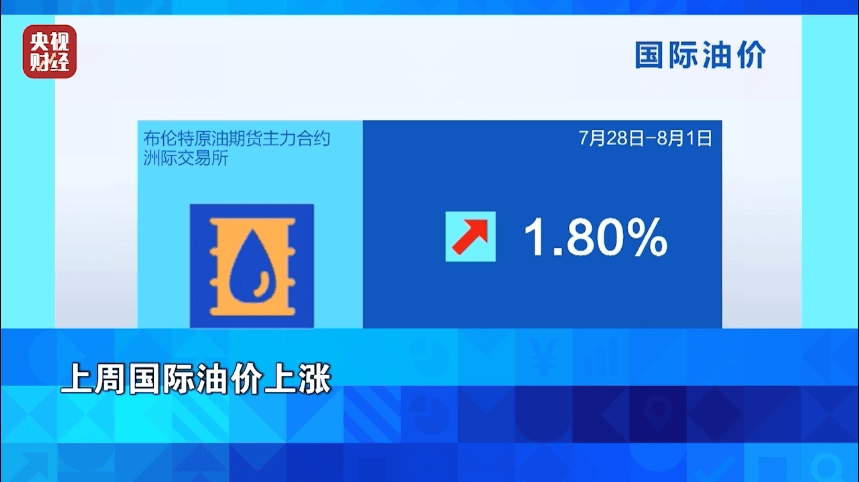
上周,面对特朗普政府不断要求降息的压力,美联储再次决定维持利率不变。与此同时,特朗普也签署行政命令,对进口 自多个国家和地区的商品额外征收10%到41%不等的关税,加之美国部分经济及就业数据不佳,以上因素打压市场风险偏 好,美国三大股指上周累计下跌。其中,道指下跌2.92%,标普500指数下跌2.36%,纳指下跌2.17%。 上周国际油价上涨 原油期货方面,上周,美国总统特朗普对俄罗斯发出制裁的警告,引发市场对部分石油贸易可能受影响的担忧。与此同 时,美欧达成贸易协议也提振燃料需求预期,推高国际油价。 纽约油价上周累计上涨3.33%,布伦特油价累计上涨 1.80%。 上周国际金价累计上涨近2% 贵金属期货方面,全球贸易局势仍面临很大不确定性,叠加地缘局势骤然紧张,市场避险情绪高涨, 推动国际金价在上 周累计上涨1.92%。 美国新一轮关税措施本周生效 美国实际关税水平将升至1933年以来最高水平 本周,投资者较为关注的仍然是关税方面的消息。当地时间7日,也就是本周四,美国对部分贸易伙伴重新设定的所谓"对 等关税"税率将生效,给全球贸易局势带来了新的不确定性。惠誉评级的最新报告显示,新关税将使美国实际关税税率升 ...
非农“掺假”、经济支柱出现裂缝,美国经济开始撑不住了?
智通财经网· 2025-08-04 11:36
Economic Overview - Recent economic data has raised warning signals, confirming concerns among U.S. corporate executives and consumers regarding the economic situation [1] - The non-farm payroll data released last Friday indicated a much worse labor market condition than previously reported, with a downward revision of nearly 260,000 jobs for May and June [3] - The average job growth over the past three months was only 35,000, marking the worst level since the pandemic [3] Consumer and Business Impact - Many U.S. businesses have paused investments and hiring due to uncertainty surrounding Trump's economic policies, particularly tariffs [4] - Consumer spending has decreased due to rising debt levels, leading to reduced consumption of non-essential goods [4] - Economic growth is expected to be steady but lower than in previous years, with forecasts predicting a 1.5% growth for 2023 and 1.7% by 2026 [4] Inflation and Pricing Pressure - Companies like Procter & Gamble have noted that economic uncertainty is suppressing consumer demand, with CFO Andre Schulten indicating a noticeable slowdown in consumption trends [5] - Prices for frequently imported goods, such as furniture and appliances, have risen, suggesting that companies are passing on higher tariff costs to consumers [5] - Economists anticipate that import tariffs will further increase prices in the coming months [5] Federal Reserve's Position - Federal Reserve Chairman Jerome Powell acknowledged the downward risks in the labor market while describing it as "robust," also noting the slowdown in consumer spending [9] - The housing market continues to be a drag on economic growth, with total spending on residential and non-residential projects down 2.9% year-over-year in June, marking one of the most severe annual declines since early 2019 [9] Employment Data Revisions - The recent large-scale revision of employment data revealed that the number of new jobs added in May and June was 258,000 less than previously reported, shifting the labor market from robust growth to near stagnation [12] - Despite a slowdown in hiring, most companies have not resorted to layoffs, and the unemployment rate rose to 4.2% in July, remaining relatively low [12] - The decline in non-farm employment and rising unemployment will significantly suppress consumer spending, particularly affecting low-income groups reliant on wages [12]

美国就业数据“说谎”,消费者缩手,一场“完美风暴”正在形成?
Jin Shi Shu Ju· 2025-08-04 10:08
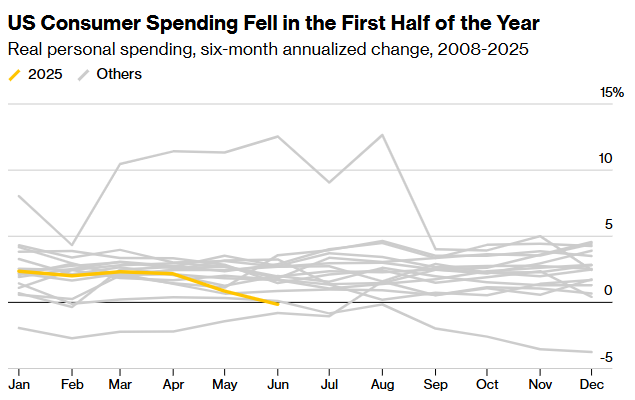
Economic Conditions - Recent economic data indicates that warning signs are flashing, with a weaker labor market and declining consumer spending in the first half of the year [1] - The average job growth over the past three months is only 35,000, marking the worst performance since the pandemic [1][4] - Many companies are postponing investment and hiring plans due to uncertainty surrounding economic policies, particularly tariffs [2] Consumer Spending - Companies like Procter & Gamble have noted a slowdown in consumer spending trends, attributed to consumer expectations rather than current realities [3] - Rising prices for imported furniture and appliances suggest that companies are beginning to pass higher tariff costs onto consumers [3] Federal Reserve and Interest Rates - The recent employment data has raised questions about the Federal Reserve's decision to maintain interest rates, increasing pressure on officials to lower rates before the economy cools excessively [3][5] - Following the employment report, the two-year U.S. Treasury prices surged, while the S&P 500 index saw a significant decline [5] Economic Growth Projections - Despite current struggles, the U.S. economy is expected to continue growing, albeit at a slower pace, with forecasts of 1.5% growth for this year and 1.7% for 2026 [2]
特朗普关税到底怎样影响美国经济?这些数据在释放信号
Di Yi Cai Jing· 2025-08-04 10:04
Group 1: Tariff Impact on Consumers and Economy - The overall effective average tariff rate for American consumers is projected to rise to 18.3%, the highest since 1934, due to the new round of "reciprocal tariffs" set to take effect on August 7 [1][2] - The increase in tariffs is expected to raise the prices of imported goods, acting as a consumption tax that will squeeze disposable income [2] - Recent economic data indicates a slowdown in the U.S. labor market, with average new jobs added over the past three months at only 35,000 and an unemployment rate rising to 4.2% [1][7] Group 2: Trade Agreements and Economic Principles - The U.S. has reached preliminary trade agreements with several economies, including the UK, Vietnam, and Japan, with the U.S.-Japan trade agreement serving as a model for future agreements [4][5] - Current trade agreements are based on four principles, including a 15% base tariff on exports to the U.S. and high tariffs on specific industries like steel and aluminum [5] - The report warns that increased tariff levels will lead to economic growth slowdown and rising inflationary pressures, predicting long-term negative impacts on international competitiveness and resource allocation efficiency [5] Group 3: Consumer Behavior and Market Trends - Consumer anxiety is rising, with significant declines in sales for major companies like Mondelez International and Procter & Gamble, indicating a slowdown in consumer spending across various income levels [8] - The restaurant industry is also experiencing shifts, with high-income families gravitating towards value-oriented dining options while lower-income families reduce their dining out frequency [8] - Economic challenges are attributed to rising tariffs and strict immigration policies, which are impacting corporate profits and household purchasing power [7]
宝洁换帅后公布2025财年业绩:定价与有机销量均增长1%
Nan Fang Du Shi Bao· 2025-08-04 08:16
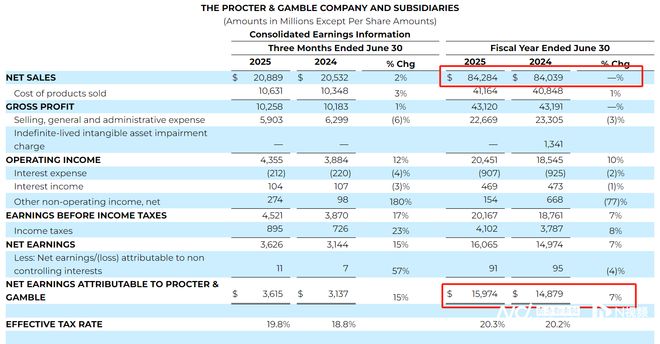
Core Insights - Procter & Gamble (P&G) announced a leadership change with COO Shailesh Jejurikar set to become the first Indian-American CEO starting January 1, 2026, succeeding Jon Moeller, who will transition to Executive Chairman [1][8][9] - The company reported a net sales figure of $84.284 billion for the fiscal year 2025, showing a slight increase from $84.039 billion in the previous year, with organic sales growth of 2% [2][4] - P&G's organic sales growth rate for fiscal year 2025 was the lowest in recent years, with a notable decline in the beauty segment, which saw a 2% drop in net sales [8][6] Financial Performance - For fiscal year 2025, P&G's net profit increased by 7% to approximately $16 billion, while gross profit remained relatively stable at $43.12 billion [2][3] - The company experienced a slight decrease in gross margin, down 0.2% to 51.2% [2] - The productivity plan announced in June aims to improve cost structure and competitiveness, with expected restructuring costs of $1 billion to $1.6 billion over the next two years [4][14] Segment Performance - The Fabric & Home Care segment generated net sales of $29.617 billion, remaining stable year-over-year, with a net profit increase of 3% to $5.848 billion [5][7] - The Beauty segment reported a 2% decline in net sales to $14.964 billion and an 8% drop in net profit to $2.715 billion [6][7] - The Health Care segment saw a 2% increase in net sales to $11.998 billion, with net profit rising by 8% to $2.440 billion [6][7] Market Trends - The Greater China region experienced a 5% decline in performance for fiscal year 2025, although there was a 2% growth in the most recent quarter [1][13] - P&G plans to raise prices on approximately 25% of its products in the U.S. due to tariff impacts, with an average price increase of about 2.5% across the portfolio [13][14] - The company anticipates a pre-tax cost increase of $1 billion due to tariffs, with specific impacts from imports from China and Canada [13][14]
美联储主席紧急预警:关税冲击比预想更猛,消费者钱包即将被“榨干”
Sou Hu Cai Jing· 2025-08-04 04:57
Group 1 - The U.S. economy is experiencing a price surge driven by tariffs, affecting a wide range of products and businesses, leading to a significant economic impact [2][9] - The Consumer Price Index (CPI) for June shows a 1% increase in home goods prices, with textiles rising by 4.2%, and appliances up by 1.9%, indicating widespread inflation across various sectors [3] - Companies like Procter & Gamble and Mohawk Industries are raising prices due to increased costs from tariffs, with Procter & Gamble announcing an average price increase of 2.5% on about a quarter of its products [3][5] Group 2 - A survey by HSBC reveals that 72% of small and medium-sized enterprises in the U.S. are forced to increase operational costs, with 81.5% planning to raise prices [5] - The fluctuating tariff rates have created uncertainty for businesses, with some companies unable to plan effectively due to drastic changes in tax rates [5] - The shipping volume at the Port of Los Angeles has decreased by 15% compared to the previous month, as retailers are reducing order cycles to avoid tariffs [5] Group 3 - Federal Reserve Chairman Jerome Powell warns that the impact of tariffs is more severe than anticipated, creating a conflict between maintaining price stability and ensuring employment [6] - Economists predict that tariffs could increase inflation by approximately 1 percentage point over the next 12 months, indicating a potential rise in consumer prices [6] - The current economic situation is characterized by stagnant growth and high inflation, leading to concerns about stagflation, which poses challenges for the Federal Reserve's monetary policy [6][9]

宏观周度观察:关税多维目标路径明晰,市场聚焦非农暴雷下的美联储降息-20250804
Guo Lian Qi Huo· 2025-08-04 03:04
Report Industry Investment Rating No relevant content provided. Core Viewpoints of the Report - The path for the US to achieve multi - dimensional strategic goals through tariff policies is clear, using tariffs not only as a trade protection tool but also to serve broader economic and geopolitical interests [3][4][5]. - The poor non - farm payroll data has led to a sharp increase in the market's expectation of a Fed rate cut, and the Fed's monetary policy decision is facing a dilemma [6][7][8]. - The July Politburo meeting in China adjusted the direction and intensity of economic policy stimulus, focusing on optimizing the economic structure and implementing effective policies [10][11][12]. - In terms of major asset directions, the US dollar is expected to fluctuate at a low level in the short term, gold is supported by safe - haven sentiment, A - shares are expected to have accelerated sector rotation, and the bond market will focus on "new - old differentiation" [14][15][16]. Summary by Directory 1. This Week's Macroeconomic Observation 1.1 The Path for the US to Achieve Multi - Dimensional Strategic Goals with Tariffs is Clear - As the August 1 deadline for Trump's tariff policy approached, the US White House announced a series of adjusted "reciprocal tariffs" with most new rates taking effect on August 7, providing a negotiation window for countries without trade agreements [3]. - The US uses differentiated tariff policies to achieve goals such as obtaining large - scale investment, procurement commitments, and market opening from trading partners, and guiding the global industrial chain layout [4][5]. - The US uses tariff negotiations to force Southeast Asian countries to make "strategic choices" in the global supply chain, aiming to weaken their industrial chain connection with China [5]. 1.2 Non - farm Payrolls Disappoint, Fed Rate Cut Expectations Soar - Since April, the market's reaction to "reciprocal tariffs" has gradually diminished, and in August, the market's focus shifted to the Fed's rate - cut process [6]. - The sharp downward revision of non - farm payroll data on Friday led to a sharp increase in the market's expectation of a Fed rate cut in September, and the Fed's monetary policy decision is in a dilemma [6][7][8]. - Trump's acceptance of Fed Governor Kugler's resignation may further boost the market's expectation of a Fed rate cut in September [9]. 1.3 The July Politburo Meeting: Optimize the Economic Structure and Implement Existing Policies - In the first half of 2025, China's economy showed strong resilience, and the Politburo meeting adjusted the description of the economic situation and the direction of policy stimulus [10]. - In the second half of 2025, policies should maintain macro - policy continuity, "implement and refine" effective policies, and focus on structural and supply - side issues such as "anti - involution" on the supply side and "releasing consumption potential" on the demand side [11][12]. 1.4 Major Asset Directions - The US dollar index is expected to fluctuate at a low level in the short term due to concerns about the US economic recession and increased expectations of a Fed rate cut [14][15]. - Gold is expected to be supported by safe - haven sentiment in the short term and is in a bull market cycle in the long term [15]. - A - shares are expected to have accelerated sector rotation, and the valuation center is expected to rise due to policy and tax factors [15][16]. - The bond market will focus on "new - old differentiation" in the short term due to the tax policy change [16]. 2. Domestic Key Events and Important Economic Data - The Politburo meeting emphasized maintaining policy continuity and stability, and promoting domestic and international double - circulation [17]. - The decision to hold the Fourth Plenary Session of the 20th Central Committee in October was made, and it will study the formulation of the 15th Five - Year Plan [17]. - The interest income of newly - issued bonds will be subject to VAT starting from August 8, 2025 [17]. - The parenting subsidy policy was implemented, and the budget was about 90 billion yuan [17]. - The manufacturing PMI in July declined, and the non - manufacturing and composite PMIs also decreased [17]. - From January to June 2025, the profits of industrial enterprises above designated size decreased by 1.8%, with different trends in different industries [17]. - Policies were introduced to promote investment, consumption, and the development of various industries, and measures were taken to "anti - involute" the market [17][18]. - The China - US tariff suspension period is expected to be extended, and China's trade with Central and Eastern European countries reached a record high in the first half of the year [18]. 3. Overseas Key Events and Important Economic Data - The Fed kept rates unchanged for the fifth consecutive meeting, but two voting members supported a rate cut, and Powell cooled market expectations of a September rate cut [19]. - US core PCE inflation heated up in June, and the second - quarter GDP growth rate exceeded expectations [19]. - The US made a series of tariff policy adjustments, including delaying the effective date, setting different tariff rates for different countries, and suspending the minimum tax - free treatment for low - value goods [20][21]. - The EU reached a trade agreement with the US, including a 15% tariff and a 60 - billion - dollar investment in the US [20]. - Other countries such as Germany, Japan, and South Korea also had important economic events and policy decisions [19][20][21]. 4. Next Week's Key Data/Events - Next week, important economic data will be released in China, the US, and the eurozone, including PMI, PPI, CPI, and unemployment data [22].