
小米

Search documents
退货率高达50%!AI眼镜是下一个iPhone,还是下一个“智商税”?
创业邦· 2025-11-19 10:11
Core Viewpoint - The AI glasses market is experiencing explosive growth, with significant sales increases during events like Double Eleven, but high return rates pose challenges for companies [3][6][18]. Sales Performance - During Double Eleven, Rokid achieved the highest sales in the AI glasses category, with a 10-fold increase on JD and an overall growth of 800%, surpassing 50 million yuan in sales [6][10]. - Rokid's new AI glasses sold 40,000 units within five days of launch, with total orders reaching 200,000 units since the beginning of 2025 [3][10]. Product Features and Comparisons - Rokid AI glasses feature a green screen display and can integrate with prescription lenses, while the Baolong AI glasses focus solely on voice control and are lighter but lack visual information [6][8]. - The weight and battery life of the glasses present trade-offs, with Rokid's glasses weighing 49 grams and having shorter battery life compared to Baolong's 39 grams and longer battery life [6][8]. Market Dynamics - The AI glasses market is expected to see intense competition by 2025, with nearly 20 companies launching products, including major players like Alibaba and Baidu [13][16]. - Rokid and other leading companies are backed by government support, which aids in their growth and funding [13][14]. Consumer Behavior and Challenges - High return rates, estimated at over 50%, are driven by consumer dissatisfaction after trying the glasses, often due to expectations not being met [4][18]. - Consumers question the value of AI glasses compared to traditional glasses and smartphones, leading to hesitance in purchasing [18]. Strategies to Reduce Returns - Implementing offline try-on services in traditional eyewear stores can help reduce return rates by allowing consumers to assess fit and comfort before purchase [19][21]. - Rokid's collaboration with Baolong includes providing trial services in over 15 eyewear chains, enhancing consumer experience and reducing returns [21]. Industry Outlook - The industry is still in its early growth phase, with companies needing to find unique positioning to succeed [22]. - The challenge of balancing weight, battery life, and performance remains, with the potential for a company to emerge as a leader akin to the iPhone if they can achieve this balance [22].


黄金突破4000美元!新能源化为泡沫?消费习惯迎来大洗牌
Sou Hu Cai Jing· 2025-11-19 09:16
Market Overview - The A-share market is stagnant around 4000 points, with individual stocks experiencing significant declines, leading to a net value drop of 20% for many investors [4][5] - The ETF market has expanded dramatically, with total shares reaching 3.16 trillion, a 19% increase from the previous year, and total scale hitting 5.74 trillion, up 2 trillion in just over six months [4] Economic Indicators - In October, household loans decreased by 360.4 billion, marking a 520.4 billion drop compared to the same period last year, indicating reduced consumer borrowing and spending [5] - Retail sales growth was only 2.9%, the lowest this year, while residential sales saw declines of 7% and 9.4% in sales volume and value, respectively [5] Investment Trends - Major funds are exiting the market, with a pension fund planning to reduce its growth stock holdings significantly and 115 companies announcing share reduction plans [6] - Share buybacks are accelerating, with proposed buybacks exceeding 330 billion, and banks have already released over 120 billion for this purpose [8] Industry Specifics - The new energy vehicle (NEV) sector is facing challenges, with a 0.8% year-on-year decline in retail sales in October, marking the first month-on-month drop since August 2024 [10] - The market for NEVs is becoming increasingly competitive, with domestic brands holding a 72.5% market share and penetration rates reaching 55.3% [10] IPO Market - The Hong Kong IPO market is thriving, with total IPO scale reaching 216.47 billion HKD, surpassing 200 billion for the first time in four years, and is expected to approach 300 billion by year-end [8] Luxury Goods Market - The luxury goods market is recovering, with LVMH planning to open multiple flagship stores in China, indicating confidence in high-end consumer spending [18] Policy Developments - The recent "13 Measures for Private Investment" policy allows private capital to hold over 10% in previously state-dominated sectors like railways and energy, presenting new investment opportunities [20] - The policy also encourages private participation in low-altitude economy and commercial aerospace, aiming to enhance competition in these emerging sectors [20]

港股速报|港股四连跌 黄金股成避风港
Mei Ri Jing Ji Xin Wen· 2025-11-19 09:14
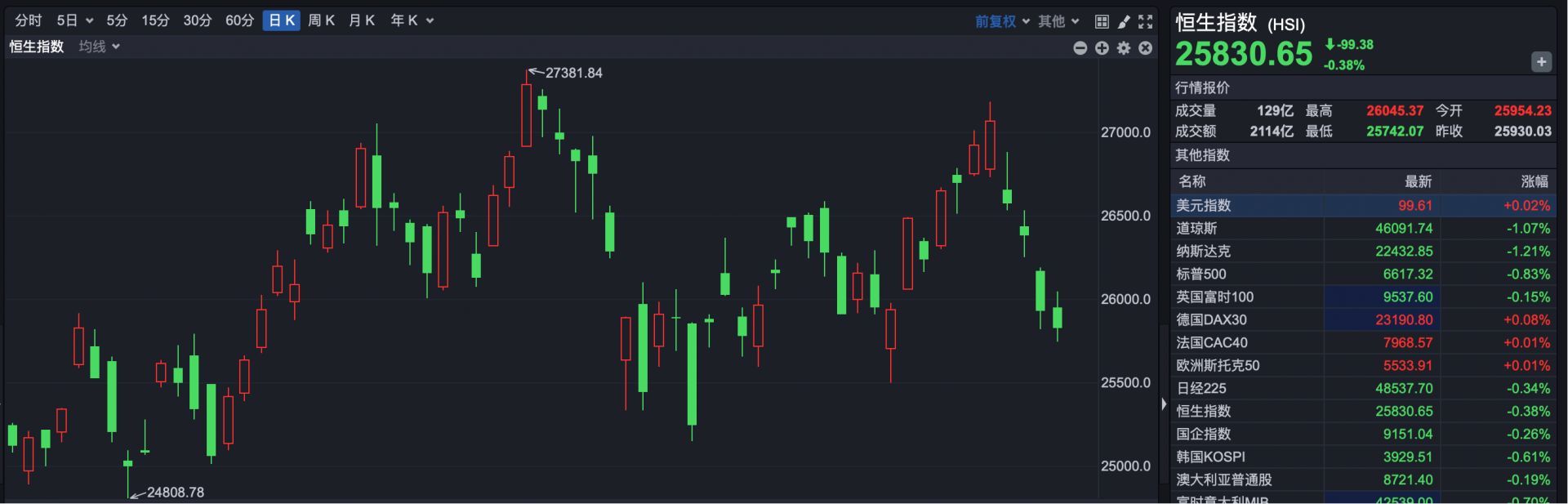
Market Overview - The Hong Kong stock market experienced a four-day decline, with the Hang Seng Index closing at 25,830.65 points, down 99.38 points, a decrease of 0.38% [1] - The Hang Seng Technology Index closed at 5,606.90 points, down 38.83 points, a decline of 0.69% [4] Sector Performance - Gold stocks emerged as a primary safe haven, with major gold stocks showing strong performance. China Gold International rose over 8%, Zhaojin Mining increased over 6%, Shandong Gold gained over 7%, Zijin Mining rose over 2%, and Luoyang Molybdenum increased over 1% [3] - Jewelry concept stocks also strengthened, with Luk Fook Holdings rising nearly 3% and Lao Poo Gold increasing over 1% [3] - Technology stocks generally declined, with Xiaomi dropping over 4% and Kuaishou down over 1%, while Alibaba rose over 1% [6] - Defense stocks were strong, with China Shipbuilding Industry rising over 9%, and oil stocks also performed well, with Sinopec increasing over 2% [6] - New energy vehicle companies weakened, with Li Auto and NIO both down over 2% [6] Investment Outlook - Recent adjustments in the Hong Kong market have led to a divergence in institutional views, but there is a general consensus that the market holds medium to long-term allocation value [8] - Current market sentiment is influenced by external market fluctuations, particularly in the US, and an internal policy vacuum. However, the valuation attractiveness of the Hong Kong market has become evident after recent adjustments [9] - The Hang Seng Technology Index's price-to-earnings ratio is at a relatively low level since its inception, positioning it as a "value pit" in the global market [9] - The technology sector is still in an adjustment phase, with a lack of new catalysts for H-shares in AI technology stocks, despite renewed market interest in US AI stocks [9] - Historically, dividend stocks tend to perform better during November and December, and the current market appears to be following this trend [9]
抛开舆论看小米:赚钱能力持续攀升,增长远未看到天花板
Tai Mei Ti A P P· 2025-11-19 08:24
Core Insights - Xiaomi is facing challenges in the market, with its stock under pressure from short-selling despite strong financial performance [2] - The company reported a significant increase in revenue and profit for Q3, indicating sustained high growth [3][4] - Xiaomi's strategy to target the high-end market is showing results, with increased market share in premium segments [6][7] Financial Performance - For Q3, Xiaomi achieved revenue of 113.1 billion RMB, a year-on-year increase of 22.3%, and a net profit of 11.3 billion RMB, up 80.9% [3] - The overall gross profit for the quarter was 25.9 billion RMB, with a gross margin of 22.9% [3] - The smartphone and AIoT segments contributed significantly to revenue, with the smartphone segment generating 46 billion RMB [4][6] Business Segments - Xiaomi's automotive and AI innovation business reported a revenue increase of over 199% year-on-year, achieving a quarterly operating profit of 700 million RMB [8][11] - The smartphone segment has seen a continuous increase in shipment volume, maintaining a position among the top three globally for 21 consecutive quarters [4][7] - The IoT and lifestyle products segment also showed growth, with revenue reaching 27.6 billion RMB, a 5.6% increase [8] Market Position and Strategy - Xiaomi's market share in the high-end smartphone segment (priced 4000-6000 RMB) reached 18.9%, an increase of 5.6 percentage points year-on-year [6] - The company aims to penetrate the ultra-high-end market (above 6000 RMB) as part of its high-end strategy [6][7] - Xiaomi's AIoT platform has connected over 1 billion devices, indicating strong ecosystem growth [8][12] Future Outlook - Xiaomi plans to expand its home appliance business overseas, with successful entries into Southeast Asia and Europe [13][15] - The company aims to establish a global retail network with plans for 10,000 stores in the next five years [15] - Xiaomi's automotive business is expected to grow, with plans to enter international markets by 2027 [15]

雷军吐槽涨价实在太多了!中芯国际赵海军:存储芯片产能紧张逼得手机厂商不敢下单【附全球存储芯片行业市场分析】
Qian Zhan Wang· 2025-11-19 06:51
Core Viewpoint - The global storage chip price surge, driven by AI computing demand, is pushing the smartphone industry into a dilemma, with manufacturers facing supply chain pressures and rising costs [2][9]. Group 1: Industry Overview - Starting in the second half of 2025, a significant price increase in global storage chips is expected, primarily due to the surge in AI computing demand [2]. - Major smartphone manufacturers like Xiaomi, OPPO, and vivo are experiencing inventory levels below the two-month safety line, with some DRAM stocks even less than three weeks [2]. - Upstream suppliers such as Micron, Samsung, and SK Hynix are reportedly increasing prices by nearly 50%, forcing manufacturers to make tough decisions between accepting price hikes or risking supply shortages [2]. Group 2: Company Responses - Xiaomi has already felt the impact of rising costs, with the Redmi K90 standard version priced at 2599 yuan, a 300 yuan increase from the previous K80 model [3]. - Xiaomi executives have publicly warned about the storage cost crisis, with forecasts indicating that storage costs will continue to rise significantly in the coming year [3][9]. - The storage chip industry is characterized by high technical and capital intensity, leading to a market dominated by major players like Samsung, SK Hynix, and Micron [3]. Group 3: Market Dynamics - The global storage chip market is highly concentrated, with Samsung holding a 43.03% share in the DRAM sector and 34% in NAND [7]. - Morgan Stanley highlights that upstream manufacturers like SK Hynix and Samsung will benefit from profit margin expansion due to their strong pricing power, while downstream sectors, including PCs and smartphones, will face severe cost pressures [9]. - The ongoing price surge has forced smartphone manufacturers into a dilemma of maintaining supply or protecting profit margins, with Xiaomi's price adjustment reflecting the collective challenges faced by the industry [9].



全球性能最强!北京人形具身智能破局,机器人ETF(159770)半日净申购超2500万份,连续24日“吸金”17.60亿元
Xin Lang Cai Jing· 2025-11-19 05:18
Core Insights - The Robot ETF (159770) has seen significant capital inflow, with a net subscription of 25.5 million shares in just half a day, despite the underlying index (CSI Robot Index H30590) declining by 1.41% [1] - The Robot ETF's total shares reached a record high of 9.823 billion, with a weekly growth of 20.41 million [2] - The Computer ETF (159998) also experienced growth, with a weekly increase of 45.26 million and a total of 8.4 million shares [3] Fund Performance - The Robot ETF (159770) recorded a trading volume of 172 million yuan, with notable individual stock performances including Weichuang Electric (688698) up by 1.24% and Zhongdali De (002896) up by 0.56% [1] - The Computer ETF (159998) had a trading volume of 29.45 million yuan, with leading stocks like Shiji Information (002153) rising by 4.71% [2][3] - Both ETFs have shown consistent net inflows, with the Robot ETF accumulating a total of 1.76 billion yuan over the past 24 days [2] Industry Developments - The Beijing Humanoid Robot Innovation Center has open-sourced the Pelican-VL1.0 model, which is the largest open-source embodied intelligent VLM model to date, enhancing the capabilities of robots in various sectors [5] - Alibaba International Station has launched AI Mode to automate cross-border e-commerce procurement processes, indicating a significant shift in the B2B e-commerce landscape [6] Institutional Insights - Recent reports suggest that Tesla is preparing for large-scale manufacturing of its Gen3 robot model, with expected shipments of 30,000 to 50,000 units, and plans for a Gen4 model [7] - The domestic robot sector is anticipated to see a tenfold increase in shipment volume by 2026, driven by favorable industry policies and capital investments [7]


帮主郑重早间观察:芯片股暴跌+AI掀狂潮,中长线该锚定哪些确定性?
Sou Hu Cai Jing· 2025-11-19 01:30
Market Overview - The US stock market experienced significant volatility, with major indices like the Dow Jones and S&P 500 declining for four consecutive trading days, and a notable drop of over 10% in the chip stock SanDisk [3] - Concerns regarding the Federal Reserve's interest rate policy and the upcoming earnings report from Nvidia contributed to market anxiety [3] - A temporary network issue at Cloudflare affected major platforms like X, ChatGPT, and Amazon, further dampening investor sentiment in tech stocks [3] AI Developments - Google launched its advanced AI model, Gemini 3, which has shown significant improvements in reasoning capabilities and was integrated into Google Search on the same day [3] - Baidu reported over 50% growth in its AI cloud business, indicating strong performance in the AI sector [3] Domestic Economic Signals - A new financial support plan from 12 departments in Beijing aims to bolster consumption in sectors like hospitality, tourism, and elderly care, with a goal to establish a diversified consumer finance service system by 2030 [4] - Xiaomi's automotive division achieved profitability for the first time, earning 700 million, with electric vehicle revenue surging over 199% year-on-year [4] Foreign Investment Trends - Recent filings indicate that major US financial institutions, including Bank of America and UBS, have significantly increased their investments in Chinese assets, particularly in the tech sector [5] - This trend suggests a recognition of the valuation advantages and growth potential of Chinese assets amidst global market fluctuations [5] Investment Strategy Insights - The current market volatility presents opportunities for long-term investors to identify undervalued companies, particularly in sectors like AI, consumption, and new energy [6] - Recommendations include diversifying investments across quality sectors, buying on dips for undervalued companies, and continuously monitoring fundamental changes in companies [6] Conclusion - The market is characterized by short-term fluctuations, but long-term investors should focus on identifying trends and opportunities in sectors with strong growth potential, such as AI and consumer upgrades [7]
富特科技(301607):小三电业务高速增长 海外及AIDC为第二增长曲线
Xin Lang Cai Jing· 2025-11-19 00:39
Group 1 - The company has a strong customer structure and robust growth momentum, focusing on the research and development of the new energy vehicle sector, with notable clients including Renault, Stellantis, Great Wall, GAC, NIO, and BYD [1] - From 2021 to Q3 2025, the company's revenue has shown continuous growth, transitioning from traditional automotive clients to new energy vehicle manufacturers, with significant revenue increases expected from clients like NIO and Xiaomi [1] - In the first three quarters of 2025, the company's revenue reached 2.559 billion, representing a year-on-year increase of 116.31%, with a net profit of 137 million, up 65.94% year-on-year [1] Group 2 - The integration trend of small three-electric systems in the new energy vehicle market is evident, with significant growth potential, as the Chinese new energy vehicle sales are expected to grow at rates of 5% from 2026 to 2028 [2] - The market for small three-electric systems in China is projected to grow from 25.3 billion to 39 billion from 2024 to 2028, while the global market is expected to increase from 33.6 billion to 57.3 billion [2] - The company has established strong binding relationships with quality new energy vehicle manufacturers, achieving over 8% market share in the first half of 2025, although long-term gross margin improvement is limited [2] Group 3 - The company is expanding its overseas operations, with significant revenue growth from international markets, achieving 262 million in overseas revenue in the first half of 2025, accounting for 17.77% of total revenue [3] - The AIDC market presents a new growth opportunity, with increasing power demands projected to rise from 74 TWh in 2022 to 500 TWh by 2027, prompting the company to explore advanced semiconductor technologies [3] - The company is actively researching the application of third-generation wide bandgap semiconductor devices to tap into the emerging AIDC charging module market [3] Group 4 - As a leading domestic supplier of vehicle power sources, the company has shifted its customer base from traditional automotive manufacturers to rapidly growing new energy vehicle companies, with an accelerated overseas layout and high-margin revenue potential [4] - The company is projected to achieve net profits of 200 million, 369 million, and 535 million from 2025 to 2027, with corresponding PE ratios of 32, 17, and 12 [3][4] - A target PE of 29 is set for 2026, corresponding to a market value of 10.55 billion, indicating a potential upside of 66% from the current valuation [4]
99%的创业者都搞反了:先抓细节,公司死得更快
3 6 Ke· 2025-11-19 00:36
Core Insights - The article emphasizes the importance of "systematic capability under detailed capability" as a key trait for successful entrepreneurs, highlighting that this skill can be developed over time rather than being innate [1][4][6] Group 1: Systematic Capability - Systematic capability refers to the ability of a company to avoid significant shortcomings in key areas and to build organizational-level capabilities [1][4] - Founders often lack systematic capabilities, leading them to seek partners or executives to fill their knowledge gaps, especially before Series B funding [2][4] - Building a system is an irreplaceable responsibility of the CEO, as a well-constructed system allows for the retention of talent and effective operations [4][7] Group 2: Detailed Capability - Detailed capability involves the pursuit of extreme professionalism in products and services, which must be established on top of systematic capability to ensure replication and iteration [1][5] - In industries like soy sauce production, the process involves numerous intricate steps where even minor changes can significantly affect the final product [5][6] - A mature business system translates strategic intentions into executable actions, with detailed capability focusing on the precise execution of these actions [5][6] Group 3: Continuous Improvement - Details serve as the core feedback source for system iteration and optimization, allowing the system to evolve based on insights from customer feedback and operational data [6][7] - Successful entrepreneurs maintain a habit of being present and engaged, using insights from various sources to identify potential system weaknesses or opportunities [6][7] Group 4: Case Studies - The article references Huawei's evolution from a hero-based management style to a structured system that emphasizes detail-oriented management, showcasing the value of a robust management system as a core asset [7]


夸克将发布全新AI浏览器;微博发布首个自研开源大模型
Mei Ri Jing Ji Xin Wen· 2025-11-18 23:14
Group 1 - Quark will launch a new AI browser that integrates with the Qianwen app, marking a strategic collaboration aimed at reshaping the internet access logic [1] - The new AI browser is positioned to enhance user experience and privacy considerations, moving beyond traditional browser functionalities [1] Group 2 - Weibo has released its first self-developed open-source large model, VibeThinker, which focuses on enhancing capabilities in complex mathematics and competitive programming [2] - The current version of VibeThinker is experimental and not yet optimized for daily chat interactions, indicating its targeted application in high-intelligence scenarios [2] Group 3 - Several smartphone manufacturers, including Xiaomi, OPPO, and vivo, have paused their storage chip procurement due to low inventory levels and rising prices from suppliers [3] - The inventory for some manufacturers is reported to be below two months, with certain DRAM stocks dropping to less than three weeks, prompting a reevaluation of procurement strategies [3]

