宝马

Search documents
插电混动汽车进化论:经济性带来持续繁荣,但终将因技术革命改变
Minmetals Securities· 2025-07-21 08:15
Investment Rating - The report rates the automotive industry as "Positive" [3] Core Insights - The Chinese plug-in hybrid electric vehicle (PHEV) market has experienced growth rates exceeding those of pure electric vehicles (BEVs) for over three years, driven primarily by economic factors and commuting needs [1][14] - The sustainability of the PHEV market will depend on its economic viability as the efficiency of BEVs continues to improve [1][2] - The evolution of PHEVs can be categorized into two main types: PHEVs that can directly drive the vehicle and extended-range electric vehicles (EREVs), with distinct trends in product development [2][39] Summary by Sections 1. Economic Basis of PHEV Market Prosperity - PHEVs have consistently outpaced BEVs in growth due to their cost-effectiveness and ability to meet commuting demands [1.1][14] - The main hybrid technologies utilize a series operation mode to address fuel consumption issues during commuting [1.2][21] - The efficiency of BEVs is improving, which raises questions about the long-term economic sustainability of PHEVs [1.3][31] 2. Product and Technology Evolution of PHEVs - Traditional automakers are optimizing PHEV products, focusing on cost efficiency and leveraging existing engine technologies [2.1][39] - New entrants in the market are adopting EREV strategies, which allow for greater integration with BEV technologies [2.2][46] - The market is witnessing a clear division between PHEVs and EREVs, with each catering to different consumer needs and preferences [2.3][48] 3. Long-term Outlook - The report anticipates that advancements in technologies such as autonomous driving and vehicle-to-grid (V2G) will significantly enhance the economic viability of BEVs, potentially leading to a decline in PHEV and traditional fuel vehicle demand [3.1][3.2] - By 2030, it is projected that PHEVs will capture nearly 40% of the Chinese automotive market, while their prospects in the U.S. remain limited and more favorable in Europe [2][4.1]

TMT行业周报(7月第3周):H20芯片有望恢复供应-20250721
Century Securities· 2025-07-21 01:19
Investment Rating - The report upgrades the semiconductor industry rating from "in line with the market" to "attractive," citing strong AI demand as a key driver [24]. Core Insights - H20 chip supply is expected to recover, with domestic CSP capital expenditures likely to restart an upward trend. The approval of H20 chip sales to China by the U.S. is anticipated to alleviate the current GPU supply shortage, enabling Chinese cloud vendors to resume capital expenditures [3][24]. - The overseas computing power chain is experiencing an upturn, with leading companies in optical modules and PCBs reporting positive earnings forecasts for the first half of 2025. Meta's plans to build multiple GW-level laboratories further validate this trend [3][24]. - The report suggests focusing on sectors significantly impacted by the H20 chip ban, including servers, liquid cooling, power supplies, computing power leasing, and cloud service providers [3][24]. Market Weekly Review - The TMT sector's performance from July 14 to July 18 shows the following weekly changes: - Communication: +7.56% - Electronics: +2.15% - Computers: +2.12% - Media: -2.24% - Notable sub-sectors include: - Communication network equipment and devices: +15.82% - Printed circuit boards: +11.05% - Horizontal general software: +5.24% - Top-performing stocks in the electronics sector include Dongtian Micro (+30.19%), *ST Hengjiu (+27.67%), and Zhongdian Port (+25.65%) [3][12][24]. Industry News and Key Company Announcements - Significant events include the 12th Trusted Cloud Conference on July 22 and the 2025 World Artificial Intelligence Conference on July 26 [14][16]. - Nvidia announced the launch of the entry-level Blackwell graphics card RTX5050, set to be released in late July [14]. - The report highlights various AI-related developments, including OpenAI's new AI agent and advancements in AI applications for malaria diagnosis [17][18][21].

威马即将复活?披露复产规划和未来经营计划!贾跃亭时隔8年再次发布新车!理想i8 35万起开启预售!丨一周大事件
电动车公社· 2025-07-20 15:27
New Car Launches - Volvo EX30 launched with a price range of 179,800 to 233,800 yuan, featuring a design language similar to the EX90 and a maximum range of 590 km [2][3][8] - Jia Yueting's FX Super One, a large 6-seat MPV, has received over 10,000 paid orders and is expected to be priced under $80,000, with production starting by the end of 2025 [12][13] - Li Auto's i8 has opened for pre-sale with a price range of 350,000 to 400,000 yuan, featuring a new design and a maximum range of 720 km [14][22][28] New Models Registered - Multiple new models including Tesla Model Y L, Zhiji LS9, and Audi A6L e-tron have been registered with the Ministry of Industry and Information Technology [29][30] - Tesla Model Y L features an extended wheelbase of 15 cm, with dimensions of 4976/1920/1668 mm and a maximum power of 198 kW [34] - Zhiji LS9 adopts a new design language with dimensions of 5279/2000/1806 mm and a maximum power of 230 kW [37] Company Dynamics - BYD has launched a driver connectivity feature compatible with major smartphone brands, enhancing the smart experience across its models [53][55] - Volkswagen is set to implement a new CEA electronic architecture, aiming to reduce control units by 30% and improve cost efficiency [56][59] - BMW has partnered with Momenta to develop a new generation of intelligent driving assistance systems tailored for the Chinese market [78][80] Domestic News - The luxury car consumption tax threshold has been lowered to 900,000 yuan, effective July 20, 2023, to adapt to the changing luxury car market [84][86] - The number of new energy vehicles in China has surpassed 10%, with 36.89 million units, indicating a significant increase in market penetration [87][90] International News - The U.S. plans to impose a 93.5% tariff on graphite products from China, which could increase battery costs by approximately $4 per kWh, impacting electric vehicle prices [92][93]


汽车行业深度:华为品牌强势上攻,尊界定义超豪华市场
Changjiang Securities· 2025-07-20 10:13
Investment Rating - The report maintains a "Positive" investment rating for the automotive industry [12]. Core Insights - The ultra-luxury market is expected to expand, with a projected space of approximately 500,000 vehicles in 2024, where BBA (Benz, BMW, Audi) and Porsche dominate 70% of the market, indicating a strong foreign brand presence [3][10]. - Huawei's ADS 4.0 upgrade and its technology, IP, brand, and channel empowerment are anticipated to redefine luxury in the automotive sector, potentially reshaping the competitive landscape for ultra-luxury vehicles in China [3][10]. - Domestic brands are expected to benefit from the rise of ultra-luxury vehicles, with a focus on companies like Seres, JAC Motors, BAIC Blue Valley, and BYD [3][10]. Summary by Sections Ultra-Luxury Market Expansion - The ultra-luxury market continues to grow, with significant potential for domestic brand replacement. In 2024, high-end, luxury, and ultra-luxury vehicle sales are projected to reach 4.164 million, 1.26 million, and 464,000 units respectively [7][21]. - The market is primarily driven by SUVs, which are expected to account for 69.9% of ultra-luxury vehicle sales in 2024, with brands like BMW, Porsche, Land Rover, and Mercedes-Benz leading the segment [7][30]. Electric and Intelligent Transformation - The penetration of electric vehicles is increasing, with the share of new energy vehicles in cars priced over 400,000 yuan rising from 3.21% in 2020 to 30.81% in 2024. Plug-in hybrids are the main driver of this growth [8][53]. - Domestic brands are leveraging their innovation capabilities in the intelligent sector, with a significant increase in market share for luxury SUVs from 2.5% in 2020 to 42.4% in 2024 [8][71]. Huawei's Role in the Market - Huawei's brand and technological capabilities are positioned to disrupt the ultra-luxury market, with the launch of the AITO M9 SUV leading the charge in the 400,000-600,000 yuan price range, achieving over 200,000 pre-orders within a year [9][74]. - The ultra-luxury sedan market remains largely unoccupied by domestic brands, presenting a significant opportunity for future growth [9][74]. Investment Recommendations - The report suggests focusing on companies like Seres, JAC Motors, BAIC Blue Valley, and BYD as they are well-positioned to capitalize on the emerging trends in the ultra-luxury vehicle market [10].
一夜涨价十几万!超豪华车征税标准调整,有车企推出“兜底”政策,行业专家认为“影响可控”
Mei Ri Jing Ji Xin Wen· 2025-07-20 08:06
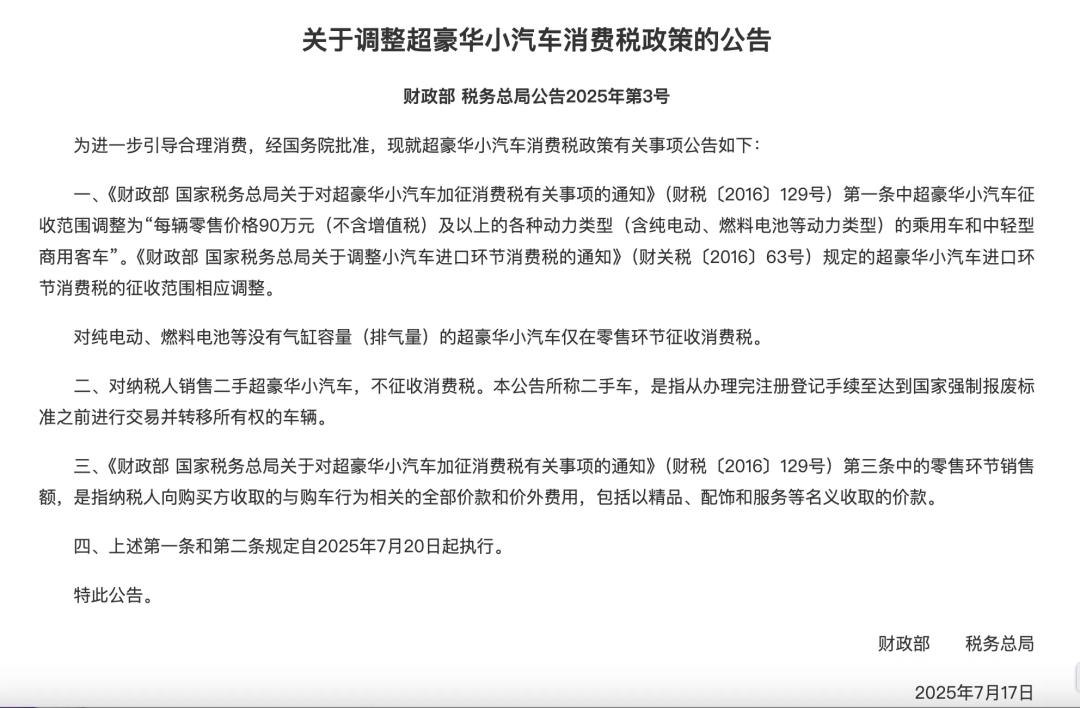
Core Viewpoint - The adjustment of the consumption tax policy for ultra-luxury cars in China has lowered the tax threshold from 1.3 million yuan to 900,000 yuan, effective from July 20, leading to significant price increases for certain luxury vehicles [1][5][4]. Group 1: Policy Changes - The new consumption tax policy now applies to ultra-luxury cars with a retail price of 900,000 yuan and above, including various power types [1][5]. - Previously, the threshold was set at 1.3 million yuan, indicating a substantial shift in the tax base [4][5]. - The new regulation is expected to create a price difference of approximately 10% for consumers purchasing vehicles just before the policy takes effect [5][6]. Group 2: Market Impact - Sales personnel from luxury car brands reported a surge in inquiries and purchases just before the policy change, indicating consumer urgency to avoid the new tax [5][6]. - Jaguar Land Rover has announced a temporary policy to absorb the additional tax costs for certain models until July 31, 2023, which may influence consumer purchasing decisions [6][19]. - The majority of affected vehicles fall within the price range of 1.017 million to 1.469 million yuan, with an estimated 20,000 units sold in the first half of the year, representing a small fraction of the overall luxury car market [19][22]. Group 3: Consumer Behavior - Consumers are encouraged to consider purchasing models priced below the new tax threshold to avoid additional costs, as demonstrated by sales personnel calculations [11][12]. - The price difference between models just below and above the threshold can lead to significant savings, prompting consumers to act quickly [11][12]. - The luxury car market is expected to see a shift in consumer preferences towards older models or those priced below the new tax threshold [11][12]. Group 4: Industry Expert Opinions - Industry experts suggest that the adjustment of the consumption tax threshold is a reasonable response to market conditions, as ultra-luxury vehicles represent a very small segment of the overall automotive market [22][23]. - The new tax policy is seen as a way to ensure tax compliance and stability in the market, emphasizing the importance of legitimate operations by dealers [22][23].
超豪华小汽车消费税扩围多部门规范新能源汽车竞争秩序
Huafu Securities· 2025-07-20 07:33
Investment Rating - The industry rating is "Outperform the Market" [7] Core Insights - The report discusses the expansion of the consumption tax on ultra-luxury cars and the regulation of the competitive order in the new energy vehicle (NEV) sector, which is expected to enhance the tax system in the automotive industry [11][12] - The NEV market in China is rapidly growing, transitioning from a fuel-based vehicle market to one dominated by electric vehicles, with recent policy adjustments aimed at guiding this transition [12][13] Summary by Sections Investment Highlights - On July 17, 2025, the Ministry of Finance and the State Administration of Taxation announced adjustments to the consumption tax policy for ultra-luxury cars, lowering the taxable price threshold from 1.3 million yuan to 900,000 yuan and including electric and fuel cell vehicles in the tax scope [11][12] - A meeting on July 18, 2025, involving key automotive enterprises and regulatory bodies, aimed to address irrational competition in the NEV sector and promote sustainable development through enhanced supervision, long-term mechanisms, standardization, and industry self-discipline [13] Market Performance - From July 14 to July 18, 2025, the automotive sector increased by 3.3%, outperforming the CSI 300 index by 2.2 percentage points, ranking third among 31 sectors [17][22] - Year-to-date, the automotive sector has risen by 11.3%, ranking tenth among the sectors [17] Key Data - Retail sales of passenger cars from July 1 to July 13, 2025, reached 571,000 units, a 7% increase year-on-year, while NEV retail sales were 332,000 units, up 26% year-on-year [35][36] - Wholesale figures for the same period showed passenger car sales at 555,000 units, a 34% increase year-on-year, with NEV wholesale sales at 316,000 units, a 37% increase year-on-year [36] Industry News - The report highlights significant developments in the automotive industry, including new vehicle launches and financial performance updates from major companies like North Vehicle Blue Valley and Jianghuai Automobile, which reported substantial losses due to competitive pressures [74][75]
汽车行业周报:鸿蒙智行多款重磅车型将于3季度上市,继续关注华为链整车及机器人链汽零-20250720
Orient Securities· 2025-07-20 05:13
Investment Rating - The report maintains a neutral investment rating for the automotive and components industry [5] Core Insights - The report emphasizes the upcoming launch of several key models from Hongmeng Zhixing in Q3, which are expected to perform well despite industry challenges [12][13] - It suggests continued focus on companies within the Huawei supply chain and the humanoid robotics sector, predicting that competitive domestic brands and new forces in intelligent driving technology will expand their market share by 2025 [14] - The report highlights that the sales growth of Hongmeng Zhixing related companies is expected to outperform the industry average due to the launch of new models and their positioning in the mid-to-high-end market [12][13] Summary by Sections Section 1: Market Outlook - The report notes that while some investors anticipate a slowdown in sales growth for the automotive industry in the second half of the year, it expects Hongmeng Zhixing related companies to perform better than the industry average [12] - The anticipated launch of the Shangjie H5 and other models is expected to drive sales upward for related companies [13] Section 2: Sales Tracking - In July, the automotive industry experienced a seasonal slowdown, yet wholesale sales increased significantly, with a year-on-year growth of 31% for the week of July 7-13 [18] - Cumulative wholesale sales for the year reached 13.83 million units, reflecting a 13% year-on-year increase [18] Section 3: Company Performance - The report lists several companies to watch, including SAIC Motor, BYD, and others, highlighting their expected performance and market positioning [15] - It notes that several component companies have reported strong half-year earnings, indicating resilience in the sector [49][50]



马斯克刚推出AI女友,被批内容露骨,又预告AI男友;特斯拉超级充电餐厅将开业:24小时营业,或引入Optimus机器人丨AI周报
创业邦· 2025-07-20 03:07
Core Viewpoints - The article highlights significant developments in the AI sector, including investment activities and technological advancements, providing insights into the global AI market trends during the week of July 12-18 [1]. Domestic Major Events - Yushu Technology has initiated its listing guidance with CITIC Securities as the advisory firm, with the controlling shareholder holding 34.76% of the company [3]. - ByteDance's visual model leader, Yang Jianchao, announced a temporary break, with Zhou Chang taking over his responsibilities [3]. - NVIDIA's CEO Jensen Huang emphasized the importance of open-source models in benefiting various industries, including healthcare and finance, during a conference [3][6]. - Yushu Technology has published a patent for a laser radar technology that enhances angle tracking precision and eliminates jitter interference [4]. Investment and Financing Overview - MiniMax is set to complete nearly $300 million in new financing, raising its valuation to over $4 billion, and is seeking an A-share listing [4]. - The week saw a total of 25 disclosed AI financing events globally, a decrease of 20 from the previous week, with a total financing scale of 5.375 billion RMB [43]. - In the domestic market, MiniMax led with a financing amount of nearly $300 million, focusing on multi-modal AI model development [52]. International Major Events - CoreWeave plans to invest $6 billion to establish an AI data center in Pennsylvania, with an initial capacity of 100 megawatts [28]. - OpenAI launched the ChatGPT Agent, capable of autonomous thinking and action [29]. - Meta has completed the acquisition of voice AI startup PlayAI, integrating its team into Meta [14]. - Apple is considering acquiring European AI startup Mistral, which has raised €1.1 billion, potentially marking its largest acquisition [34]. AI Financing Events - The highest disclosed financing in the overseas AI sector was for medical AI service provider OpenEvidence, which completed a $210 million Series B financing [55]. - The domestic AI financing events were primarily concentrated in Beijing and Jiangsu, with each reporting six events [48].



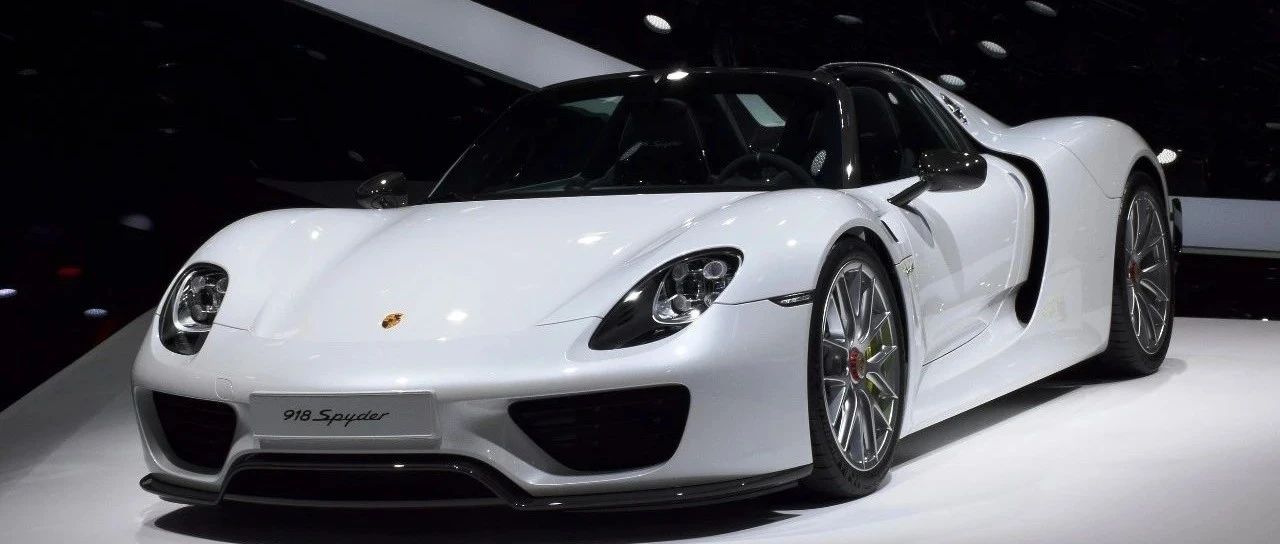
豪车税新规来了,保时捷掀抢购潮;奥迪S3原型车路测图曝光丨汽车交通日报
创业邦· 2025-07-19 10:20
Group 1 - The new luxury car consumption tax policy has led to a surge in demand for Porsche vehicles, particularly the 911 and Panamera models, with reports indicating that the inventory is extremely tight and prices are expected to rise significantly for late purchases [1] - Zeekr, a brand under Geely, has faced complaints from consumers regarding the sale of previously owned vehicles as new cars, leading to widespread dissatisfaction and calls for refunds, with no official response from the company as of yet [2] - BMW is planning to launch a new track package for the M2 model in 2026, which may include upgrades to the suspension, aerodynamics, and powertrain [3] Group 2 - Audi's S3 prototype has been spotted, featuring a larger digital dashboard and control screens, with expectations that it will follow the design trends of the A5 and Q3 models [4][5]

豪车税新规倒计时:保时捷掀抢购潮,销售称晚买两天贵十几万
财联社· 2025-07-19 06:02
Core Viewpoint - The new luxury car consumption tax policy, effective from July 20, 2025, lowers the tax threshold from 1.3 million yuan to 900,000 yuan, significantly impacting the sales of high-end brands like Porsche and Mercedes-Benz, which are expected to see increased consumer activity in the days leading up to the policy implementation [5][10][14]. Summary by Sections Tax Policy Changes - The new regulation expands the scope of luxury car consumption tax to include vehicles priced at 900,000 yuan (excluding VAT) and above, affecting various power types including electric and fuel cell vehicles [5][6]. - The previous tax threshold was set at 1.3 million yuan, meaning that new cars priced between 1.017 million yuan and 1.469 million yuan will now be subject to this tax [6][10]. Market Response - Porsche has experienced a surge in sales, with reports of selling seven cars in a single day as consumers rush to take advantage of the tax exemption before the new rules take effect [2][8]. - Sales representatives from Porsche noted that popular models like the 911 and Panamera are in high demand, with limited stock available [8][10]. Impact on Other Brands - Other luxury brands such as Mercedes-Benz and BMW will also be affected, with specific models like the S-Class and GLS falling under the new tax regulations [12]. - The luxury car market is expected to see a shift, with brands like Toyota's Alphard and Land Rover's Range Rover also impacted by the new tax policy [13]. Market Trends - The luxury car market has been facing challenges, with Porsche's sales in China dropping by 28% in 2024, and Mercedes-Benz experiencing a 7% decline in the same market [14][15]. - The new tax policy is seen as a response to the declining sales in the luxury segment, potentially leading to a further contraction in this market [15][16]. Future Outlook - The adjustment in tax policy may benefit domestic high-end brands, as the demand for imported luxury vehicles continues to decline [17]. - The overall luxury car market is anticipated to undergo significant changes as a result of this new tax regulation, potentially reshaping consumer preferences and brand strategies [18].