蔚来

Search documents
涨得比黄金还猛!“一盒堪比上海一套房”,业内人士:几乎一天一个价,还会涨
Sou Hu Cai Jing· 2026-01-08 11:05
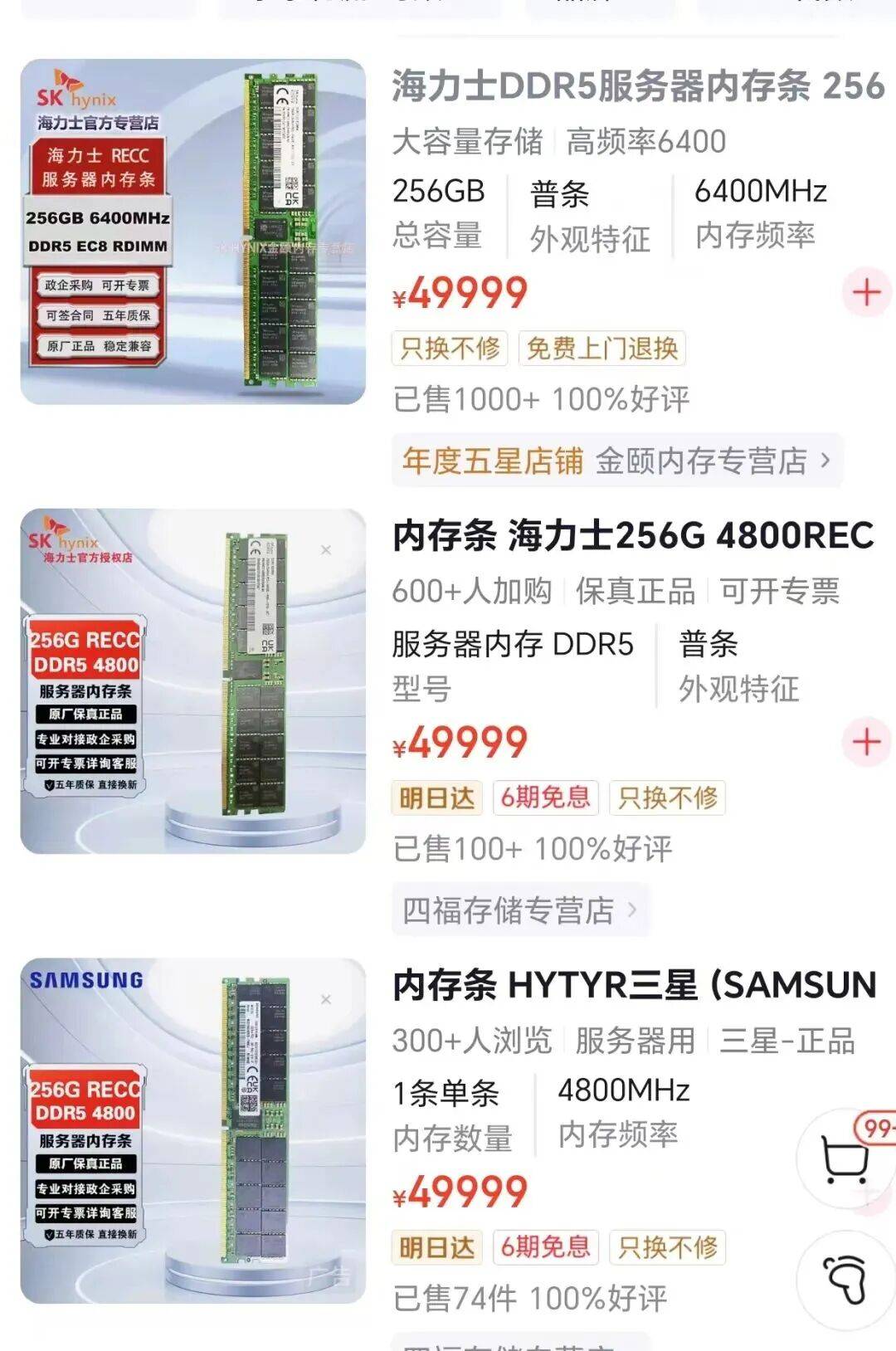
Group 1 - The price of memory modules has surged significantly, with some DDR5 server memory modules exceeding 40,000 yuan each, and prices have increased by 2-3 times within the year for both DDR4 and DDR5 [1][7] - TrendForce reported a dramatic increase in the spot prices of memory chips since September 2025, with DDR5 memory prices rising by 307% and DDR4 by 158% [7] - The demand for DRAM from AI servers is 8-10 times higher than that of regular servers, consuming 53% of global monthly production capacity, leading to a shift in production focus towards server storage [10][11] Group 2 - Major memory manufacturers like Samsung, SK Hynix, and Micron are adjusting their production strategies, focusing on high-margin products like HBM and DDR5, while reducing investments in DDR4 [11] - The price increases are expected to continue throughout 2026, with significant profit growth projected for companies like Samsung and SK Hynix, with expected operating profits increasing by 253% and 224% respectively [11] - The rising memory prices are impacting various sectors, including smartphones and the automotive industry, with companies like NIO highlighting memory price increases as a major cost pressure [12]


造车新势力10年沉浮:既分高下,也决生死
经济观察报· 2026-01-08 10:29
Core Viewpoint - The article discusses the evolution of China's new car-making forces over the past decade, highlighting the contrasting fates of companies like Leap Motor and Neta Auto, and the emergence of new players like Xiaomi and Huawei's Hongmeng Zhixing [2][4]. Group 1: Market Dynamics - By 2025, Leap Motor is projected to achieve nearly 600,000 annual sales, becoming the sales champion among new car-making forces, while Neta Auto faces auctioning due to its decline [2]. - The number of new car-making enterprises has drastically reduced from over 60 in 2015 to only a few that still report sales [2]. - The new rankings for 2025 among new car-making enterprises include Leap Motor, Hongmeng Zhixing, Xiaopeng, Li Auto, Xiaomi, and NIO [2]. Group 2: Rise of New Players - Leap Motor's sales reached 597,000 units in 2025, a 103% increase year-on-year, marking its first time at the top of the sales chart [4]. - Hongmeng Zhixing, although not a traditional new car-making force, has seen rapid growth with its AITO brand, achieving 445,000 units in 2024 and 589,000 units in 2025, a 32% increase [5]. - Xiaomi, entering the market later, achieved 120,000 units in its first year of delivery and 412,000 units in 2025, surpassing NIO, which has been in the market for ten years [5]. Group 3: Challenges for Established Players - NIO, once a leader, saw its sales drop to 326,000 units in 2025, despite launching new brands and models to regain market share [8]. - Xiaopeng Motors sold 429,000 units in 2025, a 126% increase, but faced challenges with product positioning and market competition [9]. - Li Auto's sales fell to 405,900 units in 2025, a 19.6% decline, as it struggled to meet its annual target of 640,000 units [10]. Group 4: Industry Consolidation - Many once-prominent new car-making enterprises have disappeared, categorized into three groups: those that failed before mass production, those that made strategic errors, and those that faced funding issues [12][13][14]. - The industry has undergone a brutal elimination process, with only a few companies remaining competitive as they face increasing pressure from new entrants and established brands [14]. - The next decade is expected to be even more complex, testing the operational efficiency and competitive capabilities of the remaining players [15].


蔚来站上百万辆台阶,李斌:已从谷底进入第三发展阶段
Jing Ji Guan Cha Bao· 2026-01-08 09:57
Core Insights - NIO has reached a significant milestone by rolling off its one millionth vehicle, marking a pivotal moment in its development journey [1] - The company aims to deliver 326,000 vehicles across its three brands in 2025, reflecting a year-on-year growth of 47% [1] - NIO's founder, Li Bin, indicates that the company is transitioning into its third development phase, characterized by improved sales performance and strategic goals [1][3] Group 1: Development Phases - The first phase of NIO's development lasted from its founding in 2014 until 2021, marked by a consistent annual sales growth of 100% [1] - The second phase, from 2022 to mid-2025, saw annual sales growth of 30%-40%, which was below industry expectations [1] - The third phase is expected to begin in the second half of 2025, with a rebound in sales and a focus on strategic growth [1][3] Group 2: Key Characteristics of the Third Phase - The third phase will feature collaboration among NIO, Ladao, and Firefly brands, targeting a wide user base with price ranges from 100,000 to 800,000 yuan [2] - NIO's investments in technology and R&D, totaling 65 billion yuan, are beginning to yield results, enhancing product competitiveness and improving gross margins [2] - The company's "chargeable, swappable, and upgradable" technology strategy is gaining market acceptance, as evidenced by record sales of the new ES8 and Ladao L90 [2] Group 3: Financial Outlook and Goals - NIO aims to achieve profitability in the fourth quarter of 2025, with confidence in improved gross margins from increased vehicle deliveries [3] - The company acknowledges that reaching one million vehicles is a small achievement relative to the overall market, maintaining a startup mentality [3] - Future efforts will focus on technology investment, infrastructure expansion, brand collaboration, and market penetration, with a goal of maintaining 40%-50% annual growth [3] Group 4: 2026 Plans - In 2026, NIO plans to transition all models to a third-generation platform and introduce new mid-to-large vehicles [4] - The company aims to add 1,000 new battery swap stations and enhance its sales and service network [4] - NIO's operational goal for 2026 is to achieve profitability while prioritizing growth quality and long-term development [4]
AI眼镜大战终局前瞻:阿里与百度的超级终端争夺战
3 6 Ke· 2026-01-08 09:54
Core Insights - The 2025 consumer electronics landscape is dominated by "AI glasses," with major players like Baidu and Alibaba launching significant products, leading to a global competition termed the "Hundred Glasses War" [1][12] - The competition is fundamentally about the control of the "next-generation super terminal" narrative, with a focus on hardware, AI capabilities, and ecosystem development [1][4] Group 1: Competition Focus - The competition has evolved from basic hardware comparisons to a multi-dimensional ecosystem battle, highlighting three core competitive focuses: lightweight design and user experience, practical AI capabilities, and ecosystem collaboration [1][4] - Baidu's Xiaodu AI Glasses Pro weighs 39 grams and offers a stylish design, while Alibaba's Quark AI Glasses provide two series targeting different user needs, emphasizing comfort and integrated prescription options [2][3] - The challenge of balancing display quality, battery life, and comfort is referred to as the "impossible triangle" in the industry [2] Group 2: AI Capabilities and Ecosystem - Baidu's AI glasses leverage the Wenxin Yiyan model for real-time translation, AI recognition, and meeting summaries, while Quark integrates its capabilities with local services like navigation and payment [3][4] - The two companies differ in their approaches: Baidu focuses on personal assistant features, while Quark emphasizes efficiency tools for local living [4] Group 3: Market Dynamics and Challenges - The current market faces high return rates, with traditional e-commerce platforms seeing around 30% and content platforms like Douyin reaching 40-50%, primarily due to insufficient functionality and user experience [6] - Key issues include mismatched battery life, inadequate functionality across devices, and a lack of perceived value for high-priced products, leading to consumer regret [6][7] Group 4: Future Outlook - The AI glasses market is expected to see significant growth, with global shipments projected to exceed 23.68 million units by 2026, and the Chinese market alone surpassing 4.91 million units [8][9] - The industry is anticipated to shift towards a model of "head concentration and segmented coexistence," with major players dominating the general market while niche companies focus on specialized areas [9][10] - Technological advancements are expected to address current limitations, with improvements in battery life, display technology, and the development of native applications [10][11] Group 5: Business Models and Consumer Adoption - The business model is shifting from hardware sales to a "hardware + service" subscription model, with companies like Quark and Baidu exploring service monetization strategies [10][11] - By 2026, AI glasses are projected to become more affordable, with prices potentially dropping to the 1500-2000 yuan range, making them more accessible to consumers [11]


李斌锁定了终局门票
Hua Er Jie Jian Wen· 2026-01-08 09:23
"蔚来还活着,活着就有机会"。 1月6日,被屡次质疑"还能够活多久"后,蔚来正式迎来了第100万辆量产车的交付,正式加入车企百万 俱乐部。 蔚来董事长李斌在现场发出了上述感慨。 而在造车新势力的阵营中,这一刻或许比此前任何一家车企的百万庆典都更具分量。 不同于增程模式的"曲线救国",也不同于内卷的以价换量,蔚来是用"高端纯电+换电模式"这一hard模 式跑通了商业闭环。李斌坦言,"自从做了蔚来,感觉进入到了一个无尽的游戏,泥泞路上的马拉松, 确实很辛苦"。好在蔚来在行业一轮轮洗牌中,依旧跟上了大部队。 正如蔚来联合创始人秦力洪所言,汽车行业的100万辆,对一个公司的成长来说是一个重要的里程碑, 也是一个是否能够长期存活的重要观察指标,意味着蔚来真正进入决赛圈。对于经历过"命悬一线"的蔚 来而言,这也是对"长期主义"的奖励。 过去几年,蔚来曾无数次被舆论问及"还能活多久",而站在百万辆的节点回望,蔚来之所以能活下来并 迎来增长,核心在于做对了两件极难的事:敢于在底层技术上进行"死磕式"投入,以及在基建服务上坚 持"笨功夫"。 李斌透露,蔚来累计在研发上投入了超过650亿人民币,这种投入深入到了最底层的硬骨头。甚 ...
2026仅1家目标销量翻倍,车企不再“放卫星”
凤凰网财经· 2026-01-08 08:09
Core Viewpoint - The Chinese automotive market, particularly in the new energy vehicle (NEV) sector, is transitioning from rapid growth to a more cautious approach, with manufacturers setting more conservative sales targets for 2026 compared to previous years [2]. Group 1: Sales Targets and Growth Rates - Traditional automakers are adopting more cautious growth targets, while new entrants, despite maintaining optimism, have reduced their aggressive growth ambitions [2]. - Among seven automotive manufacturers analyzed, only Leap Motor set a doubling sales target from 500,000 units in 2025 to 1 million in 2026 [2]. - Geely has the highest sales target for 2026 at 3.45 million units, representing a 14% growth from 2025, with a projected NEV sales target of 2.22 million units, up 32% from the previous year [5]. - Dongfeng aims for a total sales target of 3.25 million units in 2026, with an estimated growth rate exceeding 30% [5]. - Chery has set a target of 3.2 million units for 2026, reflecting a 14% increase from 2025 [6]. - Great Wall Motors has adjusted its 2026 sales target down to a minimum of 1.8 million units, a 36% increase from the previous year [6]. - NIO aims for a sales target of 456,000 to 489,000 units in 2026, maintaining a growth rate of 40%-50% [7]. Group 2: Market Dynamics and Strategies - The implementation of a halved purchase tax for NEVs and adjustments to subsidy policies are introducing new variables into the domestic automotive market [2]. - Dongfeng's new brand, Yipai Technology, plans to launch six new models by 2026, indicating a strategic focus on innovation [6]. - Xiaomi has set a sales target for 2026 that exceeds a 30% increase from last year's actual sales, with plans to upgrade its vehicle lineup [8]. - The new Xiaomi SU7 is expected to launch in April 2026, featuring advanced driving assistance hardware and improved range capabilities [8].





多家车企密集降价促销
Huan Qiu Shi Bao· 2026-01-08 08:01
Group 1 - Tesla China has launched a car purchase incentive program for Model 3/Y/Y L, offering a "7-year ultra-low interest" financing plan with a minimum down payment of 79,900 yuan and a monthly payment as low as 1,918 yuan. The Model Y L series is participating for the first time [1] - GAC Group has also announced promotional activities for its self-owned brands, including a limited-time purchase tax guarantee policy and additional subsidies for trade-ins or scrapping, with the maximum "government-enterprise subsidy" reaching 70,000 yuan for GAC Trumpchi [1] - NIO's Firefly brand is providing purchase benefits including a 10-year smart navigation assistance service and a 2,000 yuan purchase tax subsidy for locked-in users, along with repurchase rewards for existing customers [2] Group 2 - Traditional automakers like BMW have initiated significant price adjustments across 31 models, with the highest reduction for the BMW iX1, which dropped from 299,900 yuan to 228,000 yuan, a decrease of 24% [2] - Volvo has launched a limited-time promotion for its new XC70 model, including a direct purchase tax subsidy of 14,000 yuan, in response to the upcoming changes in the new energy vehicle purchase tax policy [2] - Dongfeng, Chery, Deep Blue, FAW-Volkswagen, and GAC Toyota are also implementing new year price reduction promotions for certain brands or models [3] Group 3 - The automotive industry is increasing discounts at the start of the year to counteract the impact of the new energy vehicle purchase tax increase, which will see a 50% reduction in tax for purchases made in 2026 and 2027, with a maximum tax exemption of 15,000 yuan [4] - Predictions indicate that the automotive market may decline in 2026 due to the adjustment of the purchase tax policy and the exit of national subsidies by the end of 2025, with many industry leaders forecasting a significant drop in the first quarter of this year [4] - The China Automobile Circulation Association forecasts a "good start" for the automotive market in January 2026, driven by pent-up demand for trade-in purchases and pre-festival buying needs, expecting demand in January to exceed that of December 2025 [4]
2025年CCC Digital Key™认证大幅攀升,进一步强化全球车辆安全接入标准影响力
Zhong Guo Qi Che Bao Wang· 2026-01-08 07:56
致力于通过标准化、安全、便捷的车联解决方案提升消费者体验的权威组织CCC全球车联联盟(Car Connectivity Consortium®),其旗 下CCC Digital Key™ 认证计划在2025年迎来爆发式增长,实现重要突破。过去一年中,CCC全球车联联盟累计为全球主流车企及零部件供 应商的115款产品授予认证。随着数字钥匙从早期创新迈向成为车辆访问与共享的核心组成部分,这一进展正深刻影响着汽车产业的未来 格局。 认证数量的快速增长,反映出该技术已在2025年覆盖全球各区域与不同制造商。 新获认证的整车品牌包括: · 奥迪 · 宝马 · 捷尼赛思 · 现代 · 银基 · 起亚 · 路特斯 · 领克 · Mahindra & Mahindra · 梅赛德斯-奔驰 · 蔚来 · 极星 · smart · 沃尔沃 · 小鹏汽车 · 极氪 新获认证的模块企业包括: · 泰雷兹 如需查看完整认证产品名单,可访问CCC认证产品展示页( CCC Certified Products Showcase)。 此次认证成果建立在2024年初步突破的基础上——当时宝马集团与NXP率先完成产品认证。2025年3月,CCC ...
雷军直播破防!当场回怼“营销大师”标签:听这俩字就恶心
Sou Hu Cai Jing· 2026-01-08 07:41
Core Viewpoint - Lei Jun, the founder of Xiaomi, reflects on being labeled a "marketing master," which originated from a humorous competition with Liu Qiangdong, highlighting the unintended consequences of such labels over the years [1][3] Group 1: Marketing and Brand Perception - Lei Jun expresses discomfort with the term "marketing," as it undermines the technical efforts and R&D investments made by Xiaomi [3] - The attention from competitors regarding Xiaomi's marketing indicates the company's significant market influence [4] Group 2: New Product Launch - The new generation SU7 has been launched with substantial upgrades, including enhanced safety features and improved battery performance, with the Pro version offering a maximum range of 902 kilometers [6][11] - The price increase for the SU7 is attributed to rising costs and added features, which may challenge consumer expectations of Xiaomi's high cost-performance ratio [4][8] Group 3: Company Response to Challenges - Xiaomi's public relations team has acknowledged past mistakes and is seeking to improve its image after facing negative publicity over the last several months [11] - Lei Jun emphasizes that the success of the SU7, which has delivered 360,000 units in just 1 year and 9 months, is due to product quality and genuine user engagement rather than solely marketing efforts [11]
告别“卡脖子”?2025年中国汽车芯片量产上车与高阶替代加速
Ju Chao Zi Xun· 2026-01-08 07:27
Core Viewpoint - In 2025, the Chinese automotive chip industry is expected to achieve significant breakthroughs in domestic substitution driven by the dual forces of the "new four modernizations" in the automotive industry and global technological competition, supported by policies, technological advancements, and market demand [2] Current Situation - National policies are enhancing top-level design, with the Ministry of Industry and Information Technology outlining key standards for smart connected vehicles and automotive chips, and the establishment of a testing laboratory for automotive-grade chips to support market regulation [3] - Local policies are providing targeted support, such as subsidies for companies achieving automotive-grade certification, and initiatives to promote the full chain transformation of automotive chips [3] - Collaborative efforts in the automotive chip supply chain are increasing, with partnerships formed between companies like Hongyi Chip and the Ministry of Industry, and various automotive innovation centers facilitating cooperation [4] Key Breakthroughs - Significant advancements in intelligent driving chips have been made, with companies like Chipone Technology and GAC Group developing high-performance chips that have begun mass production and collaboration with automotive manufacturers [5] - The domestic market for power semiconductor devices is rapidly increasing, with companies like BYD leading in IGBT power device installations and domestic MCU chip deliveries reaching over 200 million units [6] Core Trends - Technological innovation is driving the automotive chip industry towards high-quality development, with increasing demands for chip performance, integration, and energy efficiency [7] - The shift towards advanced processes and architecture optimization is evident, with 4nm technology becoming mainstream and 3nm technology entering the planning stage [7] - The demand for specialized chips is rising, with ASIC chips becoming the preferred choice for leading automotive companies due to their high performance and low power consumption [7] Expanding Substitution - The domestic market share for MCUs is projected to exceed 25% by 2026, with expectations for overall chip localization rates to surpass 50% by 2028 [8] - High-end chip substitution is accelerating, with domestic AI chips and SiC devices beginning to challenge international competitors in advanced driving scenarios [8] Future Outlook - 2025 is seen as a pivotal year for the Chinese automotive chip industry, with ongoing policy support, technological breakthroughs, and significant progress in domestic substitution [10] - The industry is expected to continue its focus on high-end, intelligent, and green technologies, with domestic chips playing a crucial role in the global automotive chip innovation landscape [10]