洋河股份

Search documents
销量爆了!吃喝板块猛攻,“茅五泸汾洋”齐涨!食品ETF(515710)盘中涨超1%
Xin Lang Ji Jin· 2025-09-29 06:33
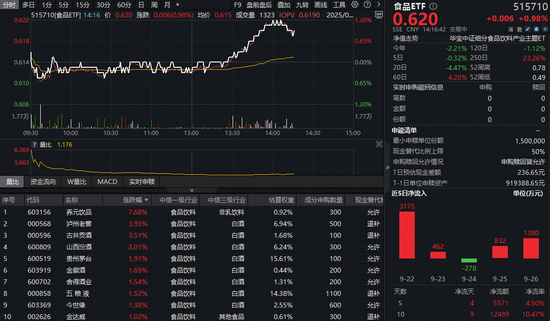
Group 1 - The food and beverage sector experienced a significant rally on September 29, with the Food ETF (515710) reaching an intraday price increase of up to 1.3% before settling at a 0.98% gain [1][3] - Key stocks in the sector showed strong performance, with Yangyuan Beverage soaring over 7%, and major liquor brands like Luzhou Laojiao and Gujing Gongji rising over 3% [1][3] - The Food ETF (515710) has seen substantial net inflows, with a total of 55.71 million yuan in net subscriptions over the last five trading days, indicating strong investor interest [3] Group 2 - Sales of popular gift items such as liquor and mooncakes surged ahead of the Mid-Autumn and National Day holidays, with liquor sales on Meituan increasing approximately eightfold year-on-year [3][4] - The current valuation of the food and beverage sector is considered low, with the food index's price-to-earnings ratio at 20.21, placing it in the lower 5.88% percentile over the past decade, suggesting a favorable investment opportunity [3][4] - Analysts predict a recovery in the liquor sector due to government policies promoting high-quality development, with expectations for Maotai's prices to rebound as market conditions improve [4][5] Group 3 - The food and beverage industry is witnessing significant policy catalysts, such as the upcoming public consultation on the national standards for prepared food safety, which may benefit leading brands [4][5] - The Food ETF (515710) is strategically positioned, with approximately 60% of its holdings in leading high-end and mid-range liquor stocks, and nearly 40% in other beverage and food segments [5] - Investors can also access core assets in the food and beverage sector through the Food ETF linked funds [5]







2025年第39周:酒行业周度市场观察
艾瑞咨询· 2025-09-29 00:05
Industry Environment - The white liquor industry is shifting its endorsement strategy from middle-aged male celebrities to younger, diverse stars like G.E.M. and Zhang Yixing, reflecting a trend towards a more youthful and lifestyle-oriented brand image [2][3] - The light bottle liquor market is experiencing a bifurcation, with traditional brands like Niulanshan facing significant revenue declines due to price competition, while high-quality products like Fenjiu's Guofen are in high demand, indicating a shift towards quality and brand strength in the market [4][5] - The upcoming 2025 China Open tennis tournament will feature enhanced spectator experiences and cultural integration, with Luzhou Laojiao as the exclusive partner, promoting Chinese liquor culture [5] - The high-end beer market is undergoing significant changes, with CR Beer surpassing Budweiser APAC in revenue, indicating the rise of local brands in the premium segment despite overall market contraction [6] - The banquet market is emerging as a new battleground for liquor companies, with several firms reporting double-digit growth in this segment as they adapt to changing consumer preferences [7] - Eight listed liquor companies reported direct sales revenue exceeding 640 billion yuan in the first half of the year, with Moutai and Wuliangye leading the market [8] - The past decade has seen significant changes in the regional liquor market, with notable growth among regional leaders while others struggle due to strategic missteps [9] Key Trends - The trend towards lower alcohol content in liquor is gaining traction, with companies like Wuliangye and Luzhou Laojiao launching lower-alcohol products to attract younger consumers, and the low-alcohol market expected to grow significantly [11] - Regional liquor companies are leveraging local sports events for marketing, enhancing brand connection with consumers, although the effectiveness of such strategies remains to be seen [12] - The first China Liquor Market Prosperity Index was released, indicating a favorable outlook for online sales and low-alcohol products driving consumption [10] Company Dynamics - Songhe Liquor is upgrading its quality strategy with a commitment to long-term aging processes, aiming to enhance its market position [13] - The launch of "Dazhen·Zhenjiu" has seen strong initial sales, indicating a successful entry into the high-end liquor market through strategic partnerships and pricing control [14] - Gujing Gongjiu is integrating cultural elements into consumer experiences, showcasing the importance of cultural heritage in modern marketing strategies [15] - The "Jiuxiao Er" brand is focusing on immediate retail and digital transformation to enhance consumer engagement and market presence [14][19] - Yanghe's summer marketing campaign successfully connected the brand with consumer experiences through sports and cultural events, emphasizing the importance of experiential marketing [20] Emerging Opportunities - The introduction of herbal yellow wine "Bencao Bang" targets health-conscious consumers, indicating a trend towards health-oriented products in the liquor market [21] - A strategic partnership between Huajun Media and Bojiangfang aims to reshape the market for sauce-flavored liquor through quality certification and consumer engagement [22] - The launch of UMEET blueberry distilled liquor exemplifies the industry's shift towards catering to younger, health-conscious consumers with innovative products [24]



中经酒业周报∣8酒企上榜中国制造业企业500强,2025年IWSC首届中国区(邛崃)烈性酒大赛启动,茅台9月终端动销同比增20%
Xin Hua Cai Jing· 2025-09-28 11:16
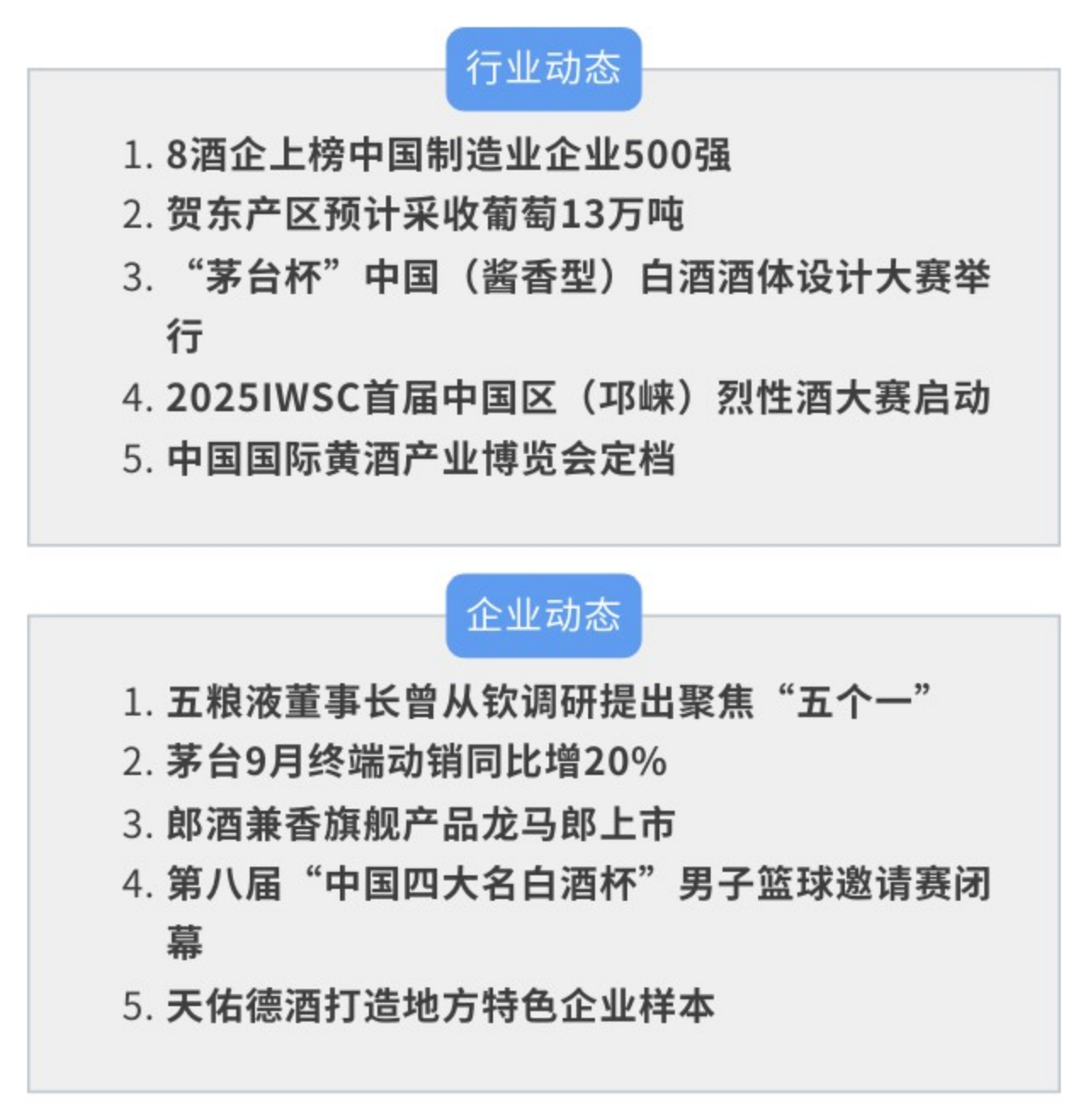
Industry Dynamics - Eight liquor companies made it to the list of China's top 500 manufacturing enterprises, including Sichuan Yibin Wuliangye Group, Guizhou Moutai, and Luzhou Laojiao [2] - The grape harvest season in the Helan Mountain East region started in mid-August and is expected to last until early October, with an estimated 130,000 tons of wine grapes to be harvested this year [3] - The "Moutai Cup" Chinese (Sauce Aroma) Baijiu Body Design Competition was held, with participants from 11 provinces, and a contestant from Guizhou Moutai winning first place [3] - The first China (Qionglai) Spirits Competition was launched, aiming to enhance the international brand recognition of Qionglai liquor [3] - The 2025 China International Huangjiu Industry Expo is scheduled for November 7-12 in Shaoxing, Zhejiang, featuring six exhibition areas and multiple related events [4] Company Dynamics - Wuliangye's chairman emphasized focusing on five strategies to enhance market presence and consumer engagement during a recent market research tour [5] - Moutai reported a 20% year-on-year increase in terminal sales for September, indicating a positive market trend [5] - Langjiu launched its flagship product "Longma Lang," which combines strong and sauce aroma techniques, as part of its ongoing product strategy [5] - The eighth "Four Famous Baijiu Cup" basketball invitation tournament concluded, with the Shaanxi team winning the championship [6] - Tianyoude Liquor, the only listed company in Qinghai's liquor industry, is focusing on local特色 and has developed a tourist attraction that has become popular among visitors [6]

25年中秋国庆白酒渠道跟踪专题报告:需求缺口依然存在,马太效应加剧
CMS· 2025-09-28 10:33
Investment Rating - The report maintains a strong buy rating for key companies such as Guizhou Moutai, Wuliangye, and Shanxi Fenjiu, while recommending an increase in holdings for companies like Yingjia Grape Wine and Kuaijie Wine [8][33]. Core Insights - The demand gap remains significant, with a 20% year-on-year decline in sales during the Mid-Autumn Festival and National Day holidays, despite a month-on-month improvement [2][11]. - The report highlights a continued "Matthew Effect," where leading brands like Moutai and Wuliangye are gaining market share at the expense of lower-tier competitors [2][8]. - The recovery of high-end liquor sales is slow, with a notable increase in demand for mid-range and low-end products, particularly in banquet settings [3][12]. Summary by Sections 1. Sales Feedback for the Holiday Season - Sales performance during the Mid-Autumn Festival and National Day was generally flat, with a 20% decline compared to the previous year, although there was a month-on-month improvement [2][11]. - Mid-range and low-end liquor sales outperformed high-end products, with brands like Moutai and Wuliangye gradually capturing market share from competitors due to price declines [2][12]. 2. Company Tracking - Guizhou Moutai's sales are on track, with a completion rate of approximately 75% for the year, and inventory levels are stable at 0.5-1 month [26][31]. - Wuliangye's sales completion rate is around 70%, with inventory levels between 1-2 months, and recent promotional efforts have improved dealer confidence [26][31]. - Shanxi Fenjiu maintains a completion rate of 75%-80%, with stable inventory levels and a strong market presence for its products [27][31]. 3. Investment Recommendations - The report suggests focusing on companies that are showing resilience and potential for recovery, particularly those that have adjusted their strategies ahead of the market, such as Shanxi Fenjiu and Guizhou Moutai [32][33]. - The anticipated recovery in demand for white liquor is expected to be supported by a positive price index in 2026, which may lead to inflation and increased profitability for companies in the sector [4][32].
文化何以成为战略
Sou Hu Cai Jing· 2025-09-28 06:45
Group 1 - The core viewpoint emphasizes the need for traditional brands to find new positioning strategies to navigate consumer cycles and for new brands to achieve rapid growth across categories [1] - Cultural strategy has become a key element in brand strategy, especially in the high-end market, where product characteristics alone are insufficient to build brand momentum [2][4] - The Chinese market shows a disparity in brand momentum between local and international brands, with examples like China Red Bull and Austrian Red Bull illustrating different market scales and brand strategies [4] Group 2 - The white liquor industry in China is experiencing a shift from quantity to quality, with market size increasing from 536.4 billion yuan in 2018 to 756.3 billion yuan in 2023, despite production halving [8] - Major liquor brands are adopting cultural strategies to connect with younger consumers, moving from traditional relationship-based consumption to self-expression and cultural values [9] - Successful brands like Moutai and Wuliangye are developing comprehensive cultural systems to enhance their brand value and consumer connection [9] Group 3 - The article discusses the pitfalls of brands that focus solely on product attributes, such as Wanglaoji and Six Walnut, which have struggled to maintain market relevance [4][5] - The case of Nongfu Spring illustrates the importance of evolving brand narratives beyond product quality to include cultural and environmental themes, leading to a resurgence in market leadership [7] - The need for liquor brands to embrace cultural strategies is highlighted, as many still rely on outdated marketing approaches that fail to resonate with modern consumers [12] Group 4 - The article notes that many liquor brands lack a strategic understanding of consumer culture, which hinders their ability to establish effective brand positioning [12] - It emphasizes the importance of emotional and ideological engagement in building brand culture, as seen in successful examples from both domestic and international markets [15] - The competitive landscape necessitates that brands connect consumer culture with added value to differentiate themselves effectively [17]



周度市场观察:酒行业-20250927
Ai Rui Zi Xun· 2025-09-27 08:46
Investment Rating - The report does not explicitly provide an investment rating for the industry Core Insights - The white liquor industry is undergoing a significant transformation with a shift towards younger and more diverse brand ambassadors, moving from traditional middle-aged male figures to younger celebrities to connect with new generations of consumers [2] - The high-end beer market is experiencing a competitive shift, with local brands like China Resources and Qingdao Beer gaining ground against international players like Budweiser [4] - The banquet market is emerging as a new battleground for revenue growth, with several liquor companies reporting double-digit growth in this segment [5] - The direct sales revenue of eight listed liquor companies exceeded 640 billion yuan in the first half of the year, with Moutai and Wuliangye leading the market [6] - The low-alcohol product segment is rapidly growing, with expectations to surpass 742 billion yuan by 2025, driven by changing consumer preferences [8] Summary by Sections Industry Trends - The white liquor industry is shifting towards younger brand ambassadors, reflecting a broader trend of appealing to younger consumers through lifestyle marketing [2] - The light bottle liquor market is experiencing a split, with traditional brands struggling while high-quality products like Guojiao are in high demand [2] - The high-end beer market is seeing local brands outperform international ones, with China Resources surpassing Budweiser in revenue [4] - The banquet market is becoming a key area for growth as companies adapt to changing consumer behaviors [5] - The direct sales model is gaining traction, with significant revenue growth reported by leading companies [6] - The low-alcohol segment is expected to grow rapidly, indicating a shift in consumer preferences towards lighter beverages [8] Top Brand News - Songhe Liquor is enhancing its quality strategy and aims for long-term growth through a focus on aged products [10] - The launch of "Dazhen·Zhenjiu" marks a significant entry into the high-end liquor market, leveraging a strong sales strategy [11] - Gujing Gongjiu is integrating cultural elements into consumer experiences to enhance brand engagement [13] - The "UMEET" blueberry distilled liquor targets younger consumers by combining health and quality [20] - The collaboration between Huajun Media and Bojiangfang aims to reshape the market for sauce-flavored liquor through strategic marketing [19]
11只白酒股下跌 贵州茅台1435元/股收盘
Bei Jing Shang Bao· 2025-09-26 15:48
Core Viewpoint - The liquor sector is experiencing a decline in stock prices, with major companies like Kweichow Moutai and Wuliangye seeing decreases, while the overall cash flow situation for distributors is gradually improving despite lower order volumes [1] Industry Summary - The Shanghai Composite Index closed at 3828.11 points, down 0.65%, with the liquor sector index at 2239.12 points, down 0.41% [1] - Eleven liquor stocks reported declines, including Kweichow Moutai at 1435.00 CNY per share (down 0.28%), Wuliangye at 120.17 CNY (down 1.11%), Shanxi Fenjiu at 191.16 CNY (down 0.64%), Luzhou Laojiao at 127.58 CNY (down 1.45%), and Yanghe Brewery at 67.95 CNY (down 0.59%) [1] Company Summary - Huachuang Food and Beverage's report indicates that while liquor companies are facing damaged financial statements, they are focusing on maintaining channel ecosystems and are not aggressively pushing inventory [1] - Companies are easing the pressure on cash flow by slowing down the collection of payments, which reduces the financial burden on distributors [1] - Distributors are managing cash flow more cautiously, cleaning up accounts receivable from end customers, and requiring cash payments for purchases, leading to a gradual improvement in cash flow [1]
“看一场少一场”,64岁刘德华演唱会爆了!茅台、洋河都出手了……
Mei Ri Jing Ji Xin Wen· 2025-09-26 14:51
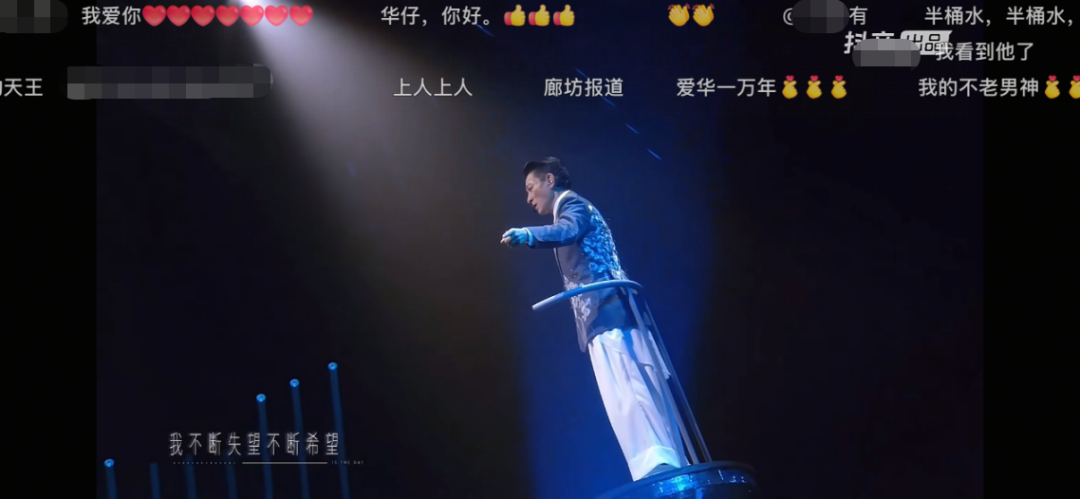
Group 1 - The online concert "Today...is the Day" by Andy Lau attracted significant viewership, with over 30 songs performed and a total of 82.4 million views during the two and a half hours of streaming [1][3] - The concert was sponsored by "Moutai 1935" and was free for all viewers, while the offline tour in 2024 has already secured sponsorship from "Yanghe Dream Blue M6+" [3][4] - The concert's popularity highlights the ongoing trend of concert sponsorships by liquor brands, with over 20 well-known liquor brands sponsoring more than 100 concerts in 2023 [4][5] Group 2 - Liquor companies are targeting younger consumers through concert sponsorships to change perceptions of liquor being "old," "expensive," and "hard to access" [5][8] - Sponsorships of concerts featuring classic artists like Andy Lau and Dao Lang serve to engage older demographics, creating a sense of nostalgia and driving sales through ticket promotions linked to liquor purchases [8][10] - The trend of liquor brands sponsoring concerts is seen as a strategy to enhance brand visibility and potentially generate over 100 million in sales [12] Group 3 - The success of concerts featuring older artists like Dao Lang and Andy Lau indicates a growing cultural consumption demand among middle-aged and elderly demographics, often referred to as the "silver economy" [13][14] - The internet penetration rate among the elderly is increasing, with 52% expected by June 2025, leading to a rise in cultural consumption from this group [16][18] - The popularity of online concerts among older audiences reflects a shift in the music industry, with artists like Cui Jian and Luo Dayou attracting millions of viewers, indicating a strong market for live performances targeting this demographic [16][18]
白酒降度,一场应付股东的仓促试验
3 6 Ke· 2025-09-26 13:06
Core Viewpoint - The low-alcohol liquor trend cannot save the liquor industry, as historical evidence shows that high-end products are the true drivers of recovery during downturns [1][2][10]. Group 1: Industry Challenges - The liquor industry has faced multiple crises, including the 1989 Asian financial crisis and the 2012 eight-point regulation, leading to a recurring trend of low-alcohol products [1][3]. - High-end liquor consumption is primarily driven by business scenarios, with Moutai's business receptions accounting for 50%, gifts 30%, and banquets 10% of its sales [3][10]. - The current push towards low-alcohol products by major liquor companies is seen as a response to shareholder pressure rather than a strategic shift [3][13]. Group 2: Low-Alcohol Liquor Dynamics - Major liquor companies are increasingly launching low-alcohol products, with some going below 30 degrees, such as Shede's 29-degree product and others planning even lower offerings [5][6]. - Historical attempts at low-alcohol liquor have not significantly impacted the industry, with high-end products being the key to recovery during past downturns [10][12]. - Low-alcohol liquor is often associated with lower quality, making it less suitable for high-end business contexts [12]. Group 3: Future Directions - The industry needs to shed the burden of short-term performance pressures and focus on creating a healthier market environment for long-term growth [4][14]. - Despite current challenges, the liquor industry has a strong underlying support due to the involvement of local state-owned enterprises, which are unlikely to let the industry fail [14]. - Companies are currently facing issues with inventory management, as evidenced by a 12.5% increase in average inventory and a rise in inventory turnover days [15].
【招银研究|House View】政策有望“空中加油”,风险偏好仍有支撑——招商银行研究院HouseView(2025年四季度)
招商银行研究· 2025-09-26 11:04
Group 1: Economic Overview - The U.S. economy is showing strong growth driven by consumer spending, with a projected GDP growth rate of 3.3% for Q3, significantly higher than the previous half-year average [14][26] - However, employment figures are declining, with an average of only 27,000 new jobs added from May to August, leading to a rise in the unemployment rate to 4.3% [16][19] - The divergence between strong economic performance and weak employment is attributed to structural factors and the lag in hiring adjustments by companies [21][22] Group 2: Monetary Policy - The Federal Reserve has restarted its rate-cutting cycle, lowering the policy rate by 25 basis points to a range of 4.0-4.25% [16][26] - The dual monetary and fiscal easing is expected to support economic resilience, although inflationary pressures remain a concern [32][26] - The Fed's cautious approach to further rate cuts is influenced by the need to balance employment and inflation risks [32][26] Group 3: International Economic Context - The European Central Bank and the Bank of Japan have maintained their interest rates, with the ECB indicating no immediate need for further cuts [36][46] - The Eurozone is experiencing a mixed economic recovery, with manufacturing underperforming while services remain stable [36][37] - Japan's central bank is showing signs of potential policy normalization, with discussions around interest rate hikes becoming more prominent [46][47] Group 4: Asset Allocation Recommendations - The investment strategy suggests maintaining a balanced allocation in equities, particularly in sectors like technology and consumer goods, while being cautious of high valuations [49][50] - Fixed income investments are recommended to focus on short to medium-term bonds due to the uncertain long-term interest rate outlook [56][57] - Gold is expected to continue its bullish trend, supported by the Fed's rate cuts and ongoing central bank purchases [71][72] Group 5: Market Trends - The U.S. stock market is projected to continue its upward trend, driven by strong corporate earnings, particularly in the technology sector [49][50] - The bond market is expected to experience a steepening yield curve, with short-term rates declining while long-term rates remain under pressure [56][58] - Currency markets are anticipated to see the U.S. dollar maintain a range-bound trading pattern, influenced by the Fed's monetary policy and global economic conditions [62][63]