
宝马

Search documents
“整个汽车行业都看到了中国反制的威力,正极度恐慌”
Guan Cha Zhe Wang· 2025-06-10 08:50
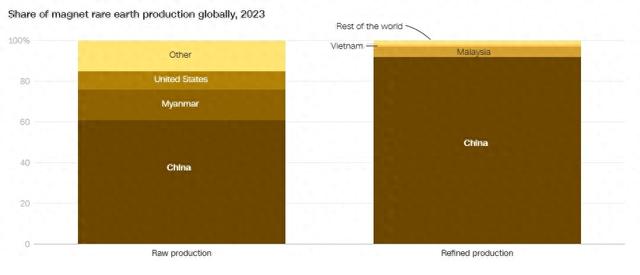
Core Viewpoint - China's export control on rare earth elements aligns with international practices and is not targeted at specific countries, but it has led to significant concerns in the Western automotive industry about potential supply shortages and the implications of "weaponizing" rare earths [1][2]. Group 1: Impact on Automotive Industry - The automotive industry is experiencing panic due to China's rare earth export restrictions, with manufacturers fearing a supply crisis that could lead to factory shutdowns by mid-July [1][5]. - Major automotive manufacturers are exploring alternative sources for rare earth magnets, but progress is slow, and many are considering stockpiling or temporarily closing production lines [1][5][12]. - The European automotive supply sector is already facing factory closures, with warnings that more shutdowns are imminent due to the ongoing supply chain issues [5][12]. Group 2: China's Dominance in Rare Earths - China controls over 70% of global rare earth mining, 85% of refining capacity, and approximately 90% of rare earth metal alloys and magnet production, indicating a near-monopoly in the sector [6][4]. - The reliance on Chinese rare earths is critical for various automotive components, including electric vehicle engines, with an average electric vehicle consuming about 0.5 kg of rare earth elements [6]. Group 3: Challenges in Finding Alternatives - Efforts by Western automakers to reduce dependence on Chinese rare earths are ongoing, but many initiatives will take years to materialize, and few companies can scale production to lower costs effectively [8][10]. - Some companies are developing products that do not require rare earth elements, but these innovations are not expected to be implemented in mainstream vehicles for several years [10]. Group 4: Broader Supply Chain Concerns - The ongoing trade tensions and supply chain disruptions have prompted automotive companies to reassess their supply chain strategies, prioritizing backup supplies for critical components [5][12]. - Analysts suggest that the supply shortages may force manufacturers to produce vehicles without certain components or to temporarily halt production, highlighting the fragility of the current supply chain [12].

中国电车的统治时代!大摩4月全球电车市场统计:比亚迪、吉利位居前二,特斯拉份额下滑
Hua Er Jie Jian Wen· 2025-06-10 01:48
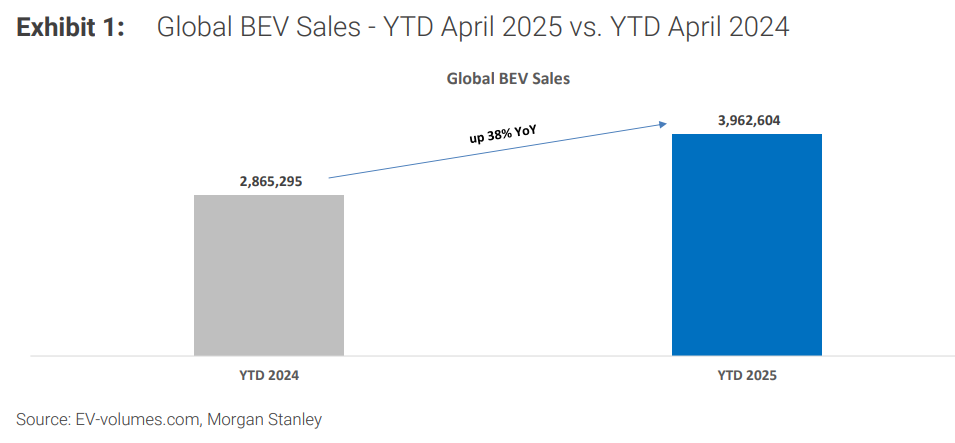
Core Insights - The global electric vehicle (EV) market is experiencing a significant shift towards dominance by Chinese manufacturers, with a 38% year-on-year increase in sales to 1.079 million units in April 2025, driven largely by a 51% increase in the Chinese market [1][8] - Morgan Stanley's report highlights that BYD and Geely are leading in sales, while Tesla's market share has declined from 10.7% to 7.9% [6][11] Market Performance - In April 2025, China accounted for 66.25 million units sold, a 51% increase, with a market penetration rate rising from 22.4% to 30.2% [8] - Europe saw a 30% increase in sales to 21.43 million units, achieving a penetration rate of 19.9% [8] - The U.S. market showed a decline, with sales dropping 4% to 9.54 million units and a penetration rate falling from 7.4% to 6.5% [8] Manufacturer Rankings - BYD led the global EV sales with 181,009 units and a 17% market share, followed by Geely with 100,764 units and a 9% share [11][12] - General Motors ranked third with 96,014 units, while Tesla's sales fell to 84,780 units, marking a 17% decline [11][12] - Tesla's market share in the U.S. also decreased from 46.0% to 41.0% [12] Battery Technology - The global battery deployment reached 6.68 million MWh in April, a 32% increase year-on-year [14] - The share of lithium iron phosphate (LFP) batteries rose from 35% to 44%, while nickel manganese cobalt (NMC) batteries decreased from 54% to 47%, indicating a strategic advantage for Chinese manufacturers in cost control and technology selection [16]



固态电池产业调研更新
2025-06-09 15:30
Summary of Solid-State Battery Industry Research Update Industry Overview - The solid-state battery industry is experiencing significant advancements, particularly in the development of sulfide solid-state batteries, which are favored for their superior conductivity compared to oxide alternatives. Major companies like CATL and BYD are actively pursuing the sulfide route, accelerating product launches and industry progress [1][5][7]. Key Points Cost Reduction Potential - Solid-state batteries have substantial cost reduction potential by utilizing higher voltage platforms and higher capacity electrode materials. For instance, CATL's next-generation solid-state battery may achieve 500 Wh/kg, which could reduce material consumption by 60% compared to current lithium iron phosphate batteries [2][5]. Market Trends - The solid-state battery technology is transitioning from pilot to mass production, with automotive-grade batteries reaching a 60 Ah application state, indicating readiness for road testing and commercial production. CATL and BYD are expected to undergo mid-term assessments by the Ministry of Industry and Information Technology and the Ministry of Finance in September 2025 [1][8]. Sulfide Electrolyte Development - The sulfide electrolyte technology is rapidly evolving, with several companies showcasing products with conductivity nearing that of liquid electrolytes. Companies like Ruigu New Materials, Yuyuan Tianci, and Solid State Technology are leading in this field, with a 300 kg production line already operational [1][9][10]. Production Techniques - Various production techniques for sulfide electrolytes are being explored, including liquid-phase, solid-phase, carbothermal reduction, and CVD methods. The CVD method, used by Xiamen Tungsten New Energy, is noted for its potential to achieve low-cost production [1][11]. Equipment Market - Key players in the solid-state battery equipment market include Honggong Technology and Nacronor, focusing on material automation processing and rolling equipment, respectively. Investment in solid-state battery sectors should prioritize sulfide electrolyte materials and related equipment [3][12]. Investment Recommendations - Investment opportunities should focus on companies involved in sulfide electrolyte materials and related equipment, such as Xiamen Tungsten New Energy, Guanghua Technology, and Yuyuan New Materials, which show significant growth potential and reasonable valuations [3][13][14]. Industry Challenges - Smaller battery companies face challenges in leveraging solid-state technology due to strict electrochemical laws, making it difficult to achieve breakthroughs without substantial technological advancements [4]. Future Outlook - The solid-state battery industry is currently transitioning from small-scale trials to mid-scale production, with expectations for increased product output and capacity expansion in the coming year [15]. Notable Company Developments - Xiamen Tungsten is expected to achieve significant performance improvements in its lithium cobalt oxide products, while Yuyuan New Materials has made rapid advancements in high-purity lithium sulfide production, collaborating closely with major clients like CATL and Huawei [21][22][23]. Emerging Players - Companies like Sanxiang New Materials in the halide electrolyte sector are also showing promise, with significant growth expected in the coming years if breakthroughs are achieved [24][25]. Conclusion - The solid-state battery industry is poised for rapid growth, driven by advancements in sulfide technology and increasing investments in production capabilities. Key players are well-positioned to capitalize on these trends, making it a compelling area for investment.



情绪价值拉满的萤火虫,能否照亮蔚来的盈利之路?
2 1 Shi Ji Jing Ji Bao Dao· 2025-06-09 13:03
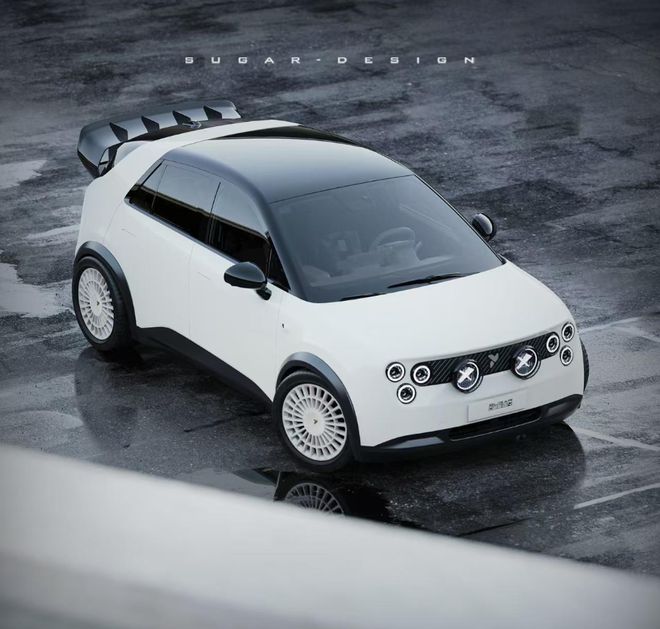
Core Insights - NIO's new brand "Firefly" has achieved a sales volume of 3,680 units in its first complete month of delivery, surpassing the combined sales of Mini and Smart electric vehicles in April [1][15] - The company aims to reach a monthly sales target of 50,000 units by Q4 2025, with Firefly expected to contribute 3,000 to 5,000 units [1][16] - The Firefly brand targets middle-class families and young consumers who prioritize emotional value and design over cost [2][4] Sales Performance - Firefly's sales in May exceeded those of Mini and Smart combined, indicating strong market acceptance [1][15] - The A0 segment, which includes Firefly, saw a significant year-on-year growth of 94% in wholesale sales in April 2025 [14] Market Positioning - Firefly is positioned as a premium small car, competing against models like BMW Mini, Mercedes Smart, and Volkswagen ID.3 [4][8] - The brand's unique design has garnered attention, transforming it into a "social media star" at events like the Shanghai Auto Show [1][2] User Demographics - Firefly's customers are primarily existing car owners looking for a second vehicle or young professionals seeking their first car [2][4] - The emotional value and distinctive design of Firefly appeal to consumers who are willing to pay a premium for these attributes [2][4] Product Features - Firefly features a user-friendly interface and advanced driving assistance systems, including a high-performance hardware setup [9] - The vehicle offers ample storage space, with a total capacity of 1,253 liters in the trunk and 92 liters in the front [9] Challenges and Concerns - Despite initial success, Firefly faces challenges in sales training and customer service, with reports of sales staff lacking product knowledge [12] - The vehicle's battery and lack of certain features, such as a heat pump air conditioning system, have raised concerns among potential buyers [13] Strategic Direction - NIO is integrating Firefly into its main operations to streamline resources and enhance profitability ahead of the Q4 2025 targets [16] - The brand's focus on emotional value may clash with the need for profitability, highlighting a tension between market positioning and financial sustainability [16]

全场景需求爆发!46大圆柱黑马“抢跑”
起点锂电· 2025-06-09 10:34
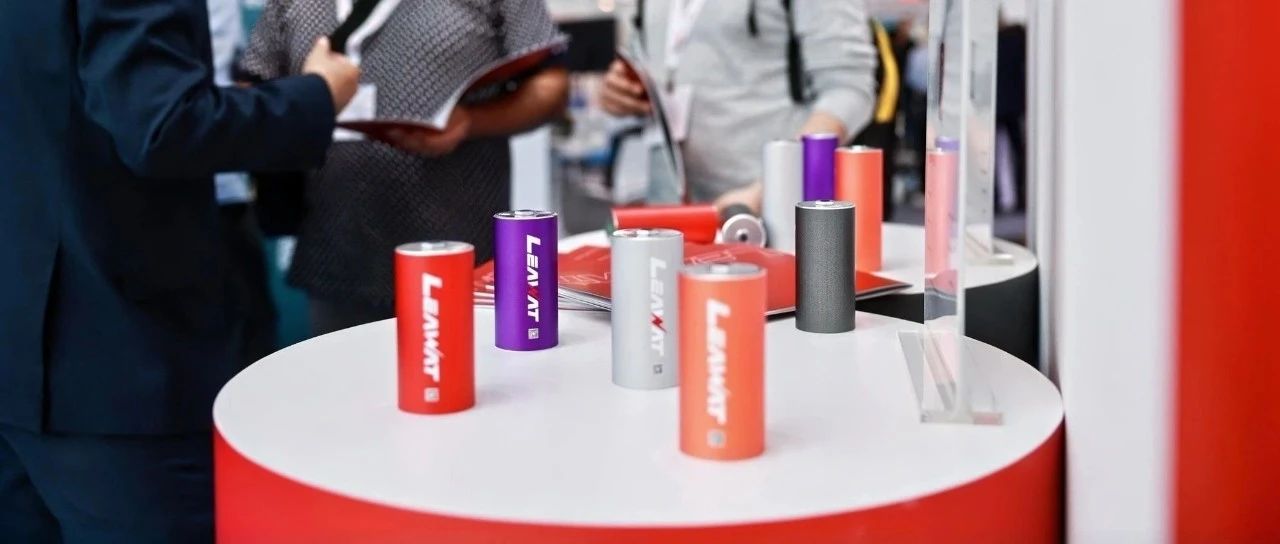
Core Viewpoint - The article emphasizes the expanding application boundaries of 46 large cylindrical batteries, with significant growth expected in various sectors, particularly in electric vehicles and energy storage, driven by advancements in production technology and industry collaboration [1][2][4]. Group 1: Market Growth and Demand - Global shipments of cylindrical batteries are projected to reach 14.61 billion units in 2024, with a year-on-year growth rate exceeding 10.9%, and large cylindrical models experiencing growth rates over 50% [1]. - By 2025, the market for large cylindrical batteries is expected to expand significantly across various applications, including electric vehicles, energy storage, and emerging markets such as humanoid robots and AI data centers [1][2]. - The demand for high-rate batteries is anticipated to increase, with high-rate batteries expected to account for 30% of drone costs and 15% of eVTOL costs, indicating a pressing need for their development [7]. Group 2: Technological Innovations - Lihua Power has introduced a star product, the ultra-high rate 46 series large cylindrical battery, which addresses fast charging concerns in the new energy sector [7]. - The innovative all-pathless ear structure developed by Lihua Power effectively resolves current bottlenecks, achieving a continuous discharge capability of up to 50C, which is a leading performance indicator in the industry [7][10]. - The new national standards have introduced safety testing requirements for fast charging, prompting Lihua Power to enhance safety features while maintaining high rate capabilities [10]. Group 3: Competitive Landscape - Lihua Power has gained attention in the industry due to its market insights and innovative product designs, positioning itself as a key player among large cylindrical battery brands [4]. - The company has established a product matrix for the 46 series large cylindrical batteries, covering various systems and models, and aims to meet the safety requirements of new national standards [20]. - With the full-scale production line launched in June, Lihua Power is set to lead the application of large cylindrical batteries in the industry, providing a reference model for others [20]. Group 4: Energy Storage Applications - Large cylindrical batteries are gaining traction in small and medium energy storage scenarios due to their flexibility and cost-effectiveness compared to square and soft-pack batteries [12]. - The transition from small cylindrical batteries to larger cylindrical batteries is accelerating, with predictions indicating that shipments in portable and household energy storage could reach 100GWh by 2030 [12][14]. - The demand for high-rate batteries in data centers is expected to grow, with large cylindrical batteries becoming the preferred choice for high-rate energy storage applications [12].
雷军称:小米YU7不可能卖23.59万元!新款零跑C16开启预售!下一代宝马X5或采用增程式技术!丨一周大事件
电动车公社· 2025-06-09 05:37
关注 「电动车公社」 和我们一起重新思考汽车 以下是上周新能源圈的新闻: 新车上市: 比亚迪海豹06 EV 上市,售价 10.98-12.98 万元; 新款零跑C16开启预售,预售价16.98-18.98万元; 吉利银河 A7 官图发布; 公司动态: 宝马或在明年推出增程车; 小马智行第七代自动驾驶车辆广深开跑; 小鹏华为联合研发AR-HUD,小鹏G7首发搭载; 长安汽车独立,成为由国资委履行出资人职责的第99家央企; 远景动力法国电池超级工厂投产; 雷军称:小米YU7不可能卖23.59万元,小米汽车业务将在今年内盈利; 蔚来公布一季度财报,营收120.3亿元,整车毛利率10.2%; 车企销量: 奇瑞集团 5 月新能源销量 63169 台; 新车上市 1 、 比亚迪海豹 06 EV 上市 售价 10.98-12.98 万元 6 月 7 日,比亚迪海豹 06EV 上市。新车共推出 3 款车型,售价 10.98-12.98 万元。 潮美质选轿跑 豹06EV P 正式上市 上市价格 12.98万元 * 备注:CLTC综合工况纯电续航里程 ILE - | | 上市权益 | | --- | --- | | | 0利息: ...

泰国电动车市场是蓝海还是红海
Zhong Guo Qi Che Bao Wang· 2025-06-09 03:41
Core Insights - The International Energy Agency's report recognizes China's leading position in the electric vehicle (EV) market and highlights the significant role of Chinese EV exports in expanding into emerging markets, particularly in Thailand, where Chinese products hold a 75% market share [4][5][8] - Despite the high production capacity of over 500,000 EVs planned in Thailand, the annual registration of EVs is only around 70,000, indicating a potential oversupply issue for Chinese automakers in the Thai market [4][8][9] Industry Overview - Thailand is solidifying its status as a major EV manufacturing hub in Southeast Asia, with production capacity exceeding 500,000 units, largely due to the active investments of Chinese automakers [5][6] - The Thai government has implemented various incentives, including the EV 3.0 policy, which reduces import tariffs by up to 40% to encourage local production and aims for 30% of vehicle production to be electric by 2030 [5][6] Company Developments - Several Chinese automakers, including BYD, Neta, GAC Aion, Changan, and Great Wall, have established manufacturing facilities in Thailand, with planned capacities exceeding 600,000 units [5][6][7] - BYD's factory in Thailand is set to produce 150,000 units, primarily the Dolphin model, while GAC Aion's facility will start with a capacity of 50,000 units, expanding to 100,000 [6][7] - Changan's factory has an initial capacity of 100,000 units, with plans to increase to 200,000, and it will also produce various models including hybrids and fuel vehicles [6][7] Market Challenges - The Thai automotive market is experiencing a decline, with a projected 2024 vehicle sales drop of 26.09% to 572,700 units, and a 20% decrease in production, marking a four-year low [8][9] - The electric vehicle registration in Thailand is expected to decline by 8.1% in 2024, marking the first drop since 2020, despite the strong performance of Chinese brands like BYD [8][9] Future Outlook - Industry experts warn of a potential oversupply crisis in the Thai EV market, with production capacity expected to exceed market demand by over 60% [9][10] - However, there is optimism regarding the long-term potential of the Thai and Southeast Asian markets, with predictions of a 1.5% to 2.5% growth in automotive production and sales in 2024 [9][11] - Chinese automakers are encouraged to deepen localization efforts beyond just establishing factories, focusing on long-term strategies that include product planning and supply chain development [11][12]

隆鑫通用:无极品牌加速成长,聚焦主业再度出发-20250609
Soochow Securities· 2025-06-09 01:08
Investment Rating - The report assigns a "Buy" rating for Longxin General [1] Core Views - Longxin General is positioned as a leader in the motorcycle industry, transitioning from an OEM to three major self-owned brands, focusing on the motorcycle and general machinery sectors [7][13] - The company has experienced steady revenue growth, with a significant profit turnaround starting in 2022, driven by its core motorcycle business [21][22] - The strategic transformation initiated in 2021 has allowed the company to focus on its main business, shedding non-core operations and enhancing operational efficiency [32][42] Summary by Sections Company Overview - Longxin General, founded in 1993, has evolved from an engine OEM to a prominent motorcycle manufacturer with a diverse product matrix, including the high-end brand VOGE and the electric motorcycle brand BICOSE [13][15] - The company has established a strong manufacturing capability through partnerships with global brands like BMW, enhancing its competitive edge [14] Company Transformation - The strategic pivot in 2021 marked a significant shift towards focusing on motorcycles and general machinery, aiming to strengthen its core business [32][41] - The successful completion of a share restructuring in December 2024 has positioned the company under new control, potentially enhancing synergies within the motorcycle sector [48] Brand Development - The launch of the VOGE brand in 2018 has allowed Longxin to penetrate the high-displacement motorcycle market, with a robust product lineup and competitive pricing [7][20] - The company has expanded its sales network significantly, with 990 domestic and 1,165 overseas sales points by the end of 2024 [7] Growth Outlook - The motorcycle market presents substantial growth potential, with the domestic high-displacement penetration rate expected to increase significantly [7][20] - Longxin's product matrix is set to benefit from the introduction of new models, with expectations for continued upward momentum in brand performance [7][20] Financial Forecast - Revenue projections for Longxin General indicate a growth trajectory, with expected revenues of 20.88 billion, 24.02 billion, and 26.42 billion yuan for 2025, 2026, and 2027 respectively [1] - Corresponding net profits are forecasted to reach 1.87 billion, 2.29 billion, and 2.57 billion yuan for the same years, reflecting a strong growth outlook [1]

比亚迪负债率70.71%处于行业中上水平 仰望月销160辆王传福称高端化是硬仗
Chang Jiang Shang Bao· 2025-06-08 23:09
长江商报消息 ●长江商报记者 黄聪 比亚迪(002594.SZ、01211.HK)是"汽车界恒大"?长城汽车董事长魏建军的一番言论,引发外界关 注。 不过,5月30日,比亚迪集团品牌及公关处总经理李云飞列举出大量数据,来说明这一观点的错误。 2025年一季度末,比亚迪资产负债率为70.71%,上年同期为77.14%。 长江商报记者对比发现,比亚迪负债率均处于行业中游偏上的水平。其中,截至2025年一季度末,福特 汽车负债率为84.3%;通用汽车负债率为76.45%;赛力斯负债率达76.83%。 此外,大众汽车、现代汽车、奔驰、宝马、丰田、吉利控股、长城汽车、上汽集团、长安汽车负债率均 超过60%。 然而,比亚迪依然有不足之处,特别是在品牌高端化方面。 长江商报记者发现,比亚迪旗下仰望品牌2025年前5月销量累计798辆,月均约160辆。 "公司意识到高端发展的重要性。"6月6日,在比亚迪2024年度股东会上,王传福表示,高端化是必须打 赢的一场硬仗。 有息负债占比约为5% 近日,长城汽车董事长魏建军发表关于"汽车界恒大已经存在,只是还没暴雷"的言论,在行业内外引起 巨大反响。 虽然魏建军并未指出哪家车企是"汽 ...
国内超豪华汽车专题:进口韧性未衰,自主破局或至
Guolian Securities· 2025-06-08 10:20
Investment Rating - Investment recommendation: Outperform the market (maintained) [7] Core Viewpoints - The report provides an in-depth analysis of the domestic ultra-luxury automobile market, highlighting the resilience of imported brands and the potential breakthrough of domestic brands. The market share of domestic brands is expected to grow from 0.8% in 2023 to 4.8% in 2024 [4][9][25]. - The ultra-luxury SUV market is highly competitive, with Porsche Cayenne leading, while domestic brand Yangwang U8 is starting to gain recognition. Imported brands dominate the ultra-luxury sedan market, but new high-end models from domestic brands like Yangwang U9 are entering the market [4][10][40]. - The ultra-luxury MPV market is led by Toyota Alphard, with domestic brand Zeekr 009 gradually making inroads [4][10]. Summary by Sections 1. Resilience of Imported Ultra-Luxury Cars and Structural Breakthrough of Domestic Brands - The overall sales of ultra-luxury cars remain resilient, with annual sales maintaining above 200,000 units. In 2024, the expected sales volume is approximately 200,000 units, a decrease of 15.2% year-on-year [9][21]. - Imported brands continue to dominate the market, but domestic brands are gradually increasing their market share, projected to rise from 0.8% in 2023 to 4.8% in 2024 [25][28]. 2. Intense Competition in Various Sub-Markets and Differentiation of Domestic Brands - The ultra-luxury SUV market is stable, with sales expected to reach 112,000 units in 2024, down 13.2% year-on-year. The top five models include Porsche Cayenne, Land Rover Range Rover, and Yangwang U8, with respective sales of 21,000, 19,000, and 7,000 units [30][32]. - The ultra-luxury sedan market is primarily dominated by imported brands, with 2024 sales expected to drop to 66,000 units, a 22.4% decrease year-on-year. However, domestic brands like Yangwang U9 and NIO ET9 are beginning to penetrate this market [40][42]. - The ultra-luxury MPV market is led by Toyota Alphard, with Zeekr 009 starting to gain traction, achieving over 2,000 units in sales in 2024 [51]. 3. Investment Recommendations: Focus on "New Luxury" Domestic Brands with Leading Smart Electric Technology - Domestic brands are expected to leverage advancements in electric and smart technologies to penetrate the ultra-luxury market. In 2024, China's new energy vehicle sales are projected to reach 12.87 million units, a 35.5% increase year-on-year [54][55]. - The report recommends focusing on brands like Yangwang from BYD and the joint venture brand Zunji from Jianghuai Automobile and Huawei, which are positioned to lead the high-end market [54][55].
