
极氪

Search documents
QuestMobile2025有孩家庭人群消费洞察报告:有孩家庭月活规模3.62亿,Z世代有孩比例超28%,引发两大消费趋势变化
QuestMobile· 2025-05-27 01:59
Core Insights - The article discusses the insights from the 2025 Children's Economy Report, highlighting the growth of families with children and the increasing influence of Gen Z parents in the consumer market [2][9]. Group 1: Family Demographics and Online Engagement - As of March 2025, the active user base of families with children reached 362 million, with an average monthly usage time of 190 hours, reflecting year-on-year increases of 2.8% and 4.8% respectively [10]. - The proportion of 90s parents has surpassed 45%, making them the dominant group, while Gen Z parents now account for 28.2% of families with children, marking their entry into parenting [13][12]. Group 2: Consumer Behavior and Preferences - Gen Z parents exhibit a significantly higher online spending capacity, with 85.5% of families able to spend over 2000 yuan, indicating a strong willingness to engage in higher-end consumption [12]. - Families with children show a preference for sectors that enhance family life quality and child development, such as travel, early education, and fresh food e-commerce [24]. Group 3: Emerging Consumption Trends - The demand for health and experiential consumption is rising among families with children, with active users on platforms like Hema and Sam's Club increasing by 33.6% and 54.2% respectively [21]. - The popularity of educational apps for early childhood, such as BabyBus and iQIYI's Qibabu, reflects a growing interest in engaging and educational content for children [26]. Group 4: Travel and Leisure Preferences - Families with children are increasingly favoring quality travel experiences, with a notable interest in educational travel, such as museum visits and university tours during school breaks [34]. - The demand for family-oriented travel planning and personalized experiences is evident, with significant engagement in apps related to family travel and accommodations [32]. Group 5: Marketing and Advertising Trends - There is a noticeable shift in advertising strategies for maternal and infant brands, with increased investment in short video and social media platforms, reflecting the preferences of younger parents [41]. - The advertising expenditure for maternal and infant products is projected to exceed 2 billion yuan by March 2025, with a year-on-year growth of 26.6% [42].


跨越两代人,摇号十四年!一个北京无车家庭的“上岸”路
Mei Ri Jing Ji Xin Wen· 2025-05-26 14:23
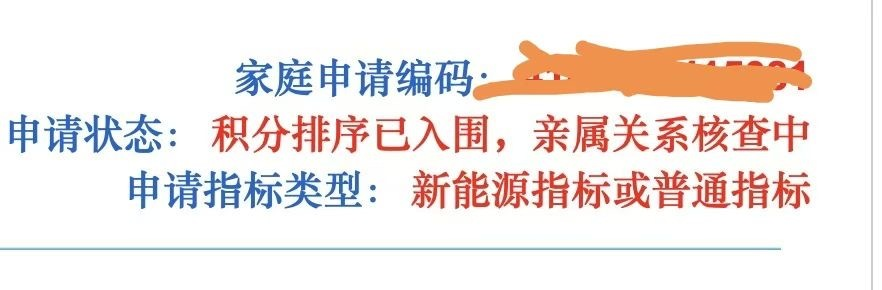
Core Points - The article discusses the recent changes in Beijing's new energy vehicle (NEV) license plate allocation policy, highlighting the increased chances for families to obtain these licenses due to the addition of new quotas [4][18][19] - It emphasizes the excitement among residents who have struggled for years to obtain a Beijing license plate, as many families are now successfully entering the NEV license allocation system [2][8][20] Group 1: Policy Changes - Beijing has announced the allocation of 118,400 family NEV licenses, with 60,000 being newly added, increasing the chances for families who have previously struggled to obtain a license [4][18] - The minimum score for obtaining a family NEV license has dropped to 42, the lowest since the implementation of the new policy, indicating a significant easing of competition [18][19] - The policy now allows for a broader family structure to apply for licenses, increasing the potential for higher scores through combined family applications [9][20] Group 2: Market Response - Car dealerships are actively targeting new license holders with various promotional offers, including discounts and incentives for early orders [11][12] - The demand for NEVs is expected to rise significantly due to the new policies, with many families already beginning to look for and order vehicles [16][20] - The overall market for NEVs in Beijing is anticipated to grow, driven by the combination of new license allocations and additional consumer incentives such as trade-in subsidies and consumption vouchers [16][20]
以旧换新政策杠杆效应明显,汽车销量正从“量变”到“质变”
3 6 Ke· 2025-05-26 10:15
Group 1 - The "old-for-new" policy has significantly boosted consumption, with over 10 million subsidy applications and a consumption increase of nearly 8% in early 2025 [1][2] - The penetration rate of new energy vehicles (NEVs) in the replacement market has surpassed 50%, indicating a clear shift from traditional fuel vehicles to NEVs [1][2] - The policy has activated the stock market and accelerated the replacement of fuel vehicles with NEVs through a dual-track system of scrapping and replacing [2][3] Group 2 - The market is experiencing a reshuffle, with traditional fuel vehicle manufacturers facing production capacity pressures while leading NEV brands gain market share through technological advantages [3] - The acceptance of NEVs by consumers is shifting from policy-driven to value recognition, driven by technological advancements and innovative business models [4] - The price range of NEVs is rapidly descending into the mainstream market, with models priced between 100,000 to 200,000 yuan now accounting for over 60% of the market [4] Group 3 - Chinese automotive exports have increased by 28% in early 2025, with companies like Tesla and BYD expanding their market share in Southeast Asia and Europe [5] - Globalization presents challenges due to trade barriers, prompting companies to build localized production and compliance capabilities [7] - The end of the new energy vehicle purchase tax exemption in 2026 raises concerns about maintaining high growth in the market, with some companies already facing profit pressure [8]

积分超50提前抢订、车企增补优惠达万元,北京车市抢跑“京标”发放窗口期
Bei Jing Shang Bao· 2025-05-26 08:59
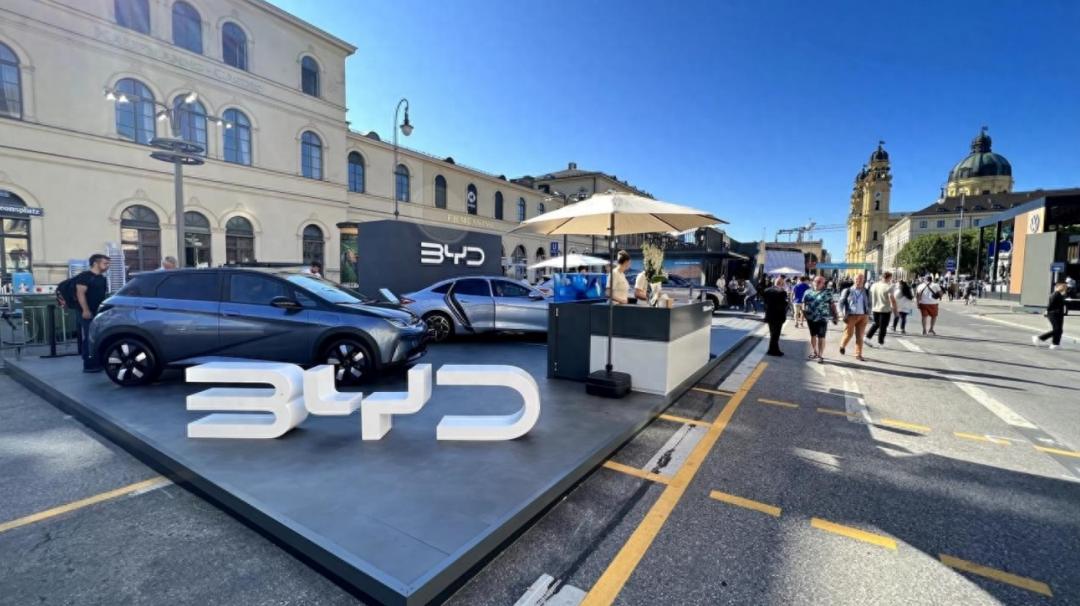
Core Insights - The core point of the article is the significant increase in the allocation of new energy vehicle (NEV) license plates in Beijing for 2025, with a total of 118,400 family NEV indicators, which is a substantial rise compared to previous years [4][5][11]. Allocation and Application Details - The total number of valid applications for family NEV indicators reached 340,172, while personal and unit applications were 532,942 and 27,667 respectively [4]. - The minimum score for families to qualify for the NEV indicators was 42, a notable decrease from last year's threshold of 60 [4][10]. - This year's allocation included an increase of 60,000 family NEV indicators, marking a 75% increase from the original annual quota of 80,000 [5][15]. Consumer Behavior and Market Response - There has been a surge in consumer interest, with many potential buyers pre-ordering vehicles before the allocation results were announced, particularly those with higher scores [3][6][10]. - Car manufacturers are responding to the increased demand by offering various incentives and discounts to attract customers holding the new NEV indicators [11][13][14]. Sales and Market Trends - The NEV market in Beijing is experiencing rapid growth, with sales figures showing a year-on-year increase of 26.9% in 2023 and a projected 31.98% growth in 2024 [15]. - The penetration rate of NEVs in Beijing reached 39.7% in 2023 and is expected to rise to 51.19% in 2024, indicating a strong market trend towards electric vehicles [15].

摩根士丹利:人工智能赋能出行与仿人机器人
摩根· 2025-05-25 14:09
Investment Rating - The industry investment rating for China Autos & Shared Mobility is "In-Line" [3]. Core Insights - The report highlights the significant market share of China in the global automotive sector, with China expected to sell 22.6 million passenger vehicles in 2025, representing 26.4% of the global market [9]. - Electric vehicle (EV) sales in China are projected to reach 7.1 million units in 2025, accounting for 52.7% of global EV sales [9]. - The report emphasizes the increasing penetration of EVs in China, with projections showing a rise from 12.4% in 2022 to 39.8% by 2030 [12]. - A robust pipeline of new models from various OEMs is anticipated, with several launches scheduled for mid-2025 [14]. - The growth of passenger vehicle exports from China is notable, with exports increasing from 760,000 units in 2020 to an estimated 4.941 million units by 2024 [18]. Summary by Sections Global Market Overview - The global passenger vehicle market is projected to reach 85.4 million units in 2025, with significant contributions from China [9]. Electric Vehicle Insights - The report outlines the expected growth in EV penetration, with China leading the charge in both production and sales [11][12]. New Model Pipeline - A detailed list of upcoming vehicle models from various manufacturers is provided, indicating a competitive landscape in the EV sector [14]. Export Growth - The report notes a substantial increase in passenger vehicle exports from China, highlighting the country's growing influence in the global automotive market [18]. Collaboration and Competition - The report discusses the evolving dynamics of competition among automotive manufacturers, emphasizing collaboration as a key strategy for innovation and cost reduction [21]. Focus Areas for OEMs - Future focus areas for automotive OEMs include AI-enabled smart cockpits, autonomous vehicles, and humanoid robotics, indicating a shift towards advanced technology integration [24].


天瞳威视王若瑜:建立技术护城河 持续拓宽AI在出行领域的应用边际
Zheng Quan Shi Bao Wang· 2025-05-23 11:49
Core Insights - The rapid development of the autonomous driving industry is driving a collective transformation across the supply chain, with a surge in domestic autonomous driving suppliers [1] - Regulatory bodies are providing new guidance for the industry's development through strict classification and promotional standards for intelligent driving [1] - There is a strong and clear market demand for autonomous driving products, necessitating broad collaboration within the industry to promote commercialization [1] Company Overview - TianTong Vision, established in 2016, focuses on providing core technology solutions in the automotive intelligent driving sector, integrating both software and hardware capabilities [2] - The company boasts strong algorithm capabilities and software system engineering, offering various intelligent driving functions such as NOA, low-speed parking, and L4 logistics [2] - TianTong Vision collaborates with over 20 OEMs and Tier 1 suppliers, including notable names like BYD and ZF, with more than 20 mass-produced models already in partnership [3] Strategic Partnerships - The strategic investment from ZF in 2021 has led to deep collaboration in technology development and supply chain, facilitating the global rollout of TianTong Vision's products and services in over 30 countries [4] - The company has established a unique "capital bond + technology symbiosis" model with ZF, differentiating its approach to international expansion [4] - TianTong Vision provides comprehensive engineering services for domestic OEMs testing new models abroad, adapting to various conditions across multiple regions [4] Future Development - The company aims to continue focusing on core technologies in intelligent driving, prioritizing safety and driving innovation for future growth [4] - TianTong Vision plans to expand the application of AI technology in the mobility sector through its comprehensive product capabilities and engineering service experience [4]
造车新势力2025年一季度成绩单出炉 行业分化加剧
Xi Niu Cai Jing· 2025-05-23 06:40
Group 1: Industry Overview - The Chinese electric vehicle (EV) industry is experiencing significant differentiation among new car manufacturers, as evidenced by their first-quarter performance [2][3] - The competition is expected to intensify, with a new benchmark of 30,000 monthly sales emerging for new car manufacturers [3] Group 2: Company Performance - XPeng Motors achieved the highest delivery volume among new car manufacturers with 94,000 units, projecting first-quarter revenue between 15.19 billion to 15.7 billion yuan, a year-on-year increase of 132% to 139.8% [2] - Li Auto delivered 92,900 units, a year-on-year growth of 15.5%, with expected revenue between 23.4 billion to 24.7 billion yuan, a decline of 3.5% to 8.7% [2] - Leap Motor delivered 87,600 units, a remarkable year-on-year increase of 162%, with revenue of 10.02 billion yuan and a significantly reduced net loss of 130 million yuan [2] - NIO's main brand delivered only 27,300 units, with projected revenue between 12.367 billion to 12.859 billion yuan, a year-on-year increase of 24.8% to 29.8% [3] Group 3: Strategic Initiatives - Leap Motor aims to achieve annual sales of 500,000 to 600,000 units and a gross margin of 10% to 12%, striving for breakeven this year [2] - Xiaomi Motors has raised its 2025 delivery target to 350,000 units, focusing on a "hardware + ecosystem" strategy [3] - XPeng plans to extend its XNGP intelligent driving system to lower-priced models to expand market share [3] - NIO is utilizing 3.7 billion yuan in financing for technology research and development [3]

续航835km!雷军官宣小米YU7:标配激光雷达,零百3.23s
Sou Hu Cai Jing· 2025-05-23 04:11
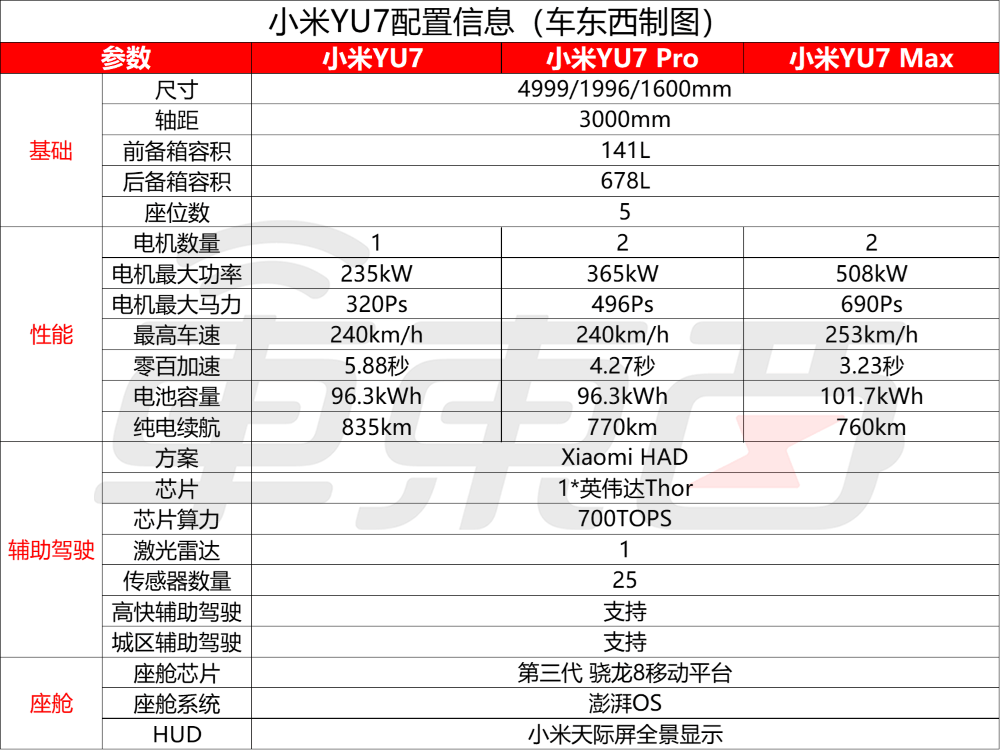
作者 | 颐圣、张睿 编辑 | 志豪 小米YU7正式亮相,雷军:新车19.9万肯定下不来。 车东西5月22日消息,就在刚刚,雷军在小米新品发布会上高调官宣小米YU7。 本次雷军共官宣了小米YU7、YU7 PRO、YU7 MAX三个版本,其中小米YU7为后驱,PRO和MAX版本均为四驱型号,并在现场重点讲解了新车的外观、内 饰、性能、底盘、安全设计等5大新特点。 | | | 小米YU7配置信息(车东西制图) | | | | --- | --- | --- | --- | --- | | | 参数 | 小米YU7 | 小米YU7 Pro | 小米YU7 Max | | | ਵਿੱ | | 4999/1996/1600mm | | | | 轴距 | | 3000mm | | | 墓础 | 前备箱容积 | | 141L | | | | 后备箱容积 | | 678L | | | | 座位数 | 7 | 5 2 | 2 | | | 电机数量 电机最大功率 | 235kW | 365kW | 508KW | | | 电机最大马力 | 320Ps | 496Ps | 690Ps | | 性能 | 最高车速 | 240km/h ...

车企智驾宣传迅速降温 强监管下车市“价格战”或趋缓
Zhong Guo Jing Ying Bao· 2025-05-23 03:45
Core Viewpoint - The automotive market is expected to see a moderation in the "price war" due to stringent regulations on "smart driving" advertising, shifting the focus from "autonomous driving" to "assisted driving" [1][4][6] Group 1: Regulatory Changes - The Ministry of Industry and Information Technology has mandated that car manufacturers avoid misleading terms like "autonomous driving" and instead use "assisted driving," emphasizing the driver's responsibility [1][4] - A recent meeting highlighted the need for manufacturers to conduct thorough testing and validation of driving assistance systems, ensuring accurate representation of their capabilities [4][6] Group 2: Industry Response - Multiple brands have acknowledged that their smart driving systems are not fully autonomous and require driver engagement, with sales representatives clarifying that hands must remain on the wheel [2][3] - Companies like Geely emphasize that while they can equip all models with advanced driving assistance systems, not all consumers require such features, indicating a focus on genuine consumer needs [3][5] Group 3: Market Dynamics - The penetration rate of L2 and above Advanced Driver Assistance Systems (ADAS) in new vehicles is projected to reach 47.9% in 2024, with a higher rate in electric vehicles at 56.9% [5] - Despite changes in smart driving advertising, industry experts believe the impact on overall vehicle sales will be limited, as competition remains fierce [6][7] Group 4: Price War and Competition - The price war in the automotive market is reportedly easing, with traditional fuel vehicle brands adopting transparent pricing strategies to reduce unhealthy competition [6] - Regulatory bodies are taking steps to address "involution" in the industry, aiming to curb excessive price competition and promote technological development [6][8] Group 5: Future Outlook - Companies are expected to reassess their smart driving system designs and marketing strategies, focusing on safety and the enhancement of driving experiences [6][7] - Industry associations are advocating for healthy competition and high-quality development, urging manufacturers to adhere to ethical advertising practices [8]
多款新能源准新车“价崩” 连特斯拉也跌得有点猛
Nan Fang Du Shi Bao· 2025-05-22 15:06
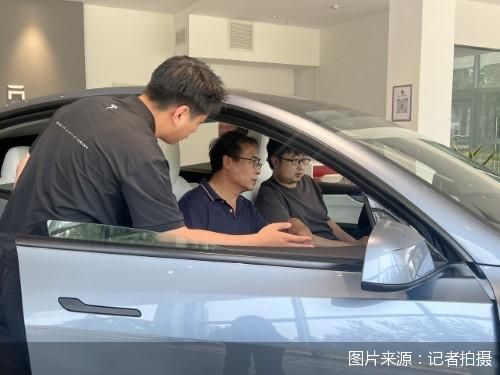
Core Viewpoint - The second-hand market for electric vehicles in China is experiencing significant price declines, particularly for popular brands like Xiaomi, Tesla, and BYD, due to increased supply and various market pressures [1][2][4]. Group 1: Market Trends - The production of new energy vehicles in China surpassed 4.4 million units from January to April, with a market penetration rate of 43%, leading to an increase in second-hand vehicle supply [1]. - In May, several models, including those from Tesla and BYD, saw notable price drops in the second-hand market, indicating a "price collapse" phenomenon [1][2]. Group 2: Specific Brand Analysis - Xiaomi's SU7 Ultra saw its second-hand price drop from 50.33 million yuan to 48.33 million yuan, with reports of a 6,000 yuan price difference due to a wave of cancellations and promotional activities [2][3]. - Tesla's Model 3 experienced a "cliff-like" price drop, with prices for nearly new models falling to 18.5 million yuan from over 25 million yuan, reflecting a cumulative price reduction of over 50,000 yuan [6]. Group 3: Market Dynamics - The depreciation of second-hand electric vehicles is exacerbated by rapid technological advancements, leading to older models becoming outdated quickly [8]. - The second-hand market is seeing a shift in acquisition strategies, with dealers prioritizing mainstream brands and rejecting vehicles with battery health below 85% [6][8]. Group 4: Export Market - The export of second-hand vehicles, particularly to the Middle East, has increased, with 436,000 units exported in 2024, a 46.5% year-on-year growth, but high-end electric vehicles still face challenges due to domestic inventory and limited overseas demand [8].