奔驰

Search documents
芯片人去德国!一口气看两场行业大展
芯世相· 2025-06-16 03:46
Core Viewpoint - The article emphasizes the importance of exploring overseas markets for the chip industry, particularly in Europe, as a strategy for industry upgrade and sustained growth amidst intense domestic competition and technological innovation [3]. Group 1: Market Exploration - Since last year, an increasing number of chip professionals have shifted their focus to overseas markets, with "going abroad" becoming a new option for industry growth [3]. - A business investigation activity in Germany is planned from September 4 to September 14, focusing on key cities and major exhibitions to understand the real demands and development directions in the consumer electronics and automotive electronics sectors [3][4]. Group 2: Key Events - The IFA, one of the largest international consumer electronics exhibitions, attracted over 1,800 exhibitors and more than 210,000 visitors from 138 countries in its last session, with AI being a significant theme [4]. - The IAA, a key global auto show, had 750 exhibitors from 38 countries and over 500,000 visitors, covering the entire automotive supply chain [4][5]. Group 3: Activities and Networking - The itinerary includes organizing industry salons and visits to well-known companies and universities, aiming to facilitate connections and discussions among participants [6][7]. - Previous events have successfully established communication bridges among industry professionals, enhancing local resource connections [6]. Group 4: City Visits - The investigation will cover five important German cities: Berlin, Leipzig, Dresden, Stuttgart, and Munich, each representing distinct industrial characteristics [7]. - Past visits in 2018 and 2023 have provided valuable resources and experiences, which will be leveraged for this trip [7][10]. Group 5: Company Visits - Planned visits include major companies such as GlobalFoundries and Mercedes-Benz, which are significant players in the semiconductor and automotive industries, respectively [19][20]. - Nexperia, a leading semiconductor company, and Fraunhofer, a model for integrating scientific research with industrial development, will also be part of the itinerary [22][23]. Group 6: Itinerary Highlights - The itinerary includes visits to major exhibitions, local enterprises, and cultural sites, providing a comprehensive experience of the German industrial landscape [16][24]. - The trip aims to foster trust and consensus among participants, facilitating potential collaborations [13].



续航破1200km!小米加码固态电池,雷军造车的又一杀器曝光
Sou Hu Cai Jing· 2025-06-15 13:18
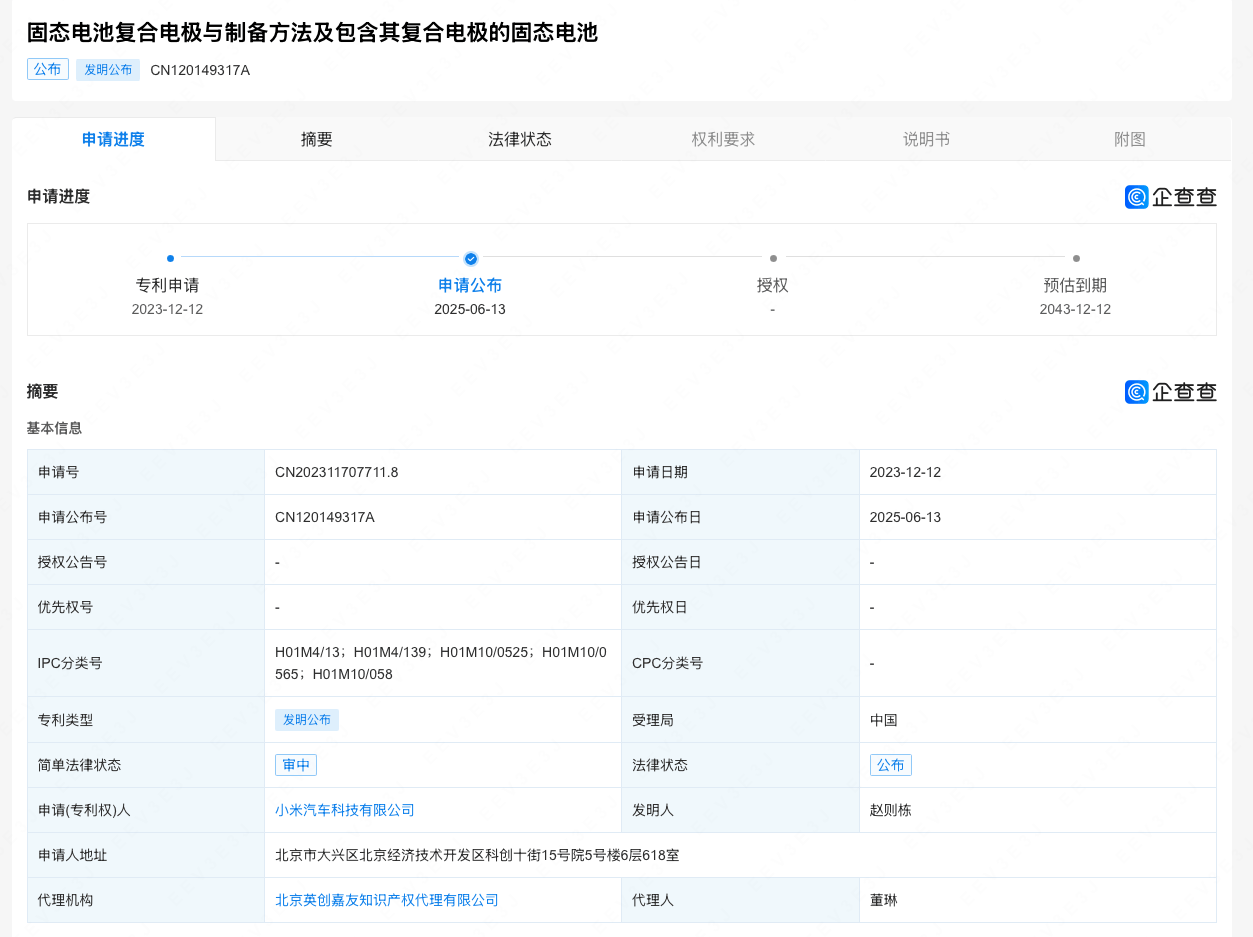
Core Viewpoint - Xiaomi Automotive has officially published a patent for "solid-state battery composite electrodes and preparation methods," indicating its commitment to developing solid-state battery technology, which is seen as a future trend in the electric vehicle industry [1][3][4]. Patent Details - The patent application number is CN202311707711.8, with a publication date set for June 13, 2025, and the application date being December 12, 2023 [2]. - The patent is categorized under IPC classifications related to battery technology, specifically focusing on solid-state batteries [2]. Technology Highlights - Xiaomi's solid-state battery features two main technological advancements: 1. Optimized structure that shortens the metal ion transport path within thick electrodes, enhancing the transport rate [7]. 2. The composite electrode has a high electrode loading capacity, achieving 480-500 mg/cm² for the positive electrode at a thickness of 2 cm, with a total battery area capacity of 60-70 mAh/cm² [8][9]. Market Position and Strategy - Xiaomi Automotive is positioning itself in the competitive electric vehicle market, emphasizing the importance of solid-state batteries for future growth and market survival [4][12]. - The company aims to achieve over 1000 km of pure electric range with its upcoming models, potentially exceeding 1200 km, which would place it among the leaders in electric vehicle range capabilities [10][20]. Competitive Landscape - Other automotive companies, such as BYD and Toyota, are also investing heavily in solid-state battery technology, with expected production timelines around 2027 [14][16][17]. - Xiaomi's entry into solid-state battery development is seen as a strategic move to secure a competitive edge in the rapidly evolving electric vehicle market [17][19]. Investment and Development - Xiaomi has been actively investing in various battery companies, indicating a strong commitment to advancing its solid-state battery technology [19]. - The company is focused on enhancing the performance and reliability of its electric vehicles, with a particular emphasis on battery technology as a key differentiator in the market [22][27].

国内芯片企业加速入局车规级UWB市场
Di Yi Cai Jing Zi Xun· 2025-06-15 12:19
Core Insights - The automotive industry is undergoing a transformation driven by the "new four modernizations," with increasing semiconductor content in vehicles, projected to rise from under $500 for traditional fuel vehicles to over $1,500 for smart electric vehicles [1] - The introduction of the "Dubhe" UWB SoC chip by Gateron aligns with the growing demand for high-precision, bidirectional positioning in smart vehicles, marking a significant opportunity in the automotive semiconductor market [1] Industry Trends - UWB technology, initially introduced in 1989, gained mainstream attention in 2019 with Apple's UWB chip, and has since penetrated the automotive sector, starting with BMW's digital key feature in 2021 [1] - The adoption of UWB technology is expanding among mid to high-end vehicles, with brands like BYD, Mercedes-Benz, and others incorporating UWB as standard or optional features [2] - The penetration rate of UWB digital keys was only 2.1% in 2022, with a market size of $0.96 million, but is expected to exceed 50% penetration and reach a market size of $22.56 million by 2027 due to technological advancements and cost reductions [2] Company Developments - Gateron has established a dedicated UWB development team of over 100 experts, including 50 specialists in wireless communication, to capitalize on the growing UWB market [2] - The company has filed over 60 patents in the UWB field, including two essential patents, indicating a strong commitment to innovation and market leadership [2] - The domestic UWB chip market is still in its early stages, with companies like NXP and Qorvo previously dominating, but local firms are now entering the space, aiming for domestic substitution opportunities [3] - Gateron's UWB chip, "Dubhe," is expected to begin mass production by the end of this year, following sample delivery in July [3]
“广进”时代的生存逻辑:“好员工”失业,“差员工”幸存?
虎嗅APP· 2025-06-15 10:35
以下文章来源于瞎说职场 ,作者Sean Ye 瞎说职场 . 时代变了,职场的规则也在变,但很多人的思维方式却没有变。 知乎80万人关注的职场话题优秀回答 者,人力资源行业浸淫10年+,先后服务于顶级人力资源招聘和咨询公司,Sean和你一起破除职场毒鸡 汤,把最真实的职场展现出来 本文来自微信公众号: 瞎说职场 ,作者:Sean Ye,原文标题:《"广进"时代的生存逻辑:为何"好 员工"可能失业,"差员工"反而幸存?》,题图来自:视觉中国 今年上半年,因为业绩问题不少互联网公司裁了一波,而外企这边,从花旗、微软到奔驰,无论哪个 行业,外企也在做调整。 很多打工人面对裁员的第一反应往往是:"为什么被裁的是我?" 我能理解这种心情,但事实上,答案并不在你我个人的能力,而藏在公司启动裁员程序的"第一 因"里。 裁员,是一道复杂的公司生存逻辑题。当它发生的时候,你我作为个体的能力如何,并不是能让我们 逃脱裁员名单的决定性因素。 管理层不同的解题思路,决定了截然不同的裁员对象和方式,也深刻影响着留下的每一个人。 裁员的'第一因',就是那只看不见的"筛子",决定了最终漏下去的是哪些人,也决定了留下来的那些 人会有怎样的前途 ...

20万的BBA,不能再降了
Xin Lang Cai Jing· 2025-06-15 06:20
Core Viewpoint - The price war among luxury car brands BBA (BMW, Benz, Audi) has led to significant price reductions, with some models of the "34C" (BMW 3 Series, Audi A4L, Benz C-Class) now available for under 200,000 yuan, although actual purchase conditions may complicate this [1][3][10]. Price Reduction Details - The Benz C-Class has seen the largest price drop, with the C200L model's price slashed from a guide price of 334,800 yuan to as low as 167,400 yuan in Beijing [3][4]. - Audi A4L's entry-level model has also dropped below 200,000 yuan, with some regions reporting prices as low as 180,000 yuan, although high-end models remain above 230,000 yuan [5][6]. - BMW's 325Li has reportedly fallen below 200,000 yuan, but consumer preference leans towards the more powerful 330Li model [7][8]. Market Dynamics - The aggressive pricing strategy has led to a consensus among dealers that low-spec models are increasingly difficult to sell, prompting a shift towards higher-spec models [7][10]. - The overall decline in prices has affected other models within the BBA lineup, including SUVs and higher-end sedans, pushing them below historical price thresholds [8][9]. Sales Performance - Sales figures for 2024 indicate a significant drop for Benz C-Class and Audi A4L, with projected sales of 44,000 and 26,000 units respectively, marking declines of 16% and 27% [12]. - The financial strain on dealers has led to reports of dealership closures and ownership changes, with only 35% of dealerships meeting sales targets in the first half of the year [12][13]. Strategic Adjustments - In response to market pressures, BBA is reducing its dealer networks and focusing on higher-end models, with plans to discontinue lower-end offerings [15][18]. - New models are being introduced, such as the Audi A5L and BMW iX3, which aim to rejuvenate brand appeal and market presence [19][20]. Innovation and Future Outlook - BBA brands are facing challenges in innovation, with traditional product cycles failing to keep pace with the rapid development of new energy vehicles [14][17]. - Collaborations with tech companies are being pursued to enhance digital services and vehicle technology, indicating a shift towards integrating more "Chinese car-making genes" into their offerings [18][19].
全固态电池上车,就差临门一脚了?
电动车公社· 2025-06-14 15:41
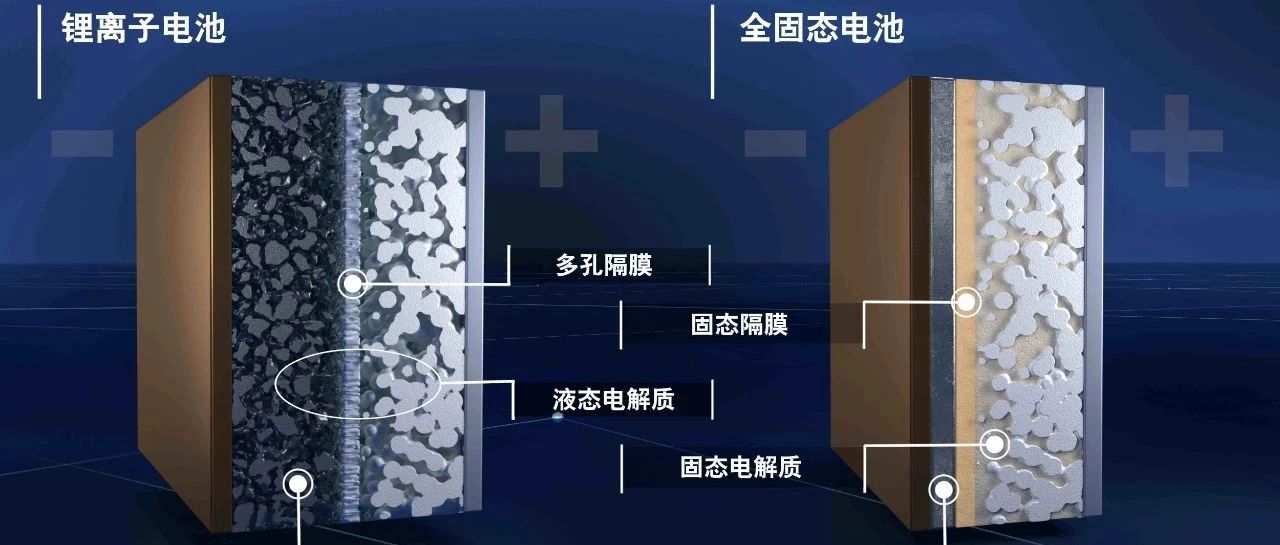
Core Viewpoint - The year 2026 is anticipated to be a breakthrough year for revolutionary technologies in the electric vehicle (EV) sector, particularly with the introduction of all-solid-state batteries by major automakers in China [1][2]. Group 1: All-Solid-State Battery Overview - Major Chinese automakers, including Changan, SAIC, GAC, Dongfeng, Geely, and Chery, have set 2026 as the target year for the deployment of all-solid-state batteries [2]. - All-solid-state batteries offer significantly higher energy density compared to traditional lithium batteries, with theoretical pure electric range reaching up to 2000 km [2][4]. - The non-flammable nature of the electrolyte in all-solid-state batteries eliminates the risk of thermal runaway and combustion [3][4]. Group 2: Industry Standards and Definitions - The China Society of Automotive Engineers has released the "All-Solid-State Battery Determination Method" (T/CSAE 434-2025), marking the first global standard defining what constitutes an all-solid-state battery [7][10]. - The standard aims to clarify the confusion between solid-state, semi-solid, and all-solid-state batteries, which has been a significant issue in the industry [11][10]. - The new standard specifies that the moisture content in the electrolyte of an all-solid-state battery must not exceed 1% [20]. Group 3: Technical Aspects and Testing - The testing method for determining all-solid-state batteries involves visual inspection for liquid leakage and a weight loss test under vacuum conditions [21][22][27]. - The method has been validated by over 50 companies, demonstrating a low error rate of less than 0.3% [27]. Group 4: Sulfide Electrolytes and Commercial Viability - Sulfide electrolytes are highlighted as the most commercially viable option for all-solid-state batteries, with several automakers announcing imminent production [35][38]. - Sulfide electrolytes exhibit high ionic conductivity, making them suitable for high charging rates and wide temperature ranges [38][41]. - The interface issue between the solid electrolyte and electrodes is a critical challenge that needs to be addressed for mass production [46]. Group 5: Challenges and Cost Considerations - Despite their advantages, sulfide solid-state batteries face challenges such as poor chemical stability and high production costs [52][67]. - The cost of materials, particularly germanium used in sulfide electrolytes, is significantly high, impacting overall battery production costs [68][70]. - Manufacturing processes for sulfide solid-state batteries require extremely dry conditions, leading to higher production costs compared to traditional batteries [74][76]. Group 6: Historical Context and Future Outlook - Japan initially led research in solid-state electrolytes but has fallen behind in commercializing these technologies due to a focus on hybrid and hydrogen fuel cell technologies [84][85]. - In contrast, Chinese battery manufacturers have made significant progress in the last decade, positioning themselves to lead in the all-solid-state battery market [87][88].

中国打出稀土这张“万能牌”,全世界明白过来,不能跟中国作对
Sou Hu Cai Jing· 2025-06-13 17:17
Group 1 - Major automotive companies like General Motors, Toyota, and Volkswagen are sounding alarms over potential production halts due to a shortage of rare earth elements from China, with a warning that factories could shut down within 40 days if supplies are not secured [1][8] - The price of rare earth elements has surged from $425 per kilogram in April to $850, more than doubling, causing significant disruptions in production lines, including Tesla's robot production line [1][8] - The global manufacturing sector is experiencing panic buying, with U.S. companies stockpiling six months' worth of supplies, leading to a dramatic increase in orders [8][10] Group 2 - China controls 36% of global rare earth reserves and 92% of refining capacity, making it a critical player in the supply chain for high-tech industries [6][10] - The U.S. and other Western countries are struggling to find alternative sources for rare earth elements, with efforts like the "Rare Earth Independence Plan" projected to meet only 20% of demand by 2027 [10][13] - The G7 summit faced significant challenges, with divisions emerging among member countries regarding their stance on China and rare earth supply issues, leading to the cancellation of a joint statement for the first time in 19 years [13][15] Group 3 - The military sector is particularly vulnerable, with reports indicating that the F-35 production line could permanently shut down if rare earth supplies are not restored within three months [8][10] - The technological gap between China and the West in rare earth processing and production capabilities is widening, with China holding 80% of global separation patents and achieving higher production yields [10][17] - The geopolitical landscape is shifting, with countries like Australia and Canada reconsidering their positions and seeking dialogue with China amid the rare earth supply crisis [13][15]
奔驰考虑推出一款超长续航的混动车,大电池是主要方向
news flash· 2025-06-13 13:05
Core Viewpoint - Mercedes-Benz plans to develop a large battery plug-in hybrid model specifically for the Chinese market, which has received preliminary approval and has initiated relevant research work [1] Group 1 - The new product is defined as a hybrid model with both gasoline and electric drive capabilities, emphasizing ultra-long range [1]
一群硬科技投资人、产业人,又要组团去德国
芯世相· 2025-06-13 10:30
Core Viewpoint - The article emphasizes the importance of exploring overseas markets for the chip industry, particularly in Europe, as a strategy for industry upgrade and sustained growth amidst intense domestic competition and technological innovation [3]. Group 1: Overview of the European Market Exploration - The chip industry is increasingly focusing on overseas markets, with "going abroad" seen as a new option for growth [3]. - A business investigation trip to Germany is planned from September 4 to September 14, focusing on two major global exhibitions: IFA and IAA [3][4]. - The IFA exhibition, one of the largest international consumer electronics shows, attracted over 1,800 exhibitors and more than 210,000 visitors from 138 countries in its last edition [4]. - The IAA exhibition, a key event in the global automotive industry, had 750 exhibitors from 38 countries and over 500,000 visitors in its previous edition [4]. Group 2: Activities and Itinerary - The trip includes visits to five major German cities: Berlin, Leipzig, Dresden, Stuttgart, and Munich, each representing significant industrial characteristics [7]. - Activities will include industry salons, company visits, and tours of leading universities, aimed at deepening understanding of local market needs and trends [4][6][7]. - The itinerary features visits to notable companies such as GlobalFoundries and Mercedes-Benz, as well as academic institutions like the Technical University of Munich [19][20][21][22]. Group 3: Networking and Resource Linking - The trip aims to facilitate connections among participants, local exhibitors, and industry professionals through deep-dive salons and networking events [6][13]. - Previous trips have successfully established communication bridges among key industry players, enhancing collaboration opportunities [6][10].

独家丨7 家主机厂已承诺经销商返利期限缩短至 60 天
晚点Auto· 2025-06-13 08:58
Core Viewpoint - The automotive industry is undergoing significant changes in payment terms and dealer operations, with many manufacturers committing to shorten payment periods to alleviate financial pressure on dealers [3][5]. Group 1: Payment Terms and Dealer Support - Starting from June 10, 17 automotive manufacturers, including Dongfeng, GAC, BYD, and Chery, have pledged to unify payment terms to within 60 days for suppliers [3]. - Notably, at least 7 manufacturers have committed to paying sales incentives and rebates to dealers within 60 days, including BMW, BAIC New Energy, and SAIC General [3]. - GAC Toyota will shift to a monthly rebate system, with 80% to 90% of rebates paid within 30 days and the remaining 10% to 20% within two months [5]. Group 2: Dealer Financial Challenges - The automotive dealership business is capital-intensive, relying heavily on financing and quick turnover, making cash flow critical for operations [5]. - Many dealers are currently facing losses due to price wars, with over 85% of dealers experiencing price discrepancies, and more than 60% facing discrepancies exceeding 15% [6]. - In the past year, over 4,000 dealers exited the market, doubling the rate of previous years, indicating significant operational pressures [6]. Group 3: Industry Restructuring and Trends - The automotive industry is witnessing a shift as luxury brands like BBA and Porsche reduce their dealer networks, with Mercedes-Benz planning to cut over 100 dealerships this year [6]. - The trend of "network reduction" and "transformation" is prevalent, as dealers adapt to changing market conditions and consumer preferences [6]. - Dealers focusing on new energy vehicles (NEVs) are performing better financially, with about half of NEV dealers reporting profits last year [7].