吉利汽车

Search documents
美国消费者技术协会首席执行官夏皮罗:期待在CES看到中国科技创新成果
Xin Lang Cai Jing· 2026-01-11 21:22
Core Insights - The 2026 CES in Las Vegas will prominently feature Chinese companies showcasing innovations in AI, robotics, smart mobility, and immersive entertainment [1][2] - The event will attract thousands of exhibitors from over 155 countries, focusing on transformative trends in AI, robotics, digital health, mobile transportation, and energy [1] - AI will remain a central theme at CES 2026, driving advancements in personalized health diagnostics, autonomous driving, industrial automation, and creative tools [1][2] Industry Highlights - Chinese companies such as Geely, Hisense, Lenovo, TCL, and Yushu Technology will participate, representing both leading firms and dynamic startups [1] - Lenovo will host an innovation technology summit during the event, while other Chinese firms will conduct discussions on innovation and leadership [1] - Digital twin technology is expected to enhance decision-making by simulating real systems before actions are taken, contributing to smarter and safer outcomes [2] Robotics and AI Developments - Robotics will be a key focus at CES, with advancements making homes smarter, agriculture more efficient, and factories safer [2] - Future developments in robotics will emphasize improving mobility and enhancing the ability to perform multiple tasks [2] - The introduction of the "CES Innovation Workshop" will provide a platform for showcasing the latest in AI and quantum technology through live demonstrations and forums [2]
商业航天迎来开门红资本抢滩太空新赛道
Zhong Guo Zheng Quan Bao· 2026-01-11 20:49
□本报记者 郝健 2024年,"商业航天"写入政府工作报告。2025年11月,《国家航天局推进商业航天高质量安全发展行动 计划(2025—2027年)》出台,不仅从资本端着力,提出"设立国家商业航天发展基金";还在准入端松 绑,明确"研制商业卫星的企业无需办理武器装备科研生产许可证"。2025年12月26日,上交所发布商业 火箭企业适用科创板第五套上市标准审核指引,商业火箭企业通往资本市场的"最后一公里"也被打通。 政策红利的持续释放,推动产业与资本共振。《中国商业航天产业研究报告》显示,2025年,我国商业 航天市场规模已增长至2.5万亿元-2.8万亿元区间。在投融资方面,商业航天领域2025年的融资总额达到 186亿元,同比增长32%,共计完成67笔融资。 中国工程院院士、商业航天产业技术创新联盟理事长赫晓东表示,商业航天已从传统国家任务的补充, 跃升为驱动技术创新、拓展应用边界、重塑产业生态的核心引擎,是科技制高点竞争前沿,也是孕育新 质生产力的蓝海。 2026年开年以来,中国商业航天领域的资本热潮强势爆发,A股相关概念板块迎来开门红。与此同时, 一级市场投融资与IPO进程按下快进键,商业航天产业正加速 ...
新款小米SU7涨价增配,4月上市!宝马集团2025年全球交付246.3万台!小鹏、比亚迪多款新车密集上市!丨一周大事件
电动车公社· 2026-01-11 16:05
Core Viewpoint - The article highlights the recent developments in the electric vehicle (EV) market, focusing on new model launches, company collaborations, and government initiatives to promote green consumption in the automotive sector [2][3][111]. New Car Launches - The new XPeng P7+ was launched with a price range of 186,800 to 198,800 yuan, offering both pure electric and extended range versions [3][11]. - The XPeng G6 was introduced at a price of 176,800 to 186,800 yuan, maintaining the design of its predecessor [13][20]. - The XPeng G7 extended range version is priced between 195,800 and 205,800 yuan, featuring upgraded technology and design [21][30]. - The XPeng G9 was launched with a price range of 248,800 to 278,800 yuan, showcasing new color options and advanced features [32][39]. - BYD's new Qin PLUS DM-i is priced at 79,800 to 99,800 yuan, maintaining its design while enhancing battery capacity [42][57]. - The BYD Qin L DM-i was launched at 96,800 to 126,800 yuan, featuring improved battery specifications [48][55]. - The BYD Song Pro DM-i was introduced at a price of 99,800 to 127,800 yuan, focusing on battery upgrades [59][65]. - The new Xiaomi SU7 is available for pre-sale at 229,900 to 309,900 yuan, with significant upgrades in technology and design [66][75]. - The Geely Galaxy V900 is set for pre-sale at 319,800 to 389,800 yuan, featuring a spacious interior and advanced powertrain [76][86]. Company Dynamics - BAIC Arcfox has partnered with Sinopec Kunlun Network Electric to enhance charging network services, with the first batch of charging stations already operational in Beijing [87][91]. - BMW Group announced a target of delivering 2,463,715 vehicles globally by 2025, with a focus on increasing electric vehicle sales [92][93]. - Porsche and Bentley have announced recalls for specific models due to safety concerns, highlighting ongoing quality control measures in the luxury automotive sector [97][100]. - NIO celebrated the production of its one millionth vehicle, marking a significant milestone in its growth trajectory [107][110]. Government Initiatives - The Ministry of Commerce and nine other departments have issued a notice to promote green consumption in the automotive sector, supporting the purchase of new energy vehicles [111][114]. - The initiative aims to strengthen the automotive industry chain and explore potential in the used car market, car rentals, and other related sectors [112][114].







汽车及汽车零部件行业周报:2026年“两新”政策落地,有望带动需求稳步向上-20260111
SINOLINK SECURITIES· 2026-01-11 15:10
Group 1 - The investment rating for the automotive industry is positive, with expectations for steady demand growth driven by the implementation of the "Two New" policy in 2026 [1][12][14] - The core viewpoint emphasizes that the subsidy policy has shifted from fixed amounts to a percentage of the vehicle price, which is expected to benefit high-end vehicles while putting pressure on low-priced cars [1][14] - The report anticipates a marginal recovery in sales growth in Q1 2026, with an upward revision of the annual domestic sales growth forecast to -2% [1][14][16] Group 2 - The report highlights opportunities in themes such as smart technology and overseas expansion, with passenger car exports maintaining a growth rate of over 20% year-on-year [2][17] - Key companies to watch include BYD, Geely, and Li Auto in the automotive sector, and Horizon Robotics and Top Group in the smart technology and robotics sectors [2][22] - The report notes that the export volume of passenger cars is expected to maintain double-digit growth in 2026, driven by recovering demand in markets like Russia and the increasing penetration of fuel and new energy vehicles [2][17] Group 3 - The automotive market saw a wholesale sales volume of 1.457 million units in the last week of December 2025, with a year-on-year increase of 5%, while new energy vehicles accounted for 772,000 units, up 22% year-on-year [4][31] - In December 2025, the total wholesale sales volume was 2.759 million units, down 10% year-on-year, with new energy vehicles at 1.554 million units, showing a 3% increase [4][31] - The retail sales data for December 2025 indicated a total of 2.296 million units sold, down 13% year-on-year, while new energy vehicles saw a 7% increase in retail sales [4][31][46]

新能源汽车行业2026年度策略:供需格局有望重塑,固态电池加速落地
Bank of China Securities· 2026-01-11 14:27
Core Insights - The report predicts that global electric vehicle (EV) sales will maintain a high level of growth, potentially reaching a record high by 2026, driven by strong demand and the acceleration of solid-state battery technology commercialization [1][3] - The report maintains an "outperform" rating for the industry, highlighting the expected reshaping of the supply-demand landscape and the potential for profit growth across the supply chain [1] Industry Overview - The global EV market continues to expand, with a projected 2026 sales volume of approximately 26 million units, representing a year-on-year growth of about 15% [3][49] - In 2025, the global EV sales reached approximately 15.02 million units, reflecting a year-on-year increase of 27.2% [15][19] - The penetration rate of EVs in the Chinese market has surpassed 50%, with expectations for continued growth despite the upcoming reduction in purchase tax exemptions [32] Battery Technology - The report emphasizes the ongoing upward trend in the power battery sector, with a significant increase in installed capacity expected to continue into 2026 [51] - Solid-state battery technology is entering a critical phase of pilot testing and small-scale production, which is anticipated to drive technological upgrades across the industry [3][51] Supply Chain Dynamics - The materials segment is expected to experience a recovery in profitability, driven by a consensus against excessive competition and a significant increase in demand [3][51] - Key materials such as lithium hexafluorophosphate are experiencing supply-demand mismatches, leading to price recovery and improved profitability for leading companies in the sector [3][51] Investment Recommendations - The report suggests focusing on leading companies in segments with tightening supply-demand dynamics, such as lithium iron phosphate cathodes, separators, anodes, and copper foils [3] - Recommended companies include CATL, EVE Energy, and others that are positioned to benefit from stable supply and mature processes [3]


2026CES(国际消费类电子产品展览会)系列跟踪:AI+加速落地,物理AI+Rubin+机器人多项重要发布
Shenwan Hongyuan Securities· 2026-01-11 13:45
Investment Rating - The report maintains a positive outlook on the sectors of physical AI, overseas computing power, robotics, and intelligent connected vehicles [4][10]. Core Insights - The report highlights significant advancements in physical AI, including NVIDIA's comprehensive suite for physical AI, which encompasses models, frameworks, and infrastructure, marking a pivotal moment in AI development [4][10]. - The robotics sector is showcased as a competitive arena, with numerous Chinese companies demonstrating their technological capabilities at CES 2026, alongside international competitors like Boston Dynamics [4][10]. - The intelligent connected vehicle industry is undergoing a comprehensive upgrade, with companies like Geely enhancing their AI capabilities and setting ambitious sales targets for 2026 [4][10]. Summary by Sections 1. NVIDIA: Launch of Physical AI Suite and Rubin - NVIDIA introduced a comprehensive suite for physical AI, termed the "Cosmos" model, which integrates various data sources for training and application [10][11]. - The Rubin platform was unveiled, featuring a new memory storage system to address KV Cache expansion issues and doubling bandwidth capabilities [29][30]. 2. AMD: Need to Enhance Scale-up Capabilities - AMD showcased its MI455X Helios rack, which includes new GPU and CPU technologies aimed at competing with NVIDIA's offerings [61][66]. - The report notes that AMD's scale-up network capabilities are still in development, with future enhancements expected from partnerships with ecosystem players [64][66]. 3. Robotics: Global Competition and Technological Showcases - The report emphasizes the rapid development of the Chinese robotics industry, with numerous companies presenting their latest advancements at CES 2026 [67][68]. - Internationally, Boston Dynamics introduced the latest version of its Atlas robot, which is set for mass production and aims to integrate advanced AI capabilities [82][83]. 4. Intelligent Connected Vehicles: Comprehensive Upgrades - Geely is enhancing its AI-driven vehicle capabilities, aiming for significant sales growth and the introduction of advanced driving features by 2026 [91].

2026智驾芯片市场格局
傅里叶的猫· 2026-01-11 12:43
Core Viewpoint - The competition in the intelligent driving chip market has shifted from algorithm functionality to core hardware chips, with significant developments from domestic chip manufacturers like Horizon and Momenta [3]. Group 1: Domestic Intelligent Driving Chips - Horizon's J6P chip has completed hardware design and is in performance testing, with plans to achieve vehicle readiness by Q2 2026, targeting mid-to-high-end models [5]. - Horizon plans to reduce the price of the J6P chip by approximately 15% by 2026, with potential discounts of up to 20% for major clients like BYD, impacting the mid-to-high-end chip market [5]. - Momenta's BMC chip has entered the testing phase, focusing on cost advantages and targeting the market for vehicles priced below 200,000 yuan, with expected mass production in 2026 [6][7]. - Momenta anticipates a significant increase in output, projecting around 1 million units in 2026, driven by partnerships with SAIC, GAC, and Chery [7]. Group 2: Algorithm and Performance Comparison - In standard driving scenarios, both Momenta and Horizon perform similarly, but Momenta excels in complex scenarios, benefiting from its extensive urban experience [8]. - Momenta's software-driven hardware model allows for better adaptation to market needs, enhancing user experience and providing tailored tools for automakers [8]. Group 3: Self-Development vs. Collaboration - Different automakers are adopting varied strategies, with companies like NIO and Li Auto focusing on self-developed chips, while others like Chery and Geely are opting for a mixed approach [9][12]. - High-end models are more likely to utilize self-developed chips to enhance profit margins and adapt to specific driving algorithms, while mid-to-low-end models prioritize cost-effectiveness [13]. Group 4: Market Dynamics and Future Outlook - The market is expected to see a coexistence of self-developed chips and third-party suppliers, with domestic chip market share projected to reach around 10% by 2026 [15]. - NVIDIA is expected to maintain a significant market share in high-end models, while domestic suppliers like Horizon and Momenta are anticipated to capture substantial portions of the mid-to-low-end market [15]. - The price trends indicate that while low-end chips are stabilizing, high-end chips from NVIDIA may see price increases, while domestic chips like those from Momenta are expected to drop significantly [21]. Group 5: Challenges and Opportunities for Domestic Chips - Domestic chips still face challenges in performance and algorithm ecosystem compared to NVIDIA, with a technology gap of about 1-1.5 generations [17]. - The Robotaxi sector presents an opportunity for domestic chips, although current limitations in performance and ecosystem integration hinder broader adoption [18][19]. Group 6: Price Trends and Market Projections - The pricing landscape for intelligent driving chips varies significantly based on performance, with low-end chips around 1,000 yuan and high-end chips from NVIDIA priced between 8,000-9,000 yuan [21]. - The competitive landscape in 2026 will be crucial, with domestic chips pushing for wider adoption and price reductions, enhancing the overall driving experience for consumers [22].

港股公告掘金 | 先声药业拟分拆先声再明的H股在联交所主板独立上市
Zhi Tong Cai Jing· 2026-01-11 12:22
Major Events - CATL (03750) plans to issue an additional 34.8584 million shares [1] - MINIMAX-WP (00100) fully exercised its over-allotment option involving a total of 4.3796 million shares [1] - MIRXES-B (02629) established a strategic partnership with N Health, and its HELICORapid and FITRapid home testing kits received regulatory approval [1] - LFG Investment Holdings (03938) was acquired by Chen Shaoyang, who purchased approximately 61.43% of shares at a discount of about 59.46% through a cash offer, with resumption of trading on January 12 [1] - Xiansheng Pharmaceutical (02096) plans to spin off its H-shares for independent listing on the main board of the Hong Kong Stock Exchange [1] - OmniVision Technologies (00501) saw its public offering in Hong Kong oversubscribed by 9.28 times, with a share price of HKD 104.8 [1] - China Nonferrous Mining (01258) released its production guidance for 2026, expecting a total copper output of approximately 484,000 tons [1] - China Rare Earth Holdings (03788) reported a 53.1% increase in JORC ore reserves to 2.62 million ounces, with JORC gold resources rising to 5.54 million ounces [1] - Black Sesame Intelligence (02533) plans to issue a total of 30.1319 million subscription shares, raising approximately HKD 568 million [1] - Shanghai Pharmaceuticals (02607) received approval for the production of bromhexine oral solution [1] - Beijing Energy International (00686) signed an EPC contract for a 100 MW wind power project in Heilongjiang Province [1] - Standard Chartered Group (02888) plans to issue SGD 750 million fixed-rate reset perpetual subordinated convertible securities [1] Share Buybacks/Reductions - Geely Automobile (00175) repurchased 1.547 million shares for HKD 26.6229 million on January 9 [2] - Sunny Optical Technology (02382) repurchased 840,000 shares for HKD 53.9894 million on January 9 [2] - Xiaomi Group-W (01810) repurchased 4 million shares for HKD 151 million on January 9 [2] Operating Performance - China Jinmao (00817) achieved a cumulative contracted sales amount of RMB 113.5 billion for 2025, a year-on-year increase of 15.52% [2] - Jiumaojiu (09922) reported stable performance for its main brands in the fourth quarter [2] - CIFI Holdings Group (00884) recorded a cumulative contract sales amount of approximately RMB 16.1 billion for 2025 [2] - R&F Properties (02777) reported total sales revenue of approximately RMB 14.21 billion for 2025, a year-on-year increase of 26.54% [2] - Zhongliang Holdings (02772) reported a cumulative contract sales amount of approximately RMB 12.07 billion for 2025, a year-on-year decrease of 32.68% [2] - Shui On Land (00272) achieved a cumulative contract property sales amount of RMB 7.916 billion for 2025 [2] Additional Performance Metrics - Greenland Hong Kong (00337) reported contract sales of approximately RMB 7.214 billion for 2025, a year-on-year decrease of 21.66% [3] - Yuzhou Group (01628) achieved a cumulative sales amount of RMB 6.727 billion for 2025 [3] - New World Development (01030) reported contract sales of approximately RMB 1.354 billion in December [3] - China Shipbuilding Defense (00317) expects a year-on-year increase of 149.61% to 196.88% in net profit attributable to shareholders for 2025 [3] - Longyuan Power (00916) completed a cumulative power generation of 76.4694 million MWh for 2025, a year-on-year increase of 1.22% [3] - Sunny Optical Technology (02382) reported a December shipment of 95.592 million mobile phone lenses, a year-on-year decrease of 8.9% [3] - COFCO Joycome (01610) reported a December pig output of 567,000 heads, a month-on-month increase of 1.43% [3] - Dekang Agriculture (02419) sold 1.1097 million pigs in December, generating sales revenue of RMB 1.664 billion [3] - Hengding Industrial (01393) reported a coal output of 5.415 million tons for 2025, a year-on-year increase of 31% [3] - Orient Overseas International (00316) reported a 17.2% decrease in quarterly shipping revenue compared to the same period last year, with total cargo volume up 0.8% and carrying capacity up 4.5% [3]
比23亿更严重:欣旺达或让数万海外车主陷入安全隐患
Tai Mei Ti A P P· 2026-01-11 12:03
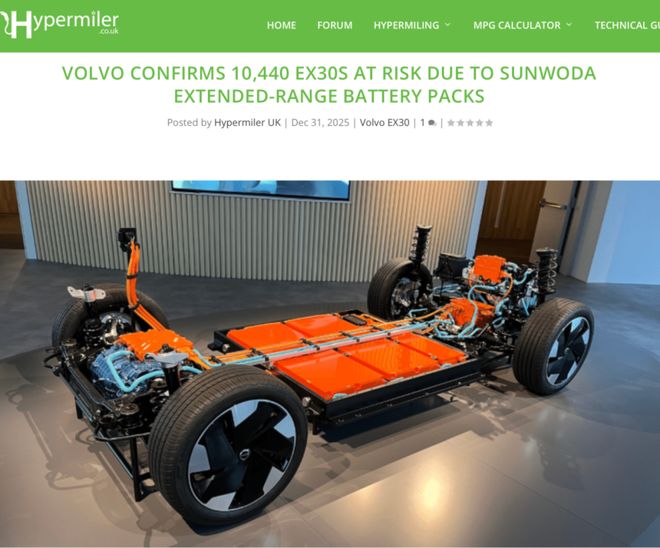
Core Viewpoint - Volvo Cars, known for its commitment to safety, is facing unprecedented challenges in the electric vehicle era due to safety concerns related to its EX30 model's battery supplied by Sunwoda [1][4][11]. Group 1: Battery Safety Issues - A total of 10,440 EX30 vehicles in the UK are affected by potential safety issues related to high-voltage batteries from Sunwoda, marking a significant acknowledgment of the problem [12]. - Among 33,777 EX30 vehicles produced with Sunwoda batteries, approximately 0.02% have reported overheating issues [4]. - A fire incident involving an EX30 in Brazil raised alarms, leading Volvo to issue warnings to owners to limit charging to 70% to mitigate fire risks [7][11]. Group 2: Recall and Legal Actions - Volvo is preparing for a large-scale recall, with the South African National Consumer Commission already issuing a recall notice for 372 EX30 vehicles due to potential battery defects [7][14]. - Geely Holding, Volvo's parent company, has filed a lawsuit against Sunwoda for 2.314 billion RMB, citing quality issues with batteries supplied between June 2021 and December 2023 [14][17]. Group 3: Consumer Trust and Market Impact - The battery safety crisis has raised significant concerns among consumers, with many questioning the reliability of electric vehicle batteries and the overall quality control in the industry [23][29]. - Volvo's temporary measure of limiting charging to 70% has led to dissatisfaction among owners, as it significantly reduces the vehicle's usable range [12][13]. - The incident has broader implications for the electric vehicle industry, potentially leading to increased scrutiny and a shift towards prioritizing safety and quality over cost [29].

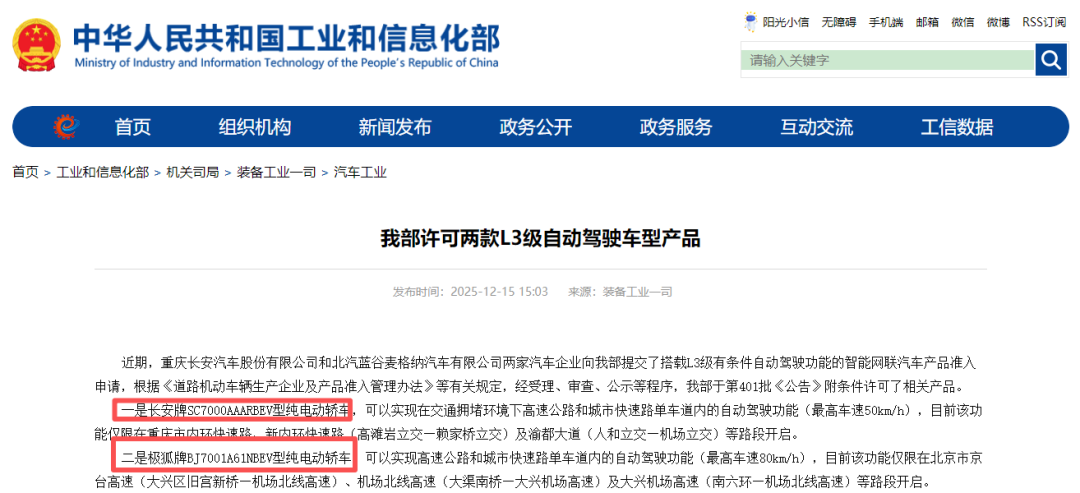
“终于上路了”!北汽、长安等车企竞逐L3
Xin Lang Cai Jing· 2026-01-11 11:44
Core Insights - The approval of L3 conditional autonomous driving vehicles by the Ministry of Industry and Information Technology marks a significant step towards commercial application in China [4][18] - Companies like BAIC and Changan are leading the charge in the L3 autonomous driving sector, with their models set to begin trial operations [1][2] Group 1: L3 Autonomous Driving Approval - The first batch of L3 conditional autonomous driving vehicles approved includes the BAIC Arcfox Alpha S (L3 version) and Changan SC7000AAARBEV [1][2] - These vehicles are designed for specific urban and highway scenarios, with the Arcfox model capable of operating at speeds up to 80 km/h on designated routes in Beijing [2][3] - The approval process involves a phased approach, with commercial operations expected to gradually open to individual users by Q2 2026 [3][12] Group 2: Competitive Landscape - Multiple automakers, including BYD, NIO, and Geely, are vying for entry into the L3 autonomous driving market, with some obtaining local government permits for testing [2][14] - The distinction between permits from the Ministry of Industry and Information Technology and local governments lies in their nature; the former allows for commercial pilot projects, while the latter focuses on research and development [15][17] - Geely's Zeekr 9X has received a testing permit covering over 9,224 square kilometers in Hangzhou, indicating the scale of testing efforts [14] Group 3: Future Developments - The industry anticipates 2026 to be a pivotal year for the mass production of L3 autonomous driving technology, with potential breakthroughs in L4 technology as well [6][18] - BAIC is committed to expanding its lineup of vehicles equipped with L3 technology, indicating a long-term strategy in the autonomous driving space [18] - The partnership between BAIC and Pony.ai aims to develop a comprehensive operational model for Robotaxi services, showcasing the industry's focus on commercializing autonomous driving [19]