华西证券

Search documents
“1时代”债市:交易员追逐0.25BP的波段收益
经济观察报· 2025-07-11 08:59
Core Viewpoint - The importance of swing trading in the bond market has increased due to continuously declining interest rates, leading to a need for traders to be more sensitive to short-term market fluctuations to capture profit opportunities [1][5][10]. Bond Market Trends - The yield on "AAA" rated credit bonds has reached historical lows, with significant declines observed; for instance, yields for AAA city investment bonds have dropped by 50-100 basis points compared to the same period in 2024 [4][9]. - As of July 2025, the yield on 10-year Chinese government bonds was recorded at 1.6570%, while 30-year bonds remained below 2% [4][9]. - The average yield for one-year bank wealth management products is around 1.20%, and three-year products are approximately 1.55% [5]. Investment Strategies - Institutions are increasingly engaging in high-frequency trading to adapt to the low-yield environment, with public funds, insurance asset management, and bank wealth management subsidiaries participating more actively [12]. - Investors are advised to maintain a primary position in city investment bonds for stable cash flow while exploring other higher-yielding assets [21][24]. Challenges in the Market - The low yield environment presents challenges for profitability, as institutions face pressure to meet rigid liability assessments while dealing with shrinking profit margins [15][16]. - The supply of high-yield assets is diminishing, and the overall bond supply remains tight despite some improvements compared to the previous year [16][18]. Future Outlook - Analysts predict that the downward trend in bond yields will continue due to factors such as the real estate cycle downturn and the delayed effects of tariffs, suggesting that there is still room for interest rate cuts [7]. - The current low yield environment is prompting institutions to shift from a debt-driven investment approach to an equity-driven strategy, emphasizing the need for innovation in investment practices [24].


华西证券(002926) - 2025 Q2 - 季度业绩预告
2025-07-11 08:50
[Huaxi Securities 2025 Semi-Annual Performance Forecast](index=1&type=section&id=Huaxi%20Securities%20Co.%2C%20Ltd.%202025%20Semi-Annual%20Performance%20Forecast) [Current Period Performance Forecast](index=1&type=section&id=I.%20Current%20Period%20Performance%20Forecast) The company projects substantial performance growth for the first half of 2025, with net profit attributable to shareholders expected to increase by over 1000% 2025 Semi-Annual Performance Forecast | Item | Current Period | Prior Year Period | | :--- | :--- | :--- | | **Net Profit Attributable to Shareholders of Listed Company** | Profit: 445.00 Million Yuan – 575.00 Million Yuan | Profit: 39.55 Million Yuan | | Year-on-Year Growth | 1025.19% - 1353.90% | - | | **Net Profit Excluding Non-Recurring Gains and Losses** | Profit: 439.00 Million Yuan – 569.00 Million Yuan | Profit: 42.05 Million Yuan | | Year-on-Year Growth | 944.10% - 1253.28% | - | | **Basic Earnings Per Share** | Profit: 0.17 Yuan/Share – 0.22 Yuan/Share | Profit: 0.02 Yuan/Share | [Communication with Accounting Firm](index=1&type=section&id=II.%20Communication%20with%20Accounting%20Firm) This performance forecast presents preliminary results and has not been audited by a certified public accountant - This performance forecast has not been audited by a certified public accountant[4](index=4&type=chunk) [Explanation of Performance Changes](index=1&type=section&id=III.%20Explanation%20of%20Performance%20Changes) The company attributes its performance growth to strategic initiatives, improved business operations, market opportunity capture, and enhanced risk management - The company attributes performance growth to[5](index=5&type=chunk) - Adhering to specialized and differentiated development directions - Improving business organizational systems and commercial models - Strengthening operational management and actively seizing market opportunities - Enhancing compliance and risk control, effectively improving asset quality [Risk Warning](index=1&type=section&id=IV.%20Risk%20Warning) The company confirms no significant uncertainties impact the accuracy of this performance forecast - The company states there are no significant uncertainties affecting the accuracy of this performance forecast[6](index=6&type=chunk) [Other Relevant Notes](index=1&type=section&id=V.%20Other%20Relevant%20Notes) This performance forecast is a preliminary estimate, with final financial data subject to the officially disclosed 2025 semi-annual report - This performance forecast is a preliminary estimate, with final data subject to the 2025 semi-annual report[8](index=8&type=chunk)

理财年中时点规模回吐:14家公司6月环比减少9500亿元,上半年增量回落至5300亿元
news flash· 2025-07-11 08:48
Group 1 - The total wealth management scale of the top 14 banks reached 22.96 trillion yuan by the end of June, a decrease of approximately 950 billion yuan compared to the end of May [1] - The growth of these institutions in the first half of the year narrowed to 530 billion yuan due to scale fluctuations in June [1] - The decline in scale in June was primarily due to a rapid loss of cash products, which decreased by over 550 billion yuan compared to the end of May and approximately 800 billion yuan since the beginning of the year [1] Group 2 - Looking ahead, the wealth management market is expected to see a rapid rebound in July, with an estimated recovery of over one trillion yuan [1]
每日投行/机构观点梳理(2025-07-11)
Jin Shi Shu Ju· 2025-07-11 08:21
Group 1 - Goldman Sachs raised its forecast for Asian stocks due to a more favorable macroeconomic environment and increased certainty around tariffs, adjusting the MSCI Asia Pacific (excluding Japan) index target by 3% to 700 points, indicating a 9% return in USD terms over the next 12 months [1] - The firm upgraded the rating for Hong Kong stocks to "market weight," highlighting that they will be major beneficiaries in the context of a Federal Reserve easing cycle and a weaker dollar, with markets like the Philippines also expected to benefit significantly [1] - The report emphasized that tariff imposition and loose monetary policy could be significant macro influences on Asian stocks in Q3, suggesting that even if the final tariff rates are slightly higher than current baseline expectations, the impact on fundamental growth may not be as severe as previously feared [1] Group 2 - Bank of America noted that despite global economic uncertainties, Brent crude oil prices have shown resilience, averaging $70.75 per barrel since January, primarily due to China's strategic oil reserve absorbing nearly all oil surpluses in Q2, tightening global supply [2] - Strong consumer demand, particularly in road travel and air travel, continues to support oil prices, alongside U.S. tariff policies prompting importers to pre-purchase crude oil to avoid potential future restrictions [2] Group 3 - Goldman Sachs analyst Alberto Ramos projected that retaliatory tariffs from Brazil against the U.S. could lead to a GDP growth reduction of 0.3 to 0.4 percentage points, with uncertainty surrounding Brazil's response [2] Group 4 - BNP Paribas economists suggested that increasing defense and infrastructure spending in the Eurozone could help mitigate the negative impacts of demographic changes, with Germany planning significant fiscal shifts towards these areas [3] - The report indicated that these measures are crucial as past labor growth was a primary driver of potential output increases in the Eurozone, making defense and infrastructure spending vital for future economic growth [3] Group 5 - JPMorgan analysts highlighted that the "Big and Beautiful" Act signed by Trump could provide a $2.5 billion boost to private student loan institutions, as it limits federal loan sources for graduate students, shifting a $14 billion student loan market towards the private sector [4] - This transition represents significant growth potential for private lenders like SoFi, Sallie Mae, and Navient, which are expected to see substantial increases in interest and fee income [4] Group 6 - CITIC Securities reported that the recent rebound in U.S. stocks has led to market divergence regarding future trends, with macro data from July indicating stability but not significantly altering the slight weakening of the U.S. economy [5] - The firm suggested that U.S. stock earnings may face further minor downward adjustments, with a focus on sectors like information technology and telecommunications that are expected to maintain high earnings growth [5] Group 7 - CITIC Securities projected a significant increase in renewable energy consumption responsibility weights by 2025, potentially supporting around 460 billion kilowatt-hours of green electricity consumption this year [6] - The report noted that the increase in responsibility weights could vary significantly, impacting pricing mechanisms and potentially slowing down local installation growth in certain regions [7] Group 8 - CITIC Securities emphasized that achieving capacity reduction in the photovoltaic industry is a gradual process, recommending a focus on leading companies with long-term competitiveness and resilience amid ongoing industry adjustments [8] Group 9 - CICC indicated that the power grid and industrial control sectors are expected to maintain resilience in their fundamentals through the first half of 2025, advising investors to pay attention to performance and valuation recovery opportunities in the second half of the year [9] - The report highlighted that domestic power grid investment remains robust, with expectations for continued upward trends in investment over the next few years [9] Group 10 - Huatai Securities expressed confidence in the upward trend of copper prices, viewing potential price corrections as good opportunities for investment, particularly in light of upcoming tariffs on copper [11] Group 11 - Galaxy Securities recommended focusing on vertical SaaS companies that are leading in AI Agent deployments, as the demand for AI capabilities continues to grow, creating investment opportunities in this sector [12]
“1时代”债市:交易员追逐0.25BP的波段收益
Jing Ji Guan Cha Wang· 2025-07-11 06:45
Core Insights - The bond market is experiencing a significant decline in yields, with "AAA" rated credit bonds reaching historical lows, prompting traders to engage in frequent wave trading to capture small profit margins [1][4][5] - The overall investment environment is shifting towards low-risk assets due to increased volatility in stocks and funds, leading to a preference for stable, low-risk investments [3][12] Bond Market Trends - The issuance rates for "AAA" rated credit bonds have dropped significantly, with examples such as Huadian International's bond at 1.89% and Zhongshan Public's bond at 1.66%, marking record lows for similar ratings and terms [1][4] - The yield for 1-year "AAA" rated city investment bonds has decreased to as low as 1.67%, down from approximately 2.5%-2.8% in the same period last year, indicating a drop of 80-110 basis points [4][5] Trading Strategies - The importance of wave trading has increased as the yield spread narrows, with traders aiming for small gains of 1-2 basis points per transaction [1][2] - Institutions are increasingly adopting high-frequency trading strategies to capitalize on short-term market fluctuations, with a notable rise in participation from public funds, insurance asset management, and bank wealth management subsidiaries [7][12] Investment Challenges - The low yield environment presents challenges for institutions, as they struggle to meet liability requirements while facing limited profit margins [8][9] - The scarcity of high-yield assets is becoming more pronounced, with banks unable to invest in the stock market due to regulatory constraints, leading to a focus on the bond market for asset allocation [9][10] Future Outlook - The bond market is expected to continue experiencing downward pressure on yields due to monetary policy shifts and economic challenges, with the potential for further interest rate cuts [5][6] - Institutions are advised to diversify their portfolios by incorporating longer-duration bonds, industry bonds, and equity assets to enhance yield potential in a low-rate environment [12][14]
通胀仍在探底
HUAXI Securities· 2025-07-10 01:28
Group 1: Inflation Overview - The June CPI year-on-year increased by 0.1%, higher than the expected 0% and the previous month’s -0.1% [1] - The core CPI, excluding food and energy, year-on-year rose by 0.7%, compared to the previous value of 0.6% [1] - The PPI year-on-year decreased by 3.6%, which was worse than the expected -3.3% [1] Group 2: Food Prices - Food prices fell by 0.4% month-on-month, but the decline was smaller than the average drop of 1.2% during the same period from 2021 to 2024 [2] - Fresh vegetable prices increased by 0.7% due to supply shortages caused by high temperatures and excessive rainfall, contrasting with the average decline of 4.1% in previous years [2] - In July, food prices continued to show a slight decline, with average prices of 28 monitored vegetables and 7 fruits dropping by 0.3% and 1.2% respectively [2] Group 3: Energy Prices - Oil prices rebounded, significantly reducing the drag on CPI from energy [2] - The average price of Brent crude oil increased by 9.1% month-on-month, leading to a month-on-month increase of 0.3% in transportation fuel prices after three consecutive months of decline [2][11] Group 4: Other Price Movements - The prices of platinum jewelry, rent, and medical services showed improvement, with platinum prices rising by 12.6%, marking the largest month-on-month increase in nearly a decade [3] - Medical service prices increased by 0.3% for three consecutive months, likely due to the implementation of new pricing guidelines [3] - Tourism services experienced a month-on-month price drop of 0.8% due to seasonal factors following the end of holiday periods [3] Group 5: PPI Analysis - The PPI remained at -0.4% month-on-month for the fourth consecutive month, indicating persistent weakness in industrial prices [4] - Seasonal and structural factors contributed to the decline, with significant price drops in the mining and raw materials sectors [4] - The increase in renewable energy generation has exerted structural pressure on traditional energy prices, contributing to the PPI decline [4] Group 6: Industry Insights - Prices in the photovoltaic and lithium battery sectors fell in June, but a policy shift is expected to curb price wars and lead to a potential rebound [5] - The automotive industry has shown signs of recovery, with prices increasing by 0.2% month-on-month after a period of aggressive price competition [6] - Overall, the CPI showed slight improvement while the PPI remained weak, indicating ongoing price stabilization efforts in various sectors [6]
稀土龙头业绩释放信号,内外价差加速收敛,行业有望迎来业绩+估值双重增长
Xuan Gu Bao· 2025-07-09 23:29
Group 1 - Northern Rare Earth expects a net profit attributable to shareholders of 0.9 billion to 0.96 billion yuan for the first half of 2025, an increase of 0.855 billion to 0.915 billion yuan compared to the same period last year, representing a year-on-year increase of 1882.54% to 2014.71% [1] - Following the China-US trade negotiations, China has partially relaxed rare earth export controls, expediting the approval process for foreign companies' export licenses, which has alleviated the high demand for rare earths from Western companies [1] - As of June, there has been a certain recovery in rare earth product export orders, although the export process has been slightly prolonged due to the time taken for license processing and customs inspections [1] Group 2 - With the upcoming peak season for domestic new energy vehicles and the subsequent overseas restocking demand, rare earth prices are expected to continue rising, benefiting the sector and leading to a dual boost in performance and valuation for domestic rare earth magnetic material companies [2] - Major domestic companies in the rare earth sector include Northern Rare Earth, China Rare Earth, Zhenghai Magnetic Materials, Ningbo Yunsheng, and Jinli Permanent Magnet [3]

债市抢配科创债ETF成分券,机构提示"超买"风险
2 1 Shi Ji Jing Ji Bao Dao· 2025-07-09 10:40
Group 1 - The launch of the first batch of Sci-Tech Bond ETFs has led to a surge in market interest and investment in underlying component bonds, indicating a strong demand for these financial products [1][2][3] - The rapid development of the Sci-Tech bond market is attributed to supportive policies, industry trends, and institutional demand, with a notable increase in R&D investments in technology sectors like AI [2][3] - The first batch of 10 Sci-Tech Bond ETFs was fully subscribed on the day of launch, contributing to the total scale of bond ETFs exceeding 400 billion yuan [1][3] Group 2 - The introduction of Sci-Tech Bond ETFs has acted as a catalyst for the valuation and trading enthusiasm of related underlying bonds, with institutional investors actively seeking to acquire these bonds [2][5] - The high credit quality of the issuers, primarily state-owned enterprises and large financial institutions, enhances the attractiveness of Sci-Tech bonds, which are seen as a premium alternative in a low-yield environment [3][7] - The ETFs provide a low-cost, transparent, and efficient trading mechanism, making them suitable for both institutional and individual investors looking to participate in the Sci-Tech bond market [4][6] Group 3 - There are indications of a "short-term overbuy" phenomenon in the market, with some component bonds experiencing excessive trading activity, leading to concerns about potential price corrections [2][8] - The yield on many Sci-Tech bonds is concentrated in the 1.7%-2% range, which may limit their appeal to certain institutional investors seeking higher returns [7][9] - The overall market for Sci-Tech bonds is expected to grow, but the valuation of component bonds may face downward pressure as the market stabilizes [9]
非银行金融行业周报:程序化交易细则实施,行业多项排名出台-20250709
Shanxi Securities· 2025-07-09 09:51
Investment Rating - The report maintains an investment rating of "Leading the Market - A" for the non-bank financial industry [1]. Core Insights - The implementation of the programmatic trading rules aims to regulate high-frequency trading behaviors, thereby reducing market volatility and protecting the interests of retail investors [4][11]. - Recent rankings in the brokerage industry show an improvement in cultural construction, with 14 A-class companies and 36 B-class companies identified among 105 evaluated brokerages [12][24]. - Major indices experienced varying degrees of increase, with the Shanghai Composite Index rising by 1.40%, the CSI 300 by 1.54%, and the ChiNext by 1.50% during the week [12][14]. Summary by Sections Investment Recommendations - The report emphasizes the significance of the newly implemented programmatic trading management rules, which include detailed regulations on trading behavior and reporting requirements [11][4]. Market Review - The report notes that the A-share trading volume reached 7.21 trillion yuan, with an average daily trading amount of 1.44 trillion yuan, reflecting a week-on-week decrease of 3.05% [14][17]. Industry Key Data Tracking 1) Market Performance and Scale: The report highlights the recent performance of major indices, with the Shanghai Composite Index increasing by 1.40% and the CSI 300 by 1.54% [14][17]. 2) Credit Business: As of July 4, the market had 3,087.84 billion shares pledged, accounting for 3.77% of the total share capital, with a margin balance of 1.85 trillion yuan [17][20]. 3) Fund Issuance: In June 2025, new fund issuance reached 1,221.24 billion shares, with a significant increase in the number of funds issued [17][18]. 4) Investment Banking: The report states that the equity underwriting scale in June 2025 was 5,530.18 billion yuan, with IPO amounts at 91.53 billion yuan [17][18]. 5) Bond Market: The report notes a 0.47% decline in the total price index of bonds since the beginning of the year, with the 10-year government bond yield at 1.64% [17][25]. Regulatory Policies and Industry Dynamics - The report discusses the results of the brokerage cultural construction evaluation, indicating a notable increase in A-class brokerages compared to previous years [24][26]. - It also mentions that 12 Chinese brokerages have been selected as the first distributors for the Hong Kong Stock Exchange's comprehensive fund platform, enhancing their role in connecting mainland and Hong Kong capital markets [24][26].

A500ETF嘉实(159351)红盘蓄势,机构:降准降息仍有空间,A股稳中向上趋势不变
Xin Lang Cai Jing· 2025-07-09 03:15
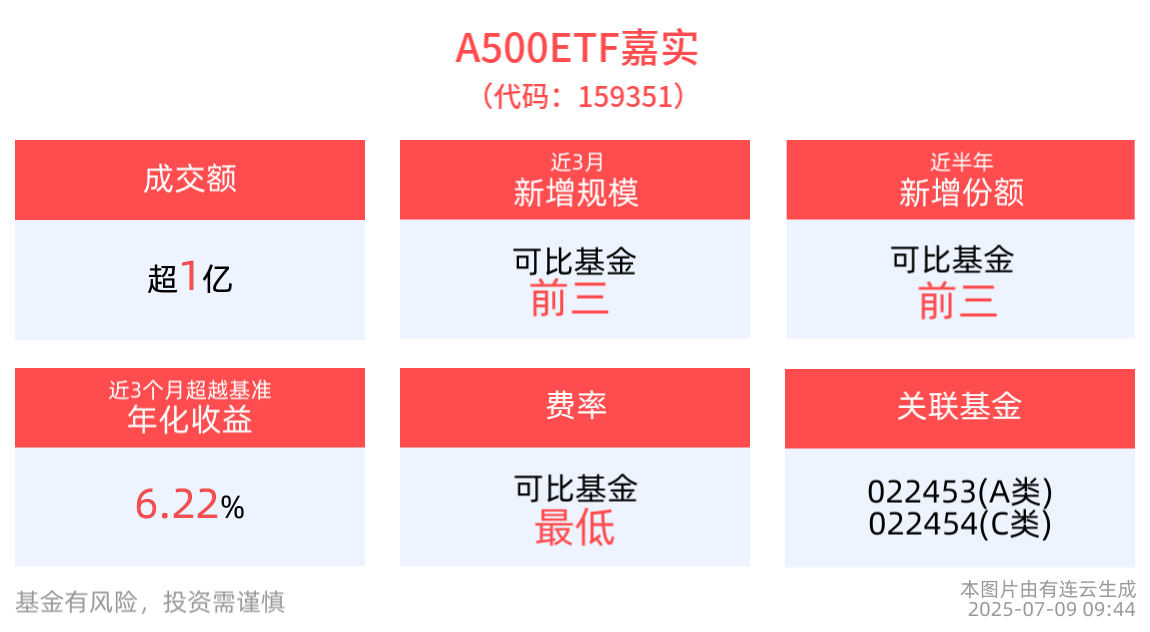
Group 1 - A500ETF Jia Shi has a turnover rate of 1.12% and a transaction volume of 165 million yuan, with an average daily transaction of 3.062 billion yuan over the past month as of July 8 [3] - The scale of A500ETF Jia Shi has increased by 272 million yuan over the past three months, and the number of shares has grown by 1.26 billion shares over the past six months [3] - As of July 8, A500ETF Jia Shi's net value has risen by 7.05% over the past six months, with the highest monthly return since inception being 3.55% and an average monthly return of 2.05% [3] Group 2 - The top ten weighted stocks in the CSI A500 Index as of June 30 include Kweichow Moutai, CATL, Ping An Insurance, and others, accounting for a total of 20.67% [3] - The market is expected to provide structural opportunities despite the index nearing new highs, with July historically being a strong month for market performance [4] - The central bank is anticipated to have room for rate cuts in the second half of the year, supporting a stable upward trend in A-shares [4] Group 3 - Investors without stock accounts can access the A500ETF Jia Shi linked fund (022454) for exposure to the top 500 A-share companies [7]