陕西煤业

Search documents
如何看待焦煤商品价格反弹原因及持续性?
Changjiang Securities· 2025-06-29 08:42
Investment Rating - The report maintains a "Positive" investment rating for the coal industry [10]. Core Insights - The recent strong rebound in coking coal futures is attributed to a combination of supply contraction and improved demand fundamentals, although medium to long-term price pressures may persist if demand does not see significant positive changes [2][7]. - The coal index (Yangtze) increased by 1.68% this week, underperforming the CSI 300 index by 0.27 percentage points, ranking 25th out of 32 industries [19]. - Coking coal prices are supported by supply tightening due to safety inspections and environmental regulations, while demand remains stable due to steel production [6][20]. Summary by Sections Coking Coal Market - Coking coal futures saw a weekly increase of 6.34%, closing at 848 CNY/ton, significantly outperforming other commodities in the coal-steel-mining chain [7][14]. - Supply-side factors include reduced production from safety checks and environmental inspections, leading to a 0.53% week-on-week decrease in weekly refined coal output [7][20]. - Demand remains stable, with average daily pig iron production from 247 steel mills at 2.4229 million tons, showing a slight increase of 0.05% week-on-week [7][20]. Investment Recommendations - The report suggests marginal allocation to long-term stable profit leaders such as China Coal Energy (A+H), China Shenhua (A+H), and Shaanxi Coal and Chemical Industry [8]. - For growth-oriented investments, Electric Power Investment and New集 Energy are recommended, while coking coal companies like Shanxi Coking Coal, Huaibei Mining, and Pingdingshan Coal are highlighted for their potential [8]. Price Trends - As of June 27, the market price for Qinhuangdao 5500 kcal thermal coal is 620 CNY/ton, reflecting an increase of 11 CNY/ton week-on-week [19][42]. - The main coking coal price at Jingtang Port remains stable at 1230 CNY/ton, while the price for first-grade metallurgical coke is 1280 CNY/ton, unchanged from the previous week [19][20].




地缘政治加剧天然气价格波动,欧洲煤炭市场再度补库催化煤价
GOLDEN SUN SECURITIES· 2025-06-29 07:31
Investment Rating - The industry investment rating is "Increase" [5][7]. Core Viewpoints - The current coal price adjustment has been ongoing for nearly four years since the historical peak in Q4 2021, and the market is well aware of the price decline. The industry is at a critical stage of price bottoming, and the bottom may not be far off. It is essential to grasp the intrinsic attributes of the industry and maintain confidence and determination [3]. - Domestic coal companies are increasingly facing losses, with over half (54.8%) of coal enterprises reporting losses as of March 2025. This situation may lead to a higher probability of both passive and active production cuts as prices continue to decline [3]. - The report emphasizes the potential for a rebound in coal prices due to the high costs of overseas coal mines, which may lead to reduced imports and a subsequent increase in domestic coal prices [3]. Summary by Sections Coal Mining - The European coal market is experiencing a price decline, with ARA port coal prices at $103.4 per ton, down $3.7 per ton (-3.4%) from the previous week. Newcastle port coal prices are at $106.5 per ton, down $0.1 per ton (-0.1%) [1][3]. - The report highlights the impact of geopolitical tensions on natural gas prices, which have led to a simultaneous increase in coal and natural gas prices in Europe by 7-9% [6][3]. Key Recommendations - The report recommends key coal enterprises such as China Shenhua (H+A), China Coal Energy (H+A), and China Qinfa, which is expected to reverse its current difficulties. Other recommended companies include Xinjie Energy, Shaanxi Coal, and Yanzhou Coal, which are expected to perform well [3][7].
煤价旺季反弹,板块逢低配置
Xinda Securities· 2025-06-29 03:23
Investment Rating - The investment rating for the coal mining sector is "Positive" [2] Core Viewpoints - The current phase is seen as the beginning of a new upward cycle in the coal economy, with a resonance between fundamentals and policies, making it an opportune time to accumulate coal sector stocks [11][12] - The coal price has stabilized and is expected to continue its upward trend due to safety inspections in production areas, ongoing inventory depletion at ports, and the initiation of peak season demand [11][12] - The valuation of the coal sector remains low, and the continuous improvement in fundamentals and price expectations has not yet been fully reflected, highlighting the sector's investment value [11][12] Summary by Sections Coal Price Trends - As of June 28, the market price for Qinhuangdao port thermal coal (Q5500) is 614 CNY/ton, up 4 CNY/ton week-on-week [11][29] - The international thermal coal offshore price for Newcastle NEWC5500 is 65.3 USD/ton, down 1.3 USD/ton week-on-week [11][29] - The price for coking coal at Jing Tang port remains stable at 1250 CNY/ton [11][31] Supply and Demand Analysis - The capacity utilization rate for sample thermal coal mines is 92.9%, down 1.6 percentage points week-on-week, while the coking coal mine utilization rate is 82.48%, down 2.0 percentage points [11][48] - Daily coal consumption in inland provinces has increased by 14.5 thousand tons/day (+4.13%), while consumption in coastal provinces has decreased by 1.6 thousand tons/day (-0.84%) [11][49] Investment Recommendations - The report suggests focusing on stable and high-performing companies such as China Shenhua, Shaanxi Coal and Chemical Industry, and China Coal Energy, as well as those with significant upside potential like Yanzhou Coal Mining and China Power Investment [12][13] - The coal sector is characterized by high performance, high cash flow, and high dividend yields, making it an attractive investment opportunity [12][13]

超长信用债涨势暂歇,3-5年中低等级表现占优
Xinda Securities· 2025-06-28 14:49
Report Industry Investment Rating The document does not provide information about the report industry investment rating. Core Viewpoints - The rally of ultra-long credit bonds has paused, with 3 - 5-year medium and low-grade bonds performing better. Interest rate bond yields have shown narrow fluctuations overall, while credit bond yields have also maintained a volatile pattern. Credit spreads have different changes across various maturities and ratings [2][5]. - Most urban investment bond spreads have increased, with varying trends among different regions and ratings [2][9]. - Industrial bond spreads are generally stable, but the spreads of mixed-ownership real estate bonds continue to rise [2][13]. - Most yields of secondary capital and perpetual bonds (Two-Permanent Bonds) have increased, and the spreads have slightly widened [2][26]. - The excess spreads of industrial perpetual bonds have decreased, while those of urban investment perpetual bonds have slightly increased [2][28]. Summary by Directory 1. The Rally of Ultra-long Credit Bonds Pauses, 3 - 5-year Medium and Low-grade Bonds Perform Better - Interest rate bond yields have narrow fluctuations: 1Y and 5Y Guokai bond yields have decreased by 1BP, 3Y yields remain flat, and 7Y and 10Y yields have increased by 1 - 2BP [5]. - Credit bond yields are volatile: The yields of 7-year and 3 - 5-year high-grade bonds have rebounded, while 3 - 5-year medium and low-grade bonds perform relatively strongly. Yield changes vary by maturity and rating [5]. - Credit spreads: 1Y spreads change between -1 and 1BP; 3Y AAA spreads increase by 3BP, others decrease by 2BP; 5Y AAA spreads increase by 3BP, others decrease by 3 - 4BP; 7Y spreads increase by 0 - 1BP; 10Y spreads of AAA, AA+, and AA change by 2BP, -2BP, and 1BP respectively [2][5]. - Rating and term spreads show obvious differentiation [5]. 2. Most Urban Investment Bond Spreads Increase - External ratings: AAA and AA+ platform spreads increase by 2BP, AA platform spreads increase by 3BP [2][9]. - Provincial platforms: Most AAA platform spreads increase by 1 - 3BP, with Guangxi decreasing by 4BP, Jilin and Liaoning increasing by 5BP; most AA+ platform spreads increase by 1 - 3BP, Jilin increasing by 7BP; most AA platform spreads increase by 1 - 3BP, Liaoning decreasing by 6BP, Xinjiang and Gansu increasing by 4BP [9][10][11]. - Administrative levels: Provincial, prefecture-level, and district-level platform spreads all increase by 2BP, with different trends in different regions [14][15]. 3. Industrial Bond Spreads are Generally Stable, Mixed-ownership Real Estate Bond Spreads Continue to Rise - Real estate bonds: Central and local state-owned enterprise real estate bond spreads are basically flat compared to last week, mixed-ownership real estate bond spreads increase by 8BP, and private enterprise real estate bond spreads increase by 40BP. Spreads of individual real estate companies vary [2][13]. - Other industrial bonds: AAA coal bond spreads increase by 1BP, AA+ remain flat, AA decrease by 1BP; AAA and AA+ steel bond spreads decrease by 1BP and 2BP respectively; spreads of various grades of chemical bonds increase by 0 - 1BP. Spreads of individual companies such as Shaanxi Coal and HBIS decrease by 1BP, while Jinkong Coal Industry increases by 7BP [13]. 4. Most Yields of Two-Permanent Bonds Increase, Spreads Slightly Widen - 1Y bonds: Secondary capital bond yields of all grades increase by 1 - 2BP, perpetual bond yields increase by 2 - 3BP, and spreads generally increase by 2 - 3BP [26]. - 3Y bonds: Secondary capital bond yields of all grades increase by 2 - 4BP, perpetual bond yields increase by 1BP, and spreads increase in line with yields [26]. - 5Y bonds: Yields and spreads of all grades of Two-Permanent Bonds increase by 0 - 1BP [26]. 5. The Excess Spreads of Industrial Perpetual Bonds Decrease, Urban Investment Bond Excess Spreads Slightly Increase - Industrial perpetual bonds: The excess spreads of industrial AAA 3Y perpetual bonds decrease by 2.38BP to 3.81BP, at the 0.07% percentile since 2015; the excess spreads of AAA 5Y perpetual bonds decrease by 2.60BP to 8.51BP, at the 5.80% percentile [2][28]. - Urban investment perpetual bonds: The excess spreads of urban investment AAA 3Y perpetual bonds increase by 0.15BP to 6.14BP, at the 2.86% percentile; the excess spreads of AAA 5Y perpetual bonds increase by 0.44BP to 9.81BP, at the 8.80% percentile [2][28]. 6. Credit Spread Database Compilation Instructions - Market credit spreads are calculated based on ChinaBond Medium and Short-term Notes and ChinaBond Perpetual Bonds data, with historical percentiles since early 2015 [36]. - Credit spreads of industrial and urban investment individual bonds are calculated by subtracting the yield of the same-term Guokai bond from the individual bond's ChinaBond valuation, and then averaged to get the industry or regional credit spreads [36]. - Excess spreads of bank secondary capital and perpetual bonds, as well as industrial and urban investment perpetual bonds, are calculated by subtracting the credit spreads of corresponding benchmark bonds [36]. - Samples of industrial and urban investment bonds are selected from medium notes and public corporate bonds, excluding guaranteed and perpetual bonds. Bonds with remaining maturities below 0.5 years or above 5 years are excluded [36]. - Industrial and urban investment bonds use external entity ratings, while commercial banks use ChinaBond implicit debt ratings [36].
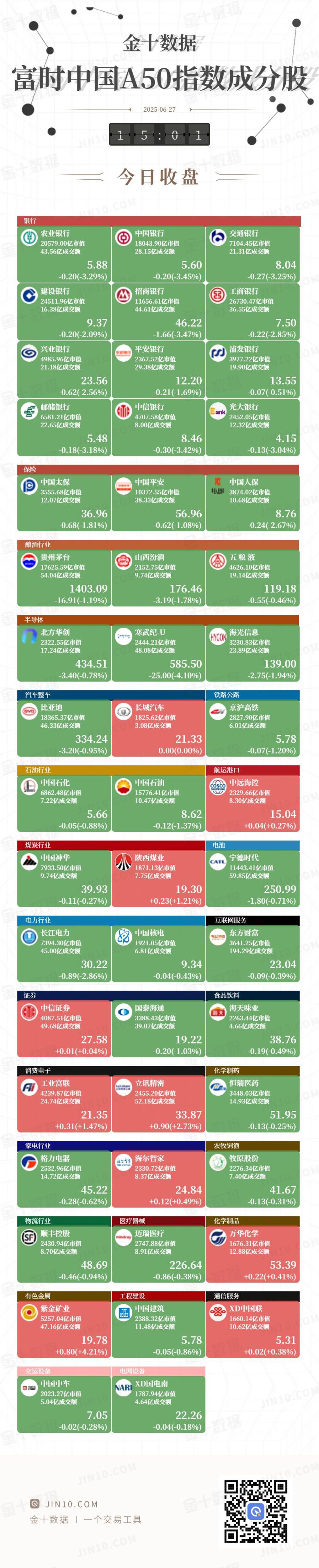
金十图示:2025年06月27日(周五)富时中国A50指数成分股今日收盘行情一览:成分股大面积飘绿,银行股午后进一步下跌
news flash· 2025-06-27 07:04
Market Overview - The FTSE China A50 Index components showed a significant decline, with many stocks closing in the red, particularly in the banking sector [1][5]. Insurance Sector - China Pacific Insurance had a market capitalization of 387.40 billion, with a trading volume of 1.207 billion, experiencing a decrease of 0.68 (-1.81%) [3]. - China Life Insurance had a market capitalization of 355.57 billion, with a trading volume of 3.833 billion, down by 0.62 (-1.08%) [3]. - Ping An Insurance reported a market capitalization of 1,037.26 billion, with a trading volume of 10.68 billion, declining by 0.24 (-2.67%) [3]. Alcohol Industry - Kweichow Moutai had a market capitalization of 1,762.56 billion, with a trading volume of 54.04 billion, down by 3.19 (-1.78%) [3]. - Wuliangye Yibin reported a market capitalization of 215.28 billion, with a trading volume of 19.14 billion, decreasing by 0.55 (-0.46%) [3]. - Shanxi Fenjiu had a market capitalization of 462.61 billion, with a trading volume of 9.74 billion, down by 16.91 (-1.19%) [3]. Semiconductor Sector - Northern Huachuang had a market capitalization of 232.26 billion, with a trading volume of 17.24 billion, decreasing by 3.40 (-0.78%) [3]. - Cambricon Technologies reported a market capitalization of 244.42 billion, with a trading volume of 48.08 billion, down by 25.00 (-4.10%) [3]. - Haiguang Information had a market capitalization of 323.08 billion, with a trading volume of 23.89 billion, declining by 2.75 (-1.94%) [3]. Automotive Sector - BYD had a market capitalization of 282.79 billion, with a trading volume of 46.33 billion, down by 3.20 (-0.95%) [3]. - Great Wall Motors reported a market capitalization of 1,836.54 billion, with a trading volume of 3.08 billion, remaining unchanged [3]. - Beijing-Shanghai High-Speed Railway had a market capitalization of 182.56 billion, with a trading volume of 6.01 billion, down by 0.07 (-1.20%) [3]. Oil and Shipping Sector - China COSCO Shipping had a market capitalization of 686.25 billion, with a trading volume of 7.22 billion, down by 0.12 (-1.37%) [3]. - Sinopec reported a market capitalization of 1,577.64 billion, with a trading volume of 10.47 billion, increasing by 0.04 (+0.27%) [3]. - China National Petroleum Corporation had a market capitalization of 232.97 billion, with a trading volume of 8.30 billion, down by 0.05 (-0.88%) [3]. Coal Industry - China Shenhua Energy had a market capitalization of 793.35 billion, with a trading volume of 59.85 billion, down by 0.11 (-0.27%) [3]. - Shaanxi Coal and Chemical Industry reported a market capitalization of 187.11 billion, with a trading volume of 9.74 billion, down by 1.80 (-0.71%) [3]. - Contemporary Amperex Technology Co., Ltd. (CATL) had a market capitalization of 1,144.34 billion, with a trading volume of 7.75 billion, increasing by 0.23 (+1.21%) [3]. Other Sectors - China Nuclear Power had a market capitalization of 192.10 billion, with a trading volume of 4.50 billion, down by 0.89 (-2.86%) [4]. - Yangtze Power reported a market capitalization of 739.43 billion, with a trading volume of 6.81 billion, down by 0.04 (-0.43%) [4]. - Dongfang Fortune had a market capitalization of 364.13 billion, with a trading volume of 194.29 billion, down by 0.09 (-0.39%) [4].







煤炭行业中期策略报告:成本倒挂煤价筑底,供需再平衡龙头先启航-20250627
Hua Yuan Zheng Quan· 2025-06-27 05:36
Group 1 - The coal industry is experiencing a cost increase, with coal prices falling below the full cost, indicating that the industry may have reached its bottom [4][10][33] - The full cost of high-quality thermal coal from the Shanxi, Shaanxi, and Inner Mongolia regions to Qinhuangdao port is estimated to be 630 RMB/ton in 2024, which is an increase from previous years [4][33] - The report highlights that the average production cost of self-produced coal for major companies like China Shenhua, Shaanxi Coal, and China Coal Energy is around 200 RMB/ton, with China Shenhua having the lowest cost at 179 RMB/ton [21][20][10] Group 2 - The report indicates that high-cost production capacity is beginning to shrink, and supply-demand rebalancing is the core logic for the bottoming of coal prices [4][5] - Domestic low coal prices are suppressing imports, with a notable decrease in imported coal volumes since 2025, which is expected to continue [4][5] - Seasonal demand improvements for electricity generation are noted, with a decrease in port inventories since mid-May, suggesting a tightening domestic supply [4][5] Group 3 - The report recommends a strategic bullish outlook on the coal sector, particularly favoring companies with high long-term contract ratios and flexible pricing mechanisms, such as China Shenhua and China Coal Energy [5][4] - The report emphasizes that while coal prices may remain low for a period, the expectation is that supply will naturally clear over time, leading to a potential rebound in prices [5][4] - The analysis of transportation costs indicates that the average transportation cost from the pit to the Qinhuangdao port is approximately 200-250 RMB/ton, which is a critical factor in determining overall coal pricing [24][25][32]
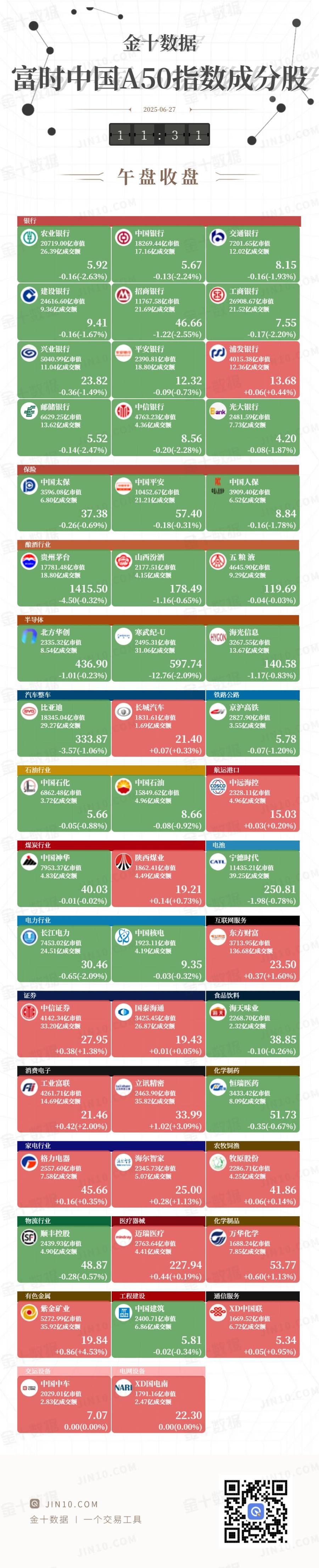
金十图示:2025年06月27日(周五)富时中国A50指数成分股午盘收盘行情一览:银行股多数飘绿,保险、酿酒、半导体等多个板块全线下跌
news flash· 2025-06-27 03:34
Core Viewpoint - The FTSE China A50 Index components showed a decline across various sectors, with banking stocks mostly in the red and significant drops in insurance, liquor, and semiconductor sectors [1][6]. Banking Sector - Most banking stocks experienced a decline, contributing to the overall negative performance of the index [1]. Insurance Sector - Major insurance companies like China Pacific Insurance, Ping An Insurance, and China Life Insurance saw market capitalizations of 390.94 billion, 359.61 billion, and 1,045.27 billion respectively, with declines of -0.26 (-0.69%), -0.18 (-0.31%), and -0.16 (-1.78%) [3]. Liquor Industry - Key players in the liquor industry, including Kweichow Moutai, Shanxi Fenjiu, and Wuliangye, reported market capitalizations of 1,778.15 billion, 217.75 billion, and 464.59 billion respectively, with price changes of -4.50 (-0.32%), -1.16 (-0.65%), and -0.04 (-0.03%) [3]. Semiconductor Sector - Semiconductor companies such as Northern Huachuang, Cambricon Technologies, and Hygon reported market capitalizations of 233.53 billion, 249.53 billion, and 326.76 billion respectively, with price changes of -1.01 (-0.23%), -12.76 (-2.09%), and -1.17 (-0.83%) [3]. Automotive Sector - In the automotive sector, BYD and Great Wall Motors had market capitalizations of 282.79 billion and 1,834.50 billion respectively, with price changes of -3.57 (-1.06%) and +0.07 (+0.33%) [3]. Energy Sector - Companies in the energy sector, including China Shipping and Sinopec, reported market capitalizations of 686.25 billion and 1,584.96 billion respectively, with price changes of +0.03 (+0.20%) and -0.05 (-0.88%) [3]. Coal Industry - In the coal industry, China Shenhua and Shaanxi Coal and Chemical Industry had market capitalizations of 186.24 billion and 795.34 billion respectively, with price changes of -1.98 (-0.78%) and -0.01 (-0.02%) [3]. Power Industry - The power sector, represented by companies like Yangtze Power and China Nuclear Power, had market capitalizations of 192.31 billion and 745.30 billion respectively, with price changes of -0.65 (-2.09%) and -0.03 (-0.32%) [4]. Internet Services - Internet service companies such as Dongfang Caifu reported a market capitalization of 371.40 billion, with a price change of +0.37 (+1.60%) [4]. Food and Beverage Sector - In the food and beverage sector, companies like Citic Securities and Haitian Flavoring reported market capitalizations of 414.23 billion and 342.55 billion respectively, with price changes of +0.38 (+1.38%) and -0.10 (-0.26%) [4]. Consumer Electronics - Companies in the consumer electronics sector, including Industrial Fulian and Luxshare Precision, had market capitalizations of 426.17 billion and 246.39 billion respectively, with price changes of +0.42 (+2.00%) and -0.35 (-0.67%) [4]. Home Appliances - In the home appliance sector, Gree Electric and Haier Smart Home reported market capitalizations of 255.76 billion and 234.57 billion respectively, with price changes of +0.16 (+0.35%) and +0.28 (+1.13%) [4]. Logistics Sector - The logistics sector, represented by companies like SF Holding, had a market capitalization of 276.36 billion, with a price change of +0.60 (+1.13%) [4]. Construction Industry - In the construction industry, China State Construction and XD China Communications reported market capitalizations of 240.07 billion and 527.30 billion respectively, with price changes of -0.02 (-0.34%) and +0.05 (+0.95%) [4].

华泰证券今日早参-20250627
HTSC· 2025-06-27 02:53
Group 1: Macro Insights - NATO has set a new defense spending target of 5% of GDP by 2035, which may lead to a moderate boost in EU economic growth but could also increase fiscal deficits and narrow surpluses [2] - The U.S. imports have shown a fluctuating trend since June, with a notable increase in South Korea's export growth, likely due to the upcoming expiration of tariff exemptions [2] - The overall U.S. consumer and employment markets are cooling, with inflation pressures still being transmitted, indicating potential disruptions in trade volumes as tariff deadlines approach [2] Group 2: Energy Sector - Recent positive changes in port coal prices have been observed, with CCI5500/5000/4500 coal prices increasing by 2/10/9 RMB per ton respectively as of June 25 [5] - The demand for coal is expected to rise due to seasonal factors, with fire power consumption likely to increase as hydropower output declines [5] - Recommendations include focusing on leading coal companies such as China Shenhua, Shaanxi Coal and Chemical Industry, and China Coal Energy, which are expected to benefit from the seasonal rebound in coal prices [5] Group 3: Fixed Income and Financial Markets - The TGA account's increasing share is impacting U.S. dollar liquidity, with expectations that the TGA balance will be exhausted by the end of August [7] - The balance of the TGA account is influenced by the debt ceiling, with historical trends showing a decrease before the ceiling is reached, followed by an increase [7] - The report highlights the potential for liquidity pressure on the U.S. dollar as the Treasury may need to issue short-term debt to replenish funds post-X-date [7] Group 4: Pharmaceutical Industry - The 2025 ASCO conference saw a 35% increase in the number of Chinese innovative drugs presented, with 67 studies included in oral presentations [8] - Notable drugs such as IBI363 and MRG003 have shown promising data that could revolutionize existing treatment protocols [8] - Companies like Shiyao Group, Kelun-Botai, and Hutchison China MediTech are recommended for investment due to their involvement in innovative drug development [8] Group 5: Technology Sector - Micron Technology reported better-than-expected revenue and profit guidance, with HBM revenue increasing by 50% quarter-over-quarter [10] - The company plans to reduce NAND wafer capacity by 10% to balance supply and demand, which may lead to short-term profit-taking due to stock price doubling since April [10] - Micron is expected to benefit from increased HBM demand driven by GPU and ASIC markets, with significant supply agreements in place with major clients [10] Group 6: Consumer Goods - The main brand Han Shu of the company has shown strong competitiveness in the mass skincare market, with a stable foundation and expansion into more categories [11] - The company is expected to benefit from a multi-brand strategy that captures market opportunities in various segments such as baby care and cosmetics [11] - The report maintains a "buy" rating based on the potential for valuation convergence with industry peers as the company continues to expand its product lines and channels [11] Group 7: Insurance Sector - Zhong An Online plans to issue new H shares at a price of 18.25 HKD, which will help meet capital needs and support its insurance and technology business development [11] - The company's insurance business fundamentals are expected to improve in the first half of the year, with potential benefits from the development of stablecoins in Hong Kong [11]

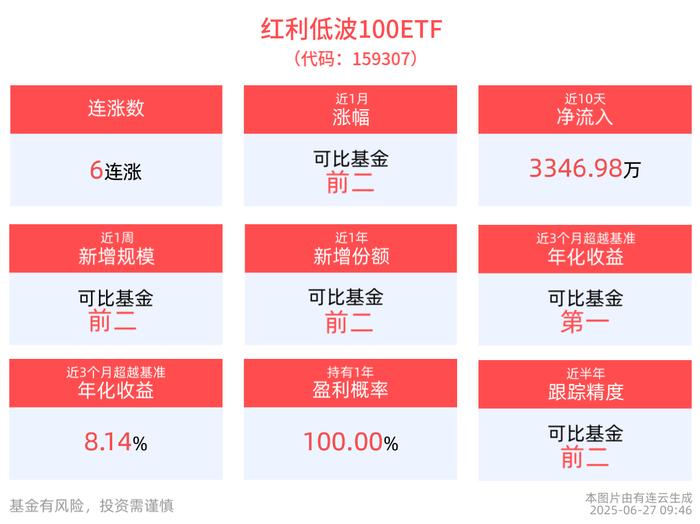
红利低波100ETF(159307)冲击6连涨,兰州银行领涨,机构建议用牛市思维看待和参与本轮银行股重大级别行情
Xin Lang Cai Jing· 2025-06-27 02:15
Core Viewpoint - The article highlights the performance and growth of the Zhongzheng Dividend Low Volatility 100 Index and its corresponding ETF, indicating a bullish outlook on bank stocks driven by low interest rates and a long-term market trend [3][4]. Performance Summary - As of June 27, 2025, the Zhongzheng Dividend Low Volatility 100 Index rose by 0.31%, with constituent stocks such as Lanzhou Bank and Guizhou Bank showing significant gains [3]. - The Zhongzheng Dividend Low Volatility 100 ETF (159307) has seen a recent price increase of 0.38%, marking its sixth consecutive rise, with a latest price of 1.05 yuan and a trading volume of 484.03 million yuan [3]. - Over the past year, the ETF's net value increased by 14.89%, ranking first among comparable funds [4]. Fund Growth and Inflows - The ETF experienced a substantial increase in shares, growing by 7.26 million shares over the past year, placing it second among comparable funds [4]. - Despite a recent net outflow of 209.37 million yuan, the ETF has seen net inflows on 8 out of the last 10 trading days, totaling 3.35 million yuan [4]. Risk and Return Metrics - The ETF's maximum drawdown this year was 6.18%, with a recovery period of 36 days, indicating relatively low risk compared to peers [4]. - The ETF's management fee is 0.15% and the custody fee is 0.05%, which are the lowest among comparable funds [5]. Index Composition - The Zhongzheng Dividend Low Volatility 100 Index includes 100 stocks characterized by high liquidity, continuous dividends, high dividend yields, and low volatility [5]. - The top ten weighted stocks in the index account for 19.64% of the total index weight, with notable companies including Jizhong Energy and Daqin Railway [5][6].



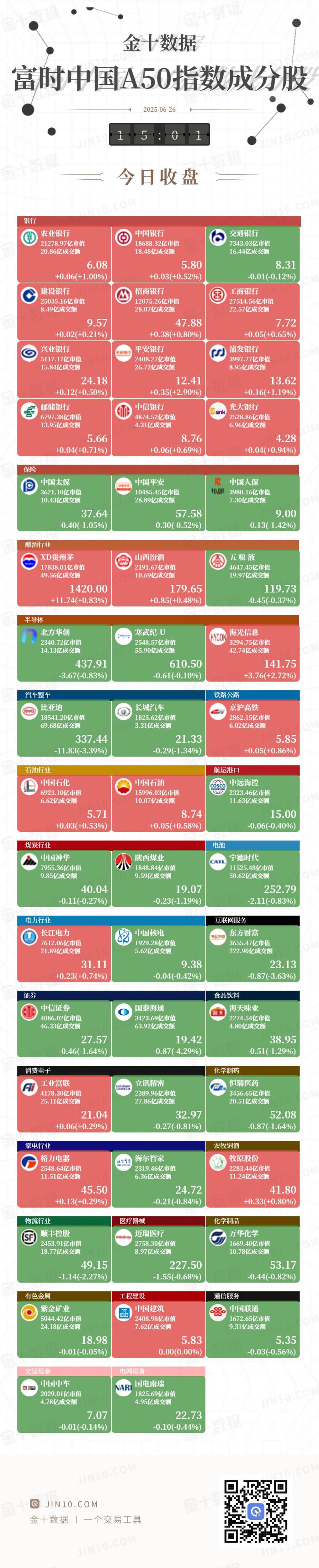
金十图示:2025年06月26日(周四)富时中国A50指数成分股今日收盘行情一览:银行股午后上涨,普遍飘红,保险股维持跌势
news flash· 2025-06-26 07:08
Market Overview - The FTSE China A50 Index component stocks showed a mixed performance with bank stocks rising in the afternoon while insurance stocks continued to decline [1][5]. Banking Sector - Bank stocks generally performed well, contributing to the positive movement in the FTSE China A50 Index [1]. Insurance Sector - Major insurance companies such as China Pacific Insurance, China Life Insurance, and Ping An Insurance experienced declines in their stock prices, with China Pacific Insurance down by 1.05%, China Life down by 0.52%, and Ping An down by 1.42% [3]. Alcohol Industry - In the alcohol sector, Kweichow Moutai saw a slight increase of 0.48%, while Shanxi Fenjiu and Wuliangye experienced declines of 0.37% and 0.83% respectively [3]. Semiconductor Industry - The semiconductor companies showed varied results, with North Huachuang increasing by 2.72%, while Cambrian and Haiguang Information saw minor declines [3]. Automotive Sector - In the automotive sector, BYD's stock fell by 3.39%, while Great Wall Motors and China Railway High-speed experienced minor declines and increases respectively [3]. Shipping and Oil Industry - China COSCO Shipping saw a slight increase of 0.53%, while Sinopec and PetroChina experienced minor declines [3]. Coal and Battery Industry - China Shenhua's stock decreased by 0.27%, while Ningde Times (CATL) saw a decline of 0.83% [3]. Power and Financial Sector - Longyuan Power and China Nuclear Power had mixed results, with Longyuan Power increasing by 0.74% and China Nuclear Power declining by 3.63% [4]. Food and Beverage Sector - The food and beverage sector showed declines, with companies like Haitian Flavor Industry and Zhongtai Securities experiencing notable decreases [4]. Consumer Electronics and Pharmaceutical Sector - The consumer electronics sector saw a slight increase in stocks like Luxshare Precision, while pharmaceutical companies like Hengrui Medicine experienced a decline [4]. Logistics and Medical Equipment - The logistics sector, represented by SF Holding, saw a minor decline, while medical equipment company Mindray Medical also experienced a decrease [4]. Non-ferrous Metals and Communication Services - Zijin Mining and China Communications Construction had mixed performances, with Zijin Mining showing a slight decline [4].