海光信息

Search documents
千问3.5引爆全球AI产业链,英伟达、华为昇腾、AMD、苹果等第一时间适配
Ge Long Hui· 2026-02-18 08:11
Core Viewpoint - The release of Qwen 3.5 has sparked significant interest in the global AI industry, showcasing advancements in model efficiency and cost-effectiveness [1] Group 1: Model Performance and Features - Qwen 3.5 has a total of 397 billion parameters, with only 17 billion activated, outperforming the previous trillion-parameter model Qwen 3-Max [1] - The deployment memory usage has decreased by 60%, while the maximum inference throughput has increased by 19 times [1] - The innovative underlying model architecture allows Qwen 3-Plus to offer competitive performance at a low cost of 0.8 yuan per million tokens on Alibaba Cloud's Bailian API, achieving high performance comparable to Gemini 3 at less than 5% of the price [1] Group 2: Industry Adoption and Compatibility - Major international hardware manufacturers such as NVIDIA, AMD, and Apple have adapted their development frameworks and chips for Qwen 3.5 [1] - Domestic GPU and platform providers, including Huawei Ascend, Moore Threads, and others, have also announced Day 0 compatibility with the new model [1] - Various platforms, both domestic and international, including National Supercomputing Internet Platform, Shuguang Cloud, and others, have quickly integrated the Qwen 3.5 model, offering API services or experience interfaces [1]


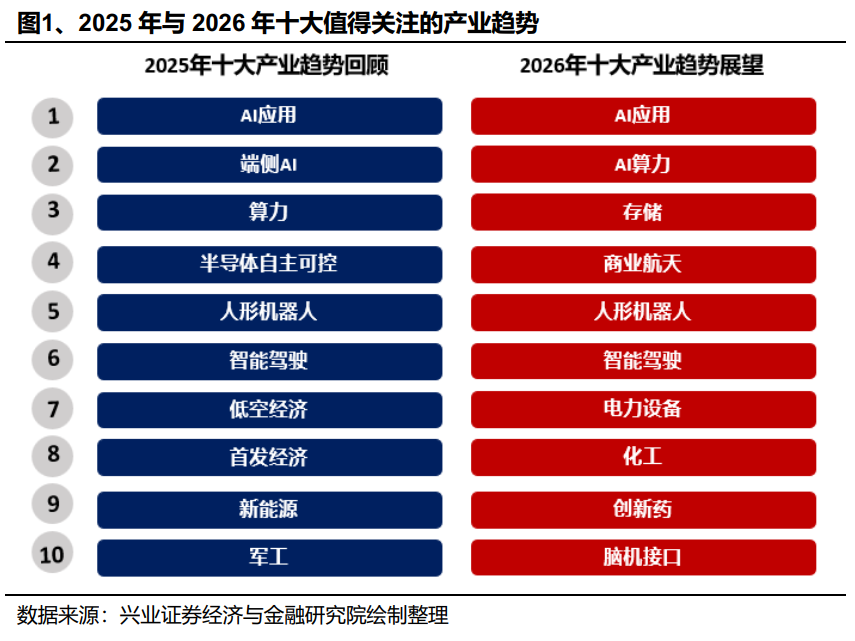
兴业证券:2026年值得关注的十大产业趋势
智通财经网· 2026-02-18 03:45
Group 1: AI Applications - The global AI competition is intensifying, with model iterations driving deeper application scenarios, and the focus is on whether significant capital expenditures by tech giants can lead to commercial applications [2][3] - The competitive landscape for AI applications is shifting from dominance by OpenAI to a more multipolar environment, with major players like Google and Meta integrating AI into their ecosystems [3] - In China, AI applications are experiencing a breakthrough, with major tech companies accelerating model iterations and application deployments, leading to a transformation from model landing to scenario monetization [5] Group 2: AI Computing Power - Overseas, major cloud service providers are maintaining high capital expenditures, with a projected increase of 67% in 2026, reflecting a strong demand for AI computing power [7][8] - In China, leading tech companies are increasing capital expenditures and accelerating the iteration of domestic large models, promoting the performance of domestic chips amid tightening supply from foreign sources [9] Group 3: Storage - The demand for storage is entering a new super cycle driven by AI training and inference needs, with AI servers consuming significantly more memory than traditional servers [11][16] - Supply constraints are expected to persist, leading to continued high prices for storage components, as major manufacturers shift production focus to advanced memory types [16] Group 4: Commercial Aerospace - Commercial aerospace is becoming a key battleground in US-China competition, with significant policy support and funding initiatives in both countries to accelerate industry development [19][21] - Domestic companies are achieving breakthroughs in satellite mass production and reusable rocket technologies, transitioning from technical validation to commercialization [22] Group 5: Humanoid Robots - Major overseas companies are ramping up production plans for humanoid robots, benefiting domestic component suppliers, with Tesla aiming for a production capacity of 500,000 units by 2026 [27][30] - Chinese manufacturers are leading in humanoid robot shipments, with significant contracts and production milestones achieved in 2025 [30] Group 6: Intelligent Driving - Domestic policies are expected to facilitate the commercialization of L3 autonomous driving in 2026, with several manufacturers preparing to launch L3 models [32][33] - Tesla's Full Self-Driving (FSD) technology is setting the direction for autonomous driving, with significant advancements in AI capabilities [35] Group 7: Energy Storage - The expansion of AI computing power in North America is driving electricity demand, with domestic power equipment expected to accelerate exports [37][40] - China's "14th Five-Year Plan" includes significant investments in the power grid and energy storage, creating a favorable environment for industry growth [40][43] Group 8: Chemicals - The chemical industry is undergoing a transformation driven by policies aimed at supply-side reform, with a focus on optimizing supply structures and reducing excess capacity [44][47] - New economic sectors are boosting demand for chemical materials, particularly in AI, renewable energy, and robotics, leading to a favorable outlook for new materials [47][48]


锚定产业趋势,共筑协同生态——《从器件到网络的协同创新论坛》2026年3月上海重磅启幕
半导体行业观察· 2026-02-18 01:13
在 AI 驱动半导体产业打破周期性定律、全球市场规模预计达 9750 亿美元(WSTS 数据)的 关键节点,半导体全产业链协同已成为突破技术瓶颈、把握结构性增长机遇的核心路径。由 半导体行业观察 与 慕尼黑上海光博会 联合主办的 《从器件到网络的协同创新论坛》 ,将于 2026年3月18日 登陆上海新国际博览中心。 论坛紧扣 "光电融合、算力革新、国产攻坚" 三大行业主线,串联 "趋势 — 基础 — 核心 — 器件 — 组件 — 应用 — 协同" 全链路,打造契合产业演进方向的高端交流平台。 Part.01 呼应产业变局,破解协同痛点 当前半导体产业正经历多重结构性变革:AI 算力需求推动硅光技术从 800G 向 1.6T 快速迭代 (2026 年 1.6T 光模块渗透率预计突破 20%)、国产算力芯片进入大规模应用关键期(海光信 息、寒武纪等企业已实现多场景落地)、先进封装成为后摩尔时代性能提升核心路径(CoWoS 产 能持续扩张)。本次论坛精准锚定这些趋势,线下汇聚 200 位运营商、设备商、EDA 企业等核心 从业者,线上通过半导体行业观察视频号同步直播,构建 "线下技术对接 + 线上趋势传播" 的双线 ...

联想创投王光熙:2026年投资更趋理性,“硅基智能”仍是长期主线丨创投贺新春
Sou Hu Cai Jing· 2026-02-17 12:30
Core Insights - Despite macroeconomic challenges, Lenovo Venture Capital has maintained a clear strategic focus, achieving significant investment milestones in 2025 [3] - The company invested in over 40 new enterprises and facilitated nearly 100 portfolio companies in securing new rounds of financing, with total investment transactions exceeding 60, 80% of which were directed towards sectors closely related to the "silicon-based ecosystem" [3] - The total number of portfolio companies has surpassed 300, with 25 successfully going public, including leading firms like CATL, Cambricon, and Haiguang Information, each valued over 500 billion [3] Industry Outlook - The industry faces a gap between technological ideals and commercial realities, particularly in fields like embodied intelligence, where establishing scalable business models is a key challenge [3] - High-quality vertical data is expected to become a core barrier for industrial AI, with China's complete industrial chain and rich scenarios providing unique advantages for incubating breakthrough technologies [3] Future Investment Strategy - Looking ahead to 2026, investments are expected to become more rational, with "silicon-based intelligence" remaining a long-term focus [4] - The company plans to deepen its investment in three main areas: the evolution of AI towards "system intelligence," focusing on intelligent agents and AI-native hardware; the commercialization of machine intelligence, leveraging the benefits of autonomous driving technology; and forward-looking investments in disruptive computing architectures such as integrated storage and computing and RISC-V [4]


芯片股退潮:财报揭示业绩分化,谁是AI真龙头?
Sou Hu Cai Jing· 2026-02-17 07:41
Core Viewpoint - The semiconductor sector in A-shares has experienced a significant divergence in performance, with leading companies benefiting from AI and advanced technologies, while traditional low-end chip companies face severe losses and declining stock prices [1][3][5] Group 1: Performance Divergence - As of January 30, 2026, among 115 semiconductor companies in A-shares, 70 are expected to be profitable while 45 are projected to incur losses, indicating a near 50-50 split in performance [3] - Leading companies like SMIC reported a revenue of 67.32 billion yuan for 2025, a 16.5% increase year-on-year, with a net profit of 5.04 billion yuan, up 36.3%, driven by AI chip and automotive electronics businesses [3] - Cambrian Technology forecasts a net profit of 1.85 to 2.15 billion yuan for 2025, with revenue expected to grow by 410.87% to 496.02%, showcasing the explosive growth of AI chip sales [4] Group 2: Characteristics of Leading Companies - Companies such as Haiguang Information and Cambrian Technology are recognized as leaders in AI chip technology, with significant profit growth and high gross margins, attracting institutional investment [4] - These leading firms possess core technologies, real orders, and sustainable profitability, distinguishing them from companies that rely on outdated business models [4][5] Group 3: Struggles of Traditional Companies - Companies like Yandong Microelectronics are projected to incur losses of 340 to 425 million yuan due to plummeting prices in consumer electronics chips and low production capacity utilization [4] - Zhaoxin Technology is expected to report a loss of 110 to 150 million yuan, as traditional chip design continues to decline without adapting to AI needs [5] - Many companies focused on low-end chips have seen revenues drop significantly, with stock prices falling by 60% to 70%, leading to a classification as "zombie stocks" [5] Group 4: Market Dynamics and Investment Strategy - The semiconductor industry has moved past a "universal rise" phase, entering a period of refined competition where only companies with technology, orders, and performance will thrive [6] - The presence of AI capabilities and sustained revenue growth are now critical indicators of a company's potential, while those lacking these attributes are likely to face further declines [6]
【兴证计算机】Seedance2.0发布,国产多模态迎DS时刻
兴业计算机团队· 2026-02-15 12:43
Core Viewpoint - ByteDance has launched Seedance 2.0, marking a significant advancement in domestic multimodal AI capabilities, enhancing content generation efficiency and cost-effectiveness [1][6]. Group 1: Seedance 2.0 Features - Seedance 2.0 integrates comprehensive multimodal content reference and editing capabilities, positioning itself as a "directable, movie-level full-process generation engine" [1]. - The model supports multimodal "all-in-one reference," allowing for input from images, videos, audio, and text, significantly improving reference generation capabilities [2]. - It demonstrates state-of-the-art (SOTA) performance in complex motion representation, adhering to physical laws and maintaining action consistency, particularly in multi-entity interactions [2]. - Enhanced generation control and instruction-following capabilities have been introduced, expanding its video editing functionalities to include cutting, camera movement, and storyboarding [2]. Group 2: Competitive Landscape - The competition in video generation models is intensifying, with domestic models like Seedance 2.0, Keling 3.0, Wan 2.6, and ViduQ 3.1 catching up to international counterparts such as Grok Imagine API, Sora 2, and Veo 3.1 [3]. - Domestic models currently lead in input control, reference generation, and intelligent storyboarding, while international models excel in generation quality and consistency [3]. - Domestic models offer a clear cost-performance advantage, making them more accessible for professional content creation [3]. Group 3: Investment Opportunities - The optimization of video generation capabilities in Seedance 2.0 is expected to enhance professional content creation efficiency and accelerate AI video penetration [3]. - Investment opportunities include companies within the ByteDance ecosystem such as Hand Information, Huicheng Co., Zhongke Chuangda, and others [3]. - Other AI application companies and computing power firms are also recommended for investment consideration, including Zhuoyi Information, Hehe Information, and Zhongke Shuguang [3].

【兴证计算机】DeepSeek(深度):加速迭代的开源大模型引领者
兴业计算机团队· 2026-02-15 12:43
Group 1 - DeepSeek aims to reshape the AI industry landscape by leading the open-source model ecosystem, breaking the monopoly of foreign models with its DeepSeek-R1 inference model launched on January 20, 2025, which features lower training costs and superior model capabilities [1][6] - The organization has a flat structure with a young team of fewer than 140 members, primarily composed of top talent from domestic universities [1] - DeepSeek adheres to a long-termism philosophy, avoiding short-term commercial interests, and is projected to reach a valuation of 1.05 trillion yuan by September 30, 2025 [1] Group 2 - DeepSeek is focused on optimizing model training and deployment costs, with the upcoming DeepSeek-V3 model set to launch in December 2024, featuring a training cost of only 5.57 million USD and performance comparable to GPT-4 [2] - The DeepSeek-R1 model, released in January 2025, offers leading inference capabilities and facilitates low-cost private deployment, significantly advancing AI applications in finance, healthcare, and government sectors [2] Group 3 - The anticipated release of the V4 model in February is expected to enhance code generation and processing capabilities, surpassing existing models like Claude and GPT [3] - The commercial potential of DeepSeek's ecosystem is seen as a core barrier to the commercialization of large models, with the company positioned to become a foundational infrastructure for AI applications across various industries [3] Group 4 - Investment opportunities are suggested in AI applications and computing power sectors, with specific companies listed for potential investment, including 卓易信息, 汉得信息, and 海光信息 among others [4]

AIDC订单疯涨,哪些赛道受益?
Xin Lang Cai Jing· 2026-02-15 11:42
Core Insights - The article discusses the increasing demand for AI Data Centers (AIDC) driven by the exponential growth in computing power requirements due to generative AI advancements and supportive government policies like "East Data West Computing" [5][32] - Major tech companies are ramping up investments in AI infrastructure, with ByteDance planning to increase its capital expenditure to approximately 160 billion RMB in 2026, while Alibaba aims to invest over 380 billion RMB in technology R&D and infrastructure over the next three years [7][34] - The article highlights the penetration of AIDC into traditional industries, evidenced by significant procurement projects such as China Mobile's purchase of 7,499 AI servers for 2025-2026 [8][35] AIDC Types and Characteristics - AIDC is categorized into three types: General Data Centers, Intelligent Computing Data Centers (AIDC), and Supercomputing Data Centers, each serving different computational needs [4][30] - General Data Centers focus on traditional data storage and management using CPU servers, while AIDC leverages AI chips like GPUs for large-scale model training, and Supercomputing Data Centers support advanced scientific research [4][30] Five-Layer Cake Theory - NVIDIA's CEO proposed a "Five-Layer Cake" structure for AI infrastructure, which includes Energy Layer, Chip and Computing Layer, Infrastructure Layer, AI Model Layer, and Application Layer [10][37] - The Energy Layer is crucial for providing stable power to AIDC, while the Chip and Computing Layer focuses on high-performance hardware [11][39] - The Infrastructure Layer integrates energy and chip resources to deliver intelligent computing services, and the AI Model Layer is essential for developing models that drive AI applications [13][41] Industry Ecosystem and Opportunities - The AIDC industry's growth is a result of the synergy between computing power demand and technological advancements, benefiting various sectors [18][45] - The transition to high-voltage and direct current power systems is becoming mainstream, with NVIDIA introducing an 800V DC power architecture to meet the power demands of next-gen AI facilities [19][46] - Liquid cooling systems are gaining traction due to the high power consumption of AI servers, leading to increased market demand for cooling technologies [20][47] Domestic AI Chip Market - The domestic AI chip market is diversifying, with multiple brands achieving significant sales volumes, indicating a shift from technology development to large-scale delivery [25][52] - The price range for domestic AI inference chips is between 30,000 to 200,000 RMB, with a notable increase in production expected as manufacturing capacity improves [25][52] Conclusion - The article emphasizes that while China has advantages in energy resources and computing infrastructure, breakthroughs in high-end chip development and core technology innovation are still needed [26][53] - The ultimate winners in the AI industry will be those who can integrate full-stack technologies and foster collaborative industrial advancements [26][53]
6家险资加码,国科投资瑞华四期基金漂亮终关
Sou Hu Cai Jing· 2026-02-15 11:41
Core Viewpoint - Guoke Investment Management's Guoke Ruihua Phase IV Fund has completed its final closing with a total scale of 4.58 billion, making it the largest market-oriented direct investment fund established in the past two years [2][3] Fund Overview - The fund's total scale reached 4.58 billion, with a significant portion of 45% coming from insurance capital, making it a representative of market-oriented equity funds with the highest insurance capital content in the industry [2][3] - Notable investors include AIA, China Pacific Insurance, and several other high-quality insurance companies, indicating strong confidence in the fund's management and investment strategy [2][3] Investment Strategy - Guoke Investment has a history of early-stage investments in technology sectors, such as the new energy vehicle supply chain and semiconductor industry, demonstrating a proactive approach to identifying investment opportunities [6][9] - The company emphasizes the importance of maintaining rationality during investment consensus bubbles, advocating for a focus on high-quality companies with continuous innovation capabilities [8][9] Market Insights - The current investment landscape is characterized by a transition from consensus formation to potential bubble periods, particularly in the artificial intelligence sector, which may face a phase of disappointment in the coming years [9][10] - The A-share market saw 116 IPOs in 2025, primarily in hardware, automotive, and semiconductor sectors, while the Hong Kong market had 111 IPOs, focusing on biomedicine, software, and medical devices [10][12] Future Outlook - Guoke Investment plans to leverage the Hong Kong market as a key exit channel, aiming to provide a platform for innovative companies that understand market demands and have strong overseas capabilities [12] - The investment roadmap will follow the "646+1" framework, aligning with national strategic needs and focusing on artificial intelligence as a primary investment theme [10][12]

跟着大资金选股!公募调仓科创板,猛攻电子、医药
市值风云· 2026-02-14 10:09
Core Viewpoint - The article discusses the current funding logic in the market, highlighting the significant movements of public funds in the technology sector, particularly in the semiconductor and biopharmaceutical industries, as they adjust their portfolios based on performance and valuation metrics [3][8]. Group 1: Public Fund Movements - Public funds have shown a notable shift in their holdings, particularly in the STAR Market, with the STAR 50 Index rising by 12.1% this year [3][4]. - The total market capitalization of STAR Market companies reached 10.4 trillion yuan, with the technology sector dominating, accounting for 62.1% of the total market cap [5][6]. - The semiconductor industry remains the core focus for fund allocation, with 12 companies in the sector having a market capitalization exceeding 10 billion yuan [9][11]. Group 2: Semiconductor Sector Insights - The market's pricing anchor for the semiconductor sector has shifted from "valuation expansion" to "performance realization," emphasizing the importance of actual earnings [13][14]. - Key drivers for future growth in the semiconductor sector include strong order backlogs, profit growth through acquisitions and expansions, and sustained price increases in advanced processes [13][14]. - Public funds have significantly increased their holdings in semiconductor materials, chip design, and equipment, with companies like ShenGong Co. seeing an 11% increase in fund holdings [15][21]. Group 3: Biopharmaceutical Sector Insights - The biopharmaceutical sector is a critical area for public funds, with major holdings in companies like BeiGene and United Imaging Healthcare, although the sector has faced a reduction in holdings for several key companies [24][26]. - The article notes that innovative drug companies are currently under pressure, with significant reductions in holdings observed in companies like BaiLi TianHeng and RongChang Biopharma [26][28]. - Despite the challenges, companies with strong earnings potential and innovative drug pipelines are still attracting interest from public funds, indicating a selective investment approach [35][40].