李宁

Search documents
中国消费的新“老”温差
财富FORTUNE· 2026-01-29 13:10
Core Viewpoint - The article highlights a significant shift in China's consumer landscape, contrasting the performance of traditional consumer brands like Kweichow Moutai with new consumer brands like Pop Mart, indicating a transition towards "new" consumption driven by changing demographics, real estate cycles, and evolving consumer values [1][3]. Group 1: Company Performance - Kweichow Moutai announced a stock buyback plan of 1.5 to 3 billion yuan but saw its stock price decline after the initial buyback, reflecting a defensive market perception [1][3]. - In contrast, Pop Mart's stock buyback of 350 million HKD led to a market capitalization increase of nearly 60 billion HKD within a week, showcasing a strong growth narrative [1][3]. - On January 29, Kweichow Moutai's stock experienced a rare surge, recovering to over 1400 yuan, which also positively impacted other liquor stocks and the real estate sector [3]. Group 2: Market Dynamics - The article discusses the divergence in investment logic between traditional and new consumer brands, with the former viewed as defensive and the latter as growth-oriented [3][4]. - Traditional consumer stocks, particularly in the liquor sector, are closely tied to macroeconomic conditions and the real estate cycle, which has been under pressure, leading to a challenging environment for recovery [3][4]. - New consumer brands like Pop Mart, Anta, and Li Ning are not solely reliant on macroeconomic support but are leveraging innovation to create structural growth opportunities [4][5]. Group 3: Growth Drivers - The core driver for new consumption has shifted from "demographic dividends" to "emotional dividends," focusing on consumer identity and self-expression rather than basic material needs [4][5]. - The Hong Kong consumer index, which includes new consumption sectors, saw a cumulative increase of about 20% in 2025, while the Shanghai consumer index, dominated by traditional sectors, fell nearly 8% [4]. Group 4: International Expansion - Traditional consumer companies lacking international expansion capabilities face stagnation, while new consumer brands are showing strong growth overseas, with Pop Mart reporting a 3.7 times increase in overseas revenue by Q3 2025 [5]. - Successful international strategies are evident in brands like Anta and Li Ning, which are expanding rapidly in Southeast Asia, indicating a shift from "Made in China" to "Global Brands" [5]. Group 5: Valuation and Investment Considerations - Traditional consumer leaders like Kweichow Moutai still hold strong market positions and stable cash flows, with their valuations entering historically low ranges, appealing to risk-averse investors [6]. - New consumer brands face unique challenges, such as sustaining IP creation and managing acquisitions, with high valuations making them sensitive to any signs of growth slowdown [6][7]. - The sustainability of "self-indulgent" consumption is questioned, as it relies on consumer sentiment and disposable income, which may be the first to be scrutinized in uncertain economic times [8].




穿越“K型”周期,解码运动户外品牌的增长密码
Di Yi Cai Jing Zi Xun· 2026-01-29 13:07
Core Insights - The outdoor sports industry is demonstrating strong growth potential despite macroeconomic challenges, driven by a shift towards health economy, emotional connections, and technological innovation [1][5][36] Group 1: Industry Trends - The industry is transitioning from traditional retail to a new paradigm focused on health, emotional connections, and technology [1] - The growth of the outdoor sports sector is supported by favorable policies and urban development strategies, with cities increasingly branding themselves around sports and outdoor activities [5][6] - The industry is characterized by a strong external influence, with products like camping gear creating a complete camping economy [6] Group 2: Consumer Behavior - The outdoor sports market has a user base of 400 million, with a penetration rate of one-third of the national population, indicating significant growth potential compared to developed countries [7] - The industry is expected to achieve a compound annual growth rate (CAGR) of 15.5% over the next five years, driven by increased penetration among existing users rather than population growth [7] - Consumer demand is evolving towards specialization, technology integration, and quality, with a notable rise in high-end and value-for-money products [8] Group 3: Market Segmentation - The current consumer market is experiencing a K-shaped differentiation, where the upper segment continues to thrive while the lower segment faces challenges [11] - Growth in the outdoor sports sector is primarily driven by three demographic groups: women, middle-aged and elderly consumers, and youth, each with distinct consumption patterns and preferences [11][12] - The market is witnessing a dual trend where luxury brands are shifting online while maintaining a strong offline presence, indicating a complex consumer landscape [12][13] Group 4: Investment Insights - The valuation logic of the outdoor sports industry is shifting from traditional retail metrics to a focus on health economy factors, emphasizing direct-to-consumer sales, supply chain technology, and community building [14][16] - Investors are increasingly interested in brands that demonstrate resilience, community engagement, and a clear product philosophy, as these factors contribute to long-term growth [19][18] - The integration of AI and technology is becoming essential for brands to enhance operational efficiency and consumer engagement [32][34] Group 5: Marketing Strategies - Successful brands in the future will focus on niche markets, innovation, and creating strong mental associations with their products [29] - Brands should prioritize user engagement and community building over sheer scale, focusing on enhancing customer lifetime value [30] - The marketing approach must adapt to dynamic consumer profiles and leverage multiple channels for effective communication [31]


穿越“K型”周期,解码运动户外品牌的增长密码
第一财经· 2026-01-29 12:42
Core Insights - The outdoor sports industry is demonstrating strong certainty and growth potential against the backdrop of a new normal in the macro economy and profound changes in consumption structure [1][3] - The industry is evolving from traditional retail to a new paradigm driven by health economy, emotional connection, and technological innovation [1][4] Macro Trends - The outdoor sports industry is in a certain development channel, with China's retail sales growing by 4% and GDP expected to grow by 5%, which is low compared to the past decade but higher than recent expectations [6] - Consumption is becoming the leading driver of economic growth, as highlighted in the "14th Five-Year Plan" which emphasizes increasing the consumption rate [6] - Changes in global trade patterns and domestic consumption structure are creating new opportunities, with emerging categories like high-end fragrances experiencing significant growth [6] Industry Opportunities - The "Sports Power" policy is shifting focus from Olympic gold medals to comprehensive sports development, providing policy support for the outdoor sports industry [6] - Local governments are transitioning from solely pursuing GDP to creating unique city labels, with many cities planning to focus on sports and outdoor activities as core identifiers [6] Consumer Insights - The outdoor sports market has a user base of 400 million, with a penetration rate equivalent to one-third of the national population, indicating substantial growth potential compared to developed countries [9] - The industry is expected to achieve a compound annual growth rate of 15.5% over the next five years, driven by increased penetration among existing users rather than population growth [9] - Key characteristics of current consumer demand include specialization, technological integration, and quality enhancement, with a notable trend towards high-end and value-for-money products [9][10] Demographic Shifts - The growth of the outdoor sports industry is primarily driven by three demographic groups: women, middle-aged and elderly consumers, and youth, each exhibiting distinct consumption patterns and preferences [12][14] - The youth market is seen as a potential growth area, with a significant opportunity for brands to develop products and ecosystems tailored to their needs [12] Brand Strategies - Brands are advised to focus on building deep user relationships, embracing cutting-edge technology, and practicing long-termism to reshape value [1][4] - The shift in consumer behavior towards viewing outdoor gear as an investment rather than a consumable is influencing brand strategies [10] Marketing and Community Engagement - Successful brands are those that prioritize community engagement and emotional storytelling, moving beyond traditional marketing funnels to foster deeper connections with consumers [25][27] - The importance of emotional value in consumer decision-making is increasing, necessitating brands to create spaces for consumers to express their feelings [31][33] Future Growth Pathways - Brands should focus on niche success, transformative innovation, and the integration of technology and new product categories to achieve long-term growth [36] - The introduction of AI and data-driven strategies is expected to enhance operational efficiency and consumer engagement, marking a significant shift in brand evaluation metrics [40][42]

李宁(02331)因转换可换股证券而发行2748股
智通财经网· 2026-01-29 08:47
Core Viewpoint - Li Ning Company Limited announced the conversion of its publicly offered convertible securities issued on April 22, 2013, at an adjusted price of HKD 3.183 per share, resulting in the issuance of 2,748 new shares with a principal amount of HKD 8,746.884 million [1] Group 1 - The company will convert its convertible securities on January 29, 2026 [1] - The adjusted conversion price for the securities is HKD 3.183 per share [1] - A total of 2,748 new shares will be issued as part of this conversion [1]
李宁因转换可换股证券而发行2748股
Zhi Tong Cai Jing· 2026-01-29 08:47
Group 1 - The company, Li Ning (02331), announced the conversion of its publicly offered convertible securities issued on April 22, 2013, at an adjusted price of HKD 3.183 per share [1] - The company will issue and allot 2,748 new shares with a principal amount of HKD 8,746.884 [1]
2025年第四季度产品竞争分析与2026年前沿洞察:运动品牌行业专题
Guoxin Securities· 2026-01-29 08:40
Investment Rating - The investment rating for the sports brand industry is "Outperform the Market" (maintained) [1] Core Insights - The industry is experiencing a bifurcation, necessitating innovation to break through. The outdoor sports market continues to grow, but there is a contrasting price trend between apparel and footwear. Apparel shows a clear trend of "volume and price rising," driven by high-priced brands, while footwear has seen "volume increase and price decrease" [5][3] - The overall market growth is slowing down in Q4, with apparel showing volume and price increases, while footwear prices are under pressure. The outdoor category has achieved a 13.5% increase in sales, while sports shoes have seen a decline in growth [5][4] - International brands like Nike are facing significant adjustment pains, with a 15.5% year-on-year decline in sales. Adidas, on the other hand, has seen growth in basketball and casual shoes despite an overall decline in sales [5][4] - Domestic brands are under pressure from price competition, but the professional product market is performing well. Brands like Li Ning and Anta are experiencing mixed results, with some product lines performing better than others [5][4] Summary by Sections 1. Industry Overview - The sports apparel market is showing a stable penetration rate, with a slight increase in average prices and a decrease in sales volume. The outdoor apparel category has achieved a double-digit growth in sales [5][60] 2. International Brands - Nike's sales have dropped significantly, with a 15.5% year-on-year decline, while Adidas has seen a slight decrease in sales but growth in specific categories like basketball shoes [5][4] 3. Domestic Brands - Domestic brands are facing price competition, with some brands like Li Ning and Anta experiencing mixed results. The professional product lines are performing well, but overall sales are under pressure [5][4] 4. Key Company Profit Forecasts and Investment Ratings - Li Ning: Outperform the Market, with an EPS forecast of 1.17 RMB for 2024A [7] - Anta Sports: Outperform the Market, with an EPS forecast of 5.58 RMB for 2024A [7] - Xtep International: Outperform the Market, with an EPS forecast of 0.44 RMB for 2024A [7] - 361 Degrees: Outperform the Market, with an EPS forecast of 0.56 RMB for 2024A [7] 5. Key Takeaways - The industry shows favorable growth potential, with brand premium and product price competition occurring simultaneously. The overall market is expected to maintain good growth, but brands that can lead new market demands are likely to show significant growth and profitability [5][8]

李宁(02331) - 翌日披露报表 - 已发行股本变动
2026-01-29 08:39
FF305 翌日披露報表 (股份發行人 ── 已發行股份或庫存股份變動、股份購回及/或在場内出售庫存股份) 表格類別: 股票 狀態: 新提交 公司名稱: 李寧有限公司 呈交日期: 2026年1月29日 第 1 頁 共 6 頁 v 1.3.0 FF305 B. 贖回/購回股份 (擬註銷但截至期終結存日期尚未註銷) (註5及6) 第 2 頁 共 6 頁 v 1.3.0 FF305 確認 根據《主板上市規則》第13.25C條 / 《GEM上市規則》第17.27C條,我們在此確認,據我們所知所信,第一章節所述的每項股份發行或庫存股份出售或轉讓已獲發行人董事會正式授權批准,並遵 照所有適用上市規則、法律及其他監管規定進行,並在適用的情況下: 如上市發行人的已發行股份或庫存股份出現變動而須根據《香港聯合交易所有限公司(「香港聯交所」)證券上市規則》(「《主板上市規則》」)第13.25A條 / 《香港聯合交易所有限公司GEM證券 上市規則》(「《GEM上市規則》」)第17.27A條作出披露,必須填妥第一章節 。 | 第一章節 | | | | | | | | | | --- | --- | --- | --- | --- | ...
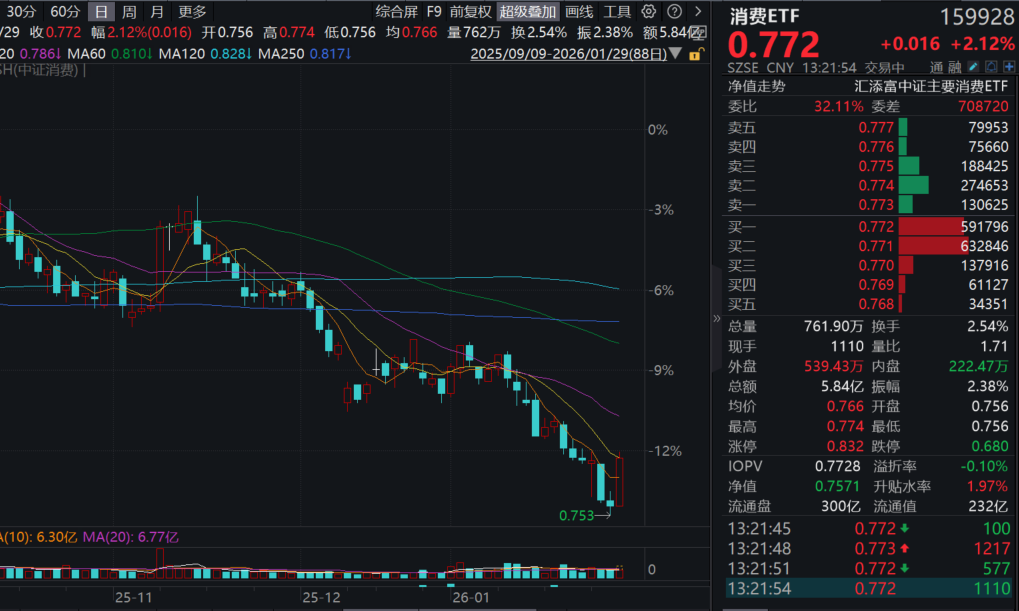
贵州茅台大涨超4%,段永平称“真的不贵”!消费ETF(159928)大涨超2%!2026白酒板块如何看?
Xin Lang Cai Jing· 2026-01-29 05:47
Group 1 - The core viewpoint of the article highlights the recent surge in the stock prices of major liquor companies, particularly Moutai, which rose over 4% after a period of decline, indicating a potential recovery in the market [2] - Notable investor Duan Yongping expressed confidence in Moutai's long-term value, emphasizing the positive impact of the iMoutai platform on consumer access to genuine products [2] - The white liquor industry is expected to benefit from a new consumer acquisition and education strategy, with a focus on channel collaboration and consumer-centric approaches [5][8] Group 2 - The white liquor sector is entering a "five-bottom phase," suggesting a potential turning point in the industry cycle, with expectations of improved sales performance as consumer demand stabilizes [8][9] - Recent data indicates that Moutai's sales and pricing are performing better than market expectations, with a projected increase in sales volume leading up to the Spring Festival [7] - The overall sentiment in the capital market regarding the white liquor industry remains low, with public fund holdings at a historical low, indicating a potential opportunity for investment as valuations are attractive [9][11] Group 3 - The upcoming Spring Festival is anticipated to maintain stable sales for the white liquor industry, with no excessive pessimism expected regarding market performance [10] - Companies are actively working on inventory reduction and price stabilization strategies, with a focus on enhancing brand strength and market share during challenging economic conditions [6][8] - The industry is witnessing a shift towards embracing consumer preferences, particularly among younger generations, which is expected to support long-term demand for white liquor products [8][9]
加入安踏宇宙,彪马的日子有盼头了
远川研究所· 2026-01-28 10:51
Core Viewpoint - Anta has acquired a 29.06% stake in Puma for approximately 12.28 billion RMB, becoming the largest shareholder, indicating a strategic move to enhance its brand portfolio and capitalize on Puma's long-term value potential despite its recent underperformance [1][4]. Group 1: Acquisition Details - The acquisition price of 35 euros per share represents a 62% premium, reflecting Anta's confidence in Puma's future despite its recent stock price decline [1]. - Puma's stock has dropped nearly 50% over the past year, leading to speculation about its sale, which ultimately resulted in Anta's acquisition [4]. - Anta's previous successful acquisitions, such as FILA and Jack Wolfskin, demonstrate its capability to revitalize struggling brands [4][12]. Group 2: Puma's Current Situation - Before the acquisition, Puma's profit levels were less than one-fourth of Anta's and half of Nike's, with revenue growth slowing from 30% to under 5% over four years [8]. - Puma has faced significant challenges, including a 17% increase in inventory pressure, resulting in a total loss of approximately 2.5 billion RMB over three quarters [8][10]. - The new CEO, Arthur Hoeld, identified key issues such as lack of brand heat, overly complex product lines, and excessive reliance on wholesale channels, which have contributed to Puma's declining profitability [10]. Group 3: Anta's Strategic Expansion - Anta's diversification strategy has evolved through two phases, starting with the acquisition of FILA in 2009, which has since become a significant revenue contributor [12][25]. - The company has focused on acquiring brands with high recognition but poor operational performance, allowing for potential growth through direct-to-consumer (DTC) strategies and brand repositioning [21][25]. - Anta's acquisitions typically involve transitioning from agency to direct management, allowing for better control over brand performance and inventory [21][22]. Group 4: Market Position and Future Prospects - Anta's main brands, Anta and FILA, are nearing sales ceilings, prompting the need for new growth drivers, which the acquisition of Puma could provide [29]. - The global sports market's growth has been driven by functional apparel and specialized footwear, areas where Anta has been less competitive, making Puma's shoe business an attractive addition [29][30]. - The acquisition is expected to lead to a revitalization of Puma's brand through store renovations and a shift towards higher-end products, aligning with Anta's overall growth strategy [34].

「苏超」没有泡沫
3 6 Ke· 2026-01-28 05:22
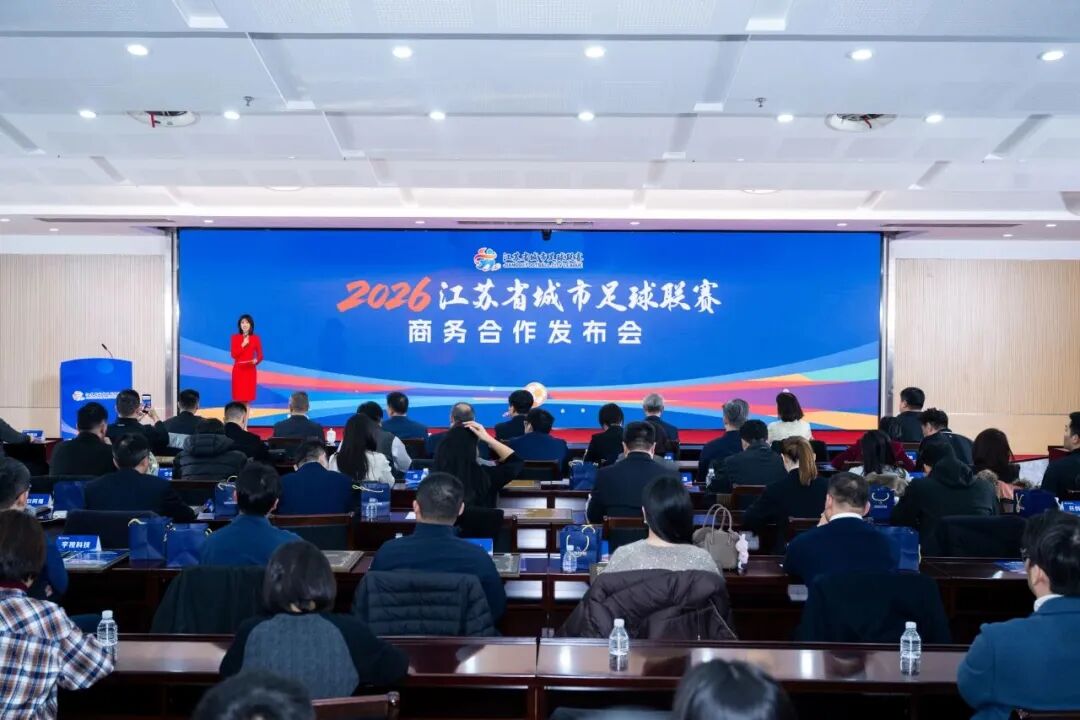
Core Insights - The article highlights the growing popularity and commercial viability of the Jiangsu Provincial Urban Football League (Su Super League), especially following the U23 national team's success in the Asian Cup [1][3]. Sponsorship and Financial Aspects - The 2026 season of Su Super League will be co-sponsored by "Jiangsu Bank · Suhao Holdings," with 24 sponsors including Adidas, Ant Financial, and Coca-Cola [3][5]. - Adidas will replace Karamay as the official apparel sponsor, providing 8 million yuan in cash support and 1 million yuan worth of apparel for each participating team, indicating a significant increase in sponsorship expectations for a provincial amateur league [3][5]. - The total sponsorship amount from Adidas for the league is reported to be 21 million yuan, which is comparable to the sponsorship amounts in top-tier leagues like the Chinese Super League [5][9]. Market Dynamics and Growth - The Su Super League has become a competitive platform for brands, with 15 new sponsors added, reflecting its attractiveness to advertisers [5][6]. - The league's sponsorship landscape has evolved, with local enterprises and internet platforms actively seeking exposure, leading to a total sponsorship amount of 15.41 million yuan in the Nanjing division alone [5][6]. - The league has driven significant consumer spending, with over 38 billion yuan generated from various consumption scenarios, including a 26.48% year-on-year increase in tourism-related spending [6][13]. Brand Strategy and Engagement - Adidas' involvement in the Su Super League aligns with its strategy to enhance its presence in grassroots football, focusing on youth training and community engagement [10][12]. - The league's structure allows brands to engage with a larger audience, providing a platform for consistent interaction with fans and consumers [15][19]. - The introduction of a sponsorship scheme for small and micro enterprises aims to integrate local businesses into the league's ecosystem, enhancing community involvement [16][19]. Broader Implications for Chinese Football - The Su Super League represents a shift in the relationship between football and urban development, integrating sports into cultural and economic frameworks [13][22]. - The league's success is indicative of a broader trend where local leagues are becoming essential components of China's football landscape, contributing to social and economic growth [19][22]. - The evolving structure of Chinese football now includes a multi-tiered system, with grassroots leagues playing a crucial role in the overall ecosystem [22][23].