
万辰集团

Search documents
如何看2025年12月消费数据
2026-01-20 01:50
Summary of Key Points from Conference Call Records Industry Overview - **Consumer Sector Performance**: In December 2025, the overall retail sales growth was 0.9% year-on-year, with a full-year growth of 3.7%. Online retail grew by 5.2% for the year, while offline retail showed slower growth [2][3]. Key Insights and Arguments - **Retail Categories**: - Supermarket retail sales increased by 4.3% year-on-year, while department stores only saw a 0.1% increase [3]. - Essential goods performed well, with grain and oil food growth at 3.9%. In the discretionary category, cosmetics grew by 8.8%, and gold and jewelry increased by 5.9% due to a rise in gold prices [3][4]. - Communication equipment maintained a growth rate of over 20%, while home appliances declined by 19% due to tightening subsidies [3][4]. - **Automotive Sector**: - The total retail sales for automobiles reached 548.2 billion, down 5% year-on-year. Passenger car sales fell by 8.8%, but new energy vehicle wholesale sales grew by 3.3% [11]. - **Textile and Apparel**: - The textile and apparel sector saw a 0.6% year-on-year retail growth in December, but a decline in month-on-month performance due to weather and the delayed Spring Festival [13][14]. - **Alcohol Industry**: - The retail sales of the liquor industry decreased by 2.9% year-on-year in December, with a price index decline of 0.19%. The industry is currently in a phase of active inventory reduction [16][17]. - **Consumer Expectations**: - Due to the late Spring Festival and expectations of rising gold prices, consumer demand is anticipated to recover in January and February 2026 [5]. Additional Important Insights - **Investment Recommendations**: - In the beauty and personal care sector, companies like Shiseido and domestic brands such as Maogeping are recommended. For the gold and jewelry sector, brands with strong store expansion logic are highlighted [6][10]. - In the automotive sector, companies like JAC Motors and Geely are recommended, focusing on high-end and luxury markets [12]. - For the textile and apparel sector, brands like Li Ning and Fuanna are suggested, with a focus on companies that can support their market value through dividends [15]. - **Household Appliances**: - The household appliance sector is experiencing a downturn, with significant declines in sales across various categories. However, leading companies like Midea and Haier are expected to maintain slight growth due to low inventory levels [21][22][24]. - **Light Industry**: - The light industry saw a decline in furniture sales by 2.2% year-on-year, with exports down by 9.8%. However, some companies are expected to see revenue and profit recovery in 2026 [26][27]. Conclusion The consumer sector is facing mixed performance across various categories, with essential goods showing resilience while discretionary spending is under pressure. Investment opportunities exist in specific brands and sectors that are positioned to benefit from changing consumer behaviors and market dynamics.
2026年食品饮料行业投资策略报告:筑底修复为主线,结构分化藏良机-20260119
Wanlian Securities· 2026-01-19 11:02
Group 1 - The core viewpoint of the report indicates that the food and beverage industry experienced a downturn in performance and stock prices in 2025, with revenue growth slowing and net profit declining for the first time [2][16][23] - The food and beverage sector's revenue for the first three quarters of 2025 was 831.395 billion yuan, a year-on-year increase of only 0.14%, while net profit decreased by 4.57%, ranking 20th and 21st among 31 industries respectively [16][20] - The stock prices of the food and beverage sector fell by 4.72% from January to November 2025, placing it at the bottom of the performance rankings among the 31 industries [23][27] Group 2 - In the liquor industry, the report notes that channel destocking and low valuations combined with high dividend yields provide support for stock prices, despite a challenging environment due to policy impacts [3][36] - The report predicts that the white liquor industry will enter a "volume-price double kill" phase, characterized by intensified competition and market consolidation [3][36] - The report highlights that the beer sector is expected to see marginal improvements in 2026 due to cost advantages and a recovery in on-premise consumption [4][36] Group 3 - The dairy sector is experiencing a recovery in demand, with low-temperature and deep-processed dairy products showing positive growth, while the overall profitability of dairy companies varies significantly [4][9] - The condiment industry is evolving towards customization driven by the rise of chain restaurants and strong retail channels, with a focus on companies that can meet tailored demands [4][9] - The frozen food sector is expected to return to positive growth as price wars ease, with companies like Anji actively exploring new sales channels [4][9] Group 4 - The soft drink market is primarily driven by functional beverages, which are seen as a high-growth segment, while the overall market growth is expected to rely on structural upgrades [4][9] - The snack industry is facing challenges with "revenue without profit," and companies with health-oriented products and strong channel advantages are recommended for attention [4][9]






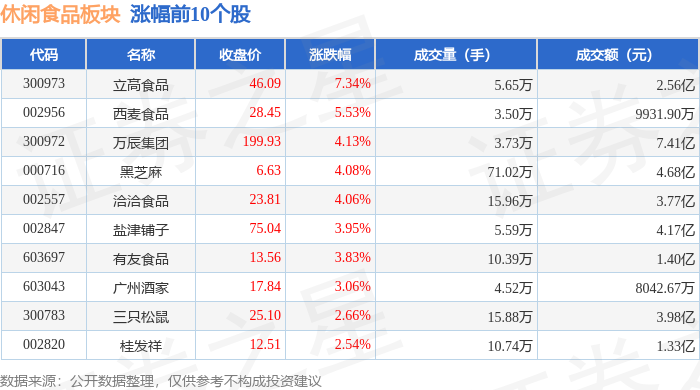
休闲食品板块1月19日涨3.01%,立高食品领涨,主力资金净流入1835.13万元
Zheng Xing Xing Ye Ri Bao· 2026-01-19 08:52
Group 1 - The leisure food sector increased by 3.01% on January 19, with Li Gao Food leading the gains [1] - The Shanghai Composite Index closed at 4114.0, up 0.29%, while the Shenzhen Component Index closed at 14294.05, up 0.09% [1] - Key stocks in the leisure food sector showed significant price increases, with Li Gao Food rising by 7.34% to a closing price of 46.09 [1] Group 2 - The leisure food sector experienced a net inflow of 18.35 million yuan from institutional investors, while retail investors contributed a net inflow of 18.64 million yuan [2] - Notable stocks included San Zhi Song Shu, which had a net inflow of 36.54 million yuan from institutional investors, despite a net outflow from retail investors [3] - The overall trading volume and turnover in the leisure food sector indicated active market participation, with significant movements in individual stock prices [1][2]





零售新旧业态差异大 企业持续加码鲜食、自有品牌
Zhong Guo Jing Ying Bao· 2026-01-19 06:05
Core Insights - The retail industry in 2025 is experiencing significant changes, with emerging channels like Hema and Aldi growing rapidly while traditional retailers face ongoing challenges [1][3] Group 1: Emerging Channels - Hema's overall revenue growth exceeded 40% year-on-year in 2025, with the company entering 40 new cities and opening over 200 new stores [2] - Aldi has expanded its presence in China, opening over 80 stores since its initial launch in Shanghai in June 2019 [2] - The snack retail sector is also thriving, with Mingming Hen Mang achieving a revenue of 36.56 billion yuan, a year-on-year increase of 77.37% [2] Group 2: Traditional Retail Challenges - Traditional retailers like Zhongbai Group reported a revenue decline of 19.41% year-on-year, resulting in a loss of 325 million yuan in the first three quarters of 2025 [3] - Bain's report indicates a continued contraction in offline channels, with traditional hypermarkets and convenience stores losing market share in fast-moving consumer goods [3] - Despite the overall pressure, new channels such as warehouse membership stores, snack stores, and discount stores are expanding rapidly, with year-on-year growth rates of 40%, 51%, and 92% respectively [3] Group 3: Retail Transformation - Traditional retailers are attempting to reverse their fortunes through store and format adjustments, with Zhongbai Group closing 30 hypermarkets and incurring a closure loss of approximately 180 million yuan [3][6] - The shift towards fresh and ready-to-eat food offerings is evident, as traditional retailers adapt to consumer preferences for fresh products [7][8] - Retailers are increasingly focusing on private label products, with Yonghui Supermarket planning to develop 100 billion-level products over three years [9] Group 4: Consumer Preferences - Consumers are gravitating towards high-value and experiential retail formats, leading to a bifurcation in the market [7][9] - The success of membership stores like Sam's Club is attributed to their unique product selection and commitment to quality, although they face challenges in supply chain management [5][7] - The retail landscape is expected to evolve into a clear "M-shaped" differentiation, with one end focusing on efficiency and the other on experiential value [9]


从双强视角看行业发展:量贩零食行业深度研究:从豆蔻时代,到万里繁花
Changjiang Securities· 2026-01-18 14:24
Investment Rating - The report maintains a "Positive" investment rating for the industry [11] Core Insights - The bulk snack industry has successfully captured current consumer trends through "extreme cost performance" and "efficient supply chains," leading to a stable "dual strong" market structure with significant scale effects for leading companies [4][6] - The market for leisure food and beverages is expected to approach 4 trillion yuan by 2025, with a compound annual growth rate (CAGR) of over single digits from 2025 to 2029 [6][30] - The two leading companies, Mingming and Wancheng, have established themselves as industry champions, with Mingming showing stronger profitability and Wancheng focusing on operational efficiency and turnover speed [4][7] Market Structure and Growth - The snack industry is transitioning from fragmented operations to brand and chain development, entering an innovative phase represented by bulk snack stores [19][21] - The leisure food and beverage market is projected to grow significantly, with the down-market segment expected to see a growth rate of 6.8% from 2024 to 2029, surpassing the high-line market's 4.1% [6][33] - The retail market for bulk snacks is expected to exceed 200 billion yuan by 2025, with significant contributions from lower-tier markets [36][38] Company Performance - As of mid-2025, both leading companies have over 15,000 stores, with Mingming's store count reaching 21,041 by November 2025, while Wancheng is enhancing its presence in lower-tier markets [7][54] - Mingming has approximately 180 million registered members, with a repurchase rate of about 77%, while Wancheng has over 150 million registered members and an average monthly purchase frequency of 2.9 times [54][55] - Profitability for both companies is improving, with Mingming's gross margin at 9.7% and Wancheng's at 11.7% for the first three quarters of 2025 [8][55] Future Outlook - The report suggests that the future growth of bulk snack companies will rely on scale effects and operational efficiency, with potential for category expansion and overseas market penetration [9][30] - The Southeast Asian snack and beverage market is projected to reach approximately 48.4 billion USD by 2025, presenting opportunities for Chinese snack companies to expand internationally [9][30]
食饮行业周报(2026年1月第3期):茅台发布市场化运营方案,看好春节旺季备货行情-20260118
ZHESHANG SECURITIES· 2026-01-18 13:23
Investment Rating - The industry rating is maintained as "Positive" [5] Core Views - The report highlights that the liquor sector is currently at a bottom phase, with leading brands expected to see an upward trend in sales during the upcoming Spring Festival, particularly for core products [2][10] - The report emphasizes the importance of the Spring Festival stocking season for consumer goods, with a focus on new consumption trends in the medium to long term [3][12] Summary by Sections Market Performance Review - The food and beverage sector experienced a decline of 2.10% from January 12 to January 16, 2026, underperforming compared to the Shanghai Composite Index, which fell by 0.45%, and the CSI 300 Index, which dropped by 0.57% [1][19] - Specific declines included the liquor sector at -2.35%, processed foods at -2.13%, and dairy products at -2.09% [1][19] Weekly Updates - **Liquor Sector**: The liquor sector's performance was weaker than the overall food and beverage sector, with a notable decline of 2.35%. The report mentions the release of a market-oriented operational plan by Kweichow Moutai, which aims to stabilize retail prices and enhance sales channels [2][10] - **Consumer Goods**: The report indicates a positive outlook for snack foods, with significant gains in stocks such as "Good Idea" and "Kangbiter" [3][12] Investment Recommendations - **Liquor Sector**: Recommended stocks include Kweichow Moutai, Luzhou Laojiao, Shanxi Fenjiu, and Gujing Gongjiu, with a focus on potential sales exceeding expectations during the Spring Festival [2][10][17] - **Consumer Goods**: Emphasis on the importance of stocking for the Spring Festival, with recommendations for companies like Wei Long and Wanchen Group, as well as monitoring new product launches and channel adjustments [3][12][18] Sector and Stock Performance - The report provides detailed performance metrics for various sectors, indicating that the processed food and baking sectors also faced declines, with specific stocks like Weizhi Xiang and Kemei Foods showing some resilience [15][19] - The report notes that the dynamic price-to-earnings ratio for the food and beverage sector is currently at 21 times, ranking it 24th among primary industries [24]
【转|太平洋食饮-26年度策略】底部向阳,寻找结构性亮点
远峰电子· 2026-01-18 11:38
Overall Sector Review - The food and beverage sector significantly underperformed the market, with a year-to-date decline of -0.62%, lagging behind the Shanghai Composite Index by 15.0 percentage points [2] - The sector experienced a deep correction after an initial rebound driven by expectations of consumption recovery and supportive policies, but the actual recovery rate was lower than anticipated, leading to a consensus on weak domestic demand [2] Subsector Performance - The snack sector outperformed with a year-to-date increase of 28.88%, driven by channel expansion and a revenue growth rate of 30.97% in the first three quarters [4] - Soft drinks also showed resilience with a 10.11% stock price increase, benefiting from strong travel demand and low-cost, high-frequency consumption [4] - The restaurant chain sector saw a rebound with gains of approximately 10.34% and 10.29% for pre-processed and baked goods, respectively [4] - The liquor sector, particularly high-end liquor, faced challenges with weaker sales and declining prices, while beer performance was supported but affected by high-end market constraints [4] Investment Insights - The sector is under pressure from deflationary trends and a weak recovery, with consumer confidence remaining low, indicating a shift to a "new normal" of low growth [8] - High-end consumption has shown slight recovery due to stock market wealth effects, but sustainability remains a concern [9] - The food and beverage sector's valuation is at historical lows, with a current PE (TTM) of 21.9X, indicating potential investment opportunities in undervalued segments [12] Fund Holdings - As of Q3 2025, the food and beverage sector's fund holdings decreased to 6.38%, nearing levels seen in 2016, with the liquor segment comprising 5.52% of this [14] - Fund holdings in the liquor sector increased for certain subsectors, including white liquor and seasoning products, while others saw declines [16] Long-term Trends - The liquor industry is undergoing its longest adjustment period since 2003, with significant price corrections and a potential bottoming out of valuations [21] - The white liquor sector has underperformed the market with a year-to-date return of -4.87%, reflecting weak demand and a divergence from broader market trends [24] - The third quarter of 2025 saw a significant decline in revenue and net profit for the white liquor sector, indicating a deep adjustment phase [27] Pricing Dynamics - The white liquor market is experiencing a general decline in prices, particularly in high-end segments, while lower price segments show resilience [29] - The average price of high-end products like Moutai has dropped significantly, while mid-range and lower-range products have maintained stability or slight increases [31] Investment Recommendations - The white liquor sector is advised to focus on inventory reduction and demand recovery, with a preference for leading brands that can maintain pricing power and product stability [32]




“谷子”引流 服务“上新” 新供给推动线下零售回暖
Shang Hai Zheng Quan Bao· 2026-01-16 18:34
Core Viewpoint - The article highlights the recovery of offline retail driven by new supply and consumer engagement, particularly through popular products and experiential shopping environments. Group 1: Offline Retail Trends - The popularity of the "Right Right Sauce" character and related blind boxes has attracted significant consumer interest, with over 7,000 units sold in a month at a single store in Wuhan [4] - The national business conference emphasized "expanding domestic demand and boosting consumption" as a key focus for the year, enhancing confidence among retail operators [4] - New supply is creating demand, as seen in the rise of snack retail stores where consumers engage with products in innovative ways [4] Group 2: Emerging Retail Formats - By 2025, retail channels are expected to show significant differentiation, with traditional supermarkets under pressure while new formats like bulk snack stores and membership supermarkets are experiencing growth [5] - The parent company of "Snack Busy" is set to become the first bulk snack stock in Hong Kong, with plans to expand its store count to 19,500 by September 2025, focusing on store expansion and supply chain optimization [6] - The snack retail leader, Wancheng Group, anticipates a continued market recovery in 2026, emphasizing refined operations and innovative consumer experiences [6] Group 3: Traditional Retail Adaptation - Traditional retail companies are adapting by enhancing service and product offerings to meet changing consumer trends, such as transforming some supermarkets into food-themed stores [7] - Wu Shang Group is entering the membership retail space, focusing on personalized consumer needs and plans to open two new stores by 2026 based on the success of its first membership store [7] - The integration of cultural and experiential elements in retail is becoming a focus, with plans to introduce more popular IP content and toys in the future [7] Group 4: Consumer Supply Shift - Industry experts note a shift in consumer supply from "scale expansion" to "quality enhancement and scene refinement," with opportunities arising in green and health-conscious consumption [8] - The combination of supply-side innovation and policy support is expected to further boost offline retail recovery [8]

乳企,电商愈加重要
2 1 Shi Ji Jing Ji Bao Dao· 2026-01-16 01:42
Group 1: E-commerce and Dairy Industry Dynamics - Dairy companies are increasingly forming strategic partnerships with e-commerce platforms, as seen with Sanyuan Foods launching its new product on JD.com and signing a strategic cooperation agreement with JD Group [1] - The rising cost of online traffic is a concern for dairy executives, who emphasize that offline channels offer higher profit margins [1][2] - Despite the challenges, e-commerce is filling gaps left by offline channels, providing easier coordination for new product launches compared to the complexities of offline distribution [2] Group 2: Market Trends and Sales Data - The dairy market is experiencing a contraction, with Nielsen IQ reporting a 16.8% year-on-year decline in total channel sales for dairy products as of September 2025, with offline channels seeing a 21.3% drop [3] - The trend indicates that while online channels are becoming more expensive, they are also generating systematic growth and addressing structural issues in offline distribution [2] Group 3: Corporate Developments - Salted Fish Company announced the resignation of its Vice President Li Hanming due to personal reasons [4] - Former CEO of Weidong, Sun Yinan, has joined Dayao as CEO [5] - China Resources Beverage appointed Gao Li as Executive Director and Chairman of the Board [6]
乳企,电商愈加重要丨消费参考
2 1 Shi Ji Jing Ji Bao Dao· 2026-01-16 01:30
Group 1: E-commerce and Dairy Industry Dynamics - Dairy companies are increasingly forming strategic partnerships with e-commerce platforms, as seen with Sanyuan Foods launching its new product on JD.com and signing a strategic cooperation agreement with JD Group [1] - The rising cost of online traffic is a concern for dairy executives, who emphasize that offline channels offer higher profit margins [1][2] - Despite the challenges, e-commerce is filling gaps left by offline channels, providing easier coordination for new product launches compared to the complexities of offline distribution [2] Group 2: Market Trends and Sales Data - The dairy market is experiencing a contraction, with Nielsen IQ reporting a 16.8% year-on-year decline in total channel sales for dairy products as of September 2025, with offline channels seeing a 21.3% drop [3] - The trend indicates that while online channels are becoming more expensive, they are also generating systematic growth and addressing structural issues in offline distribution [2]