
卡游

Search documents
文化魅力+创意赋能,中国潮玩掀起全球文娱新浪潮
Xin Hua Wang· 2025-06-24 02:29
Core Insights - The rise of Chinese潮玩 (trendy toys) is transforming into a global phenomenon, driven by the strength of "Made in China" and cultural appeal [1][2][6] Group 1: Market Performance - In 2024, Pop Mart reported a revenue of 7.97 billion RMB in mainland China, a year-on-year increase of 52.3%, while overseas and Hong Kong, Macau, and Taiwan revenue reached 5.07 billion RMB, growing by 375.2% [3] - The Southeast Asian market saw a remarkable revenue growth of 619.1%, with North America and other regions also experiencing significant increases of 556.9% and 310.7% respectively [3] - MINISO's first global MINISO LAND store in Shanghai achieved a sales record of 12.03 million RMB in its first month of trial operation [3] Group 2: Supply Chain and Production Advantages - The efficiency of China's supply chain is highlighted, with a typical delivery time of 3 to 7 days for domestic markets and 20 to 30 days for overseas markets, significantly faster than other countries [4] - Chinese潮玩 companies can respond quickly to market demands, with new products designed and launched within two weeks [4] Group 3: Cultural Impact and Consumer Trends - The潮玩 industry is becoming a universal social language, with products serving as a medium for self-expression and social interaction among global youth [6] - The concept of "interest consumption" is gaining traction, reflecting a shift from material to emotional and cultural needs as GDP per capita rises [6][7] - The global acceptance of Chinese潮玩 is seen as a recognition of Chinese aesthetics and culture by the younger generation worldwide [7]


2025新消费系列报告:潮玩国货何以在全球攻城略地
Sou Hu Cai Jing· 2025-06-24 01:47
Core Insights - The report highlights the rapid expansion of Chinese trendy toy brands in global markets, particularly in Southeast Asia and Europe, reshaping the competitive landscape of the toy industry [1][2][6] - The global toy market reached a size of 773.1 billion yuan in 2023, with a projected compound annual growth rate (CAGR) of 5.1% from 2024 to 2028, driven primarily by the rise of collectible toys [2][16] - The shift in consumer demographics towards adult collectors, termed "Kidult" culture, is a significant driver of this market transformation [2][3] Market Dynamics - The collectible toy segment has become a core growth engine, with the global market for collectible toys reaching 57.1 billion USD in 2023 and expected to exceed 69.6 billion USD by 2028, reflecting a CAGR of 4.0% [2][17] - Traditional toy giants like Mattel and Hasbro are facing challenges due to aging IPs and reliance on offline channels, leading to a decline in market share [3][37] - The competitive landscape is shifting, with new brands like Squishmallows and Funko gaining traction, while established brands struggle to maintain their positions [3][33] Competitive Advantages of Chinese Brands - Chinese trendy toy brands leverage a three-pronged advantage: designer talent, supply chain efficiency, and IP ecosystem development [4][5] - The number of art students in China has increased significantly, from 133,000 in 2004 to 647,000 in 2024, providing a robust talent pool for design innovation [4] - Chinese manufacturers are enhancing production precision and efficiency, exemplified by companies like Gaodesi, which produces over 10 billion building blocks annually [4] Regional Market Insights - Southeast Asia is identified as a key battleground for Chinese brands, with a toy market size of 4.1 billion USD in 2023 and a young population driving demand [6][7] - The U.S. market shows high consumer spending on toys, with an average of 136.8 USD per person, significantly higher than in China [7][8] - Chinese brands are successfully penetrating the U.S. market through localized strategies and partnerships with popular IPs, achieving notable sales growth [7][8] Strategic Developments - Companies like Pop Mart are adopting a dual strategy of original IP development and global licensing partnerships, enhancing their market presence [5][8] - The trend of "prosumer" engagement is emerging, where consumers actively participate in the creation and promotion of IPs, increasing brand loyalty [8][9] - The report emphasizes the transformation of the Chinese toy industry from a manufacturing base to a global brand powerhouse, with significant cultural implications [9]


聚焦|中国潮玩出海成外贸新风口
Guang Zhou Ri Bao· 2025-06-19 15:58
Core Insights - The Chinese潮玩 (trendy toys) industry is experiencing significant growth in international markets, with brands like Pop Mart and 52TOYS gaining popularity among foreign buyers [1][2] - The overseas sales of潮玩 have surged, with Pop Mart's GMV increasing by 300% in the first half of the year, and its overseas market performance growing nearly 480% [2][3] - The global潮玩 market is in a rapid expansion phase, with a projected growth from 631.2 billion yuan in 2019 to 993.7 billion yuan by 2028, reflecting a compound annual growth rate of 5.2% [3] Market Trends - The recent overseas 618 shopping festival saw Pop Mart's live stream attract 240,000 viewers, indicating a strong demand for潮玩 [1] - The success of潮玩 brands is attributed to their unique designs and limited edition releases, which resonate well with overseas consumers [2][3] - Social media platforms play a crucial role in promoting潮玩 culture, with significant user engagement driving sales [2] Strategic Recommendations -潮玩 companies are encouraged to adopt an "IP thinking" approach, focusing on creating and licensing innovative IPs to enhance their market presence [4][5] - Expanding into diverse commercial avenues beyond product sales, such as IP licensing and adaptations, can unlock larger market opportunities [6] - Companies like Aofei Entertainment are already leveraging their popular IPs to diversify into animation, licensing, and theme parks, showcasing the potential for a full industry chain [6] Challenges and Considerations - Despite the growth,潮玩 brands face challenges related to cultural differences, aesthetic preferences, and consumer habits in various regions [3] - Maintaining product quality and innovation is essential to prevent imitation and ensure the longevity of IPs in the competitive market [8] - The balance between rapid expansion and quality control is critical for潮玩 brands to transition from "phenomenal hits" to "global classics" [8]
TMT专场 - 中信建投证券2025年中期资本市场投资峰会
2025-06-19 09:46
Summary of Key Points from the Conference Call Industry and Company Focus - **Industry**: AI and Semiconductor Industry, particularly focusing on edge AI and GPU markets - **Companies Mentioned**: NVIDIA, Amazon, Google, Microsoft, Apple, Xiaomi, Huawei, and domestic Chinese companies in the semiconductor space Core Insights and Arguments 1. **Focus on Edge AI**: The conference highlighted the growing importance of edge AI hardware, particularly in smartphones, PCs, smart assistants, and automotive applications, driven by a prolonged smartphone replacement cycle [1][2][15] 2. **Domestic Upgrades**: Significant upgrades in domestic high-end production capacity and computing chips are expected in Q3 and Q4, aligning with supply-side reforms [1][5] 3. **GPU Market Dynamics**: NVIDIA's stock has rebounded to pre-tariff levels, with the GP300 set for mass production in the second half of the year, featuring a 50% increase in bandwidth due to 12 high HBM3E memory [1][7] 4. **Server Demand**: The demand for new process technologies in servers is surpassing that of smartphones, indicating a shift in industry focus [1][9][10] 5. **Challenges in Domestic AI Development**: Domestic companies face challenges such as the "memory wall" and lack of competitiveness in wafer manufacturing, although progress in HBM localization is noted [1][12][13] 6. **Price Increases in Memory**: The prices of DDR4 and LPDDR4 have doubled due to HBM's impact on production capacity, with further increases expected [1][24] 7. **Investment Trends**: U.S. investors are focusing on both cloud and edge AI model developments, with significant releases from major tech companies [1][6] 8. **AI Chip Manufacturing**: The development of AI chip manufacturing capabilities is crucial, with TSMC achieving record highs due to NVIDIA's resurgence [1][8] 9. **Market for Smart Glasses**: The smart glasses market is projected to see shipments of 5 to 6 million units in 2025, with several companies launching products [1][17] 10. **Foldable Phone Market**: The foldable phone market is expected to grow significantly with Apple's anticipated release, which could impact the entire supply chain [1][18][19] Other Important but Potentially Overlooked Content 1. **Policy Support for AI**: Recent policies aimed at boosting domestic demand and consumption are crucial for the electronics manufacturing sector, which constitutes 50% of China's overall output [1][31] 2. **AI in Smart Devices**: The integration of AI into smart devices is expected to reshape the industry, with significant implications for hardware and software development [1][29] 3. **Investment in Semiconductor Materials**: The domestic semiconductor materials industry is experiencing rapid growth, with companies like Anji Microelectronics and Yake Technology showing significant revenue increases [1][26] 4. **Challenges in Analog Semiconductor Manufacturing**: Domestic analog semiconductor manufacturers face low profit margins due to intense competition, necessitating consolidation through acquisitions [1][28] 5. **Future of AI Agents**: The future of AI agents is promising, with expectations for them to act as proactive assistants, enhancing user interaction and decision-making capabilities [1][45] This summary encapsulates the key points discussed during the conference call, providing insights into the current state and future trends of the AI and semiconductor industries.
传媒行业半年度策略:多主线布局,攻守兼备
Zhongyuan Securities· 2025-06-19 09:18
Group 1 - The media sector has shown excellent performance over the past year, with a significant increase of 36.04%, outperforming the CSI 300 index by 26.45 percentage points [10][11][15] - In 2024, the media sector's overall performance declined, with total revenue of 549.80 billion yuan, a slight decrease of 0.10%, and a net profit of 17.88 billion yuan, down 56.58% year-on-year [17][20] - The first quarter of 2025 saw a recovery in the media sector, with revenue reaching 134.23 billion yuan, an increase of 5.02%, and net profit rising by 44.47% to 11.03 billion yuan [20][21] Group 2 - The gaming industry is experiencing stable growth, with the domestic gaming market size reaching approximately 325.78 billion yuan in 2024, a year-on-year increase of 7.53% [29] - The overseas revenue from self-developed games reached 18.56 billion USD in 2024, marking a year-on-year growth of 13.39% [39] - The issuance of game licenses has increased significantly, with 1,306 domestic game licenses issued in 2024, a year-on-year increase of 33.67% [49][51] Group 3 - The IP derivative market is witnessing strong growth, with the global market size expected to reach 100 billion yuan by 2025, driven by the rise of new consumer demographics [6][9] - The publishing sector remains stable, with a solid demand for educational materials and a focus on high-dividend stocks for long-term returns [6][27] - The publishing sector's revenue in 2024 was 148.48 billion yuan, with a slight decrease of 2.46% year-on-year, but the first quarter of 2025 showed resilience with a revenue of 32.19 billion yuan [28][20]
日本IP吸金术:11个IP一年收入429亿,中国成“谷子经济”主战场?
3 6 Ke· 2025-06-18 01:30
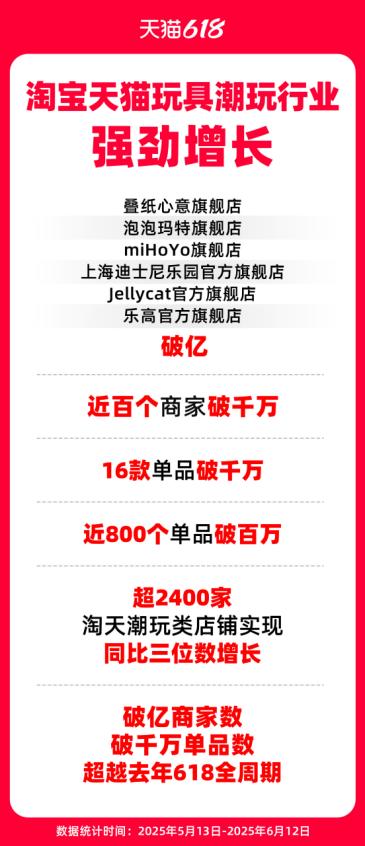
Group 1 - The toy and trendy play industry in China is experiencing explosive growth during the 618 shopping festival, with six merchants surpassing 100 million yuan in sales and nearly 100 merchants exceeding 10 million yuan [1][2] - The top IP products, including Sanrio and Ultraman cards, are performing exceptionally well, indicating a strong demand for Japanese IP in the Chinese market [2][3] - The overall market for trendy toys is expanding, with over 2,400 stores achieving triple-digit growth compared to the previous year [1][2] Group 2 - Major Japanese companies like Bandai, Sanrio, and Tsuburaya have reported significant revenue from their IPs, with Bandai's Dragon Ball generating approximately 9.44 billion yuan, a 35.6% increase year-on-year [4][5] - Sanrio's revenue in China has surged to 816 million yuan, with IP licensing contributing significantly to its growth [5][7] - Tsuburaya's Ultraman IP has generated 260 million yuan in licensing revenue in China, highlighting the strong performance of card sales [7][19] Group 3 - The competitive landscape of the trendy toy market is intensifying, with over 100 stores closing in the first half of 2025, indicating a significant shakeout in the industry [15][16] - The trend of localization is evident, as companies like Sanrio and Bandai are focusing on developing original IPs and collaborating with local partners to enhance their market presence [21][29] - The shift from content output to collaborative ecosystem building is becoming a key strategy for Japanese IP companies in China, aiming for sustainable growth in the competitive market [29][30]

IP产业链梳理及观点更新
2025-06-18 00:54
Summary of the IP Industry Conference Call Industry Overview - The IP derivative market is experiencing rapid growth, with revenue from derivatives surpassing that of the IP itself, indicating a significant potential for expansion in the market [1][2] - The IP industry chain consists of three segments: upstream content creators (movies, novels, games), midstream product developers (blind boxes, plush toys, cards), and downstream distribution channels (dealers, retail chains, secondary markets) [1][3] Key Insights - The demand for emotional value products varies by consumer demographics, with higher age groups favoring trendy toys and younger audiences gravitating towards card games [1][5] - Notable investment targets include companies in the trendy toy sector like Pop Mart, plush toy brands like Labubu and Jellycat, card game companies like Kayo, and entertainment consumer goods firms like Yadea Electric [1][6] Market Dynamics - Midstream product companies earn 50%-60% of consumer spending, with profit margins highly dependent on product categories; card products have a margin of about 70%, while trendy toys and plush toys range from 40%-70% [1][10] - The IP industry is recognized as a lucrative business, with the derivative products accounting for more than 50% of revenue in overseas markets [2] Future Prospects - The Chinese derivative market is expected to maintain high growth in the coming years, with companies like Pop Mart and Kayo leading the way [3][14] - Emerging companies are exploring new product categories such as food toys and card games, indicating a trend towards diversification in product offerings [14][24] Noteworthy Companies - **Pop Mart**: Demonstrates strong performance in IP incubation and operation, with significant revenue from major IPs like Labubu, and a successful global market presence [16] - **Aofei Entertainment**: Leverages a wide range of channels and has developed national-level IPs across various product categories [17][18] - **Ali Pictures**: Operates the largest IP licensing platform in China, showing rapid growth in sales and a strong portfolio of global IP resources [19] - **Shanghai Film**: Holds a diverse portfolio of classic IPs and is actively pursuing derivative product development [20] - **Kayo**: Plans to go public, with a focus on collectible card games and a projected revenue of 10 billion in 2024 [25] Additional Insights - The secondary market allows consumers to trade products with platforms taking a small commission, while self-operated channels can cover the entire industry chain [8] - The operational success of content stores is closely tied to location and product selection, affecting profitability [9] - Companies are increasingly diversifying their product lines, blurring the lines between different categories [24] Conclusion The IP industry is poised for significant growth, driven by increasing consumer demand for emotional value products and the successful strategies of key players in the market. The diversification of product offerings and the expansion into new categories will further enhance the industry's potential.
3月玩模行业,品牌联名“谷子化”硬控泛二次元|世研消费指数品牌榜
3 6 Ke· 2025-06-17 11:14
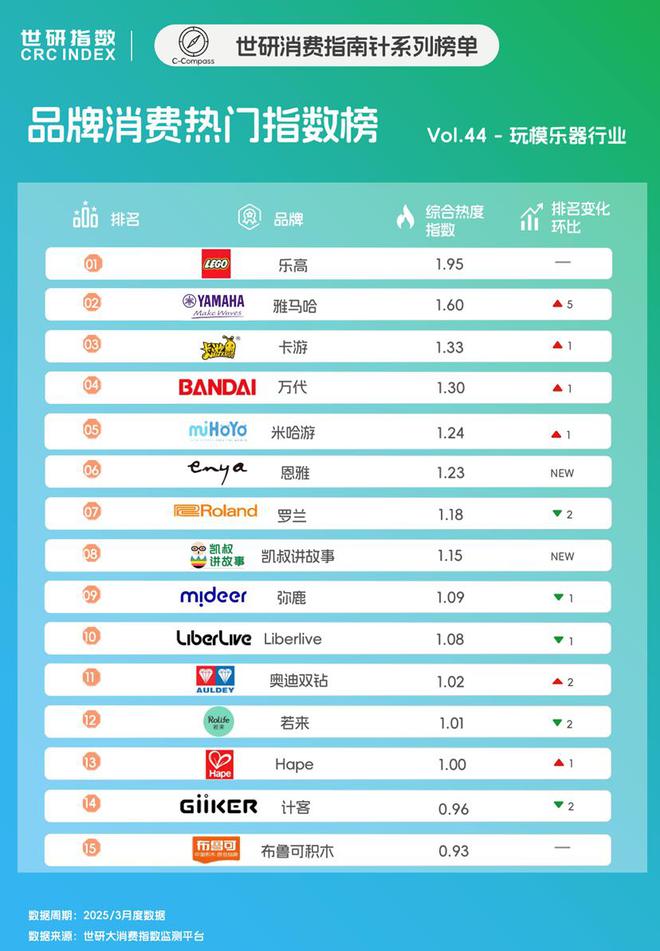
Group 1: Brand Performance - LEGO, Yamaha, and miHoYo are leading brands with heat index scores of 1.95, 1.60, and 1.24 respectively, reflecting strong demand from the pan-2D user group driven by the "Guzi Economy" [2] - LEGO announced new products at the International Toy Fair in New York, including the LEGO® Blue Series and six new LEGO Jurassic World sets, which generated significant pre-sale interest [2] - Bandai collaborated with Hatsune Miku to launch the Mobile Suit Gundam series figurines, enhancing brand visibility on social media [2] Group 2: Consumer Trends - Consumers are increasingly seeking emotional resonance with virtual IPs while valuing the practicality and collectibility of physical products [2] - Low-decision-threshold products like trading cards and blind boxes are becoming popular entry points for consumers [2] - Brand collaborations are stimulating user-generated content on social media, leading to viral marketing effects [2] Group 3: Instrument Industry Evolution - The instrument industry is trending towards portability, intelligence, and integration, as seen with brands like Yamaha, Roland, and Liberlive [3] - Yamaha's lightweight hand roll piano and portable electric pianos connect via Bluetooth for enhanced functionality [3] - Liberlive's smart guitar features an AI chord assistance system, catering to users' dual needs for learning and entertainment [3] Group 4: Index Report Overview - The report is part of the Consumer Index Evaluation System developed by Shiyan Index, which includes various consumption index rankings to track market trends [4] - The index monitors 12 major industries, including 3C digital, apparel, food, home appliances, and musical instruments [4]
轻工纺服行业2025年中期策略:内需弱复苏,泛娱乐玩具景气向上
Dongxing Securities· 2025-06-16 12:25
Group 1: Overview - The report indicates a weak recovery in domestic demand for the home furnishing sector, while the pan-entertainment toy industry is experiencing upward momentum driven by emotional consumption [15][39]. Group 2: Home Furnishing Industry - Domestic demand for home furnishings is under pressure, with a projected decline of 3.9% in building materials and home sales for 2024, but a gradual improvement is expected in Q4 2024 due to government subsidies [4][16]. - The introduction of a doubling of the old-for-new subsidy to 300 billion yuan in 2025 is anticipated to stimulate demand and help leading companies increase market share [4][28]. - Key companies in the home furnishing sector, such as Gujia Home and Sophia, are expected to show resilience in performance due to high dividend yields and strong brand advantages, with PE ratios generally below 15 [4][30][32]. - Export performance for home furnishing companies has been improving since November 2023, driven by overseas retailers replenishing inventory, although uncertainties remain due to changing tariff policies [4][33]. Group 3: Pan-Entertainment Toy Industry - The pan-entertainment toy industry in China is rapidly expanding, with GMV projected to grow from 48.8 billion yuan in 2019 to 101.8 billion yuan in 2024, reflecting a compound annual growth rate of 15.8% [5][51]. - The industry is categorized into card games and IP toys, with card games holding a 70% market share, while the IP toy market is more fragmented [5][54]. - Key players such as Pop Mart and Blokus are experiencing significant growth, with Pop Mart's revenue expected to increase substantially due to its diverse IP matrix and strong online and offline channels [5][61][64]. - The report highlights the importance of emotional consumption and the rise of local designers as key drivers for the future development of the pan-entertainment toy industry [5][51].
以创新产品激发消费活力,卡游澳门首店开业
Nan Fang Du Shi Bao· 2025-06-16 07:39
Core Insights - 卡游澳门首家旗舰店在威尼斯人购物中心开业,标志着公司在全球市场的进一步拓展 [1] - 澳门作为国际旅游休闲中心,吸引了大量游客,为新消费品牌提供了良好的市场机会 [2][4] Group 1: Market Expansion - 卡游自去年起开始布局境外市场,澳门首店是其全球市场拓展的重要一步 [1] - 澳门预计在2024年接待2800万游客,入境旅客消费主要用于购物,占45.4% [2] - 卡游计划在东南亚市场进一步扩展,马来西亚和新加坡的首店将在下半年开业 [2] Group 2: Cultural and Consumer Engagement - 卡游澳门首店结合了独特的IP内容与城市符号,吸引了游客的关注 [3] - 开业当天的活动吸引了大量游客,增强了品牌的文化消费体验 [3] - 中国泛娱乐产品行业的市场规模预计从2019年的919亿元人民币增长至2024年的1741亿元人民币,显示出行业的快速发展 [4]