蔚来

Search documents
深夜,存储概念股大涨!巨头最新回应:供不应求,都在涨价!
Xin Lang Cai Jing· 2026-02-12 15:54
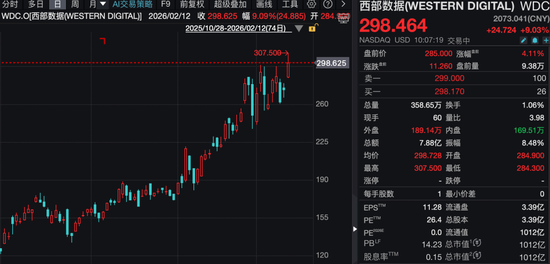
Core Viewpoint - The U.S. stock market showed mixed performance, with storage-related stocks continuing to strengthen, particularly Western Digital and SanDisk, both rising over 9%, and Micron Technology increasing over 6% [1][2]. Group 1: Micron Technology and NAND Flash Market - Micron Technology is advancing its new NAND flash wafer factory as planned, expecting the first batch of wafers to be shipped in the second half of 2028. The HBM4 customer shipment volume is also on track to increase in the first quarter of 2028, one quarter ahead of the original schedule [3][11]. - The CFO of Micron indicated that market demand significantly exceeds supply, with supply tightness expected to persist until after 2026 [3][11]. - TrendForce analysts predict that DRAM contract prices for various applications will rise by over 40% by the fourth quarter of 2025, with significant price increases continuing into the first quarter of 2026, particularly in the DDR4 market [3][11]. Group 2: Semiconductor Market Insights - Semiconductor company SMIC reported that its memory and BCD products are in high demand, leading to price increases, while supply in the market is declining [3][11]. - Prices for certain categories like CIS and LCD Drivers have stabilized, but competitive and iterative products are seeing price increases, while non-iterative standard products may experience price declines [3][11]. Group 3: Tesla and Energy Business - Tesla's stock rose over 1% following a Morgan Stanley report suggesting that its plan to build 100 GW of vertically integrated solar manufacturing capacity could increase its energy business valuation by $20 billion to $50 billion [4][12]. - The report noted that much of the solar capacity will be directed towards space data centers, aligning with Elon Musk's space strategy [4][12]. Group 4: Cisco and AI Demand - Cisco's stock fell nearly 10% despite reporting double-digit growth in revenue and earnings for the last fiscal quarter and raising its guidance for the current fiscal year. Concerns arose over weak gross margin guidance for the current quarter, as AI demand, while boosting revenue, is also increasing related expenses that could erode profitability [5][12]. Group 5: AI Application Software Stocks - AI application software stocks showed mixed results, with Fastly surging over 60% post-earnings, while Applovin dropped over 14% [7][14]. - The Nasdaq Golden Dragon China Index fell over 1%, with companies like NIO, Xpeng Motors, Baidu, Weibo, and New Oriental all declining by over 1% [7][14]. Group 6: Financing and Growth Initiatives - Yika Technology's stock rose over 7% after announcing the completion of a $100 million convertible bond issuance, which included refinancing a previous $65 million bond and securing an additional $35 million in funding [9][16]. - Kingsoft Cloud's stock increased over 6% after announcing the integration of the new Zhiyu GLM-5 model, with Goldman Sachs indicating that Kingsoft Cloud could benefit from Xiaomi's increased investment in AI [9][16]. - WeRide announced the launch of the first Robotaxi commercial service in downtown Abu Dhabi, covering about 70% of the core area, with a fourfold increase in fleet size since the service began in December 2024 [9][16].

美股中概股,集体下跌
第一财经· 2026-02-12 14:48
Market Overview - On February 12, US stock indices opened higher, with the Nasdaq up 0.38%, the Dow Jones up 0.36%, and the S&P 500 up 0.34% [1][2]. Chinese Stocks Performance - Chinese concept stocks collectively declined, with the Nasdaq China Golden Dragon Index down 0.4%. Notable declines included Ctrip Group down over 4%, Tencent Music and Beike down over 2%, and Pinduoduo, Li Auto, Dingdong Maicai, and JD Group down over 1%. Alibaba fell nearly 1% [2][3]. Storage Sector Performance - Storage concept stocks continued their upward trend, with Seagate Technology and Western Digital both rising over 9%, and SanDisk increasing over 8% [4][5]. Technology Stocks Performance - Technology stocks showed mixed results, with AMD, Tesla, and NVIDIA rising over 1%. However, Cisco experienced a significant drop of over 6%, and Netflix fell over 2% [5][6].

汽车零部件领域“蛇吞象”,天汽模拟收购东实股份60%股权
Jing Ji Guan Cha Wang· 2026-02-12 13:32
Core Viewpoint - Tianjin Automotive Mould Co., Ltd. (Tianqi Mould) is set to acquire a 60% stake in Dongshi Automotive Technology Group Co., Ltd. (Dongshi) through a combination of share issuance and cash payment, aiming for absolute control of 85% post-transaction [2][4]. Group 1: Company Overview - Tianqi Mould, established in 1996 and listed in 2010, specializes in the research, design, production, and sales of automotive body covering moulds and related products, serving major automotive companies like Tesla and BYD [2]. - Dongshi, founded in 2001, is a significant player in the automotive parts sector, providing components for both commercial and passenger vehicles, with a strong market presence due to partnerships with companies like Lear and Cummins [3]. Group 2: Financial Performance - Dongshi's projected revenues for 2024 and 2025 are 3.875 billion and 4.733 billion respectively, with net profits of 369 million and 355 million [3]. - In contrast, Tianqi Mould's revenues for 2024 are expected to be 2.746 billion, with a net profit of 83 million, indicating a significant disparity in financial performance [3]. Group 3: Strategic Importance of the Acquisition - This acquisition marks Tianqi Mould's first major capital operation since a change in control in December 2025, with new management focusing on resource integration to enhance company quality [4]. - The acquisition is viewed as a strategic move to expand Tianqi Mould's business and improve its product chain, customer structure, and regional coverage, leveraging synergies in technology and market [5]. Group 4: Transaction Structure and Market Reaction - The transaction structure has been adjusted to a combination of share issuance and cash payment, which is seen as a pragmatic approach given Tianqi Mould's financial situation, with a cash balance of 1.071 billion and interest-bearing debt of 1.607 billion as of September 2025 [5]. - The market has reacted positively to the acquisition due to the potential for significant operational synergies between the two companies, particularly in enhancing product precision and expanding customer channels [6]. Group 5: Industry Context - The automotive parts industry is undergoing a transformation driven by the shift towards electric vehicles, creating new demands for integrated die-casting and lightweight structural components [5]. - Tianqi Mould's focus on mould development and Dongshi's strength in large-scale component production can create a closed-loop industrial chain, enhancing overall competitiveness in the evolving market [6].


内存紧缺,被压了三年价的供应商替车企扛住第一波冲击
晚点Auto· 2026-02-12 11:37
Core Viewpoint - The demand for memory chips, driven by AI training and inference, has surged over the past two years, leading to price increases and supply shortages that are impacting the automotive supply chain. The shortage is expected to persist for one to two years, with limited space for domestic alternatives [3][4]. Group 1: Supply Chain Dynamics - The automotive industry is facing a significant supply gap of approximately 30% for memory chips, with suppliers unable to meet the demand from multiple clients simultaneously [5]. - Major memory manufacturers like SK Hynix, Samsung, and Micron have shifted their production focus from traditional DRAM to higher-margin HBM chips due to strong AI demand, resulting in a price increase of over 300% for DDR5 and over 150% for DDR4 since September 2025 [9][10]. - The automotive sector accounts for less than 10% of the global DRAM market, and memory chips only represent about 1% of the total BOM cost for vehicles, leading manufacturers to prioritize higher-paying clients [9][10]. Group 2: Competitive Landscape - Companies that secured memory chip capacity in advance are gaining a competitive edge, as they can protect their clients and navigate the crisis more effectively [5][11]. - Some leading automotive companies have begun switching suppliers to secure stable pricing and supply commitments, but this process is complicated by the need for certification and testing [11]. - The reliance on suppliers for inventory and negotiations means that automotive companies are at a disadvantage during supply crises, as suppliers prioritize clients willing to share cost burdens [11]. Group 3: Future Implications - The ongoing memory supply crisis is likely to lead automotive companies to make more strategic decisions regarding memory configurations in their products, potentially reducing specifications for lower-tier models and freezing certain software functionalities [12]. - Domestic manufacturers like Changxin Storage and Yangtze Memory Technologies are expanding their DRAM production, but the delivery timelines have extended significantly, indicating limited immediate relief for the automotive sector [12].


禁止亏本卖车,车圈反内卷新规出炉,价格战乱象大整治
3 6 Ke· 2026-02-12 11:25
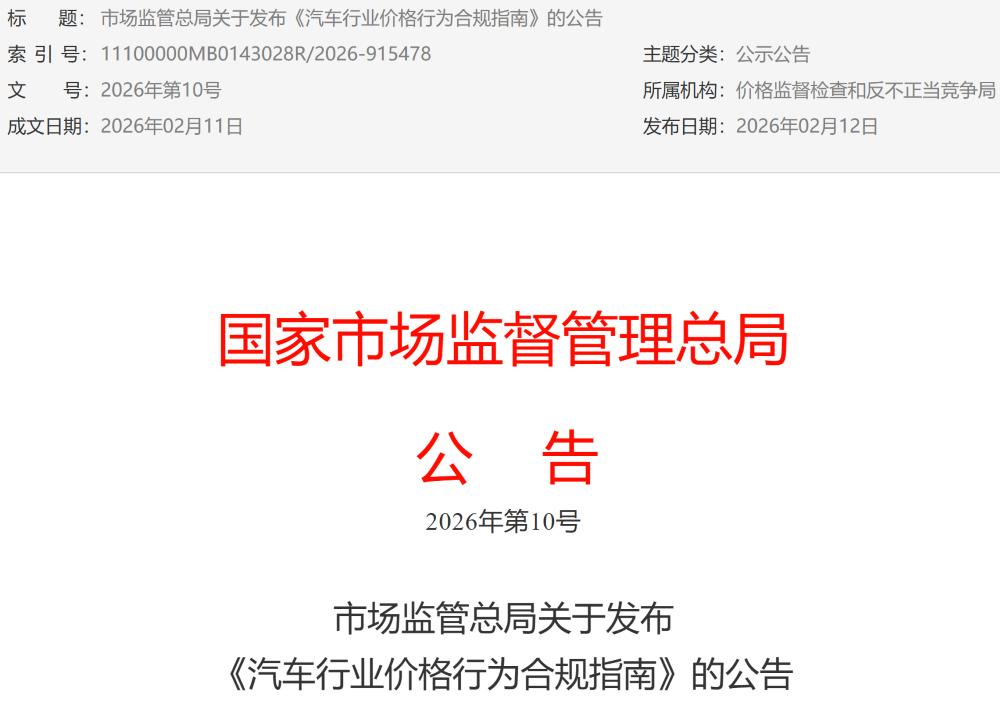
Core Viewpoint - The release of the "Guidelines for Compliance with Pricing Behavior in the Automotive Industry" by the State Administration for Market Regulation aims to standardize pricing behavior in the automotive sector, ensuring fair competition and protecting consumer rights while promoting high-quality industry development [3][24]. Group 1: Pricing Guidelines for Automotive Manufacturers - Automotive manufacturers must base pricing on production costs and market demand, prohibiting loss-leading sales aimed at eliminating competitors or monopolizing the market [5][6]. - Manufacturers are not allowed to significantly raise prices without justifiable reasons, even when there is a severe supply-demand imbalance in the automotive supply chain [6]. - The guidelines require manufacturers to clearly inform consumers about the terms and costs associated with "pay-to-unlock" features, including any free trial periods [6][13]. Group 2: Pricing Guidelines for Automotive Dealers - Automotive dealers are required to display clear pricing, including vehicle name, price, unit of measurement, model, manufacturer, and key specifications [13][18]. - Dealers must publicly disclose promotional rules, activity duration, and applicable scope, ensuring transparency in discounts and promotional offers [13][18]. - Similar to manufacturers, dealers are prohibited from loss-leading sales except during inventory clearance [14][18]. Group 3: Supplier Payment Terms and Industry Practices - A survey by the China Automotive Industry Association indicates that most of the 17 key automotive companies have reduced payment terms to within 60 days, with an average of 54 days, which is a reduction of about 10 days compared to the previous year [20][21]. - 15 companies have adopted cash or bank acceptance bills for payments, with some companies allowing early payment requests for cash-strapped small and medium enterprises [20][21]. - The guidelines are part of a broader effort to ensure compliance with the revised "Regulations on Payment of Funds to Small and Medium Enterprises" by the State Council, promoting timely payments to suppliers [21][24].
中汽协:17家车企中多数账期已低于60天,少数趁机“勒索”供应商
Jing Ji Guan Cha Wang· 2026-02-12 09:20
Core Insights - The China Automotive Industry Association (CAAM) released a report indicating that most of the 17 key automotive enterprises have reduced their payment terms to within 60 days, with an average payment term of approximately 54 days, which is a reduction of about 10 days compared to the previous year [2] - The revised "Regulations on Payment for Small and Medium-sized Enterprises" will take effect in June 2025, mandating large enterprises to pay small and medium-sized enterprises within 60 days of delivery [2] - The report highlights that the average accounts payable turnover days for domestic listed automotive companies in 2024 is 182 days, significantly higher than that of German (40.5 days) and American (60.5 days) automotive companies, causing financial strain on upstream enterprises [2] Group 1 - The CAAM's survey shows that all key automotive enterprises are prioritizing the implementation of payment term commitments, with many forming special task forces and establishing long-term mechanisms for commitment fulfillment [3] - The survey indicates that 15 out of 17 key automotive enterprises use cash or bank acceptance bills for payments, with 5 companies having a cash payment ratio exceeding 50% and 2 companies exceeding 70% [3] - 14 out of the 17 key enterprises are implementing additional preferential policies for small and medium-sized enterprises, ensuring that the payment process from delivery to payment does not exceed 60 days [3] Group 2 - There are still issues in the payment processes of some automotive enterprises, such as discrepancies in the starting point for payment terms, which can lead to extended payment periods despite nominally adhering to the 60-day term [4] - The CAAM emphasizes the need for continuous efforts to address these issues, as the management of the payment process is not sufficiently standardized [4]

Smart开年遇冷,1000辆限量车至今未能售罄
Xin Lang Cai Jing· 2026-02-12 06:57
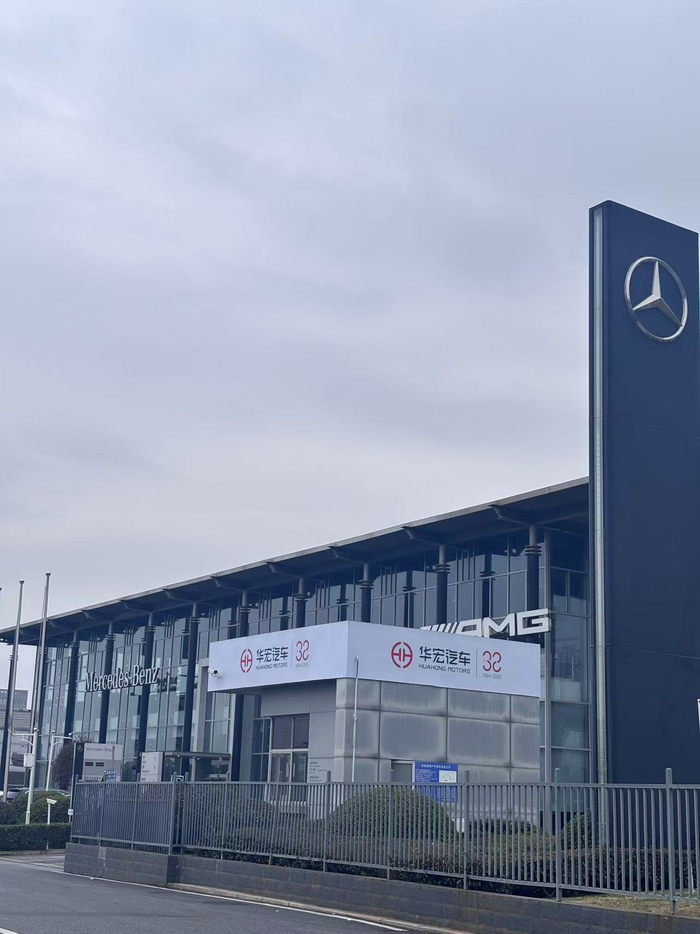
同售奔驰和Smart的门店外观。图片拍摄/刘舒雨 上述门店工作人员告诉智通财经,该店奔驰和Smart的售后服务和销售人员不会做单独的区分,但Smart 的业务量占比很小。据他透露,此前Smart有一个单独的售后门店,近一两年才与奔驰合并。 Smart由奔驰和吉利各持股50%。智通财经获悉,考虑到Smart在部分地区销量不高和为节约建店成本, 奔驰经销商会附带承担Smart的销售和售后工作。 一线门店接连遇冷的背后,是Smart销量连续两年下跌的残酷现实。据第三方平台数据,2024年Smart在 华全年销量为3.34万辆,较2023年同比下滑近20%,2025年则进一步下滑至3.08万辆。其中,2025年精 灵1号销量为2.08万辆,占品牌全年销量的67.7%。 为了提振销量,Smart尝试在2026年初推出了"马年开运版"精灵1号,该版本增加马年专属车顶涂装设 计,官方售价较普通版直接下调了1.5万元。一位湖北地区的销售告诉智通财经,两个车型版本在核心 产品点上并无本质区别。 距离Smart推出限量"马年开运版"精灵1号已经过去了一个多月,但Smart并没有等到它想象中的"热 闹"。 今年1月底,江西一家商场 ...
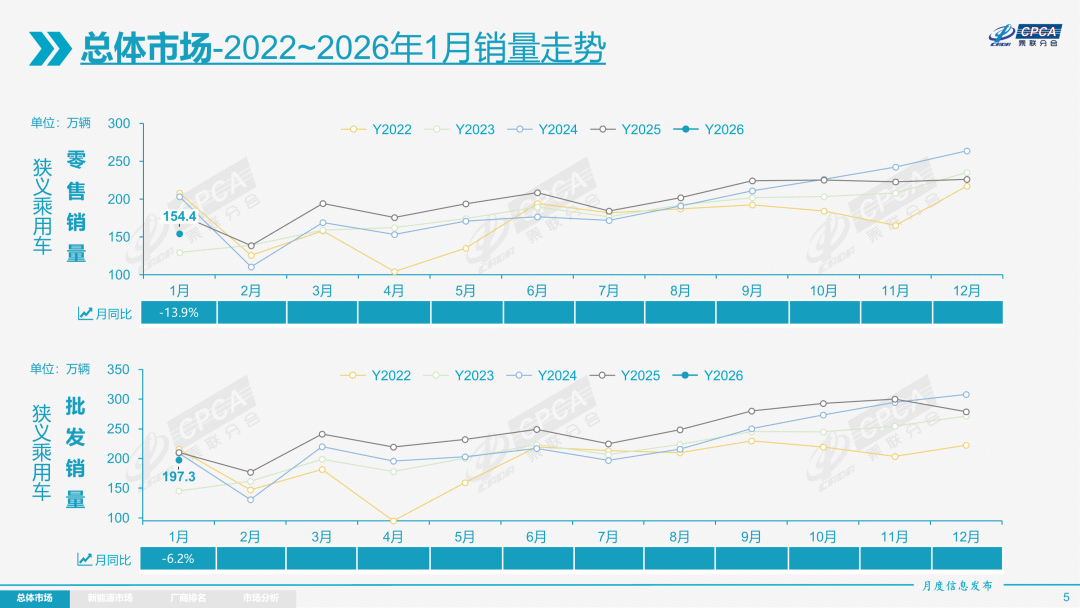
乘联分会:1月全国乘用车市场零售154.4万辆 新能源车渗透率为38.6%
智通财经网· 2026-02-12 06:41
Core Insights - The overall retail sales of passenger cars in January decreased by 13.9% year-on-year, with a total of 1.544 million units sold. The retail sales of new energy vehicles (NEVs) reached 596,000 units, representing a penetration rate of 38.6%, down 3 percentage points from the previous year [1][11]. Retail Market Overview - In January, the retail sales of self-owned fuel passenger cars were 250,000 units, up 17% year-on-year, while self-owned NEVs sold 226,000 units, marking a significant increase of 115%. NEVs accounted for 47.5% of self-owned exports, indicating growing international influence [2]. - The retail sales of self-owned brands totaled 890,000 units, down 18% year-on-year, with a domestic market share of 57.5%, a decrease of 3.5 percentage points [2]. - Mainstream joint venture brands sold 470,000 units, down 4% year-on-year, with German brands increasing their market share to 19.8%, up 1.4 percentage points [2]. Production and Wholesale Analysis - In January, the production of passenger cars was 2.003 million units, down 4.4% year-on-year. The wholesale volume was 1.973 million units, a decrease of 6.2% year-on-year [4]. - The wholesale of self-owned brands was 1.326 million units, down 8%, while luxury car wholesale increased by 4% to 228,000 units [4]. - The overall wholesale landscape is changing, with some mid-tier companies showing strong performance, such as SAIC-GM-Wuling and NIO [4]. New Energy Vehicle Insights - The production of NEVs reached 938,000 units, a slight decrease of 0.6% year-on-year, while wholesale sales were 864,000 units, down 3.3% [5][6]. - NEV retail sales were 596,000 units, down 20% year-on-year, with conventional fuel vehicles selling 948,000 units, down 10% [7]. - NEV exports reached 286,000 units, a remarkable increase of 103.6%, accounting for 49.6% of total passenger car exports [11][12]. Market Trends and Future Outlook - The new energy vehicle market is expected to face challenges in February due to the impact of the Spring Festival, which may lead to lower sales volumes [16]. - The transition from merely selling cars to exporting entire industrial chains is anticipated, indicating a shift towards quality growth in the automotive export sector [17].




【月度分析】2026年1月份全国乘用车市场分析
乘联分会· 2026-02-12 06:06
Overall Market - In January 2026, the retail sales of passenger cars reached 1.544 million units, a year-on-year decrease of 13.9% [14] - The decline in retail sales is attributed to complex market factors and a historical pattern of fluctuating sales in January [14] - The end of the new energy vehicle purchase tax exemption in December 2025 has led to a recovery period for the new energy vehicle market, with some consumers having made purchases in December to take advantage of the policy [14] - January 2026 saw a significant increase in exports, with passenger car exports reaching 576,000 units, a year-on-year increase of 52.0% [16] - The production of passenger cars in January 2026 was 2.003 million units, a year-on-year decrease of 4.4% [16] - The wholesale volume for January 2026 was 1.973 million units, a year-on-year decrease of 6.2% [17] New Energy Market - In January 2026, retail sales of new energy vehicles (NEVs) totaled 596,000 units, down 20.0% year-on-year [18] - The penetration rate of NEVs in the domestic market was 38.6%, while the export penetration rate was 49.6% [15] - The production of NEVs reached 938,000 units, a slight decrease of 0.6% year-on-year [18] - The wholesale volume of NEVs was 864,000 units, down 3.3% year-on-year [18] - The export of NEVs reached 286,000 units, a significant increase of 103.6% year-on-year, accounting for 49.6% of total passenger car exports [22] Company Performance - BYD, Geely, and Chery are leading in the new energy vehicle market, with BYD's sales reaching 205,518 units in January 2026 [24] - The market share of domestic brands in the new energy sector is increasing, with a notable rise in the export of new energy vehicles to Europe and Southeast Asia [15][22] - The new energy vehicle market is characterized by a shift towards higher quality products, with an increase in the proportion of high-end NEVs [15] Market Outlook - February 2026 is expected to see lower sales due to the shorter working days caused by the extended Spring Festival holiday [27] - The market is anticipated to stabilize post-holiday, with potential recovery in the entry-level electric vehicle segment [28] - The overall sentiment in the consumer market remains cautious, influenced by high costs and economic factors [28]



债市早报:1月CPI涨幅回落,PPI降幅继续收窄;资金面整体仍偏紧,债市延续暖意
Sou Hu Cai Jing· 2026-02-12 03:16
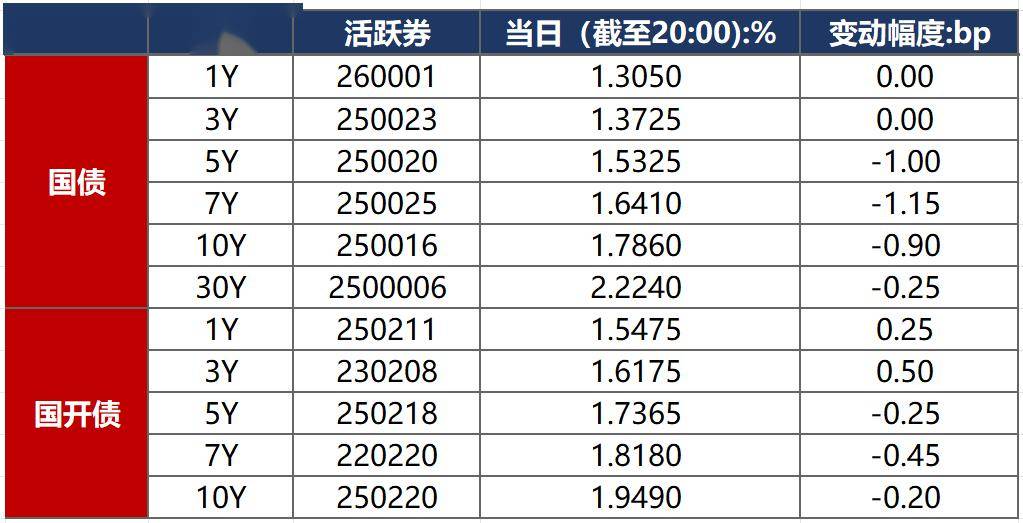
Group 1: Domestic Market Insights - The People's Bank of China reported that the average daily transaction volume of interbank lending in 2025 was 3610.7 billion yuan, a decrease of 12.1% compared to 2024 [2] - The net financing of government bonds in 2025 reached 13.8 trillion yuan, an increase of 2.5 trillion yuan from 2024 [2] - The total custody balance of the bond market at the end of 2025 was 196.7 trillion yuan, with foreign institutions holding 3.5 trillion yuan, accounting for 1.8% of the total [2] Group 2: Economic Indicators - In January 2026, the Consumer Price Index (CPI) rose by 0.2% year-on-year, while the Producer Price Index (PPI) fell by 1.4%, indicating a narrowing decline compared to the previous month [3] - The average hourly wage in the U.S. increased by 0.4% in January, surpassing expectations, while the unemployment rate dropped to 4.3% [6] Group 3: Government Policies - The State Council emphasized the need to curb new hidden debts and proposed measures to enhance government investment efficiency, including strict accountability for local government borrowing [4] - The State Council's implementation opinion aims to establish a unified national electricity market system by 2035, with market transactions expected to account for about 70% of total electricity consumption by 2030 [5] Group 4: Bond Market Dynamics - The bond market showed a warming trend as institutions preferred to hold bonds during the holiday season, with the yield on the 10-year government bond decreasing by 0.90 basis points to 1.7860% [11] - In the secondary market, seven industrial bonds experienced significant price deviations, with some bonds seeing price drops exceeding 64% [13] Group 5: Convertible Bonds and Stock Market - The convertible bond market experienced mixed performance, with the China Convertible Bond Index and Shenzhen Convertible Bond Index rising by 0.05% and 0.28%, respectively, while the Shanghai Convertible Bond Index fell by 0.13% [20] - The A-share market showed slight fluctuations, with the Shanghai Composite Index rising by 0.09% and the Shenzhen Component Index and ChiNext Index declining by 0.35% and 1.08%, respectively [20]