中国船舶

Search documents
交通运输行业周报(2026年1月5日-2026年1月11日):全国邮政会议召开,地缘再显油运价值-20260112
Hua Yuan Zheng Quan· 2026-01-12 10:25
Investment Rating - The investment rating for the transportation industry is "Positive" (maintained) [4] Core Views - The express logistics industry is expected to maintain a steady growth rate of 8% in 2026, with a projected completion of 2.14 billion packages, reflecting a year-on-year increase of approximately 8% [4] - The industry is shifting focus from traditional growth based on scale and speed to quality improvement and reasonable growth, emphasizing the role of government in regulation and compliance [4] - The demand for e-commerce express delivery remains resilient, with a "de-involution" trend driving up express prices and releasing profit elasticity for companies [14] - The shipping market is expected to benefit from the OPEC+ production increase cycle and the Federal Reserve's interest rate cuts, enhancing the elasticity of VLCC freight rates [15] - The air transport sector is showing signs of a long-term bullish trend, with stable demand growth and tightening supply conditions [15] Summary by Sections Express Logistics - The national postal conference highlighted the need for quality development and government involvement in the express logistics sector [4] - Jitu Express reported a 14.5% year-on-year increase in package volume for Q4 2025, with significant growth in Southeast Asia and new markets [5] - The Jiangxi Provincial Postal Administration held a meeting to address the "de-involution" issue in the express industry, focusing on protecting couriers' rights and standardizing payment structures [6] Shipping and Ports - The Iranian unrest poses potential risks to oil exports and shipping rates, with three possible future scenarios affecting the oil transport market [10] - South Korean shipowners are actively acquiring older VLCCs, indicating a positive outlook for the VLCC market [11] - The overall shipping rates have shown slight declines, with the SCFI index decreasing by 0.5% [12] - The BDI index for bulk shipping has decreased by 4.7%, indicating a downward trend in shipping rates [13] Aviation - The civil aviation sector achieved a total profit of 6.5 billion yuan in 2025, with significant increases in passenger and cargo transport volumes [9] - The overall passenger load factor for major airlines was 85.57%, reflecting a slight decrease from the previous month [59] Road and Rail - National logistics operations have been running smoothly, with a decrease in freight transport volumes reported [13] - The road freight volume for November 2025 was 3.876 billion tons, showing a year-on-year increase of 3.57% [67] Port Operations - The total cargo throughput at Chinese ports decreased by 0.65% week-on-week, while container throughput increased by 6.27% [78]
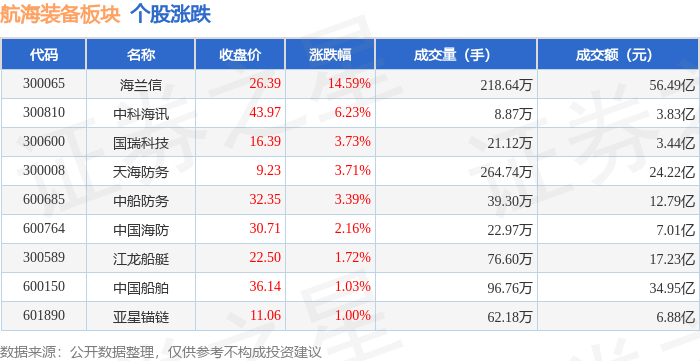
航海装备板块1月12日涨2.03%,海兰信领涨,主力资金净流入2.21亿元
Zheng Xing Xing Ye Ri Bao· 2026-01-12 09:10
Core Insights - The maritime equipment sector experienced a 2.03% increase on January 12, with Hailanxin leading the gains [1] - The Shanghai Composite Index closed at 4165.29, up 1.09%, while the Shenzhen Component Index closed at 14366.91, up 1.75% [1] Sector Performance - Hailanxin (300065) saw a closing price of 26.39, with a significant increase of 14.59% and a trading volume of 2.1864 million shares, amounting to a transaction value of 564.9 million [1] - Other notable performers included: - Zhongmofan (300810) with a closing price of 43.97, up 6.23% [1] - Yuanrui Technology (300600) at 16.39, up 3.73% [1] - Tianhai Defense (300008) at 9.23, up 3.71% [1] - China Shipbuilding (600150) at 36.14, up 1.03% [1] Capital Flow - The maritime equipment sector saw a net inflow of 221 million yuan from institutional investors, while retail investors experienced a net outflow of 30.41 million yuan [1] - Detailed capital flow for key stocks includes: - China Shipbuilding (600150) with a net inflow of 220 million yuan from institutional investors [2] - Tianhai Defense (300008) with a net inflow of 57.1 million yuan from institutional investors [2] - Hailanxin (300065) with a net inflow of 12.64 million yuan from institutional investors [2]





军工本周观点:重视商业航天强辐射效应:国防军工-20260111
Huafu Securities· 2026-01-11 11:47
Investment Rating - The report maintains a "stronger than the market" rating for the defense and military industry [5] Core Viewpoints - The report emphasizes the strong radiation effect of commercial aerospace, highlighting significant developments in the sector, including the approval of satellite frequency resources and the construction of additional satellites by SpaceX [37][38] - The report notes that the military industry index has outperformed the broader market, with a 13.63% increase compared to a 2.79% rise in the Shanghai Composite Index during the same period [10][37] - The report suggests that the commercial aerospace sector will continue to drive asset value reassessment across various industries, particularly in the rocket supply chain and satellite networks [39] Summary by Sections 1. Weekly Market Review - The military industry index rose by 13.63% from January 5 to January 9, outperforming the Shanghai Composite Index by 10.84 percentage points [10][16] - The aerospace sector showed a significant increase of 34.57%, while the low-altitude economy sector performed relatively flat [21][24] 2. Key Developments in the Industry - The report highlights the approval of plans to accelerate the construction of advanced manufacturing in Guangzhou, which includes support for satellite constellation projects [37] - The report mentions the successful launch of SpaceX's Falcon 9 rocket, which deployed an Earth observation satellite [41] 3. Investment Recommendations - The report recommends focusing on specific companies within the rocket sector, overseas commercial aerospace, satellite technology, nuclear fusion, stealth materials, deep-sea technology, engines, unmanned systems, AI, aircraft, and land equipment [40]
兴业证券:如何看待A股本轮开门红的结构与延续性?
智通财经网· 2026-01-11 10:36
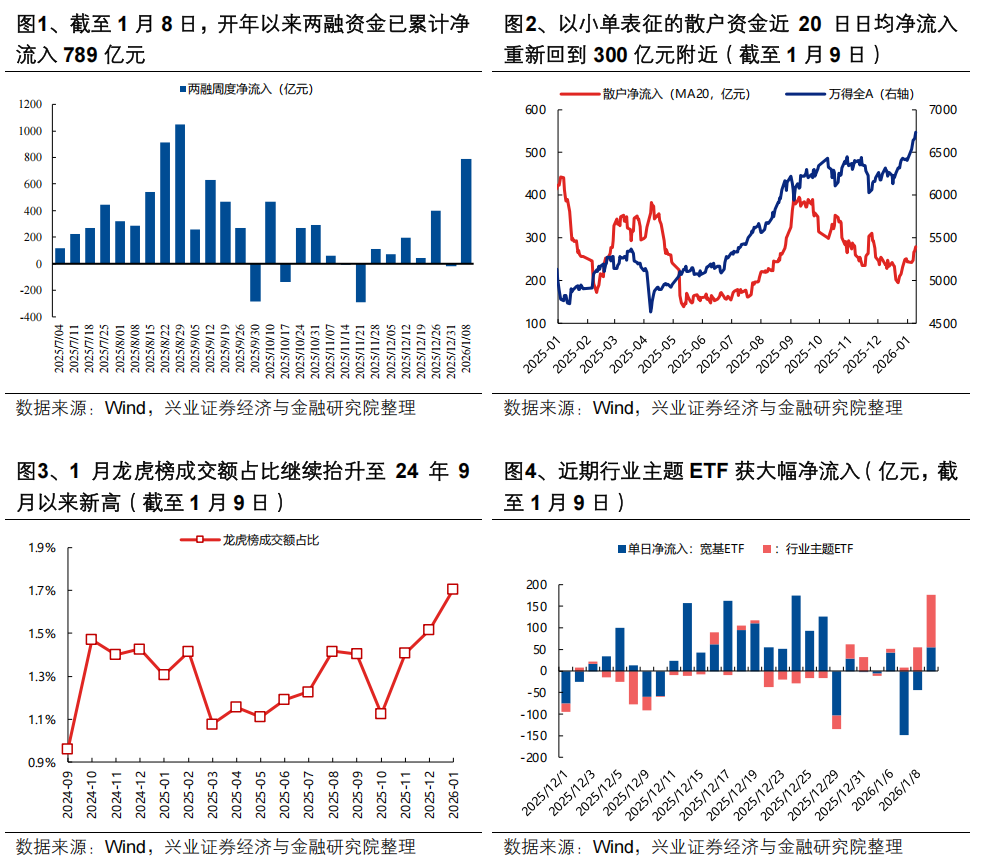
Core Viewpoint - The recent "opening red" in the A-share market reflects a favorable macroeconomic environment and abundant liquidity, which supports market risk appetite and attracts incremental capital inflow, creating a positive feedback loop between capital inflow and market rise [2][18]. Group 1: Market Dynamics - The A-share market has experienced a strong start with the Shanghai Composite Index breaking key levels and achieving a "sixteen consecutive days" rise, exceeding many investors' expectations [1][19]. - Historical data indicates that after a single-day trading volume exceeds 3 trillion yuan, there is typically at least a monthly-level market rally [19]. - Various types of trading funds have shown signs of accelerated entry, including a net inflow of 78.9 billion yuan in margin financing since the beginning of the year and a return of retail investor net inflow to around 30 billion yuan daily [2][5]. Group 2: Structural Characteristics - The inflow structure of different funds shows a strong consensus on key themes, primarily focusing on TMT (storage, AI applications), military industry (commercial aerospace), non-ferrous metals, new energy (controlled nuclear fusion), machinery (robots), and pharmaceuticals (innovative drugs, brain-machine interfaces) [5][36]. - The global stock market has also seen a strong start in 2026, driven by macroeconomic and industrial narratives, with A-shares reflecting similar trends [13][18]. Group 3: Future Directions - As companies begin to disclose annual reports, earnings will become a key factor driving market dynamics, leading to a structural adjustment where previously hot sectors face performance validation, while some low-performing sectors may attract new capital inflows [36]. - Industries with significant upward revisions in profit forecasts since November include technology (consumer electronics, computing), advanced manufacturing (new energy, military), cyclical sectors (building materials, non-ferrous metals), and consumer sectors (food processing, retail) [37][38].

兴证策略:如何看待本轮开门红的结构与延续性?
Xin Lang Cai Jing· 2026-01-11 10:28
Group 1 - The current market rally, referred to as "开门红," is supported by improving macroeconomic data and ample liquidity, which enhances market risk appetite and attracts new capital inflows [1][9][40] - Various types of trading funds have shown accelerated entry into the market, including a net inflow of 78.9 billion yuan in margin financing since the beginning of the year and an average daily net inflow of retail funds returning to around 30 billion yuan [1][9][40] - The structural consensus among different types of funds is strong, focusing on sectors such as TMT (storage, AI applications), military (commercial aerospace), non-ferrous metals, new energy (controlled nuclear fusion), machinery (robots), and pharmaceuticals (innovative drugs, brain-machine interfaces) [2][35][38] Group 2 - The global stock market is experiencing a strong start in 2026, driven by expectations of loose liquidity, geopolitical changes, and emerging industrial trends, with A-shares reflecting this global narrative [5][38] - Key events such as the International Consumer Electronics Show (CES) and geopolitical developments are catalyzing themes in the market, enhancing the strategic value of resource products and driving structural similarities across global markets [5][38] - The market is currently in a favorable position with limited downside risk and significant potential for upward movement, supported by improved PMI and price data, as well as a high percentage of stocks still below their previous highs [11][44] Group 3 - The recent surge in the commercial aerospace sector has raised concerns about its current crowding and sustainability, with trading volume indicating a potential for further upward movement [16][51] - As the earnings forecast disclosure period approaches, the correlation between stock prices and earnings will increase, necessitating a focus on structural adjustments based on performance [21][57] - Industries with significant upward revisions in profit forecasts since November include technology (consumer electronics, computing), advanced manufacturing (new energy, military), and cyclical sectors (building materials, non-ferrous metals) [26][58]
中国制造何以碾压
投资界· 2026-01-11 08:11
Core Viewpoint - The article emphasizes that China's manufacturing efficiency and cost-effectiveness have significantly improved, surpassing traditional perceptions of low labor costs as the primary reason for its manufacturing dominance. [3][6][19] Group 1: Manufacturing Efficiency Comparison - Tesla's Shanghai factory produces nearly 1 million vehicles in 2024 with a workforce of about 20,000, achieving an average output of 50 vehicles per worker annually, which is nearly double the output of the Fremont factory in California, which produces 560,000 vehicles with the same number of workers, averaging 28 vehicles per worker. [5] - The annual salary of a Tesla worker in Shanghai is approximately $14,000 to $15,000, while a worker in the U.S. earns about $82,500. This results in a labor cost-effectiveness ratio of 8 to 14 times in favor of the Chinese factory. [5][6] - The article highlights that this efficiency advantage extends throughout the supply chain, including batteries and components, with the Shanghai factory expected to produce 5 million battery packs by November 2025. [5] Group 2: Broader Industry Trends - China's shipbuilding industry is projected to account for 60-84% of global orders by 2025, a significant increase from 44% in 2020, with China building approximately 1,700 ships in 2024 compared to fewer than 5 by the U.S. annually. [7][8] - In the steel industry, China's production is expected to reach 955 million tons in 2025, while the U.S. will produce about 80 million tons, with Chinese steel mills achieving an average output of 1,000 tons per worker compared to 300-400 tons in the U.S. [8] - China produces 80% of the world's solar panels, with a 73% increase in exports expected by 2025. The average output per worker in China is about 500 megawatts, compared to 250 megawatts in the U.S. [9] Group 3: The Productivity Paradox - Despite the high efficiency observed in Chinese manufacturing, international organizations like the World Bank and IMF report that China's labor productivity is only 15-20% of that in the U.S., creating a paradox. [11][14] - The discrepancy arises from the method of calculating labor productivity, which is based on value-added rather than physical output. For example, a significant portion of the profit from an iPhone is attributed to Apple in the U.S., while the Chinese assembly contributes only a small fraction. [16] - Price distortions also play a role, as the same product can have different market values in China and the U.S., affecting reported productivity figures. [17] Group 4: Systemic Advantages of Chinese Manufacturing - The article argues that the true strength of Chinese manufacturing lies not only in low labor costs but also in a combination of high efficiency, a robust supply chain ecosystem, and a large pool of STEM graduates, which is four times that of the U.S. [18][19] - The ongoing transformation towards high-value industries like artificial intelligence and electric vehicles further enhances China's competitive edge in manufacturing. [18]


2025年全球新造船订单出现下滑:韩国船厂斩获247艘,中国呢?
Sou Hu Cai Jing· 2026-01-11 07:11
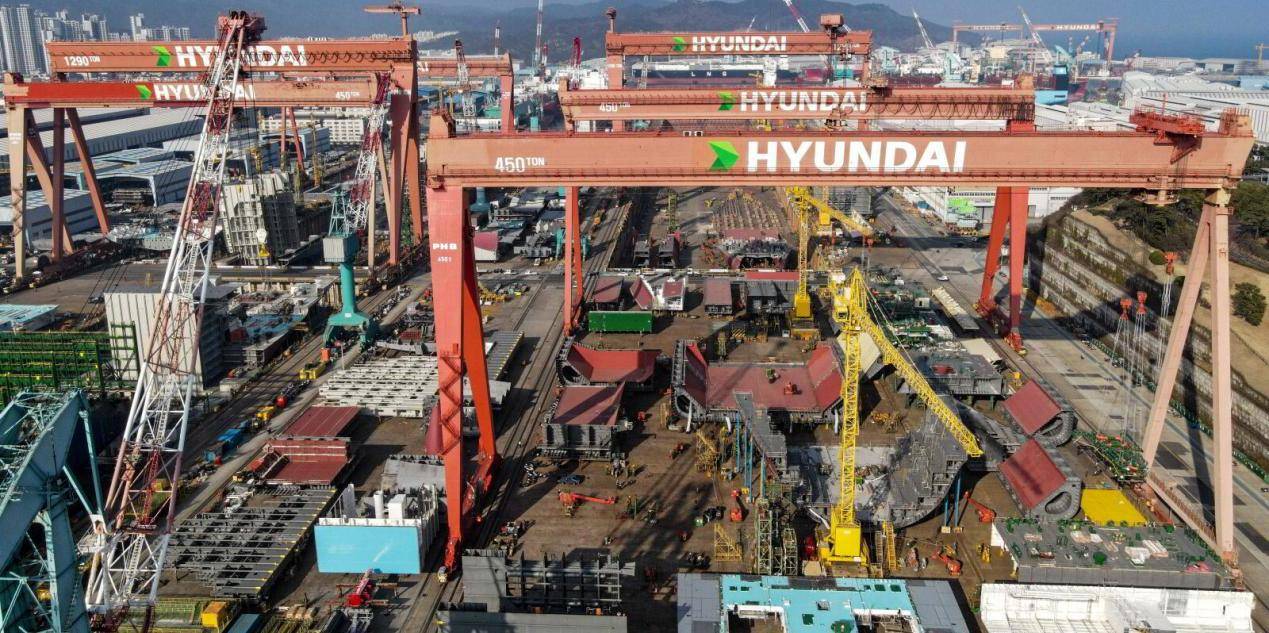
Group 1: Global Shipbuilding Market Overview - In 2025, the global new shipbuilding market cooled significantly after a record year in 2024, with a total of 2,036 new ship orders amounting to 56.43 million CGT, a 27% decrease in CGT compared to 2024 [1] - The global shipbuilding companies held an order backlog of 173.91 million CGT by the end of 2025 [1] Group 2: South Korean Shipbuilding Industry - South Korean shipbuilders ranked second globally, securing 247 orders totaling 11.6 million CGT, an 8% increase from 2024 [3] - The market share of South Korean shipbuilders rose to 21%, with a backlog of 35.12 million CGT, although this represented a decrease of 2.45 million CGT year-on-year [3] - South Korea maintained its position as the world's leading builder of LNG carriers, with 34 new LNG ship orders in the previous year [3] - The shipbuilding export value from South Korea reached $32.03 billion, a 25% increase year-on-year, marking the highest level since 2018 [3] Group 3: Chinese Shipbuilding Industry - Chinese shipbuilders received 1,421 orders totaling 35.37 million CGT, a 35% decline year-on-year, resulting in a market share of 63% [5] - This marked the first decline in market share for Chinese shipbuilders in five years, despite holding a backlog of 107.48 million CGT, which increased by 10.01 million CGT year-on-year [5] - China dominated the construction of bulk carriers, container ships, and oil tankers, with a significant increase in the order share for bulk carriers exceeding 80% [5] Group 4: Private Shipbuilding Companies - Hengli Shipbuilding emerged as a significant player, signing contracts for 7 new ships, including 2 VLCCs and 4 Capesize bulk carriers, with a total order of 115 ships and a contract value exceeding 100 billion yuan [7] - Hengli Shipbuilding set a global record by launching 4 VLCCs simultaneously from the same dock [7] Group 5: China Shipbuilding Group - China Shipbuilding Group, the largest shipbuilding company globally, signed a record contract for 87 new ships with China COSCO Shipping Group, totaling approximately 50 billion yuan [9] - The company is focusing on upgrading its product structure towards high-tech and high-value-added vessels, with significant contracts for LNG dual-fuel container ships and other advanced ship types [9]
机械行业研究:看好商业航天、机器人、核聚变、船舶和工程机械
SINOLINK SECURITIES· 2026-01-11 05:53
Investment Rating - The SW Machinery Equipment Index increased by 5.39% during the week of January 5 to January 9, 2026, ranking 10th among 31 primary industry categories [12][14]. Core Insights - The report anticipates a significant increase in domestic rocket launches in 2026, driven by the urgent demand for satellite deployment [21]. - The robotics sector is expected to experience a strong market trend in Q1 2026, with advancements in humanoid robots [21]. - The nuclear fusion energy sector is highlighted as a potential investment opportunity during the 14th Five-Year Plan period, with significant technological breakthroughs reported [22]. - The global shipbuilding industry is showing signs of recovery, with new ship prices increasing and order volumes significantly improving [31]. - The engineering machinery sector is entering an upward cycle, with robust domestic and export sales of excavators and loaders [35]. - The report indicates varying degrees of industry performance, with general machinery under pressure, while engineering machinery and railway equipment show positive trends [46][45]. Summary by Sections 1. Stock Portfolio - Recommended stocks include Chaojie Co., Feiwo Technology, Guanglian Aviation, Hengli Hydraulic, Lianchuang Optoelectronics, XCMG, SANY Heavy Industry, Zoomlion, LiuGong, and China Shipbuilding [10]. 2. Market Review - The SW Machinery Equipment Index rose by 5.39% in the first week of 2026, outperforming the CSI 300 Index, which increased by 2.79% [12][14]. 3. Key Data Tracking 3.1 General Machinery - The manufacturing PMI was reported at 50.1% in December, indicating a slight recovery [23]. 3.2 Engineering Machinery - Excavator sales reached 23,095 units in December, marking a year-on-year increase of 17.6% [35]. 3.3 Railway Equipment - Railway fixed asset investment has maintained a steady growth rate of around 6% since 2025 [45]. 3.4 Shipbuilding - The global new ship price index reached 184.65 in December, with a month-on-month increase of 0.17% [46]. 3.5 Oil Service Equipment - The oil service equipment sector is stabilizing, with high demand in the Middle East [49]. 3.6 Industrial Gases - A decrease in raw material prices is expected to improve profitability in the steel sector, boosting demand for industrial gases [55]. 3.7 Gas Turbines - GEV's new gas turbine orders grew by 39% year-on-year in the first three quarters of 2025, indicating a robust market [57].




申万宏源交运一周天地汇:委变局油轮淡季预期逆转,航运景气度联动造船
Shenwan Hongyuan Securities· 2026-01-10 13:31
Investment Rating - The report maintains a positive outlook on the shipping industry, particularly focusing on VLCC and medium-sized oil tankers, indicating a strong demand due to geopolitical changes and seasonal shifts in shipping patterns [4]. Core Insights - The report highlights a significant increase in VLCC freight rates, with a 45% week-on-week rebound to $63,608 per day, driven by unexpected demand from the Middle East [4]. - New ship prices remain strong, with a slight weekly decline of 0.11%, indicating a robust pricing power in the shipbuilding sector [4]. - The aviation sector is expected to experience a significant improvement in profitability due to supply constraints and increasing passenger volumes, marking a potential golden era for airlines [4]. - The express delivery sector is entering a new phase of competition, with three potential scenarios outlined for future industry dynamics [4]. Summary by Sections Shipping Industry - The report notes a structural growth in VLCC demand, with compliance in Venezuelan oil exports potentially increasing transport volumes by approximately 1.4% [4]. - The average freight rate for VLCCs from the Middle East to the Far East reached $66,240 per day, reflecting a 71% increase from the previous week [4]. - The report emphasizes the strong performance of second-hand ship prices and suggests continued monitoring of companies like China Merchants Energy and COSCO Shipping Energy [4]. Aviation Sector - The report anticipates a significant uplift in airline profitability due to historical high passenger load factors and a constrained supply of aircraft [4]. - Airlines such as China Eastern Airlines, China Southern Airlines, and Spring Airlines are highlighted as key players to watch in this sector [4]. Express Delivery - The report discusses the potential for industry consolidation and improved profitability in the express delivery sector, with companies like Shentong Express and YTO Express being noted for their competitive advantages [4]. Road and Rail Transport - The report indicates resilience in railway freight volumes and highway truck traffic, with a slight decrease in recent weeks but overall stability expected [4]. - The report suggests that high-dividend investment themes and potential value management catalysts in the highway sector are worth monitoring [4].
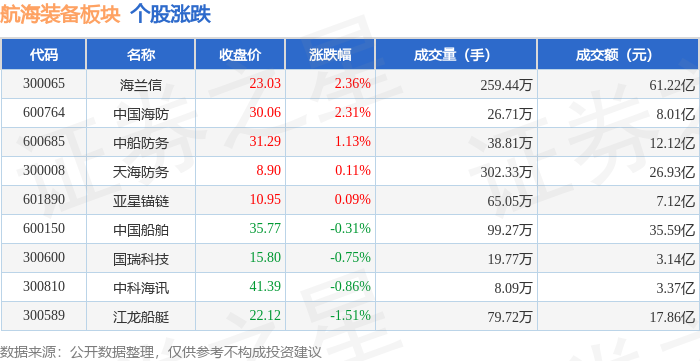
航海装备板块1月9日涨0.04%,海兰信领涨,主力资金净流出11.5亿元
Zheng Xing Xing Ye Ri Bao· 2026-01-09 09:00
Core Viewpoint - The maritime equipment sector experienced a slight increase of 0.04% on January 9, with Hailanxin leading the gains, while the overall market indices also showed positive performance [1]. Group 1: Market Performance - The Shanghai Composite Index closed at 4120.43, up by 0.92% [1]. - The Shenzhen Component Index closed at 14120.15, up by 1.15% [1]. - Hailanxin's stock price rose to 23.03, reflecting a gain of 2.36% [1]. Group 2: Individual Stock Performance - China Haifang (600764) closed at 30.06, with a rise of 2.31% and a trading volume of 267,100 shares, amounting to 800 million yuan [1]. - China Shipbuilding Defense (600685) saw its stock price increase to 31.29, up by 1.13%, with a trading volume of 388,100 shares, totaling 1.212 billion yuan [1]. - Tianhai Defense (300008) had a marginal increase of 0.11%, closing at 8.90, with a trading volume of 3.0233 million shares, amounting to 2.693 billion yuan [1]. Group 3: Capital Flow - The maritime equipment sector experienced a net outflow of 1.15 billion yuan from institutional investors, while retail investors saw a net inflow of 947 million yuan [1]. - The individual stock capital flow indicates that China Shipbuilding Defense had a net inflow of 41.18 million yuan from institutional investors [2]. - Hailanxin experienced a significant net outflow of 715 million yuan from institutional investors, while retail investors contributed a net inflow of 444.5 million yuan [2].